Key Takeaways
- An agent decides, and a chatbot responds. The defining feature is autonomy over the sequence of steps, not the quality of the language output.
- The model is the smallest part of the build. Instead, tool access, memory, guardrails and evaluation take up most of the engineering.
- Most production systems are multi-agent. Instead of one agent doing everything, a coordinating agent delegates to specialists, and each has a narrow scope and its own tools.
- Start narrow. Agents fail on ambiguous, wide-open tasks. By contrast, they succeed on bounded, repeatable ones with clear success criteria.
- Evaluation is not optional. Without a harness that catches regressions, you only find out an agent has drifted when a customer tells you.
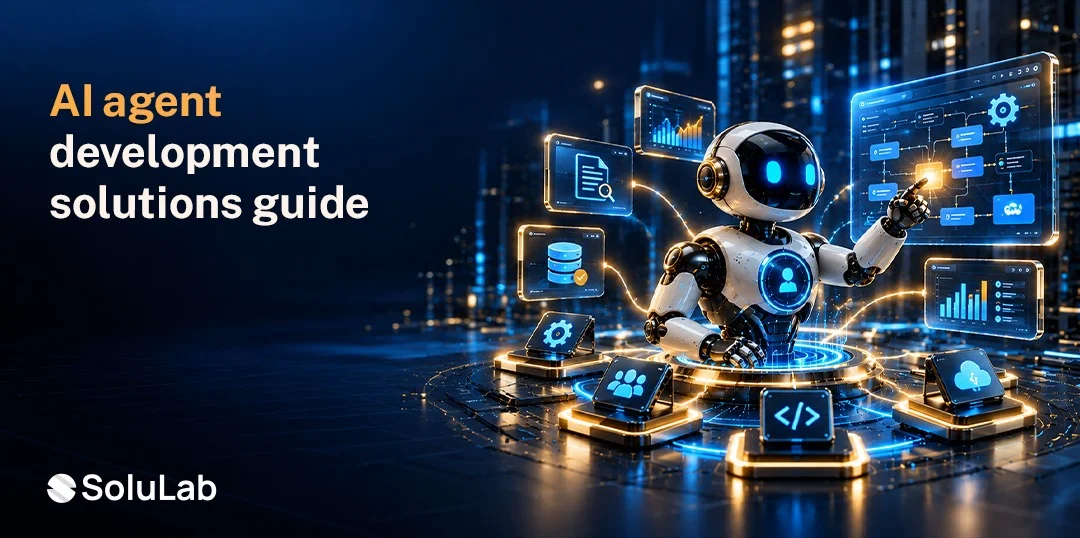
AI agent development solutions are systems that plan and act on their own toward a goal, rather than answering one prompt at a time. First, an agent takes an objective and breaks it into steps. Then it calls the tools and data it needs, checks its own output and reports back. In short, that loop of plan, act, observe and correct is what separates an agent from a chatbot.
On this page: what an AI agent is, and how agents differ from chatbots and rules-based automation. Then what they’re used for now, the tech stack, how a build runs, what it costs, and what to check before choosing a partner.
If you’re evaluating AI agent development solutions for a real project, our AI agent development company page covers scope, engagement models and delivery.
What are AI agent development solutions?
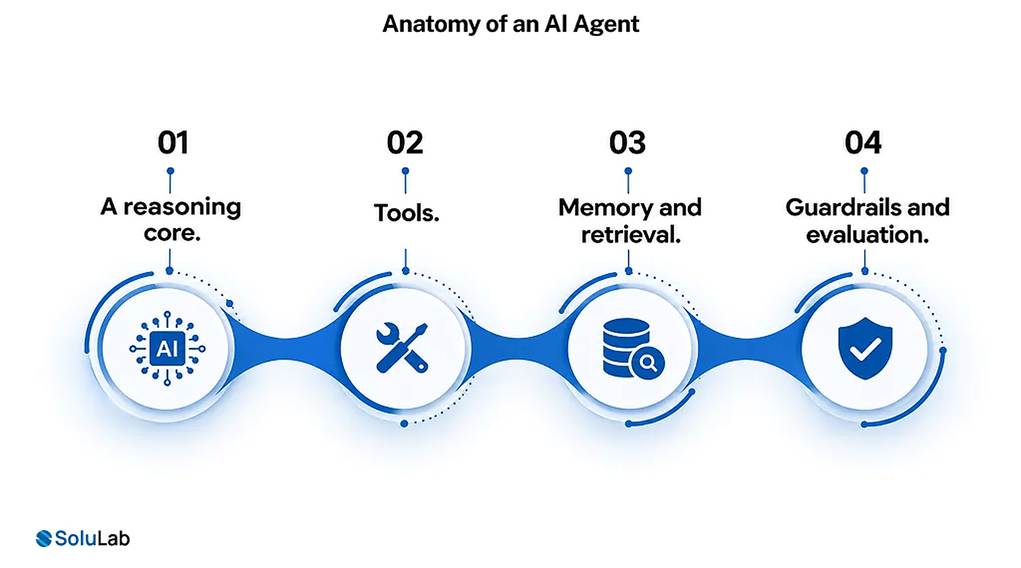
In short, AI agent development solutions are end-to-end services for designing, building and deploying software agents. These agents carry out multi-step work with limited human supervision. A finished agent has four parts, and our guide to AI agent development architecture covers each in depth.
A reasoning core. First, a large language model interprets the goal and decides the next step. Everyone talks about this part. However, it is also the part you will most likely swap out at some point.
Tools. These are the APIs, databases, browsers and internal systems the agent is allowed to call. An agent with no tools is just a chatbot. In fact, tool design, meaning what it can call, with what arguments and under what conditions, is where most of the real engineering sits.
Memory and retrieval. First, short-term context holds the current task. Meanwhile, a retrieval layer over your own documents and records means the agent works from your data, not the model’s training data. Agentic RAG also takes this pattern further.
Guardrails and evaluation. Permission boundaries, human approval for consequential actions, and an automated test suite that scores agent behaviour on every change. So skip this, and you have a demo, not a product.
For teams still deciding whether an agent fits the problem at all, a scoped AI PoC answers that in four to six weeks. That way, you know before the full build is committed.
How is an AI agent different from a chatbot or workflow automation?
Vendors often blur these three. But the real difference is who decides the sequence of steps.
| Dimension | Rules-based automation | Chatbot / assistant | AI agent |
| Decides the steps | Developer, at build time | User, one turn at a time | The agent, at run time |
| Handles the unexpected | Fails or stops | Asks the user | Re-plans and retries |
| Takes actions in other systems | Yes, fixed paths only | Rarely, one call at a time | Yes, chooses which and when |
| Runs unattended | Yes | No | Yes, within set boundaries |
| Main failure mode | Breaks when inputs change | Confidently wrong answers | Confidently wrong actions |
| Best suited to | Stable, high-volume processes | Q&A, drafting, support | Multi-step work with variable inputs |
That last row is the one to sit with. For example, a chatbot that hallucinates produces a bad sentence. An agent that hallucinates, however, issues a refund, sends an email or updates a record. As a result, the blast radius is larger, which is why permissions and approval gates matter more than model choice.

What are AI agents being used for right now?
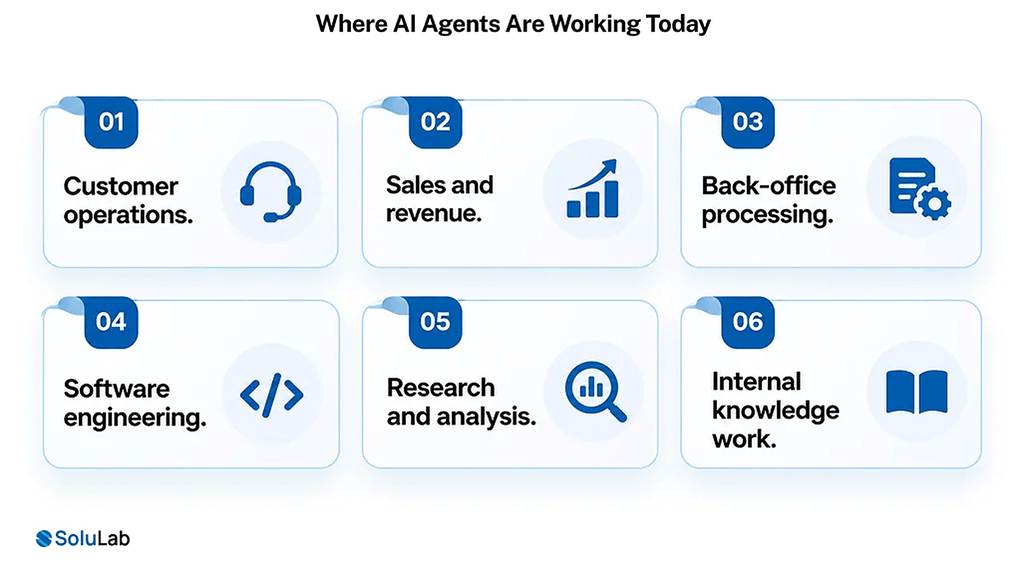
Across deployments, the pattern is narrow scope and clear success criteria. These are the strongest current categories, and our roundup of AI agent use cases covers more:
- Customer operations. Triaging tickets, pulling the account history and drafting the response. Then escalating anything outside policy.
- Sales and revenue. Researching accounts, enriching CRM records, preparing call briefs and drafting follow-ups from meeting notes.
- Back-office processing. Reading invoices, purchase orders and claims. Then matching them against systems of record and flagging exceptions for a human.
- Software engineering. Writing tests, reviewing diffs and handling routine migrations. Also, our write-up on AI coding agents goes deeper on this one.
- Research and analysis. Gathering sources, comparing them and producing a structured brief with citations. For example, general-purpose systems like Manus AI popularised this pattern.
- Internal knowledge work. Answering staff questions against policy documents, HR systems and product documentation, using retrieval over the company’s own content.
Here’s a working example of the multi-agent pattern. For UpdateIA, we built a central orchestration engine that coordinates more than fourteen specialised agents across business functions. As a result, manual effort fell by 65% and response times by 70%. Still, the point isn’t the agent count. Instead, each agent had one narrow job, and the orchestrator handled the routing.
What Tech Stack Powers AI Agent Development Solutions?
There are four layers, and only the first one changes often.
Models. A frontier model handles reasoning and planning, and a smaller, cheaper model usually handles classification and routing. So assume you will change this layer at least once during the product’s life.
Orchestration. Frameworks such as LangGraph, CrewAI, AutoGen and LlamaIndex manage agent state, delegation between agents and control flow around tool calls. However, some teams write this layer themselves to avoid framework churn. Also, our guide to building AI agents with LangGraph shows one approach.
Data and retrieval. First, a vector store such as Pinecone or Weaviate sits alongside your existing databases. Then a retrieval layer decides what context the agent sees. In practice, retrieval quality drives output quality more than model choice does.
Deployment and observability. Containerised services, tracing on every agent step, and monitoring that shows what the agent did and why. Without step-level tracing, however, debugging an agent is guesswork.
Evaluation is the layer teams underinvest in most. It means a fixed set of real tasks with known-good outcomes, run automatically on every prompt or model change. In other words, it separates shipping improvements from shipping regressions.
How does an AI agent build actually run?
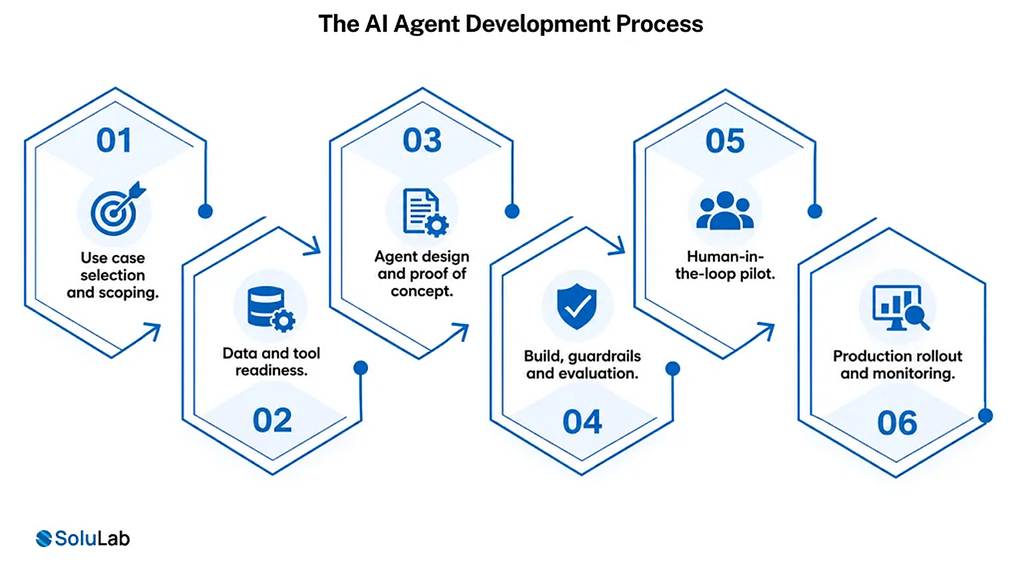
- Use case selection and scoping. Pick a process with a defined start, a defined finish and a measurable outcome. After all, ambiguous goals are where agent projects die.
- Data and tool readiness. First, confirm the agent can actually reach what it needs. Permissions, API rate limits and messy source data surface here, not later.
- Agent design and proof of concept. Then prove the loop works on real data before committing to a full build.
- Build, guardrails and evaluation. Build the agent alongside the test harness, not after it.
- Human-in-the-loop pilot. Run the agent with a person approving consequential actions. Then use the approval log to decide where the boundaries should sit.
- Production rollout and monitoring. Finally, widen autonomy gradually and keep tracing on. Also, treat drift as a normal operating condition rather than an incident.
What do AI agent development solutions cost?
The cost of AI agent development solutions is driven by scope, not a list price. The biggest variables are how many systems the agent must integrate with and whether your data is retrieval-ready. In addition, the number of agents, compliance requirements, and the depth of evaluation and monitoring also move it. For typical ranges, see our breakdown of what it costs to build an AI agent.
However, teams routinely leave out two costs. First, evaluation and retry traffic: development, testing and guardrail checks generate token volume that never appears in a usage forecast. Second, model migration. Vendors retire models on a schedule, so prompts tuned to one version need real engineering work to move. Therefore, budget for one migration a year, whatever the vendor.
A scoped proof of concept is the cheapest way to get a real number. For example, ours run four to six weeks, with a fixed price and a documented go/no-go outcome.
How do you choose an AI agent development partner?
Run five checks, in order. For a wider view of the market, see our list of top AI agent development companies.
- Have they shipped agents to production, not demos? Ask for a system running unattended with real users, and what broke in the first month.
- How do they evaluate? If the answer is “we test it manually”, then they will not catch regressions in yours either.
- Who owns the IP, the prompts and the data? Then get it in writing before scoping starts.
- What is their model portability position? A partner locked to one vendor becomes an obstacle the week that vendor changes pricing.
- What happens after launch? Agents need tuning as your processes and the underlying models change. Otherwise, a build-and-leave engagement gets expensive later.
Our AI development company page also sets out how we approach AI agent development solutions more broadly, from strategy through delivery.
Where SoluLab fits
We have built software since 2014 with a team of 250+ engineers. Importantly, we work across the whole agent stack, not just the model layer. That includes retrieval over client data, evaluation harnesses that catch regressions before users do, and abstraction that turns a model swap into a configuration change.
We hold ISO 27001:2022 and SOC 2 certification and are assessed at CMMI Level 3. That matters because an agent may need access to systems holding customer or financial data.
Most of our agent engagements start with a scoped proof of concept. After all, the honest answer to “should we build this” is sometimes no, and it’s far cheaper to learn that in week five than in month nine.

Frequently asked questions
Shipra Garg is a tech-focused content strategist and copywriter specializing in Web3, blockchain, and artificial intelligence. She has worked with startups and enterprise teams to craft high-conversion content that bridges deep tech with business impact. Her work translates complex innovations into clear, credible, and engaging narratives that drive growth and build trust in emerging tech markets.