
Key Takeaways
- A white-label blockchain solution lets you license a production-ready ledger platform and still own your data, deployment, and business logic.
- You get meaningfully deeper customization, stronger audit trails, and a less painful exit path than most SaaS contracts ever offer.
- The commercial sweet spot is multi-party workflows, regulated industries, and cross-organizational data sharing where no single party should own the system.
- AI-powered white-label blockchain platforms now bundle anomaly detection, predictive scoring, and workflow automation on top of the shared ledger layer.
- Total cost of ownership depends far more on integration complexity and governance than on the license fee alone.
White-label blockchain platforms are pre-built, configurable ledger-based products that enterprises license, brand, and deploy as their own infrastructure. Unlike SaaS, you control the data, the logic, and the deployment environment.
Built using advanced blockchain development frameworks, these platforms allow businesses to accelerate deployment without building a decentralized infrastructure entirely from scratch. From smart contract automation and tokenization modules to secure data sharing and compliance-ready architectures, modern blockchain development solutions make white-label platforms highly scalable and enterprise-ready.
For organizations running regulated, multi-party, or asset-heavy workflows, this model is replacing conventional SaaS subscriptions faster than most vendors want to admit.
What Are White-Label Blockchain Platforms?
White-label blockchain platforms are pre-engineered, modular software products built on distributed ledger infrastructure that enterprises can brand, configure, and run as their own. You license a white-label blockchain solution, adapt the data models and workflow logic to your context, and deploy it under your own product name without commissioning a ground-up build.
The distinction from SaaS development is structural, not cosmetic. With a SaaS subscription, the vendor controls the schema, the roadmap, and the data environment. With a white-label platform, you hold those decisions. An enterprise white-label blockchain solutions provider ships a core product with modules for identity, asset management, smart contract templates, permissions, and integration tooling. You configure the tenant model and rules without touching the underlying code.
Compared to engaging top Blockchain development companies for a fully custom build, you get a shorter path to production and significantly lower execution risk in the early phases. The trade-off is that you work within the platform’s architecture rather than designing it from scratch. For most enterprises, that constraint is worth the speed advantage.
The ownership angle is the part most teams undervalue at the start. You are not just renting features. You have real influence over where the platform runs, what data it holds, and how it evolves when your requirements change.
How White-Label Blockchain Platforms Work?
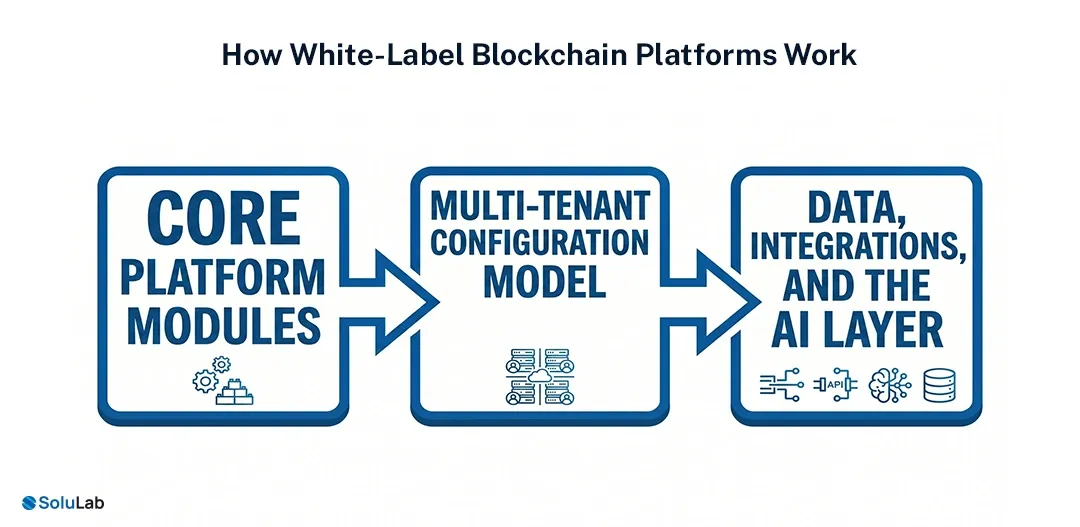
These platforms combine a reusable distributed ledger core with a layered configuration system that enterprise teams customize without modifying source code. One shared, proven foundation. One configurable layer on top. That separation is what makes them practical at enterprise scale.
- Core Platform Modules
Most mature platforms include a ledger layer (public chain, permissioned network, or hybrid), reusable smart contract templates for assets and transactions, role-based identity and access management, admin dashboards, and API endpoints with event streams. You can evaluate these against Top blockchain platforms as infrastructure candidates since many white-label products are built on or compatible with leading L1 and L2 networks.
- Multi-Tenant Configuration Model
Enterprise platforms support multiple tenants within a single deployment. These may be internal business units, channel partners, or enterprise clients, each operating in isolated but connected environments. Per tenant, you can apply distinct branding, configure unique workflow rules and approval chains, set granular data visibility, and enable or disable modules. Same engine underneath. Different rules, interfaces, and policies on top. That is the white-label model in practical terms.
- Data, Integrations, and the AI Layer
White-label systems connect to your CRMs, ERPs, compliance tools, and external data sources, ingesting inputs and returning outputs to wherever your teams actually work. What has shifted meaningfully in 2026 is the intelligence layer. AI-powered white-label blockchain platforms now bundle anomaly detection, dynamic risk scoring, workflow recommendations, and automated triggers on top of the ledger. The blockchain handles traceability and shared state. The AI layer helps you interpret and act on that state before problems compound.

SaaS vs White-Label Blockchain Platforms
SaaS vs white-label blockchain platforms is a question of who holds the keys to the system you depend on most. SaaS optimizes for vendor convenience and fast deployment. White-label blockchain optimizes for enterprise ownership, flexibility, and long-term control. Neither is universally better. They are designed for different operating priorities.
| Dimension | Traditional SaaS | White-Label Blockchain Platforms |
| Ownership and control | Vendor owns the stack; you rent access | You license and control deployment, data, and rules |
| Customization depth | Limited, vendor roadmap-dependent | High, via configuration and custom contract logic |
| Data residency and audit | Typically vendor-managed | Designed for auditability and flexible data residency |
| Vendor lock-in | High and costly to exit | Lower, with more portable data and transferable logic |
| Integration flexibility | Constrained by vendor APIs | Event-driven and contract-based, often significantly deeper |
| Long-term economics | Lower upfront, escalates at scale | Higher upfront effort, stronger TCO in the right use cases |
Pros and Cons: White-Label Blockchain vs SaaS
White-Label Blockchain: Pros
- Full data ownership and deployment control
- Deep customization without waiting for the vendor roadmap
- Strong multi-party audit and compliance capability
- Better long-term TCO for complex, high-volume workflows
- More leverage in vendor negotiations and migration planning
White-Label Blockchain: Cons
- Higher upfront implementation effort and cost
- Requires stronger internal or partner technical capability
- Longer time to initial deployment compared to SaaS signup
- Ongoing governance and operations responsibility sits with you
SaaS: Pros
- Fast deployment with minimal technical overhead
- Predictable pricing in early stages
- Vendor handles maintenance, upgrades, and infrastructure
SaaS: Cons
- Vendor controls the roadmap and your feature priority
- Lock-in deepens silently over time
- Limited ability to customize core data models or workflows
- Data residency and audit capabilities are often constrained
When your workflows are peripheral, enterprise SaaS solutions win on simplicity. When they are central to how your business runs, or when you want to turn them into a product you offer others, white-label blockchain becomes the more defensible long-term architecture.
Why Enterprises Prefer White-Label Blockchain Platforms Over SaaS?
Enterprises prefer white-label blockchain platforms over SaaS when control, compliance, and multi-party coordination matter more than deployment convenience. In those scenarios, configurable screens are not enough. You need infrastructure that behaves like an owned asset, not a monthly subscription.
Four drivers come up consistently in enterprise conversations.
First, white-label blockchain platforms’ benefits start with auditability. Every participant in a workflow, whether internal auditors, external regulators, or trading counterparties, can reference the same tamper-evident ledger instead of reconciling across disconnected vendor systems. That alone eliminates entire categories of operational friction and audit preparation work.
Second, extensibility is a real differentiator. SaaS vendors prioritize features for the broadest customer segment. Your niche workflow requirements, particularly in vertical industries or cross-organizational processes, will wait in the backlog or never arrive. With white-label blockchain, you extend contracts, add integration endpoints, and build custom modules on your own timeline.
Third, multilateral collaboration is often the whole point of these platforms. If you operate in supply chain, trade finance, healthcare, or financial infrastructure, the biggest friction is systems that cannot share state across organizational boundaries. Ledger-based platforms handle this structurally. This is exactly where Blockchain Development Use Cases For Enterprises and broader Blockchain Applications stop being conference-room concepts and start generating measurable operational value.
Fourth, exit flexibility matters more than most teams acknowledge until they need it. Leaving a deeply embedded SaaS platform is frequently a multi-year project. With white-label blockchain, portability is not perfect, but you own more of the logic, and that gives you real commercial leverage when contracts come up for renewal.
How White-Label Blockchain Platforms Solve SaaS Limitations?
White-label blockchain platforms solve SaaS limitations by addressing lock-in, shallow customization, fragmented audit capability, and the structural inability of single-vendor systems to support trusted multi-party workflows. The problems are well understood by anyone who has managed enterprise software long enough.
The specific pain points that drive these decisions include:
- Roadmap misalignment: Vendor feature priorities reflect their largest customer segment, not your operations
- Rigid data models: You build workarounds instead of proper solutions because the schema is locked
- Fragmented audit trails: Compliance evidence is spread across five different tools with incompatible formats
- Punitive pricing at scale: License structures that make growth more expensive rather than less
- Limited data sovereignty: You have minimal control over where data lives and who can access it operationally
Blockchain-based SaaS alternatives address these structurally rather than cosmetically. When business rules live in smart contracts or auditable configuration rather than hidden vendor logic, you can inspect them, test them, and in many cases change them. Integration becomes event-driven rather than a web of fragile point-to-point API dependencies.
This is what practitioners mean when they discuss how blockchain replaces SaaS platforms in specific domains. Not a wholesale replacement across all software categories. A deliberate, high-value substitution in workflows where shared trust, regulatory compliance, and long-term data sovereignty outweigh the convenience of a SaaS subscription.
How White-Label Blockchain Platforms Reduce Vendor Lock-In?
White-label blockchain platforms reduce vendor lock-in by making your data, workflows, and integrations structurally more portable. The provider still matters, but you are not trapped behind opaque schemas and proprietary logic you cannot inspect or export.
Lock-in with SaaS is rarely a sudden problem. It accumulates quietly. By year three, when pricing changes or a new competitor enters your space, you realize migration is effectively impossible without rebuilding the workflows that have formed around the platform. That is not an accident. It is the SaaS business model working as designed.
White-label blockchain reduces that risk through deployment flexibility. You can run the platform in your own cloud environment, a dedicated hosted setup, or a hybrid configuration aligned to your compliance requirements. That is a fundamentally different negotiating position than a SaaS URL and a data processing agreement, which you mostly hope is adequate.
Key business rules live in contracts and configuration that you can read, export, and reason about. Migration is still real work, but it is work you can scope and budget for rather than a ransom negotiation with an incumbent vendor.
This is also where the White-label vs Custom Blockchain decision deserves honest analysis. For many organizations, white-label is not the final destination. It is the most intelligent starting point. You launch faster, learn what your actual production requirements are, and decide later whether full customization justifies the investment. You can also evaluate the top blockchain platforms as infrastructure foundations for the next phase of your architecture.
Key Features to Look For in a White-Label Blockchain Platform
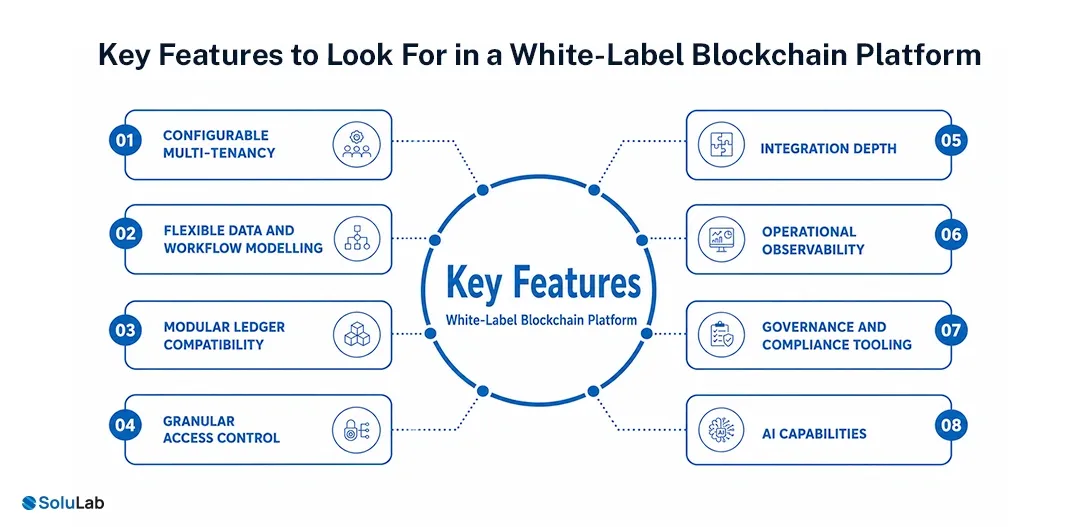
The features that matter are not the ones in the vendor’s marketing deck. They are the ones that determine whether the platform can support real enterprise operations under actual production conditions.
When evaluating white-label blockchain platforms key features, prioritize these eight capabilities:
- Configurable multi-tenancy: clean isolation between business units, partners, and clients without compromising shared infrastructure efficiency
- Flexible data and workflow modeling: adapt schemas and approval chains without touching source code
- Modular ledger compatibility: integration with multiple blockchain applications or DLTs, rather than a hard dependency on one chain
- Granular access control: role-based permissions, audit logs, and compliance reporting that satisfy real governance requirements
- Integration depth: event streams, webhooks, REST and GraphQL APIs, and pre-built connectors for common enterprise systems
- Operational observability: monitoring at both the application layer and the ledger level, not just uptime dashboards
- Governance and compliance tooling: built-in support for regulatory reporting, data residency controls, and policy management
- AI capabilities: mature platforms now offer AI-powered white-label blockchain platform features, including anomaly detection, predictive analytics, and intelligent workflow triggers
If a vendor cannot walk you clearly through each of these without deflecting to marketing language, that is a signal about their actual engineering depth, not their positioning.

Use Cases of White-Label Blockchain Platforms
The strongest use cases of white-label blockchain platforms share one structural pattern: multiple stakeholders, shared data, compliance obligations, and workflows that have historically depended on manual reconciliation or brittle integrations between incompatible systems.
Supply chain and trade is one of the most developed verticals. Shared registries, trade document tracking, provenance verification, and multi-party settlement workflows fit naturally on ledger-backed infrastructure where every participant has a verifiable view of the same state.
Financial services is another strong category. Asset tokenization platforms, secondary market operations, invoice finance systems, and compliance-heavy recordkeeping all benefit from the immutability and shared access that distributed ledgers provide. Many of the most commercially viable Blockchain Projects to Build and Invest in right now sit at this intersection of finance and ledger infrastructure.
Healthcare and identity are gaining traction specifically because regulatory requirements demand long-lived, tamper-evident records that multiple organizations must access under controlled, auditable conditions. Credentialing systems, patient data sharing, and clinical trial record-keeping are real deployments, not pilot projects.
For enterprises exploring new real world Blockchain Applications, the white-label approach delivers a concrete product shape rather than an open architectural question. You demonstrate real functionality to internal stakeholders in weeks rather than quarters, which matters enormously for securing ongoing organizational commitment.
Most Blockchain Development Use Cases that survive from pilot to production share the same structural traits: multi-party involvement, compliance burdens, long-lived records, and asset-centric logic. White-label platforms are purpose-built for exactly that profile.
How to Build a White-Label Blockchain Platform: Step-by-Step
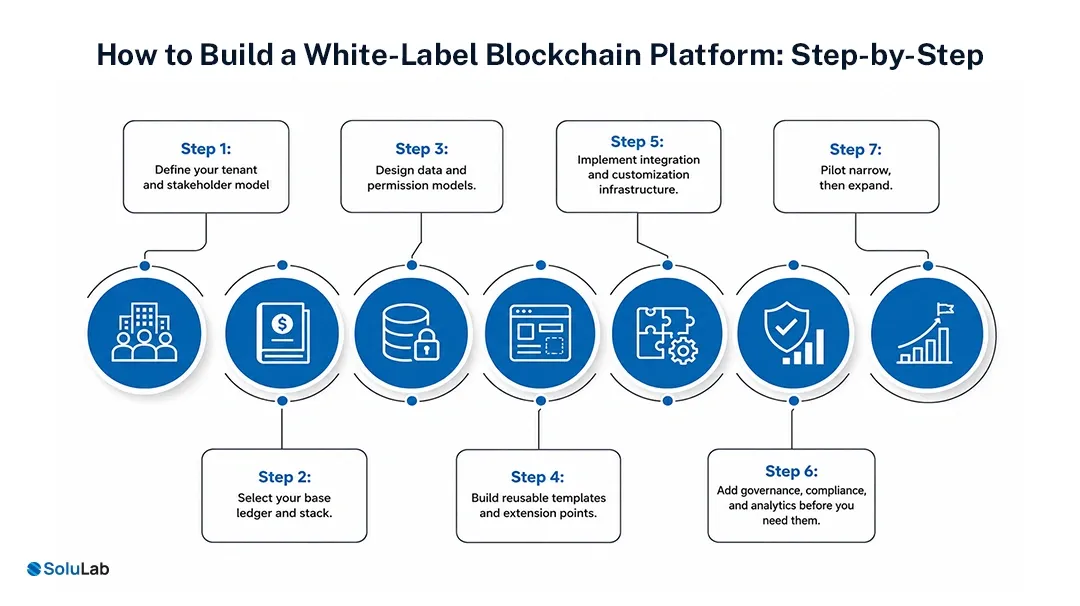
Before committing to a build, ask honestly whether you need to build one or whether licensing and extending an existing platform is the more defensible decision. The build choice is often made too early, driven by a preference for theoretical control rather than a genuine requirement that existing platforms cannot meet.
If you decide to build, treat it as a product development exercise, not a technology project. A product has tenants, onboarding flows, documentation, and a governed roadmap. A blockchain technology project has a launch date and a changelog.
Step 1: Define your tenant and stakeholder model.
Map who will use the platform: internal teams, external partners, enterprise clients, or third-party developers. Their workflow requirements drive every subsequent architectural decision. Start with blockchain consulting first, not with infrastructure selection.
Step 2: Select your base ledger and stack.
Evaluate Top blockchain platforms on performance, developer tooling, compliance posture, and ecosystem maturity. Your ledger choice affects upgrade paths, regulatory positioning, and developer hiring for the next several years.
Step 3: Design data and permission models.
Decide what belongs on-chain versus off-chain, who can read specific data fields, and who can authorize state changes. This is where most enterprises build introductions that raise complexity that they later regret. Keep the permission model as simple as the use case allows.
Step 4: Build reusable templates and extension points.
Think in modules: assets, identities, workflows, policies. A white-label platform serves multiple use cases. If your architecture requires heavy customization per use case, you have built a project, not a blockchain platform.
Step 5: Implement integration and customization infrastructure.
Make it practical for tenants and partners to connect your platform to their existing systems. Event streams, documented APIs, and pre-built connectors are not nice-to-haves. They determine whether enterprise clients actually adopt the platform.
Step 6: Add governance, compliance, and analytics before you need them.
These are the hardest capabilities to retrofit after launch. Build the control plane, audit tooling, and monitoring infrastructure before you promise the platform to production users.
Step 7: Pilot narrow, then expand.
Launch with one use case, one tenant segment, and one measurable success metric. Expand from demonstrated production value, not from assumptions made during planning.
Depending on your team’s capabilities, you will blend internal engineering with external Blockchain development services. Budget your Blockchain development cost to cover documentation, developer tooling, and tenant onboarding infrastructure alongside core code. Without those operational layers, you have software. With them, you have a platform.
How Blockchain Replaces SaaS Platforms in Specific Domains?
Blockchain replaces SaaS platforms in workflows where shared state, long-term auditability, and multi-party trust justify the additional architectural responsibility. It does not replace SaaS across all software categories, and the teams that pretend otherwise tend to build platforms nobody outside a whitepaper actually uses.
The practical picture often looks like this: users interact with a familiar web or mobile interface with clean UX and reasonable load times. Underneath, the system runs ledger-backed workflows that give every authorized participant access to the same immutable record. That is what blockchain-based SaaS alternatives look like in production. Not a reimagined consensus mechanism, but a better trust architecture underneath a normal user experience.
For purely internal, single-organization tasks with no compliance angle and no multi-party coordination requirement, SaaS typically remains the more practical choice. The moment you add external counterparties, regulatory oversight, or any scenario where “who changed what and when” becomes a legal or commercial question, the ledger model earns its complexity premium.
The realistic replacement thesis is not “blockchain kills SaaS.” It is “blockchain handles the workflows where SaaS creates more problems than it solves.”
Choosing the Right Enterprise White-Label Blockchain Solutions Provider
The most common vendor selection mistake is evaluating technology depth instead of domain fit and delivery track record. A platform that works well for trade finance may be a poor choice for healthcare credentialing, even if the underlying engineering architecture looks similar on paper.
Start with these questions before any vendor demonstration:
- Do they have production deployments in your vertical or a directly adjacent one?
- Can they support your preferred deployment model: cloud, on-premises, or hybrid?
- How much real influence do you have over their product roadmap?
- Do they operate like a genuine Blockchain development company that solves problems, or like a SaaS vendor that manages accounts and escalations?
Bringing in an Expert Blockchain Consultants before you enter formal procurement conversations is frequently the highest-ROI investment in the early stage. A good consultant defines requirements precisely, stress-tests vendor claims against real deployment experience, and helps you avoid committing to a platform that performs well in demos but cannot support your actual workflow at production scale.
That same consultant can help you decide the right resourcing model: whether to Hire Blockchain Developers for internal capability, engage a managed provider for ongoing operations, or combine both approaches based on your team’s existing strengths and long-term product ambitions.

Cost and Build Strategy for White-Label Blockchain Platforms
Cost conversations about blockchain platforms consistently start in the wrong place. Teams compare license fees as if that were the meaningful variable. It rarely is.
The actual Blockchain development cost for a white-label strategy breaks into four categories that each require independent estimation:
- Platform license and support: the base recurring cost, which varies significantly by vendor, deployment model, and negotiated terms
- Customization and integration work: adapting data models, building workflow extensions, and connecting existing enterprise systems; frequently the largest single cost line
- Infrastructure and operations: node hosting, monitoring, compliance tooling, backups, and the team overhead required to run the platform reliably
- Ongoing evolution: regulatory changes, new use cases, additional tenant onboarding, and performance optimization over a multi-year horizon
White-label vs Custom Blockchain is ultimately a trade-off between speed and architectural control. White-label gives you a faster time to production and shared maintenance responsibility. A fully custom build gives you maximum flexibility at the cost of higher execution risk, longer timelines, and full platform ownership responsibility from day one.
For most enterprises, the most defensible strategy is staged. Start white-label to validate the use case and learn what production requirements actually are. Make a data-informed decision about custom blockchain app development once you have real operational evidence rather than planning assumptions.
FAQs
Shipra Garg is a tech-focused content strategist and copywriter specializing in Web3, blockchain, and artificial intelligence. She has worked with startups and enterprise teams to craft high-conversion content that bridges deep tech with business impact. Her work translates complex innovations into clear, credible, and engaging narratives that drive growth and build trust in emerging tech markets.