Key Takeaways
- The Problem Quantum computers, once sufficiently powerful, can break the elliptic curve cryptography that secures wallets and signatures across Bitcoin, Ethereum, and Solana. Every public key exposed on the blockchain is a potential target. According to the World Economic Forum, up to 4 billion Bitcoin addresses could be vulnerable as quantum capability scales.
- The Solution NIST will finalize post-quantum cryptography (PQC) standards in 2024, providing a viable path forward. But migrating an entire blockchain to new cryptographic primitives is non-trivial. Some chains are better positioned to do it than others.
- How SoluLab Can Help We work with founders and enterprise teams to assess quantum exposure, design future-proof architecture, and build on the right chain for your use case, before the window closes.
Most founders are still debating gas fees and TPS. That’s understandable. But it’s also dangerously short-term.
In late 2024, Google’s Willow quantum chip completed a benchmark computation in minutes, something that would take today’s fastest classical supercomputer longer than the lifetime of the universe. That event quietly changed the risk profile of every system built on classical cryptography. Not tomorrow. Already.
If you’re choosing where to build a blockchain solution right now between Bitcoin, Ethereum, or Solana, you’re locking in cryptographic assumptions that will be brutally expensive to reverse. Wallets, signatures, validator security, custody models.
These are not refactors; they’re foundations. And the founders who ignore this now will be the ones forced to migrate later, when the cost, risk, and user fallout are far higher.
What Breaks First Under Quantum Attacks in Bitcoin, Ethereum, and Solana Blockchains?
Before getting into the chain-by-chain breakdown, it’s worth being clear about what a quantum attack actually means in this context, because the internet is full of vague fear and not enough specifics.
The main vulnerability isn’t the blockchain technology itself, it’s public key cryptography. Specifically, Shor’s algorithm (running on a sufficiently large quantum computer) can derive private keys from public keys. That means any wallet that has ever broadcast a transaction and therefore exposed its public key becomes potentially crackable.
Grover’s algorithm is a second concern, but a slower-burning one. It roughly halves the effective security of hash functions, which threatens proof-of-work mining more than user wallets.
So when builders and security teams talk about blockchain quantum security solutions, they’re really talking about two things: replacing vulnerable signature schemes (ECDSA mostly) and hardening hash-based systems against brute force speedup.
The timeline debate is real. Most credible researchers, including teams at IBM and NIST, estimate that a cryptographically relevant quantum computer is still 10–15 years away. But migration at blockchain scale takes years, too.
Which is why this conversation matters right now, in 2026, as you’re deciding where to put your stack.
Bitcoin vs Ethereum vs Solana Security Comparison in the Age of Quantum Computing
Let’s be direct. Bitcoin vs Ethereum vs Solana security comparison isn’t just a technical conversation, it’s a business decision. Where you build determines what your upgrade path looks like when (not if) the cryptographic baseline changes.
| Feature | Bitcoin | Ethereum | Solana |
| Signature Scheme | ECDSA (secp256k1) | ECDSA → BLS migration in progress | Ed25519 |
| Upgrade Mechanism | Slow, consensus-heavy | EIPs are modular and faster | On-chain governance, fast but risky |
| PQC Readiness | Low | Medium-High | Medium |
| Decentralization | Highest | High | Lower |
| Quantum Risk Level | High (long-term) | Medium | Medium-High |

Why Bitcoin Is the Most Exposed Chain in a Post-Quantum World?
Bitcoin and the Proof of Work model are genuinely one of the most battle-tested systems in the history of computing. Over $500 billion in market cap. The system has gone fifteen years without a core protocol exploit. That’s not nothing, that’s extraordinary.
But here’s the honest tension: that same conservative, slow-by-design governance that makes Bitcoin trustworthy is precisely what makes quantum upgrades hard. There is no Ethereum improvement proposal equivalent that moves quickly.
Any change to Bitcoin’s signature scheme requires overwhelming miner and node consensus, and historically, even uncontroversial changes take years. The block size debate ran for four years and ended in a split.
ECDSA is still Bitcoin’s core signing algorithm. If a quantum adversary can crack it, every address that has ever sent BTC, not just held it, but sent it, is exposed. That’s a significant share of all coins ever moved.
Estimates vary, but researchers at Deloitte put the number of potentially vulnerable Bitcoins at over 4 million BTC.
Now, none of this means Bitcoin is broken. Quantum computers capable of this kind of attack are years away at minimum. But if you’re a builder deciding whether to use Bitcoin as a settlement layer, base asset, or infrastructure backbone for a product that needs to last a decade, factor this in.
Quantum computing vs bitcoin is not yet a real-world threat. It is a very real planning threat.
Why Ethereum has the Strongest Post-Quantum Migration Path?
Of the three, Ethereum blockchain is best positioned for a quantum transition, not because it’s immune, but because it’s built to change.
The Ethereum roadmap already includes EIP-7560 discussions around quantum-resistant account abstraction. Vitalik Buterin has publicly acknowledged post-quantum migration as a medium-term priority, and the shift to BLS signatures (as part of the consensus layer post-Merge) already moves away from pure ECDSA for validators.
Ethereum, as a smart contract platform, also has something Bitcoin doesn’t: programmable migration paths. Through account abstraction (ERC-4337), wallets can technically be upgraded to use new signature schemes without changing the base protocol drastically. This provides Ethereum builders an actual runway to adapt.
The caveat is that Ethereum’s upgrades still require coordination across a large, sometimes opinionated ecosystem. And the existing base layer still runs ECDSA for transaction signing. It’s not safe today; it’s safer to migrate tomorrow.
For enterprise builders, especially those building blockchain development services on top of Ethereum, the practical recommendation is to design your wallet and key management layer with PQC flexibility in mind from day one. Don’t hardcode assumptions about ECDSA.
How Bitcoin, Ethereum, and Solana work at a cryptographic level is honestly the most important thing a technical CTO or founder should understand before picking a chain for a serious product.
Why Solana’s Post-Quantum Strategy Trades Speed for Survival For Builders?
Solana blockchain’s edge is speed and throughput around 65,000 TPS, sub-second finality, and fees that don’t make your users cry. That makes it genuinely attractive for consumer-grade web3 products, trading apps, and high-volume token ecosystems. And to their credit, Solana uses Ed25519 instead of ECDSA, which is a slightly more modern signature scheme, though still not quantum-resistant.
The governance model is where things get intriguing. Solana can move faster on upgrades than either Bitcoin or Ethereum. The Solana Foundation and core team have historically shipped changes quickly. But that speed comes from a more centralized coordination structure, and that’s a double-edged sword when it comes to something as high-stakes as a cryptographic migration.
When we talk about Solana vs. Bitcoin vs. Ethereum from a governance lens, Solana has the fastest potential upgrade path but also the most concentrated risk if that upgrade doesn’t go smoothly. For builders, the question is, do you trust the core team to execute a PQC migration cleanly, and can your product survive the disruption window?
The difference between Bitcoin, Ethereum, and Solana at this level isn’t about TPS charts or fee structures. It’s about governance philosophy, and that philosophy will determine who adapts first when quantum pressure becomes real.

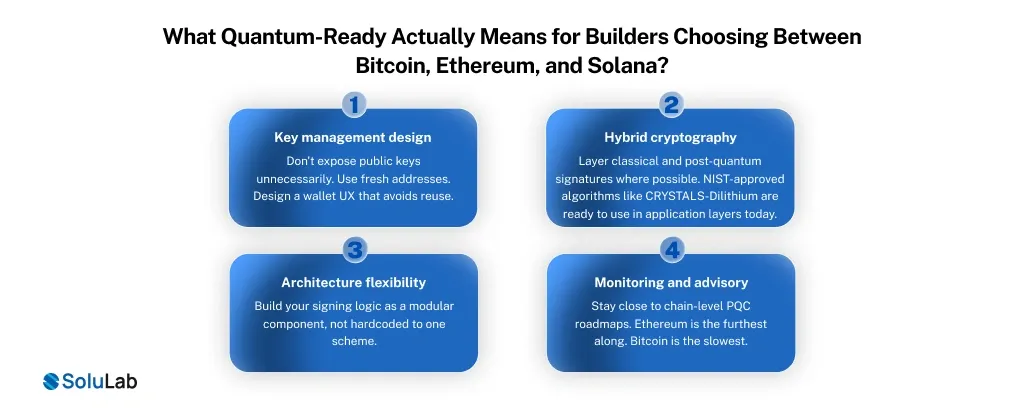
What Quantum-Ready Actually Means for Builders Choosing Between Bitcoin, Ethereum, and Solana?
Quantum-ready has become a bit of a buzzword, and it’s worth cutting through that.
For most builders in 2026, blockchain quantum security solutions don’t mean rebuilding everything today. It means a few things practically:
- Key management design — Don’t expose public keys unnecessarily. Use fresh addresses. Design a wallet UX that avoids reuse.
- Hybrid cryptography — Layer classical and post-quantum signatures where possible. NIST-approved algorithms like CRYSTALS-Dilithium are ready to use in application layers today.
- Architecture flexibility — Build your signing logic as a modular component, not hardcoded to one scheme.
- Monitoring and advisory — Stay close to chain-level PQC roadmaps. Ethereum is the furthest along. Bitcoin is the slowest.
If you’re building on a Crypto Development company partner’s stack or evaluating one, ask them directly what their quantum migration story is. If they don’t have an answer, that tells you something.
Blockchain-based cryptocurrencies are all theoretically vulnerable to quantum at some point. The question is which ones have a realistic, well-funded, well-governed upgrade path.
Should You Build Now or Wait? A Decision Framework for Bitcoin vs Ethereum vs Solana
This is the question almost every serious founder asks, and the honest answer is to build now, but build smart.
Waiting isn’t a risk management strategy; it’s a market timing gamble. The builders who’ll win the next cycle are the ones shipping products today with architecture that doesn’t require full rewrites when PQC becomes mandatory.
Here’s a quick decision lens:
- If you’re building a payment or custody product, prioritize Ethereum or a Layer 2 solution with account abstraction. The upgrade path matters more than raw speed.
- If you’re building high-throughput consumer apps, Solana is still a strong choice, but lobby your infrastructure providers to document their PQC roadmap.
- If you’re building enterprise infrastructure or long-lifecycle systems, blockchain security consulting for quantum threats should be a line item in your budget, not an afterthought.
Which crypto is better Bitcoin, Ethereum or Solana for quantum resilience?
Ethereum, as of 2026. But better is always relative to what you’re building and your risk horizon.
For teams exploring the Decentralized Web3 Ecosystem, especially those thinking about long-term infrastructure, quantum readiness is now part of the architecture conversation, not just the security audit.
Statista projects the global quantum computing market to hit $450 billion by 2030, and that growth directly accelerates the timeline for quantum-capable machines that could impact cryptographic systems.
How SoluLab Helps Build Quantum-Aware Blockchain Infrastructure?
At SoluLab, we’ve been in this space long enough to know that most teams don’t fail on ideas, they fail on infrastructure decisions made too early or too late.
Whether you’re launching a new chain-native product, migrating an existing system, or just trying to understand what blockchain security consulting for quantum threats actually looks like in practice, we bring technical depth and an honest perspective.
If you want to Hire Blockchain developers who understand quantum risk, smart contract architecture, and the real-world implications of chain selection, that’s exactly what our team does.
For founders exploring the broader landscape, like Top Web3 Platforms, AI in Web3 integration, and Web3 development companies, these aren’t separate questions from quantum readiness.
They’re all part of the same infrastructure decision.

Conclusion
Quantum computing isn’t going to destroy Bitcoin next Tuesday. But it is going to force every serious blockchain builder to make some hard architectural decisions, and the chains that make that migration easier will attract the best developers, the most institutional capital, and the long-term user base.
Bitcoin vs Ethereum vs Solana each have genuine strengths.
- Bitcoin has credibility and decentralization.
- Ethereum has adaptability and ecosystem depth.
- Solana has speed and momentum.
But when quantum computing vs bitcoin and the other chains become a real-world test, the winner won’t be the fastest or the most popular. It’ll be the one that ships a credible post-quantum roadmap and executes without a crisis. A reliable blockchain consultant, like SoluLab can help you make the best decision.
Build accordingly. And if you want a team that actually thinks about this stuff, not just follows the hype, as you know where to find us.
FAQs
With over 3 years of experience, I specialize in breaking down complex Web3 and crypto concepts into clear, actionable content. From deep-dive technical explainers to project documentation, I help brands educate and engage their audience through well-researched, developer-friendly writing.