Key Takeaways
- To launch an AI model tokenization platform business must have a clear understanding of what is being tokenized, who can use it, and how ownership will be protected
- A compliant AI tokenization platform development combines the legal rights, platform, and revenue goals.
- Tokenized AI models can open new business opportunities through licensing, controlled access, revenue sharing, and marketplace-led distribution.
- AI model tokenization process helps businesses reduce risk, improve trust, and launch with a model that the market can understand.
- SoluLab is an AI native company with unmatchable expertise in tokenization platform development and
Enterprise interest in tokenized digital assets is moving beyond finance. As of April 2026, RWA.xyz reported about $26.71 billion in distributed asset value across tokenized real-world assets, while a survey found that 78 percent of organizations already use AI in at least one business function. Those two shifts are starting to meet. Companies now want to package model access, licensing rights, revenue shares, and governance controls into structured digital assets.
That is why demand is rising for a compliant tokenization platform development for ownership, monetization, and trust. This guide provides clear step-by-step instructions on how to build an AI Model Tokenization Platform.
Why Businesses Need an AI Asset Tokenization Platform To Generate ROI in 2026?
A business does not create value by tokenizing technology, but by making AI assets easier to own, license, govern, and monetize, and AI model tokenization promises this. Instead of treating a model as a black-box internal resource, a company can package access rights, usage limits, royalty terms, and governance logic into digital instruments. These tokenized AI models are more practical for partnerships, controlled distribution, channel sales, and cross-border licensing.
Asset tokenization adds programmability, round-the-clock operability, and more automated settlement logic, while AI adoption itself is already widespread across enterprises. In that environment, an AI asset tokenization platform becomes an operating layer that connects legal rights, technical access, and commercial value in one place.

Step-by-Step Instructions To Build an AI Model Tokenization Platform
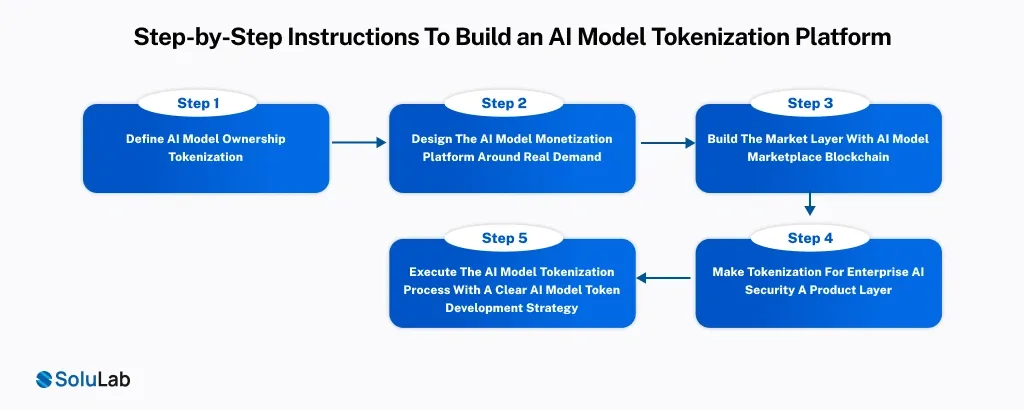
Building an AI model tokenization platform requires combining AI development, blockchain infrastructure, and scalable architecture. The goal is to convert AI models into tokenized digital assets that can be owned, traded, and monetized efficiently. The process goes like-
Step 1: Define AI model ownership tokenization
A company must decide what the token actually represents for AI model ownership tokenization. The token may stand for full ownership, limited commercial rights, inference credits, partner access, region-based licensing, revenue participation, or governance privileges. Each option creates a different legal, financial, and operational structure.
AI intellectual property tokenization must stay disciplined. Most failed concepts start by tokenizing vague claims around “ownership” without resolving the underlying IP, training data rights, model provenance, or license scope. A reliable platform defines the asset with precision, covering:
- What rights travel on-chain?
- What evidence stays off-chain?
- How royalties flow?
- How are disputes handled?
AI tokenization for asset ownership only works when the legal wrapper, metadata schema, and contract logic match one another. Tokenization is not a shortcut around IP structure; it is a system that forces clarity.
Step 2: Design the AI model monetization platform around real demand.
Once the asset is defined, the business must choose how value will move through the platform. A credible AI model monetization platform depends on utility. The token should solve a commercial problem: buying model access, allocating compute credits, splitting revenue among contributors, enabling governed resale, or creating auditable usage rights for enterprise clients.
AI asset tokenization use cases need to be mapped carefully. One company may use tokens to license domain-specific models to channel partners. Another may issue tokens that represent prepaid inference capacity. A third may structure royalty-bearing tokens for a marketplace of fine-tuned models. The right model depends on who pays, how often they pay, and what outcome they expect. A platform that serves enterprises should prioritize predictable pricing, compliance-ready workflows, and transparent reporting. Markets reward clarity. Buyers pay for usable rights, measurable value, and low-friction onboarding.
Step 3: Build the market layer with AI model marketplace blockchain.
A scalable platform needs market architecture, not just smart contracts. The blockchain layer should support listing, discovery, settlement, and governance without exposing the business to unnecessary operational risk. This is why the AI model marketplace blockchain choice matters early. A public network may support openness and composability. A permissioned or hybrid model may better suit regulated industries, private licensing, or enterprise procurement workflows.
A durable AI model tokenization platform should separate what belongs on-chain from what should remain off-chain. Ownership records, transfer rules, royalty logic, and governance actions may live on-chain. Model weights, sensitive data, access credentials, compliance documents, and high-volume inference activity may sit off-chain with secure references. The best AI-powered tokenization platforms also behave like software products, not only token issuers. They include wallet orchestration, user identity, permission control, payment rails, audit logs, pricing logic, and analytics.
Step 4: Make tokenization for enterprise AI security a product layer
Tokenization for enterprise AI security should shape the architecture from day one. A company building around AI assets must protect not only token flows, but also model access, API usage, contributor rights, and confidential data connections. That means identity controls, role-based permissions, secure key management, smart contract audits, tamper-evident logs, and strict separation between ownership logic and model execution environments.
Security also has a governance dimension. A platform should record model provenance, version history, permitted usage, and policy enforcement. It should support revocation, suspension, dispute resolution, and compliance reporting.
It should also integrate privacy safeguards for training data and customer data that may relate to a tokenized model’s lifecycle.
Step 5: Execute the AI model tokenization process with a clear AI model token development strategy
The AI model tokenization process works best when it follows a staged delivery model.
- First, the company inventories AI assets and ranks them by monetization potential, legal clarity, and demand.
- Second, it defines the token class and transfer rules.
- Third, it maps the commercial workflow: issuance, purchase, access activation, royalty distribution, resale, and reporting.
- Fourth, it builds the technical interfaces that connect wallets, smart contracts, model APIs, billing systems, and user dashboards.
Here, the AI token development and integration becomes decisive; if token ownership cannot trigger real access, the platform remains cosmetic.
A strong AI model token development strategy also addresses governance before launch. The business should define supply rules, treasury logic, fee policies, secondary-market permissions, and dispute controls before the first token is issued.
After that, the AI model token development process should move through pilot launch, controlled partner testing, analytics review, and compliance hardening. This sequence matters because most enterprises do not fail on vision.
Read more – Oil tokenization
What Companies Must Do to Build an AI Model Tokenization Platform?
Building an AI model tokenization platform is not just about combining AI and blockchain. It requires a clear strategy, scalable architecture, and an AI-native approach to ensure long-term success. Companies need to think beyond development and focus on monetization, interoperability, and compliance from day one.
- Define rights, ownership, and usage terms before token design begins.
Companies must decide what the token represents before they move into AI-led development. That includes ownership rights, licensing scope, revenue-sharing logic, transferability, resale conditions, and access permissions. In an AI model tokenization platform, clear rights design creates trust, reduces legal ambiguity, and gives buyers confidence in what they are actually acquiring.
- Build the full platform ecosystem.
A successful platform needs more than token issuance. Companies must invest in compliance workflows, analytics, onboarding, API connectivity, billing systems, governance controls, and user experience. Strong AI tokenization platform development connects the token to real platform operations, so businesses can manage assets, users, transactions, and reporting in a way that supports enterprise adoption.
- Align the platform with a real market need.
Companies must use an AI Model Tokenization platform, considering commercial use cases. Buyers demand a reason to engage. Tokenized AI models gain traction when the business value is visible, practical, and easy for the market to understand.
- Start with a focused asset class and buyer segment.
Companies must narrow the initial scope of the platform to one strong use case with expert AI consultants, one well-defined audience, and one monetization model. This approach makes the product easier to position, validate, and scale. In an AI asset tokenization platform, clarity drives adoption. When buyers understand what the token does, how value flows, and what protections are built in, the platform becomes easier to trust and easier to buy.

Conclusion
A strong AI model tokenization platform starts with a business case, a rights framework, a secure architecture, and a monetization design that buyers can use without friction. The companies that lead this market are those that can turn AI assets into governed products having ownership, utility, and controls.
Businesses that treat white label tokenization solutions as infrastructure for distribution, licensing, and trust can create compliant ecosystems and generate higher ROI around AI. In this market, disciplined execution and structure matter the most.
Partner With Solulab For AI Model Tokenization Platform Development!
SoluLab executes Asset tokenization development with an AI-first approach. Our team helps businesses shape token logic, marketplace architecture, smart contracts, compliance-ready workflows, and secure product integrations without losing sight of commercial goals.
A company that wants to build an AI model tokenization platform needs asset design, governance model, and launch sequence. Our mix of strategy, engineering, and delivery support can help reduce execution risk, accelerate pilot readiness, and turn an idea into a platform that enterprises can actually adopt.
FAQs
Shipra Garg is a tech-focused content strategist and copywriter specializing in Web3, blockchain, and artificial intelligence. She has worked with startups and enterprise teams to craft high-conversion content that bridges deep tech with business impact. Her work translates complex innovations into clear, credible, and engaging narratives that drive growth and build trust in emerging tech markets.