Key Takeaways
- Property tokenization turns ownership or income rights in real estate into digital tokens. Traditional investment still runs on deeds, fund shares, or LP agreements.
- Fractional property ownership blockchain models let you in for a few hundred dollars. A traditional deal often wants six figures before anyone will talk to you.
- Liquidity is where the two models genuinely diverge, but not the way most pitch decks claim. REITs already have decades of trading volume. Tokenized secondary markets are still thin.
- Risk doesn’t disappear with tokenization; it just changes shape. You trade some property-market exposure for smart contract, custody, and platform risk.
- Real-world asset tokenization is graduating from pilot programs into actual production by 2026, though the regulatory picture still shifts depending on where you’re issuing.
Buying property has always meant one of two things: a large lump sum, or years tied up in a fund you can’t easily exit. Tokenization is starting to change that math. By converting a property’s title, or a fund’s underlying assets, into digital tokens on a blockchain, businesses can let investors buy in for a few hundred dollars, trade their stake nights and weekends instead of waiting on a buyer, and settle transactions in minutes instead of weeks.
That doesn’t make it a free upgrade over traditional investment. Tokenized property is newer, less liquid in practice than its 24/7 marketing suggests, and still catching up on legal recognition in many jurisdictions. Traditional real estate remains slower and less accessible, but it’s backed by a century of case law, title insurance, and institutional trust. Tokenization platforms are still building.
This guide breaks down where each model actually wins on cost, risk, liquidity, and real returns so you can weigh them on the numbers, not the hype.
What Is Property Tokenization?
Property tokenization converts ownership rights, or the economic rights tied to a property’s income and appreciation, into digital tokens recorded on a blockchain. Each token stands in for a defined slice of the asset. Think stock certificate, not paper deed, issued and moved through smart contracts instead of a title company.
One thing worth clearing up early: this has nothing to do with buying an NFT of a house photo. A real tokenized real estate investment sits on top of an actual legal structure, usually a special purpose vehicle (SPV) that holds the physical property. The tokens represent shares or membership interests in that SPV. Blockchain handles the record-keeping, the transfers, and, where the offering permits it, the income distribution.
The appetite for this model has grown alongside the wider real-world asset (RWA) tokenization push, which several analysts expect to reach into the trillions in tokenized value by the early 2030s as institutions test the rails on bonds, funds, and now property.
How Does Property Tokenization Work?
The mechanics look nothing like a normal closing, and each step drags its own compliance burden along with it.
1. Select the Property
Someone identifies a commercial, residential, hospitality, or other eligible asset. Not every property makes a good tokenization candidate. Income-producing commercial real estate and stabilized rental portfolios tend to pull in the most investor interest, for the obvious reason that predictable cash flow is easier to sell.
2. Establish the Legal Structure
The issuer sets up an SPV or comparable ownership vehicle to legally hold the property. This is the part that anchors the digital token to a real, enforceable claim, and it’s also the part regulators look at hardest.
3. Perform Due Diligence
Before a single token gets minted, the issuer verifies title, valuation, outstanding debt, income history, and legal status. Skip this step, or rush it, and you’re building the exact failure mode that sank several early tokenization projects.
4. Create the Tokens
Once the legal and financial picture checks out, the platform issues tokens representing the defined ownership or economic rights. Typically as security tokens, on either a permissioned or public chain.
5. Offer Tokens to Investors
Tokens go out to investors after KYC and AML checks clear and the offering satisfies applicable securities rules. Most legitimate tokenized property offerings are regulated securities. They are not unregulated crypto assets, no matter how the marketing reads.
6. Manage Ownership and Distributions
Smart contracts, backed by off-chain systems that handle the parts blockchain can’t, track who owns what and automate distribution of eligible rental income or other returns.
7. Enable Transfers Where Permitted
Secondary trading gets pitched as tokenization’s headline advantage. Real liquidity, though, depends on regulation, the platform’s actual investor base, genuine demand, and how the secondary market is built. A token isn’t liquid just because it happens to be digital, and treating “on a blockchain” as a synonym for “tradeable” is where a lot of investors get burned.
Teams building this kind of infrastructure usually get further working with a specialized real estate tokenization development company than by picking a blockchain and hoping the legal side sorts itself out. It rarely does on its own.
What Is Traditional Property Investment?
Traditional property investment covers the paths most investors already know: buying a property outright, investing in a REIT, or putting capital into a private fund or syndication. Ownership shows up as deeds, fund shares, or limited partnership interests, and the transactions run through title companies, brokers, fund administrators, and, for public REITs, a stock exchange.
Decades of legal precedent back this model, along with settled valuation methods and deep institutional participation. What it doesn’t offer is flexibility on ticket size or speed. Direct purchases take 30 to 60 days to close on average, and private funds routinely lock capital up for five to ten years. You knew that going in, but it’s worth saying plainly.
Property Tokenization vs Traditional Investment: Key Differences
| Factor | Property Tokenization | Traditional Investment |
| Minimum investment | Often $100–$5,000 through fractional ownership | Often $25,000+ for funds; full price for direct purchase |
| Liquidity | Depends on an active secondary market and current regulation | Established for REITs; low for direct ownership and private funds |
| Transfer speed | Minutes to days via smart contract, where permitted | Weeks for direct sales; fund-dependent for private vehicles |
| Investor access | Can be global, subject to securities rules | Often geographically or accreditation-restricted |
| Transparency | On-chain ownership and distribution records | Periodic reporting, less granular |
| Regulatory maturity | Evolving, varies by jurisdiction | Well established |
| Extra risk layer | Smart contract, platform, custody | None beyond standard property risk |
Which Is More Liquid: Tokenized or Traditional Real Estate?
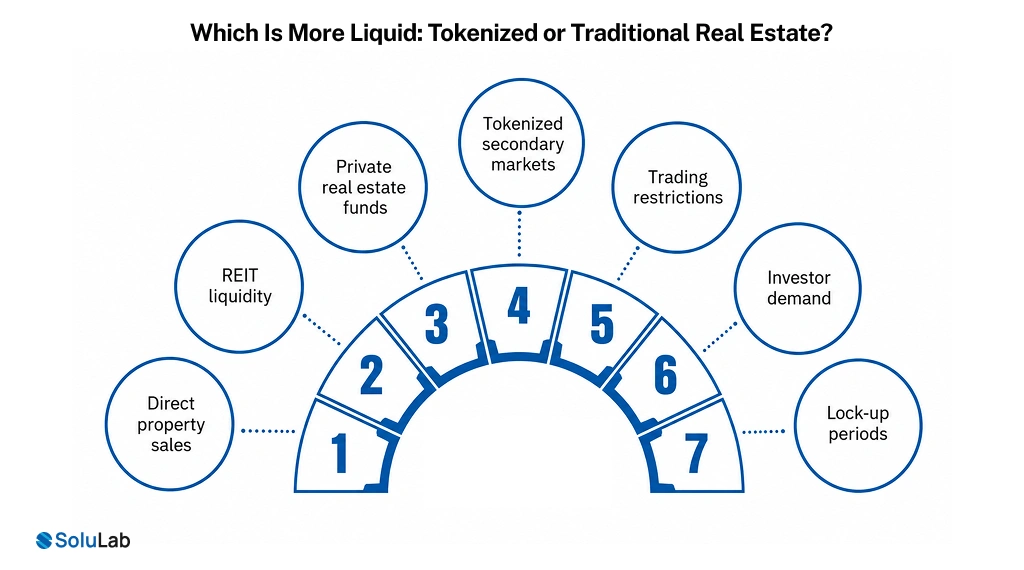
Neither wins outright. It comes down to which traditional vehicle you’re actually comparing tokenization against.
- Direct property sales sit at the bottom of the liquidity ladder either way, tokenized or not, since the underlying asset still has to legally change hands.
- REIT liquidity is genuinely strong. A publicly traded REIT settles like any other listed security, often same-day.
- Private real estate funds lock capital for years, with redemption windows that range from limited to nonexistent.
- Tokenized secondary markets promise faster transfers. In practice, most are still thin, with fewer buyers and sellers than you’d find on an established exchange, and that gap matters more than the pitch admits.
- Trading restrictions apply to tokenized offerings and private REITs alike once they’re structured as securities sold only to accredited investors.
- Investor demand is the real deciding factor. A token with no active buyer trades exactly as slowly as a paper deed. Slower, actually, because at least the deed has an established resale process.
- Lock-up periods show up in tokenized deals too, commonly for the first 6 to 12 months after issuance. “Liquid” claims deserve a second look at the offering terms before you believe them.
Is Tokenized Real Estate Safer Than Traditional Property Investment?
Neither model is inherently safer than the other. The risk categories just look different, and tokenization stacks a new layer on top rather than swapping one out.
Traditional Risks
- Property market risk (price and demand swings)
- Tenant risk (vacancy, non-payment, turnover)
- Financing risk (rate changes, refinancing terms)
- Management risk (operational execution, or the lack of it)
- Legal and title risk
Tokenized Investment Risks
Tokenized real estate investment inherits everything on that list above, then adds a second stack most first-time investors haven’t priced in:
- Smart contract risk (bugs or exploits baked into the code governing ownership and distributions)
- Cybersecurity risk (wallet compromise, platform breaches)
- Platform risk (issuer solvency, whether the operation stays running)
- Digital custody risk (lost private keys, a custodian that fails)
- Regulatory uncertainty (rules for security tokens are still being written in plenty of jurisdictions)
The honest read: tokenization doesn’t lower real estate risk. It adds a technology and compliance layer on top of risk that was already there. Anyone weighing REITs vs tokenized real estate should put that extra layer on the scale against whatever access and flexibility it’s buying them.

When Is Traditional Property Investment Better?
A few situations still tilt clearly toward the traditional route:
- You want direct control over the asset and the management decisions that come with it.
- Long-term ownership, not an eventual resale, is actually the goal.
- Tokenized markets in your target asset class don’t have enough liquidity yet to matter.
- Regulatory uncertainty around security tokens sits outside your comfort zone.
- You’d rather work with legal structures that have already been tested in court, not newer digital ones still finding their footing.
When Does Property Tokenization Make More Sense?
Tokenization tends to earn its keep when:
- Fractional investment is the actual goal, not full ownership of one asset.
- Your investor base is comfortable with digital-first onboarding: KYC, wallets, e-signatures.
- Global investor access matters, and the offering’s securities structure actually supports it.
- Automated distributions cut down administrative overhead on both sides of the deal.
- Multiple investors each want a small, transparent stake rather than one buyer taking the whole thing.
- The issuer already has digital asset infrastructure, or plans to build it for future raises anyway.
- Secondary-market trading is a genuine, working feature of the platform, not just a line in the deck.
Property Tokenization Use Cases in 2026
Tokenization has moved well past the single-family flip pitches that got it a bad reputation a few years back. The more credible use cases now include:
- Residential properties, particularly build-to-rent portfolios sold in fractional shares to smaller investors.
- Commercial buildings, where tokenization spreads a large ticket size across many participants instead of one.
- Hotels, tokenized to raise capital while an experienced operator keeps control of day-to-day management.
- Warehouses, riding steady industrial demand and long lease terms.
- Data centers, an RWA category that’s grown fast given how capital-intensive the asset class is.
- Real estate funds wrap an entire fund’s shares as tokens instead of traditional LP interests.
- Development projects, raising construction capital in stages tied to milestones.
- Rental properties, distributing income to token holders through automated smart contract payouts.
How to Evaluate a Tokenized Property Investment?
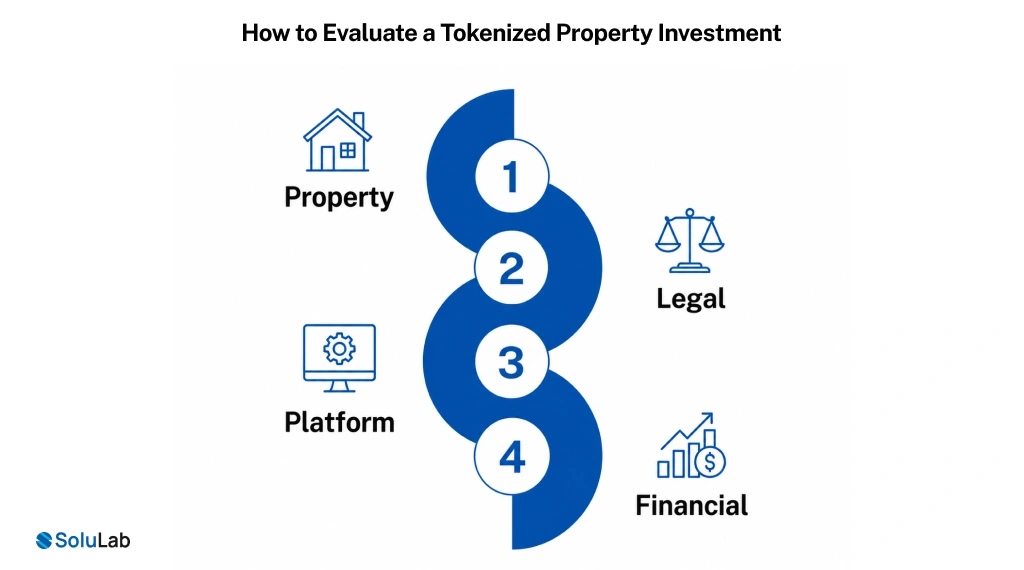
Run any offering through four checkpoints before capital moves.
1. Property
Start with the asset itself: independent valuation, occupancy history, location fundamentals, condition. A tokenized wrapper doesn’t change what actually makes a property a good or bad investment, and it never will.
2. Legal
Verify the SPV structure, the jurisdiction it’s registered in, exactly what the token confers (equity, debt, or a revenue share), and whether the offering actually complies with the securities law it’s operating under.
3. Platform
Look at the issuer’s track record, security audits, custody arrangements, and whether they built the offering with a credible tokenization platform development partner rather than bolting tokens onto a no-code generator over a weekend.
4. Financial
Review projected returns, the fee structure, the distribution schedule, and, this is the one people skip, any actual trading history on the secondary market. Not a marketing claim of liquidity. Real transaction data.
What Does the Future of Tokenized Real Estate Look Like?
The next stretch of growth in tokenized real estate depends less on new blockchains and more on the boring infrastructure catching up. Five shifts are shaping where this heads by the end of the decade.
1. Real-world asset tokenization
Real-world asset tokenization is spreading past real estate into bonds, private credit, and commodities, which builds shared standards and investor familiarity that end up benefiting property tokens too.
- Standardized token frameworks across asset classes
- Institutional capital finally entering RWA markets
- Shared compliance tooling across issuers
2. Stablecoin settlement
Stablecoins are becoming the default settlement rail for tokenized asset trades, which cuts out the friction of converting fiat to crypto and back for every single transaction.
- Faster settlement than traditional wire transfers
- Less currency-conversion overhead
- Regulatory frameworks for stablecoin issuers maturing
3. Blockchain interoperability
As more platforms launch, whether chains can actually talk to each other decides if tokenized property can move and trade across ecosystems, or just sits siloed on whichever chain it launched on.
- Cross-chain transfer standards maturing
- Less platform lock-in for investors
- Bridges introducing their own new security considerations
4. On-chain compliance
Compliance logic is increasingly built straight into the token, automating investor eligibility checks instead of leaning on a compliance officer to catch everything manually.
- Automated KYC and AML checks at the token level
- Transfer restrictions built in by jurisdiction
- Fewer manual compliance bottlenecks
5. Digital identity
Reusable, verifiable digital identity is cutting the friction of onboarding across multiple tokenized platforms, so investors stop repeating the same KYC paperwork every time a new offering shows up.
- Reusable KYC credentials across platforms
- Faster investor onboarding cycles
- Stronger fraud prevention through verified identity

Conclusion
Property tokenization and traditional real estate investment aren’t really fighting for the same investor every time. Tokenization earns its place when fractional access, global reach, and hands-off administration matter more than direct control or a fully mature secondary market.
Traditional structures still win when someone wants a proven legal framework, direct control over the property, or the deep liquidity public REITs already have. For most portfolios walking into 2026, the real answer isn’t picking one model and sticking with it forever.
It’s matching the property and the investor’s actual goals to the right structure, and treating legal and technical due diligence as non-negotiable either way.
If you’re weighing a tokenization strategy, or need a partner to actually build what’s behind it, SoluLab real estate tokenization development company works with real estate issuers and RWA platforms on smart contract architecture, compliance workflows.
Talk to a SoluLab blockchain architect about your token launch compliance requirements.
FAQs
Neha is a curious content writer with a knack for breaking down complex technologies into meaningful, reader-friendly insights. With experience in blockchain, digital assets, and enterprise tech, she focuses on creating content that informs, connects, and supports strategic decision-making.