Key Takeaways
- Tokenization of base metals is opening industrial commodity markets to fractional ownership and real-time liquidity.
- Copper tokenization, nickel tokenization, and aluminum tokenization are gaining institutional traction because EV manufacturing and renewable infrastructure depend heavily on these metals.
- The 2026 regulatory environment now separates compliant RWA tokenization of base metals from speculative crypto assets.
- Enterprises are moving from synthetic commodity exposure toward fully backed, metal-backed digital assets with verifiable custody.
- IoT tracking, LMEpassport credentials, and Chainlink Proof of Reserve are becoming mandatory components for base metals on blockchain frameworks.
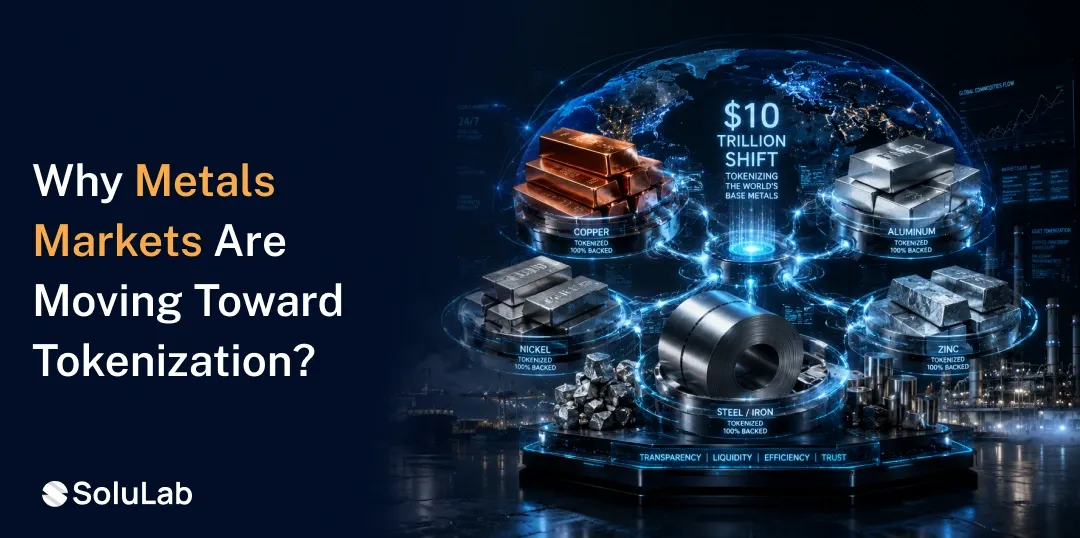
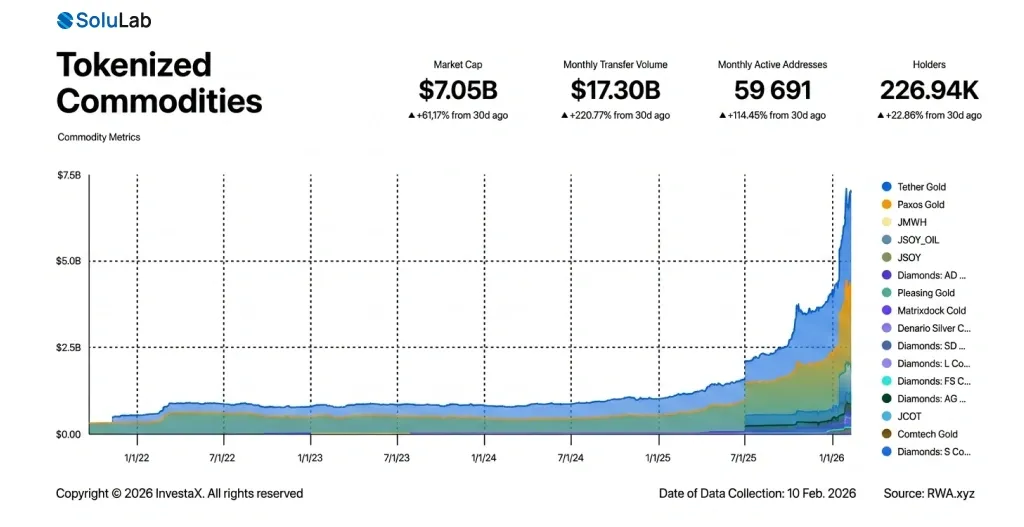
The tokenized commodity market crossed $6.1 billion in early 2026, with industrial metals becoming the fastest-growing category. While gold-backed assets like PAX Gold and Tether Gold still dominate market share, institutions are rapidly moving toward the tokenization of base metals such as copper, nickel, and aluminum.
Supply chain disruptions, rising energy demand, and EV manufacturing growth are pushing enterprises toward audited real-world asset tokenization development instead of speculative crypto exposure.
In his highly anticipated 2026 Annual Letter, BlackRock CEO Larry Fink declared:
“Tokenization is the mechanism for updating the plumbing of the global financial system… making investments easier to issue, easier to trade, and easier to access.”
His words powered base metal asset tokenization development, which now enables
- instant settlement,
- fractional ownership,
- compliant collateralization, and
- Transparent commodity trading across global industrial markets.
Why Base Metals Are the New Frontier for RWA Tokenization Development
Gold remains a strong store of value, but industrial metals generate economic activity across manufacturing, energy, and infrastructure markets.
Copper, nickel, and aluminum directly support EV production, battery manufacturing, transmission grids, and renewable energy systems. That practical utility is why tokenization of base metals is attracting institutional attention much faster in 2026.
- The demand outlook is also hard to ignore. Global copper demand is expected to nearly double by 2035. This is due to electrification and renewable infrastructure expansion, while nickel consumption continues rising across EV battery supply chains.
- Additionally, by breaking down physical inventory into fractional on-chain ownership units, any institutional buyer can gain exact exposure to $10,000 or $10,000,000 worth of copper or aluminum.
- This is without altering the physical storage architecture or incurring massive execution friction.
This is pushing enterprises toward tokenized base metals that offer faster liquidity access and transparent ownership verification.
1. Copper Tokenization Is Tied to the EV and Energy Economy
- Copper tokenization is becoming one of the strongest segments within commodity tokenization markets.
- Electric vehicles require almost four times more copper than traditional fuel-powered vehicles.
- Solar grids, charging stations, industrial motors, and smart transmission networks also depend heavily on copper-intensive infrastructure.
- This creates a long-term industrial demand cycle instead of short-term speculative pricing activity.
- Through base metals on blockchain infrastructure, enterprises can now gain direct exposure to copper inventory with real-time settlement and auditable custody tracking.
2. Nickel Tokenization and Aluminum Tokenization Are Expanding Rapidly
- Nickel tokenization is growing because battery-grade nickel remains essential for high-density EV battery manufacturing across the United States, Europe, China, and South Korea.
- At the same time, aluminum tokenization is gaining traction across aerospace, construction, automotive manufacturing, and low-carbon industrial supply chains.
- Many institutional investors now see tokenized raw materials as strategic industrial assets rather than volatile trading instruments.
- This is especially true as governments continue funding energy-transition infrastructure projects globally.
3. Why Traditional Commodity Tokenization Markets Still Create Entry Barriers
Despite the size of the industrial metals market, access remains concentrated among commodity exchanges, brokers, and large industrial buyers.
Traditional commodity participation still involves:
- High minimum lot sizes
- Delayed settlement cycles
- Heavy intermediary dependence
- Complex custody management
- Limited cross-border liquidity access
For example, traditional copper contracts often require multi-ton participation structures that remain inaccessible for smaller institutional buyers and accredited investors.
This is where asset tokenization creates practical value.
4. How Digital Tokenization of Base Metals Improves Market Access
Through digital tokenization of base metals, physical copper, nickel, or aluminum inventory can be divided into blockchain-based ownership units without changing the legal custody structure of the underlying asset.
This allows:
- Fractional ownership
- Faster global settlement
- Transparent inventory tracking
- Real-time collateral verification
- Lower capital entry requirements
- AI-powered RWA tokenization integrations.
As a result, hedge funds, family offices, corporate treasury teams, and smaller accredited investors can participate in industrial commodity ownership more efficiently.
Read more: How Tokenization Platform Development Helps Boutique Banks Unlock New Deals
5. Supply Chain Disruptions Are Driving Demand for Tokenized Commodities
Macroeconomic conditions are also accelerating the adoption of real-world asset tokenization trends.
The Strait of Hormuz supply disruptions, rising oil prices, and global shipping instability exposed major weaknesses in derivative-heavy commodity systems during 2025 and 2026.
Institutions increasingly prefer fully backed, metal-backed digital assets because they provide direct visibility into:
- Warehouse inventory
- Custody conditions
- Commodity grades
- Carbon footprint data
- Legal ownership records
This is pushing enterprises away from speculative exposure models and toward compliant, audited RWA tokenization of base metals infrastructure.
From Mine to Mainnet: The Lifecycle of a Base Metal Tokenization
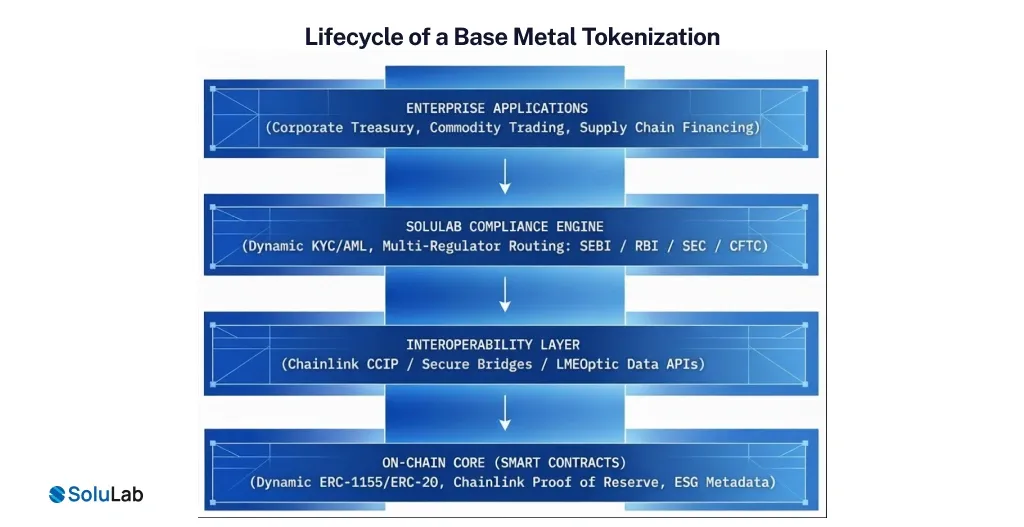
Base metal tokenization works differently from precious metal tokenization because industrial metals involve variable grades, certifications, purity levels, and carbon exposure metrics.
This requires a much deeper verification stack.
1. Sourcing and Digital Fingerprinting in Base Metal Asset Tokenization
The process begins at the refinery or approved industrial supplier.
Every batch of copper, nickel, or aluminum receives a digital commodity identity connected to:
- Purity grades
- Smelting origin
- Carbon footprint metrics
- Warehouse custody records
- Logistics data
- Regulatory certifications
Platforms increasingly integrate London Metal Exchange systems like LMEsword, LMEpassport, and LMEoptic to validate industrial inventory data.
LMEpassport now acts as a digital ESG registry layer for industrial commodities. This matters because low-carbon metals command pricing premiums across manufacturing supply chains.
2. Custody Infrastructure for Tokenized Base Metals
The physical inventory is then stored inside:
- LME-approved warehouses
- Bonded storage facilities
- Commodity vaults
- Institutional custody centers
At this stage, IoT sensors continuously track environmental conditions, inventory movement, and custody integrity.
This digital verification layer supports fully-backed metal-backed digital assets rather than synthetic price-tracking tokens.
That distinction matters significantly in 2026.
Markets are actively moving away from price-pegged commodity exposure and toward legal-title commodity ownership structures.
3. Minting Base Metals on Blockchain Networks
Once custody verification is complete, blockchain minting begins.
A 1:1 token representation of the physical inventory is issued across networks such as:
- Ethereum
- Polygon
- Avalanche
Most enterprise-grade systems utilize ERC-1155 or ERC-20 standard for smart contract architectures, depending on the asset structure and liquidity requirements.
The smart contracts integrate:
- Dynamic metadata updates
- Chainlink Proof of Reserve
- ESG verification records
- Jurisdiction-based compliance rules
- Custody synchronization APIs
This creates legally auditable asset-backed tokens tied directly to real inventory.
4. Trading and Fractional Ownership Through RWA Tokenization Platform for Metals
After minting, the tokenized raw materials become tradeable across approved marketplaces or institutional liquidity venues.
This is where liquidity efficiency improves dramatically.
- Traditional copper contracts may require 25-ton minimum participation sizes.
- Through base metal tokenization services, an investor can gain fractional exposure with significantly smaller capital commitments.
This model expands commodity market access while preserving institutional-grade custody and compliance standards.
How Base Metal Tokenization Solves the Liquidity and Entry-Barrier Crisis?
The traditional commodity market remains operationally slow. Settlement cycles still rely heavily on intermediaries, paperwork, clearing systems, and manual verification workflows.
Base metal tokenization platform infrastructure reduces these bottlenecks.
1. Fractional Commodity Ownership Through Tokenized Base Metals
Fractional ownership is one of the strongest commercial use cases for tokenized base metals.
- A corporate treasury desk may want limited copper exposure for hedging purposes without purchasing industrial-scale inventory.
- Similarly, smaller investment firms may want exposure to aluminum tokenization markets without maintaining warehouse contracts.
- Blockchain-based ownership units solve this efficiently.
Digital tokenization of base metals allows capital participation without forcing investors into operational commodity management.
2. Instant Settlement and Operational Efficiency
Traditional commodity settlements often follow T+2 or longer cycles.
With base metals on blockchain systems, settlement can happen almost instantly, depending on the network infrastructure and compliance layer.
This improves:
- Treasury liquidity
- Collateral mobility
- Cross-border settlement speed
- Trade execution efficiency
The impact becomes even larger for international commodity financing operations.
3. Collateralization and DeFi Integration
One of the most commercially interesting developments is collateralized lending using tokenized commodity-based metals.
- Enterprises can now use tokenized nickel inventory or tokenized copper reserves as collateral for stablecoin financing structures.
- This creates faster access to working capital without liquidating strategic commodity holdings.
As institutional DeFi frameworks mature, commodity-backed lending is expected to become a major part of industrial treasury management.
The “Green” Premium: Leveraging RWA Tokenization Development to Value ESG and Carbon Footprints
ESG reporting is no longer optional for industrial supply chains.
Manufacturers increasingly require proof that industrial metals originate from low-carbon mining and processing environments.
This is where carbon credit tokenization and commodity tokenization infrastructure begin intersecting.
1. ESG Metadata Inside Metal-Backed Digital Assets
Modern tokenized base metals no longer represent only ownership quantity.
They also store:
- Carbon intensity metrics
- Mining origin records
- Renewable energy usage data
- Smelting emissions profiles
- Supply chain audit trails
This creates digital twins of physical commodities.
A tokenized copper asset can now prove both ownership and environmental quality simultaneously.
That capability is becoming commercially valuable.
2. Green Copper and Low-Carbon Aluminum Premium Markets
- Low-carbon aluminum and green copper increasingly trade at premium pricing because manufacturers need ESG-compliant materials for reporting obligations.
- Blockchain verification reduces disputes around carbon accounting and prevents double-counting across supply chains.
- As a result, natural resource tokenization infrastructure is becoming deeply connected to ESG finance markets.
This also explains why carbon credit tokenization ecosystems are increasingly integrating with commodity custody platforms.
Regulatory Roadmap: Navigating Legal Titles in Base Metal Tokenization
Regulatory clarity changed dramatically during 2026.
Several jurisdictions now distinguish compliant real-world asset tokenization from speculative crypto trading activity.
That distinction is critical for banks and institutional custody providers.
1. India’s Asset Tokenisation Bill and SEBI-RBI Coordination
India’s proposed Asset Tokenisation framework establishes legal recognition for blockchain-based digital ownership rights tied to real assets.
Instead of creating an entirely separate regulator, the structure distributes oversight across existing authorities:
- The Securities and Exchange Board of India supervises security-linked tokenized assets
- Reserve Bank of India supervises payment-linked and stable-value systems
This creates a more workable regulatory environment for enterprise-grade asset tokenization services.
2. The US CLARITY Act and Commodity Classification
The United States has also introduced stronger regulatory segmentation through the CLARITY Act.
The framework separates:
- Digital commodities
- Investment contract assets
- Permitted payment stablecoins
This classification structure matters because tokenized commodities, base metals, can now operate with clearer compliance expectations under commodity-focused oversight structures.
Banks also gained more flexibility after the removal of restrictive digital asset custody accounting treatment.
Institutional participation is now increasing much faster.
3. The London Metal Exchange and Blockchain Registry Integration
The London Metal Exchange continues modernizing its digital infrastructure through systems like:
- LMEsword
- LMEpassport
- LMEoptic
These tools improve inventory visibility, ESG reporting, and warehouse tracking.
Many enterprise platforms now integrate these systems directly into their tokenization platform development architecture.
This creates stronger interoperability between traditional commodity exchanges and blockchain-based settlement infrastructure.
Read more: Top Asset Tokenization Companies in the USA
Conclusion
The rewiring of the $10 trillion global base metals market is well underway.
Driven by geopolitical instability and ongoing supply-chain bottlenecks, enterprises are rapidly moving toward fully backed, on-chain industrial metals.
At the same time, strict corporate ESG mandates are pushing commodity markets toward transparent and auditable infrastructure, making tokenized industrial assets a long-term upgrade to global financial systems.
So, now is the high time for you to partner with a #1 tokenization platform development company to replace
- outdated paper warrants with automated,
- transparent smart contracts,
- Unlock high-velocity collateralization.
Tokenization democratizes market access and drives liquidity.
With SoluLab by your side, you can win the base tokenization market with ease. Contact us today!
FAQs
Deepika is a content writer who blends storytelling with strategic thinking. She explores topics across digital innovation, emerging tech, and the evolving blockchain industry. She enjoys breaking down complex ideas into simple, engaging narratives in the growing global markets.