Key Takeaways
- Move from T+5 to T-Zero by leveraging atomic swaps within your platform architecture.
- Integrate IoT and Oracles to provide immutable Proof of Reserves for minerals, energy, and metals.
- Balance institutional privacy with public market liquidity using permissioned subnets.
Commodity markets still run on settlement cycles that were built for paperwork, intermediaries, and delayed trust. For resource enterprises, this creates a structural problem: value exists in the ground, in transit, or in storage, but cash remains locked until clearing is complete.
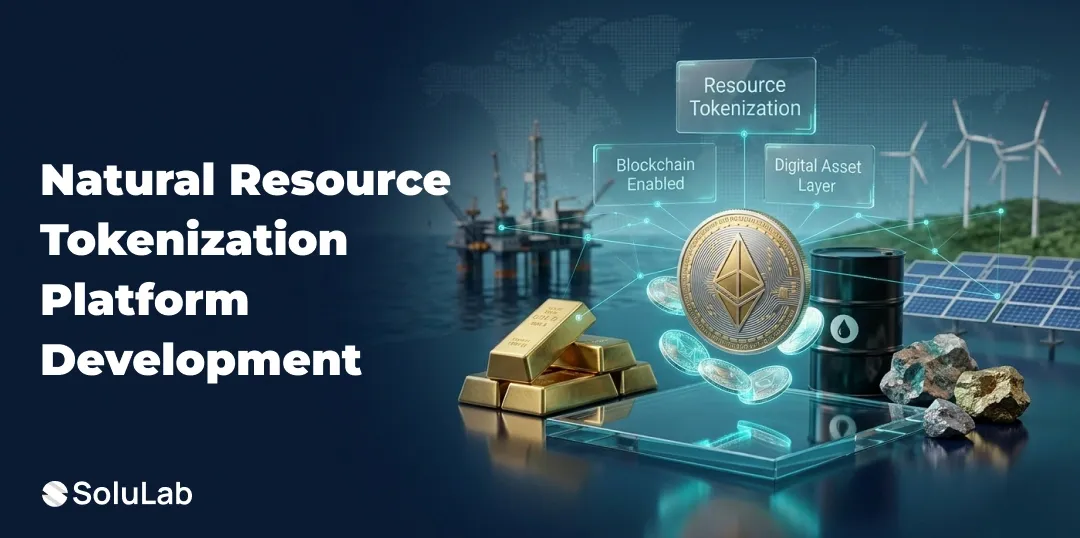
That is why natural resource tokenization platform development is becoming a serious infrastructure decision in 2026.
Mining companies, renewable energy operators, agricultural exporters, and metals traders are under pressure to improve liquidity without increasing balance sheet risk.
- Traditional systems make that difficult. Inventory often sits idle for 30 to 90 days. Cross-border trades get delayed by fragmented KYC processes. Quarterly audits leave room for fraud and reporting gaps.
Therefore, the solution lies in
- move from T+5 settlement to near-instant settlement,
- unlock capital tied in inventory and clearing buffers,
- create real-time reserve transparency,
- automate cross-border compliance,
- access private and public liquidity pools.
For enterprises planning long-term resource infrastructure, tokenization is now less about experimentation and more about execution.

How do Natural Resource Tokenization Platform Solutions eliminate the T+5 settlement delay for global commodities?
Traditional commodity trades are capital inefficient by design. Ownership transfer, payment settlement, broker verification, and clearinghouse reconciliation often take several business days.
That delay may look manageable on paper, but for enterprises moving large volumes, it creates massive hidden costs.
1. The hidden cost of trapped commodity capital
When a mining operator ships copper, lithium, or iron ore, value is already created. But the enterprise cannot fully deploy that value until:
- counterparties confirm delivery,
- settlement clears,
- banks release funds.
This creates trapped capital in:
- warehouse inventory,
- shipments in transit,
- clearinghouse buffers.
For a mid-sized mining company moving $500 million annually, delayed settlement can create a 12% to 18% cost-of-carry burden. In real terms, that can leave more than $60 million sitting idle instead of being used for expansion, equipment, or debt optimization.
This is one of the biggest reasons enterprises are investing in tokenization of natural resources.
2. How T-Zero settlement works in tokenized resource platforms
A modern commodity tokenization platform replaces fragmented handoffs with atomic settlement.
In simple terms, delivery and payment happen at the same time.
The architecture typically includes:
2.1 ERC-3643 based smart contracts
ERC-3643 enables identity-aware token transfers. This allows:
- permissioned investor access,
- transfer restrictions,
- compliance controls.
It is ideal for enterprise-grade resource assets because ownership is programmable and regulated.
2.2 Delivery versus Payment logic
DvP smart contracts ensure:
- Buyer funds are verified first,
- Seller tokens remain in escrow,
- Ownership transfers only after payment clears.
This removes settlement uncertainty.
2.3 MiCA-compliant stable settlement rails
Using regulated digital payment rails such as:
- tokenized bank deposits,
- compliant stablecoins,
helps enterprises settle 24/7 without relying on traditional banking windows.
3. Why instant settlement matters commercially
Enterprises using the RWA tokenization platform development strategies benefit from:
- faster working capital cycles,
- reduced financing costs,
- better supplier payment flexibility,
- Improved treasury forecasting.
Unlike legacy exchanges such as LME or COMEX, tokenized platforms also support weekend and after-hours liquidity movement. That matters in volatile markets like rare earth minerals and energy assets, where price swings can change quickly.
How does the Natural Resource Tokenization Platform automate cross-border regulatory alignment?
Cross-border resource trading is slow because compliance is still manual in most enterprise environments.
Legal teams often need to:
- verify investor jurisdiction,
- review ownership structures,
- validate sanctions exposure,
- process KYT reports.
This adds friction to every transaction.
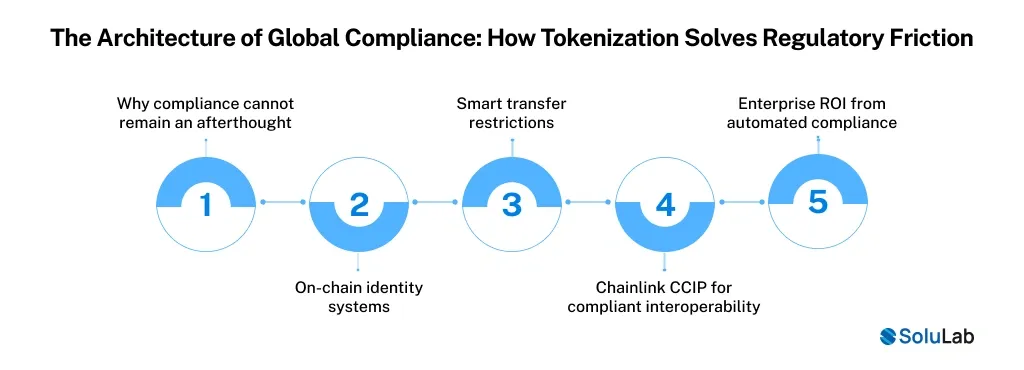
1. Why compliance cannot remain an afterthought
A scalable natural resource tokenization platform development company approach must embed compliance into infrastructure.
In 2026, enterprise buyers want platforms that enforce rules automatically instead of depending on manual checks.
2. On-chain identity systems
Identity frameworks like ONCHAINID help create digital regulatory passports for participants.
This enables the platform to verify:
- geography,
- accreditation,
- transaction eligibility.
If a buyer does not meet jurisdiction rules, the transaction fails before execution.
3. Smart transfer restrictions
Compliance rules can be coded to:
- block sanctioned wallets,
- restrict country-specific access,
- limit transfer size,
- enforce lock-in periods.
This is critical for sectors like metals, diamonds, and energy.
4. Chainlink CCIP for compliant interoperability
Cross-chain interoperability matters when enterprises need:
- private trading for institutional buyers,
- public access for secondary liquidity.
Chainlink CCIP helps ensure that when a token moves between chains, its compliance logic moves with it.
5. Enterprise ROI from automated compliance
For businesses offering natural resource tokenization services, compliance automation delivers measurable value:
- up to 65% lower legal and reporting overhead,
- faster deal closures,
- fewer compliance bottlenecks,
- stronger institutional trust.
For cross-border commodities, compliance-as-code is no longer optional.
How can natural resource tokenization services ensure 100% transparency between mines and digital ledgers?
One of the biggest risks in resource markets is trust failure.
Buyers often depend on:
- delayed audit reports,
- third-party warehouse statements,
- manual stock reconciliation.
This creates exposure to over-issuance, fraud, and reporting gaps.
1. Why quarterly audits no longer work
In legacy markets, physical inventory and ownership records are often disconnected.
This causes:
- double counting,
- hidden shortages,
- audit delays,
- inflated collateral claims.
That is why modern Tokenizing Nature-Based Assets platforms are shifting to live reserve verification.
2. Hardware integration at source
At mines, warehouses, and energy sites, enterprises can install:
- industrial flow meters,
- digital scales,
- RFID inventory scanners,
- edge sensors.
These devices continuously capture:
- extraction volumes,
- shipment weights,
- storage levels.
3. Decentralized Oracle Networks
The physical data is pushed securely to the blockchain technology through the oracle infrastructure.
This creates:
- timestamped production logs,
- tamper-resistant inventory proof,
- live asset verification.
4. Digital twins for physical resources
Each resource lot can be mapped to a digital twin.
Examples include:
- 1,000 tons of copper ore,
- solar production certificates,
- carbon credit lots,
- agricultural commodity batches.
If physical reserves drop without an on-chain transaction:
- alerts are triggered,
- a circuit breaker can pause trading,
- administrators can investigate instantly.
Forward-thinking giants like BASF Agricultural Solutions are proving that the value of a farm isn’t just in the harvest, but in the data. By 2026, the industry will have shifted toward tokenizing regenerative agriculture data.
This can reduce audit costs by up to 70%, lower fraud-related financing premiums, and improve lender and investor confidence through always-on trust.
Customizing Natural Resource Tokenization Platform Solutions for permissioned and public interoperability
Enterprises want privacy. Markets want liquidity. The challenge is balancing both. What integrations can bring this to you, let’s see…
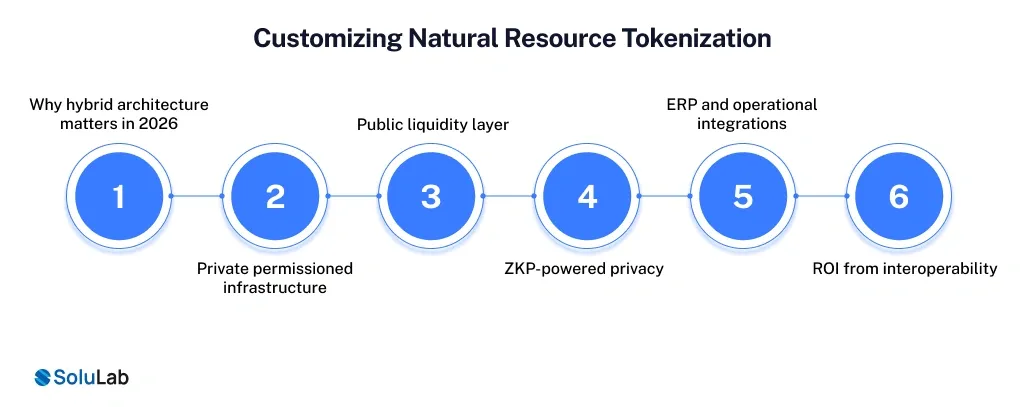
1. Why hybrid architecture matters in 2026
A strong asset tokenization platform development strategy should support:
- private operational control,
- public liquidity access.
This avoids isolated ecosystems that limit market participation.
2. Private permissioned infrastructure
Sensitive enterprise data should stay protected.
This includes:
- NAV calculations,
- contract terms,
- institutional identities,
- treasury data.
Platforms often use:
- Avalanche Subnets,
- Polygon Supernets.
This gives enterprises:
- governance control,
- privacy,
- performance.
3. Public liquidity layer
Wrapped versions of non-sensitive assets can be bridged to public chains.
For example:
- Solana for high-speed secondary trading,
- DeFi liquidity pools for collateral use.
This expands:
- investor participation,
- asset price discovery,
- secondary volume.
4. ZKP-powered privacy
Zero-knowledge proofs help platforms prove:
- compliance status,
- reserve sufficiency,
- trade validity,
without revealing:
- total treasury exposure,
- institutional wallet balances.
5. ERP and operational integrations
Any enterprise planning to build natural resource tokenization platform infrastructure should connect token workflows with internal systems.
This includes:
- SAP,
- Oracle ERP,
- logistics systems,
- treasury platforms.
Event-driven architecture ensures:
- token trades update ERP ledgers,
- warehouse movements sync instantly,
- finance teams avoid reconciliation gaps.
6. ROI from interoperability
Platforms that bridge private systems with public liquidity pools are seeing up to 4.5x higher daily trading volume compared to isolated private chains.
| Resource Sector | The “Isolated” Problem | Interoperable Solution (2026) | Performance Uplift (ROI) |
| Rare Earth Minerals | High-value stock (Lithium/Neodymium) locked in private trade portals; 48-hour bid/ask lag. | CCIP-Enabled Subnets: Connects private supply chain data to global DeFi collateral pools for instant borrowing. | 4.5x Liquidity Depth: Instant access to 24/7 global secondary markets. |
| Solar Energy Assets | PPA (Power Purchase Agreement) revenue is “invisible” to external retail or institutional investors. | Cross-Chain Yield Aggregators: Streams real-time solar dividends from a private ledger to public L1s like Solana/Ethereum. | 3.2x Capital Inflow: Fractionalizing entry points from $1M to $10. |
| Agricultural Assets | “Paper-based” silo data creates a 15% valuation discount due to audit uncertainty. | IoT-to-Public Ledger Sync: Uses decentralized oracles to push “Proof of Grain” metadata to public transparency dashboards. | 22% Margin Recovery: Eliminates the “risk premium” usually charged by commodity lenders. |
This allows your platform to settle a copper or solar trade in tokenized USD rather than volatile crypto tokens, providing the “Institutional Safety” that C-suite executives demand.
Why Natural Resource Tokenization Is Becoming a Strategic Enterprise Advantage
The shift is already underway. By 2026, tokenization will move from pilot projects to operating infrastructure.
1. Industrial metals and copper
AI infrastructure demand has increased pressure on the supply of copper tokens.
Tokenized pre-purchase models now help:
- lock future supply,
- reduce procurement risk,
- improve hedging.
Recent market examples have already shown fast institutional traction in tokenized metals.
2. UAE and regulated resource markets
Dubai’s updated 2026 virtual asset guidelines have made regulated resource tokenization more viable.
For enterprises, this means:
- stronger reserve trust,
- clearer legal frameworks,
- easier sovereign onboarding.
3. Banking-led settlement rails
Banks are now supporting tokenized settlement infrastructure.
This improves:
- 24/7 treasury operations,
- institutional settlement confidence,
- regulated payment rails.
4. Additional monetization opportunities
Beyond ownership transfer, enterprises can use tokenized assets for:
- supply chain financing,
- collateralized lending,
- yield opportunities while inventory is held.
This creates a stronger return profile for the tokenization of existing physical assets.

Conclusion
As you can analyse, the modern end-to-end tokenization platform development helps enterprises reduce costs and improve efficiency. To avail this faster, you can partner with a tokenization platform development company like SoluLab.
A well-built platform helps enterprises:
- settle faster,
- unlock trapped liquidity,
- automate compliance,
- improve reserve transparency,
- expand into new markets.
If you’re planning to modernize operations through asset tokenization services, connect with SoluLab to explore the right architecture for your business goals.
FAQs
Deepika is a content writer who blends storytelling with strategic thinking. She explores topics across digital innovation, emerging tech, and the evolving blockchain industry. She enjoys breaking down complex ideas into simple, engaging narratives in the growing global markets.