
Key Takeaways
- Multimodal AI applications combine text, images, audio, video and structured data in a single system, because most real business problems arrive in more than one format.
- The strongest use cases are where a decision genuinely needs two or more modalities. Adding images to a text problem for the sake of it just raises cost.
- Healthcare leads on imaging plus clinical notes, retail on visual search and shelf monitoring, finance on document and identity verification.
- Alignment is the hard part. Getting the model to connect the right paragraph to the right region of an image is where most projects struggle.
- Evaluation is harder than with text alone, because a wrong answer can come from any modality or from the fusion between them.
- Inference costs more. Images and video carry far more tokens than text, and that shows up on the bill at scale.
- Start with two modalities and one decision. Systems that accept everything from the outset rarely reach production.
Most business problems do not arrive as clean text. A claims adjuster looks at photos and a policy document. A radiologist reads a scan alongside a patient history. A shopper describes what they want and uploads a picture of something similar.
Multimodal AI applications handle those inputs together, reasoning across formats rather than processing each one separately.
Gartner predicts that 40% of generative AI solutions will be multimodal by 2027, up from just 1% in 2023.
The capability is no longer the constraint. Knowing where it earns its cost is. This guide covers what multimodal systems actually do, where they are working today in healthcare, retail, and finance, what building one involves, and the costs and limits worth knowing before you commit a budget to it.

What Are Multimodal AI Applications?
Multimodal AI applications are systems that take in and reason across more than one type of data at once, such as text with images, audio with transcripts, or video with sensor readings, and produce a single coherent output.
1. What Counts as a Modality
Text, images, audio, video, structured tabular data, time series from sensors, and increasingly 3D and geospatial data. A system reading a PDF containing both paragraphs and charts is already working across modalities, even if nobody labelled it that way.
2. Multimodal Input Versus Multimodal Output
Most business applications take multiple inputs and return text or a structured decision. Generating images or video as output is a different and usually less commercially urgent problem. Knowing which side you need changes the architecture considerably.
3. How It Differs From Running Separate Models
You could run an image classifier, a speech-to-text model and a text model, then stitch the results together. Multimodal systems reason across the inputs jointly, which matters when the meaning sits in the relationship between them. The underlying architectures are covered in our guide to multimodal models.
How Do Multimodal AI Applications Work?
They work by converting each input into a shared representation, aligning those representations, then reasoning over the combined picture. Alignment is the part that decides whether the system is useful.
1. Encoding Each Modality
Every input type gets converted into vectors by a specialised encoder. A vision encoder handles images, an audio encoder handles speech, a text encoder handles language. Large-scale image understanding leans on large vision models trained for exactly this job.
2. Aligning the Representations
The model learns which parts of one modality correspond to which parts of another: this phrase describes that region of the image, this spoken sentence matches that moment in the video. Poor alignment produces confident answers about the wrong thing.
3. Fusion and Reasoning
The aligned representations are combined, either early in the pipeline, late at the decision stage, or somewhere in between. The choice affects accuracy, cost and how easily you can explain the output, and it should be a deliberate decision rather than a default.
4. Grounding in Your Own Data
General models know general things. Connecting them to your product catalogue, clinical guidelines or policy documents requires retrieval, which is why a RAG platform usually sits underneath any serious enterprise deployment.
5. Output and Action
The result is a classification, an extraction, a summary or a triggered workflow. Structured output matters more than fluent prose in most business contexts, because something downstream has to consume it.
7 Multimodal AI Applications Across Industries
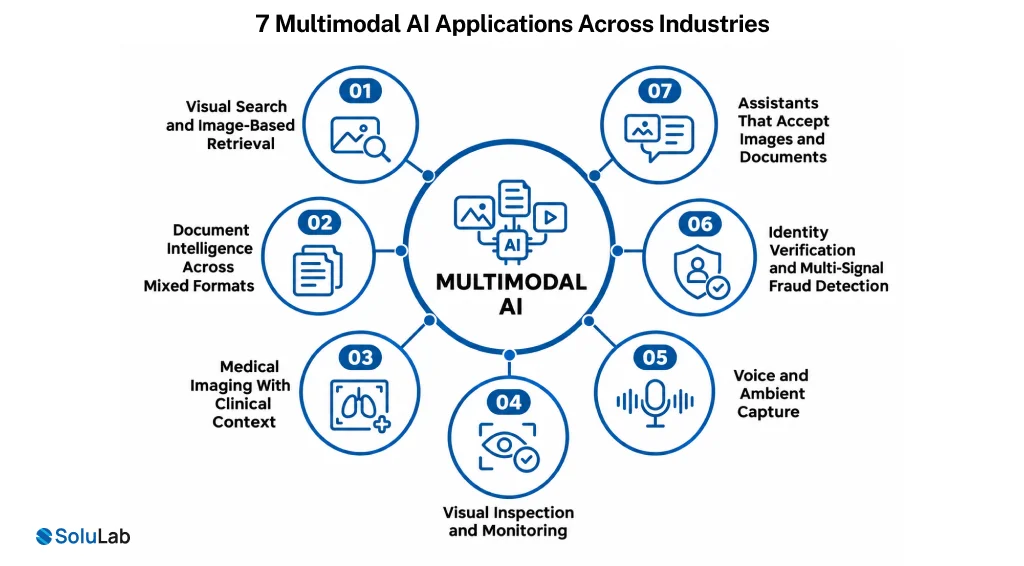
Seven applications account for most production deployments today. Each one combines at least two input types, and each is already running in more than one sector.
1. Visual Search and Image-Based Retrieval
A shopper photographs a jacket, an engineer photographs a worn bearing, an estate agent uploads a room. The system returns matching or similar items from a catalogue. This removes the vocabulary problem that breaks keyword search, and it works wherever people recognise what they want faster than they can describe it. Retail and e-commerce lead here, with industrial spare parts and property close behind, and the patterns are covered further in AI agents in retail and e-commerce.
2. Document Intelligence Across Mixed Formats
Most business documents are half text and half image: scanned invoices, insurance claims, identity documents, loan files, lab reports. Models read the layout, the tables, the stamps and the handwriting together, then output structured data. Finance uses it for onboarding, insurance for claims, healthcare for records intake. This is intelligent document processing applied where a text-only model would miss half the page.
3. Medical Imaging With Clinical Context
Combining a scan with patient history, prior imaging and lab values produces a far more useful read than the image alone, because a finding that is unremarkable in one patient is urgent in another. The FDA’s register of AI-enabled medical devices reached 1,524 authorisations through the first quarter of 2026, with radiology accounting for roughly 76% of them. Related workflow applications sit in AI agents in healthcare.
4. Visual Inspection and Monitoring
Cameras plus sensor data plus maintenance history, assessed together. Manufacturing uses it for defect detection with probable cause attached, retail for shelf and planogram compliance, logistics for damage documentation at handover, construction for site progress. The common factor is that a photograph alone tells you something is wrong but not why.
5. Voice and Ambient Capture
Audio transcribed and structured in context, rather than dumped as a transcript. Clinicians get a drafted note separating history from examination from plan. Contact centres get a summary with sentiment and next action. Field technicians describe a fault aloud and receive the relevant procedure. Latency matters in the last case, which often pushes inference toward edge AI development.
6. Identity Verification and Multi-Signal Fraud Detection
Matching a selfie or short video against an identity document, with liveness checks, then scoring the result alongside transaction patterns, device data and behavioural signals. Fraud rarely shows in one channel alone, which is precisely why combining them works. Banking, fintech, gig platforms and travel all run this, and comparable approaches appear in AI for fraud detection in fintech.
7. Assistants That Accept Images and Documents
Conversational systems where the user can show as well as tell. A customer photographs damage and describes what happened, and the system assesses severity against the policy wording. A shopper uploads a picture and asks for something similar in a different colour. A technician shares a photo mid-job. Insurance first notice of loss and retail support are the clearest commercial uses, with wider context in AI in banking.
Top Multimodal AI Models to Know
The model layer moves quickly, so pick by capability rather than brand. Four families cover almost every enterprise requirement, and most teams end up using more than one.
1. Frontier Commercial Models
The large general-purpose models from the major labs now accept images, documents and audio alongside text, with strong reasoning across them. They are the fastest route to a working prototype and usually the right starting point unless data residency rules out an external API.
2. Open-Weight Vision-Language Models
Open models have closed much of the gap on document understanding and image captioning. They matter when data cannot leave your environment, when inference cost at volume is the binding constraint, or when you need to fine-tune on imagery unlike anything in general training data.
3. Specialist Vision and Speech Encoders
Dedicated models for detection, segmentation, optical character recognition and speech remain more accurate and far cheaper than a general model for narrow tasks. A production system often pairs a specialist encoder with a general model for reasoning. The underlying architectures are covered in our guide to multimodal models.
4. Domain-Tuned Models
Models adapted for medical imaging, industrial inspection, satellite imagery or legal documents. Worth the cost when your inputs look nothing like internet images, which is common in clinical and industrial settings. Large-scale image understanding in these domains builds on the same vision architectures described earlier.
How Do You Build a Multimodal AI Application?
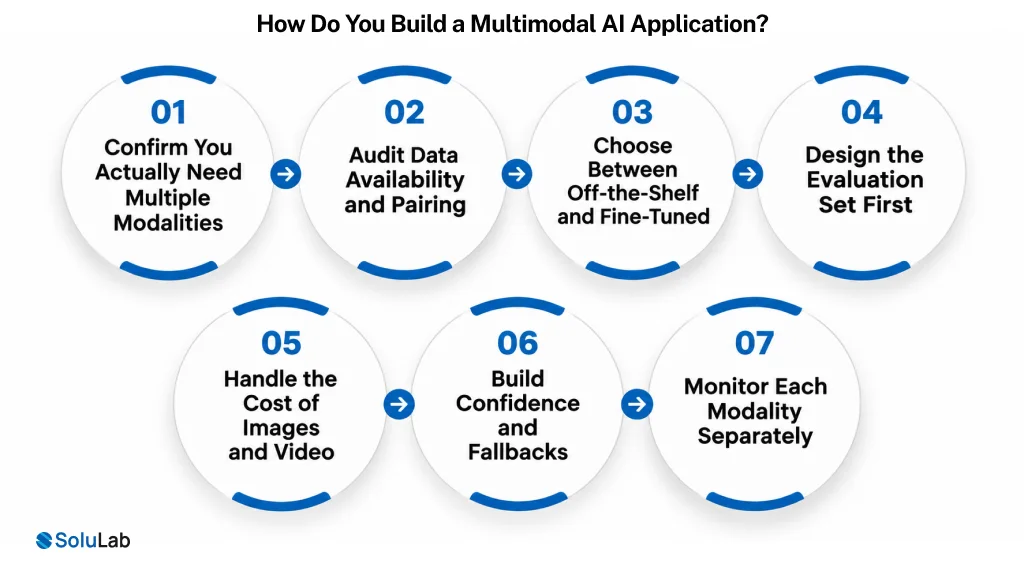
Building multimodal is mostly a data and evaluation problem. The models are largely available; getting your own data into a usable, aligned state is where the work sits.
1. Confirm You Actually Need Multiple Modalities
The first question is whether the decision genuinely requires more than one input type. If text alone answers it, adding images multiplies cost and complexity for nothing. Text-only language models already handle a surprising amount of what people assume needs vision.
2. Audit Data Availability and Pairing
You need examples where the modalities appear together and relate to each other, not separate archives of images and documents. Paired data is far rarer than teams expect, and discovering that in month three is expensive.
3. Choose Between Off-the-Shelf and Fine-Tuned
Commercial multimodal APIs handle a surprising amount of general work. Fine-tuning or training earns its cost when your images, documents or audio are unlike anything in the general training data, which is common in industrial and clinical settings.
4. Design the Evaluation Set First
Assemble real examples with known correct answers, covering the awkward cases: poor lighting, low-resolution scans, accented speech, unusual document layouts. Evaluation is harder here because failure can originate in any modality or in the fusion between them.
5. Handle the Cost of Images and Video
Visual inputs consume far more tokens than text. Resizing, sampling video frames rather than processing every one, and caching repeated inputs are the practical levers. Model this before launch rather than after the first invoice.
6. Build Confidence and Fallbacks
Define what happens when the model is unsure or one input is missing or unreadable. Degrading gracefully to a single modality, or to a human, is a design decision worth making explicitly.
7. Monitor Each Modality Separately
Performance can decay in one input stream while the others hold, such as a new camera model changing image characteristics. Track accuracy per modality, following normal MLOps practice extended across input types.
What Are the Limits, Costs and Risks?
The technology works. Most disappointments come from cost, evaluation and data-pairing problems that were foreseeable at the scoping stage.
1. The Pilot-to-Production Gap
Deloitte’s State of AI in the Enterprise research found only about 25% of organisations had moved 40% or more of their AI experiments into production. Multimodal projects fail at that step for the same reasons others do, with integration and evaluation the usual culprits.
2. Inference Cost at Scale
A single high-resolution image can cost more than a long document to process. Video multiplies that again. Applications that look affordable in a pilot can become uneconomic at production volume, so model the unit cost early.
3. Alignment and Hallucination Across Modalities
The model may describe something that is not in the image, or connect a caption to the wrong region. These errors are harder to spot than text hallucinations because they sound specific and plausible.
4. Bias in Visual and Audio Data
Image models perform differently across skin tones, lighting and camera types. Speech models perform differently across accents. Test across subgroups before launch and monitor afterwards, particularly in healthcare and identity verification.
5. Privacy in Images, Video and Voice
Visual and audio data carry biometric and incidental-capture risk that text does not. Consent, retention limits and redaction belong in the design, and in several jurisdictions this is a legal requirement rather than good practice.
6. Explainability Is Harder
Explaining why a system concluded an image plus a document is considerably harder than explaining a text-only decision. In regulated contexts, this limits what you can deploy, regardless of accuracy.
What Is the Future of Multimodal AI?
Four shifts are worth tracking, and most point toward cheaper inference and tighter integration rather than dramatically new capability.
1. Video Becomes Affordable
Video is the most information-dense input and the most expensive to process. As inference costs fall and models get better at sampling intelligently rather than frame by frame, continuous video understanding moves from pilot to production.
2. Real-Time and On-Device Processing
More capable chips mean perception runs where the data is created rather than in a data centre. That reduces latency, cuts data movement, and sidesteps a good deal of privacy exposure at the same time.
3. Agents That See and Act
Multimodal perception combined with tool access, so a system can read a screen, a document or a camera feed and then do something about it. This raises the permission and audit questions that any agent deployment carries.
4. Evaluation Standards Catch Up
Benchmarking multimodal systems is still immature compared with text. Expect better shared evaluation methods, which will make vendor claims considerably easier to check than they are today.
How Can SoluLab Help With Multimodal AI?
We build multimodal systems end to end, and most of our work sits in the parts teams underestimate: data pairing, evaluation and production cost.
1. Use Case Assessment
Working out whether your problem genuinely needs more than one modality, and what it will cost to run at real volume before anyone writes code.
2. Data Preparation and Annotation
Assembling and labelling paired datasets where images, documents and text relate to each other, which is almost always the longest phase.
3. Model Selection and Fine-Tuning
Benchmarking frontier, open and specialist models against your own evaluation set, then tuning where your inputs differ from general training data.
4. Production Engineering and Integration
Building the pipeline, connecting it to your existing systems, and keeping unit economics viable at volume through AI integration services.
5. Monitoring and Ongoing Support
Tracking accuracy per modality after launch, since performance can decay in one input stream while the others hold steady.

Conclusion
Multimodal AI applications earn their complexity when a decision genuinely needs more than one kind of input. A scan read alongside a patient history, a damage photo assessed against a policy, a product found from a picture rather than a description. In each case, the value sits in the relationship between the inputs rather than in any one of them.
The practical advice is narrow. Confirm the decision really needs two modalities, check you have paired data rather than separate archives, build the evaluation set before the model, and model inference cost at production volume rather than pilot volume. Most failures trace back to skipping one of those four.
SoluLab, an AI development company, can help your business work out whether multimodal is genuinely required, assemble and evaluate the data, and build applications that hold up at production cost and volume.
FAQs
Neha is a curious content writer with a knack for breaking down complex technologies into meaningful, reader-friendly insights. With experience in blockchain, digital assets, and enterprise tech, she focuses on creating content that informs, connects, and supports strategic decision-making.