
Key Takeaways
- AI in investing supports research, signal generation, portfolio construction, execution, risk and client service, rather than replacing the investment decision.
- The clearest wins are in research and operations, where AI reads documents and reconciles data far faster than analysts can.
- Markets are adversarial and non-stationary. A model that worked last cycle can fail in the next one, which is unlike most AI use cases.
- Explainability is a regulatory requirement, not a nice-to-have. Firms must be able to justify recommendations to clients and supervisors.
- Overstating AI capability has become an enforcement risk. Regulators have acted against firms exaggerating their use of AI.
- Data quality and survivorship bias in backtests destroy more strategies than model architecture ever will.
- Start with an internal, non-client-facing use case and prove it before anything touches a portfolio.
Ask most investment professionals where their time actually goes. The answer is reading. Filings, transcripts, broker notes, fund documents and market commentary pile up faster than any team can work through them. AI in investing attacks that problem first, then moves outward into signal generation, portfolio construction, execution, risk monitoring and client reporting.
The scale makes small gains worth having. Statista projects assets under management in the global wealth management market to reach US$158.67 trillion in 2026, growing at 6.50% a year to US$217.44 trillion by 2031. Against numbers like that, a few hours saved per analyst each week compounds into something material.
What follows covers where AI genuinely works across the investment lifecycle, which use cases are safest to start with, what building one involves in a regulated environment, and where the real limits sit.

What Is AI in Investing?
AI in investing applies machine learning, natural language processing and generative models to investment research, decision support, execution, and client service. It augments professional judgement and operates inside existing regulatory obligations.
1. What AI Actually Does Here
Models read, summarise, classify, forecast and optimise across far more material than a team can cover. They do not form investment views on their own, and in regulated contexts a named human stays accountable for the recommendation or the trade that follows.
2. How It Differs From Traditional Quant
Quantitative investing has used statistical models for decades, so the mathematics is not new. What changed is unstructured data: language models can now process text, audio and images that were previously unusable at scale, which widens the input set considerably.
3. Where It Sits in the Stack
AI usually augments existing systems rather than replacing them, layering onto the order management, portfolio accounting and CRM platforms firms already run. Integration quality decides whether anyone uses it. Far more than model choice does.
Why Are Investment Firms Adopting AI Now?
Three pressures converge here: information volume far beyond human capacity, margin compression from passive competition, and client service expectations now set by consumer technology rather than by financial services firms.
1. Information Volume Has Outgrown Analyst Capacity
Filings, transcripts, news, alternative data and broker research arrive faster than any team can read them, and the volume grows every quarter. Coverage is the constraint here, not analytical intelligence. That gap is exactly what machines close well.
2. Fee Compression Demands Operating Efficiency
Passive products have pushed fees down across the industry, leaving less room to absorb manual process costs. Firms now serve more clients per adviser without letting service quality slip. That arithmetic only works with automation behind it.
3. Clients Expect Personalised Digital Service
Investors compare their portal to the consumer apps on their phone, not to other brokers. Generic quarterly statements no longer clear that bar, which is driving demand for personalised reporting and faster answers across AI in wealth management.
4. Automated Advice Keeps Growing
Grand View Research values the global robo advisory market at $8.47 billion in 2024, projecting $41.83 billion by 2030 at a 30.5% compound annual growth rate. Hybrid advice models are expanding fastest. Younger investors lead that shift.
What Are the Benefits of AI in Investing?
The benefits here are mostly about coverage, speed and consistency of process rather than better returns, since no technology can credibly promise performance in adversarial and constantly changing markets.
1. Wider Research Coverage
Models process far more documents and data sources than a research team can reach, then surface only what deserves human attention. More names get covered per analyst. Changes in disclosure language surface earlier too.
2. Faster Decision Support
Analysts receive structured context before a meeting rather than assembling it afterwards, which shortens the path from information to decision. Briefing packs, peer comparisons and sourced answers arrive in minutes. Not days.
3. More Consistent Process
A model applies the same screening criteria every time, which reduces variation between analysts and across market conditions. Fewer decisions get shaped by fatigue or workload. The reasoning behind each screen stays auditable.
4. Better Risk Monitoring
Continuous scanning of exposures, concentrations and correlations catches the drift that periodic review misses entirely. Limit breaches surface immediately and correlation shifts get flagged earlier. Stress scenarios run far more often than a quarterly cycle allows.
5. Lower Cost to Serve
Automating reporting, reconciliation and routine client questions reduces the cost of serving each account. That matters most in smaller segments. Accounts previously uneconomic to serve properly can become viable again.
6. Stronger Compliance Coverage
Transaction monitoring, suitability checks and communications surveillance run across the full population rather than on samples. Suspicious patterns surface sooner and evidence trails build automatically, following patterns also seen in AI for fraud detection in fintech.
What Are the Main Use Cases of AI in Investing?
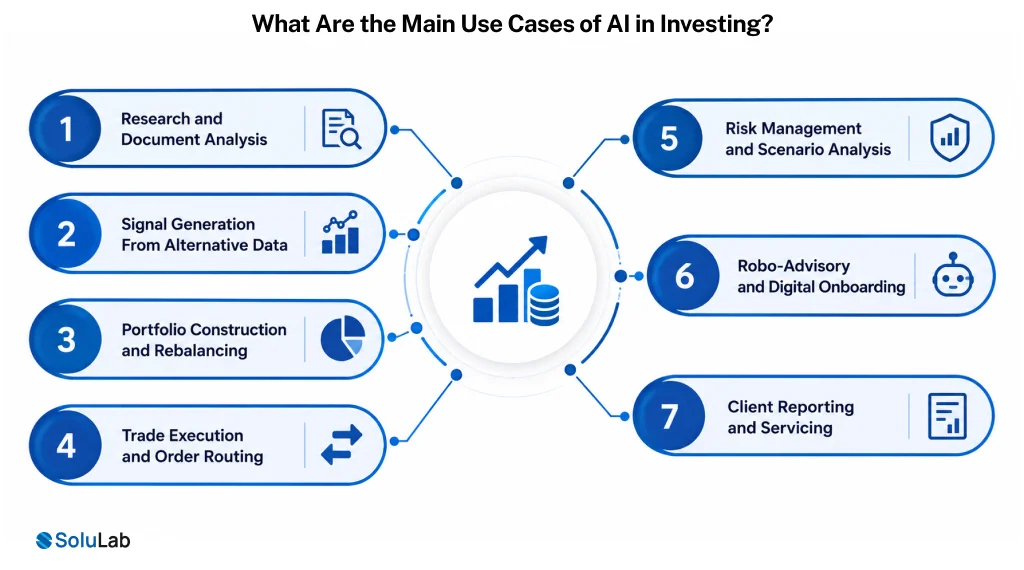
Seven use cases span the full investment lifecycle, running from research through portfolio construction and execution to client service. Most firms start upstream, where mistakes are cheapest to catch.
1. Research and Document Analysis
Summarising filings, transcripts and broker notes, extracting figures, and flagging where disclosure language has shifted between periods. This is the safest starting point and the most widely adopted, because it informs professionals rather than advising clients directly.
2. Signal Generation From Alternative Data
Deriving indicators from satellite imagery, card spending, web traffic, job postings and sentiment data. Powerful, and the most prone to overfitting on this list. Signals decay as adoption spreads. Treat early results sceptically.
3. Portfolio Construction and Rebalancing
Optimising allocations against stated objectives, constraints and tax considerations, then proposing rebalances as positions drift from target weights. The techniques and trade-offs are covered in depth in AI in portfolio management.
4. Trade Execution and Order Routing
Predicting market impact, slicing orders across time windows and selecting venues to reduce slippage. This is established territory rather than frontier work, and it is explored further in algorithmic trading bots and AI in stock trading.
5. Risk Management and Scenario Analysis
Modelling exposures, running stress tests and detecting correlation regime changes faster than scheduled review cycles allow. Concentration risk gets flagged close to real time. Scenario libraries expand without anyone maintaining them by hand.
6. Robo-Advisory and Digital Onboarding
Automated goal-based portfolios with risk profiling, digital onboarding and ongoing rebalancing, built from questionnaire responses. Most now run as hybrid models. Automation handles routine management while human advisers take the complex planning and life events.
7. Client Reporting and Servicing
Generating personalised commentary for each portfolio, answering routine account questions and preparing review meeting packs before an adviser sits down. Related agent patterns sit in AI agents for finance.
How Do You Build an AI Investing Platform?
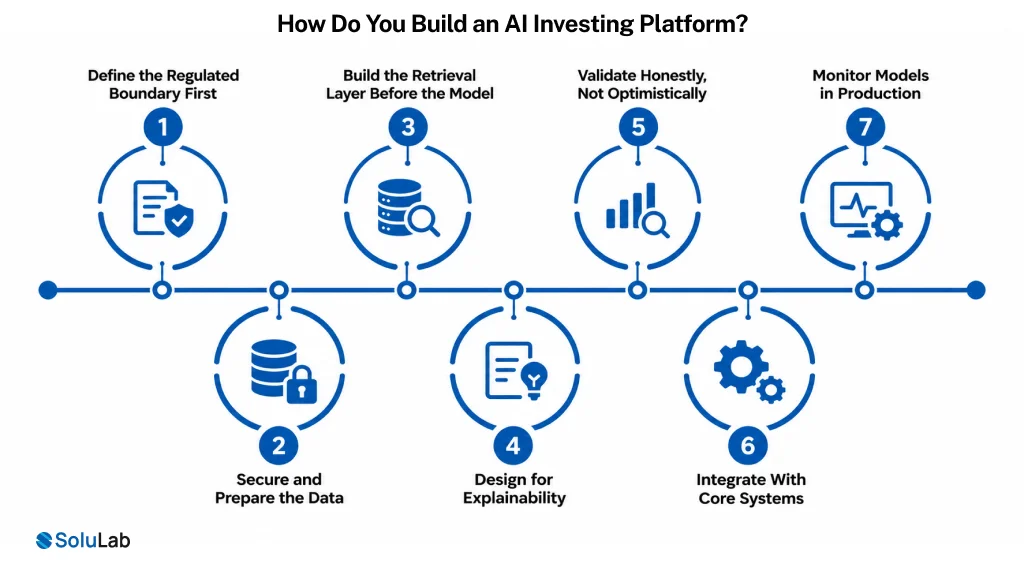
Building for regulated investment workflows follows a very different sequence from consumer software, because supervision, explainability and audit requirements shape the architecture from the first sprint onward.
1. Define the Regulated Boundary First
Establish whether the system informs a professional or advises a client, because that single distinction determines your licensing, disclosure and record-keeping obligations. Everything downstream follows from where you draw that line. Architecture included.
2. Secure and Prepare the Data
Market data, fundamentals, holdings, transactions and unstructured research all need cleaning, aligning and point-in-time correctness before any modelling begins. Removing survivorship bias belongs in this phase. So does checking vendor licensing terms.
3. Build the Retrieval Layer Before the Model
Most investment questions are answered from documents rather than predictions. A RAG platform over filings and internal research delivers value quickly, with citations attached to every answer and regulatory risk kept low.
4. Design for Explainability
Every output that influences a recommendation must be traceable back to its inputs and to reasoning a supervisor can review. Overrides need logging with a stated justification. That record is what makes the system defensible later.
5. Validate Honestly, Not Optimistically
Backtests flatter strategies. Always. Use out-of-sample periods held back deliberately, walk-forward validation and realistic transaction cost assumptions. Then have someone independent review the findings before they reach a committee.
6. Integrate With Core Systems
Connect to order management, portfolio accounting, custody and CRM so outputs land inside the systems people already work in. This is where AI integration services effort concentrates, alongside broader fintech app development.
7. Monitor Models in Production
Markets change, so model performance decays whether anyone is watching or not. Drift monitoring, scheduled revalidation and a named owner per model are operating costs, not project phases. This is standard MLOps practice.
What Are the Risks, Limits and Regulatory Constraints?
Investment applications carry risks that most other AI use cases simply do not, because markets adapt to the models applied to them and errors move real client money.
1. Markets Are Adversarial and Non-Stationary
A signal that works stops working once enough participants trade it, and historical patterns carry no obligation to repeat. Unlike image recognition, the environment changes in response to the model applied to it. That is a genuinely different problem to solve.
2. Backtest Overfitting Is Endemic
Test enough strategies and some will look excellent purely by chance, especially once survivorship bias flatters the historical data. This destroys more live strategies than any modelling flaw does. Live results rarely match what the backtest promised.
3. Explainability Is a Regulatory Requirement
Firms must justify recommendations to clients and to supervisors, with an audit trail behind every decision. A model nobody can explain is hard to place in front of clients. Opaque architectures limit permitted use. Design for this early.
4. Overstating AI Capability Carries Enforcement Risk
Regulators have acted against firms exaggerating their use of AI, a practice usually described as AI washing. Marketing claims should match what the system actually does, backed by documentation. Have compliance review public statements before they ship.
5. Governance Often Lags Deployment
In Deloitte’s State of AI in the Enterprise research, only about one in five companies reported a mature governance model for autonomous AI agents. Model inventories are frequently incomplete. Ownership blurs after project handover.
6. Many Projects Never Reach Production
Gartner predicts more than 40% of agentic AI projects will be canceled by the end of 2027, citing escalating costs, unclear value and inadequate risk controls. Unclear scope kills most of them. Underestimated integration work kills the rest.
What Are the Future Trends in AI Investing?
The direction of travel is toward agentic research workflows, personalisation at portfolio scale and tighter supervisory expectations, with adoption still running very unevenly across firm sizes and segments.
1. Agentic Research Workflows
Multi-step agents that gather data, run analysis and draft investment memos, with analysts reviewing the output rather than assembling it. Audit trails become mandatory at every step. The reasoning chain is now part of the record.
2. Personalisation at Portfolio Level
Direct indexing and tax-aware customisation reaching smaller accounts as automation drops the cost of tailoring a portfolio. Tax-loss harvesting and values-based screening stop being a high-net-worth privilege. They arrive at individual account level.
3. Private Markets and Unstructured Data
AI applied to private company documents, fund reporting and deal flow, where data has historically been unstructured, inconsistent and handled manually. Extracting fund reporting from PDFs at scale makes private market data searchable. For the first time.
4. Supervisory Technology Catching Up
Regulators are building their own analytical capability, which steadily raises expectations for documentation and model governance at the firms they supervise. Testing evidence is requested more often now. Explainability standards keep rising across jurisdictions.
5. Convergence With Digital Assets
Tokenised instruments and AI-driven analysis are converging as more asset classes move on-chain, which brings new data inputs and much shorter settlement timelines. Both threads are covered in AI in fintech and AI in finance.
How Can SoluLab Help Build AI Investing Products?
We build regulated financial technology, which means designing for explainability, auditability and integration with core systems from the first sprint rather than bolting any of it on afterwards.
1. Use Case Scoping and Feasibility
Assessing which parts of your investment workflow are buildable, compliant and genuinely worth the investment before any development starts. The regulated boundary gets defined upfront. The roadmap is sequenced by risk level, not by enthusiasm.
2. Research and Retrieval Platforms
Document intelligence over filings, transcripts and your own internal research library, with citations attached to every answer and access controls enforced per user. This is usually the fastest route to visible value inside a firm. It also builds internal confidence.
3. Portfolio and Risk Tooling
Models supporting allocation, rebalancing and exposure monitoring, built so their outputs can be explained to supervisors and to clients. Constraints are encoded and enforced in code. Monitoring ships with the system rather than following later.
4. Platform Integration
Connecting AI capability to the order management, custody, accounting and CRM systems already running in production, with data flows mapped and documented. The aim is minimal disruption to daily operations while the new capability goes live. Nobody wants a migration.
5. Team Capacity and Advisory
Extra engineering capacity for defined build phases, plus advisory on governance, documentation and model risk. Teams can hire AI developers with financial services experience from day one rather than training generalists mid-build.

Conclusion
AI in investing is most valuable where it expands coverage, speeds up research, and makes processes consistent, not where it promises better returns. The firms getting real value started with internal research and operations, proved the output, then moved carefully toward anything touching client portfolios.
The build sequence matters more here than in most sectors. Define the regulated boundary, get point-in-time data right, build retrieval before prediction, design for explainability, and validate honestly rather than optimistically. Those disciplines are what separate a system supervisors accept from one that stays in pilot.
SoluLab, an AI development company, can help your business scope compliant use cases, build research and portfolio tooling that explains itself, and integrate it with the systems you already run. We will also tell you plainly when a use case carries more regulatory risk than commercial upside.
FAQs
Neha is a curious content writer with a knack for breaking down complex technologies into meaningful, reader-friendly insights. With experience in blockchain, digital assets, and enterprise tech, she focuses on creating content that informs, connects, and supports strategic decision-making.