Key Takeaways
- AI dentistry refers to machine learning systems that read dental images, draft clinical notes, triage insurance claims, and automate front-office work inside a practice or dental software platform.
- Diagnostic imaging is the most mature application. Several caries and pathology detection tools now hold FDA 510(k) clearance, which means they are regulated devices rather than experiments.
- Adoption is real but uneven. Dentists have moved fastest on scheduling, charting, and radiograph review, and have stayed deliberately cautious about anything that touches a treatment recommendation.
- The commercial case rarely rests on clinical accuracy alone. Most practices recover value through fewer missed findings, faster claim approvals, shorter charting time, and fewer no-shows.
- Buying well matters more than buying early. Clearance scope, training data provenance, PMS integration, and a documented false-positive rate separate usable products from demos.
AI dentistry is no longer a conference topic waiting for proof. Grand View Research values the AI in dentistry market growing to USD 6.6 billion by 2033 at a 22.7% CAGR, with AI-powered diagnostic software holding 42% of that revenue.
The adoption data tells a more interesting story than the forecast. An American Dental Association Health Policy Institute panel published in July 2026 found 43.3% of US dentists already using AI for at least one task, yet fewer than 5% using it for treatment recommendations.
That gap is the whole subject. Dentists have accepted AI as a second reader and an administrative engine. They have not handed it clinical authority. This guide covers what works today, which claims the evidence supports, how to buy without being sold a demo, and where the technology is heading.

What Is AI in Dentistry?
AI dentistry is the use of machine learning models inside dental practice workflows to detect pathology on radiographs and intraoral scans, generate clinical documentation, predict treatment outcomes, and automate scheduling, billing, and patient communication. Most deployed systems are computer vision tools that flag findings for a dentist to confirm.
The term covers a wider range of software than most people assume. A caries detection overlay on a bitewing is AI dentistry. So is a model that predicts which patients will cancel on Friday afternoon, and a large language model that turns a dictated exam into a structured chart note.
What unites them is the role they play: these systems narrow attention rather than make decisions. A radiograph model does not diagnose. It marks regions with a confidence score, and the dentist accepts or dismisses each mark. That framing is not marketing caution. It is how the clearances are written, and it is how the liability sits.
Computer vision led the technology split at 31.4% of the market in 2025, with generative AI projected as the fastest-growing segment. Cloud deployment dominated at 75.1%, which matters for anyone comparing on-premises imaging servers against a subscription overlay. If you want the broader picture of how these patterns play out beyond oral health, our guide to the future of AI in healthcare covers the same architecture questions across specialties.
How AI Dentistry Differs From Standard Dental Software
- It Learns From Images, Not Rules. Traditional practice management software executes logic a developer wrote. A vision model derives its behaviour from thousands of annotated radiographs, which means its performance depends entirely on whose teeth were in the training set.
- Its Output Carries Uncertainty. Rule-based software returns a definite answer. An AI model returns a probability, and the threshold you set for showing a finding changes both sensitivity and the volume of false alarms a dentist has to clear.
- It Is Often a Regulated Device. Software that detects disease on an image is a medical device in the US and EU. That triggers clearance requirements, change-control obligations, and post-market surveillance that ordinary scheduling software never faces.
AI in Dentistry Use Cases by Practice Setting
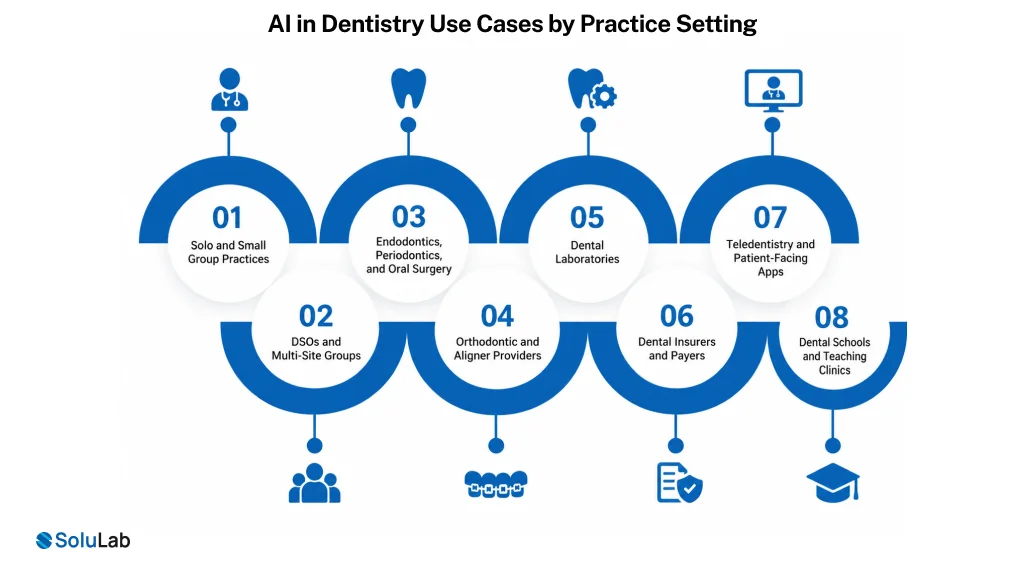
The same model behaves like a different product depending on who deploys it. A solo practice and a 200-location group have almost nothing in common in how they justify, configure, and govern the tool, so the AI in dentistry applications that pay back differ sharply by setting.
1. Solo and Small Group Practices
The case here rests on one clinician’s time and one clinician’s blind spots. A second reader on radiographs plus automated note generation gives back minutes per patient without any change management overhead. Avoid anything that needs a dedicated administrator to maintain, because nobody in a four-person practice has that capacity.
2. DSOs and Multi-Site Groups
Scale changes the question from accuracy to consistency. Groups use aggregated detection and acceptance data to see where diagnostic patterns diverge between locations, then address outliers through training rather than policy. Centralised threshold control matters more than per-chair tuning, and an audit trail stops being a nice feature and becomes a governance requirement.
3. Endodontics, Periodontics, and Oral Surgery
Specialists need narrower, deeper models. Periapical radiolucency detection, automated bone-level staging, and CBCT segmentation for nerve canal proximity carry real value, while a general caries overlay adds very little to a referral-based practice. Clearance scope is the deciding factor, since general dental tools rarely cover specialist findings.
4. Orthodontic and Aligner Providers
Aligner platforms have run on machine learning longer than any other dental category. Intraoral scan segmentation, movement simulation, and progress tracking against a planned sequence are mature. The newer work is remote monitoring from patient-submitted photos, which turns every check-in into a data point instead of an appointment.
5. Dental Laboratories
Labs apply AI to margin detection on scans, automated crown and bridge design proposals, and quality control before a case ships. The economics are different from a clinic: throughput and remake rate are the metrics, and even a small reduction in remakes shows up immediately on the production line.
6. Dental Insurers and Payers
Payers use image models to audit claims at scale, checking whether submitted radiographs support the billed procedure. This is the application practices should watch most closely, because it changes documentation expectations on their side. Our work on generative AI in healthcare operations covers the same claims-review patterns in medical.
7. Teledentistry and Patient-Facing Apps
Triage from patient photos, symptom intake, and post-operative follow-up all sit outside the operatory. The constraint is regulatory rather than technical, since advising a patient who has not been examined carries different risk than flagging a finding for a dentist. Teams building in this space usually need both an imaging pipeline and a compliant mobile layer, which is the combination we handle in healthcare mobile app development.
8. Dental Schools and Teaching Clinics
Teaching clinics use AI as a calibration tool, comparing a student’s reading against the model and against a faculty reference. It works well for feedback. It needs care in curriculum design, because a student who learns to read films with the overlay always on may never develop the unaided skill.
How AI in Dental Diagnosis Actually Works
A radiograph goes through four stages before a finding appears on screen. Understanding them explains why two products trained on similar data behave very differently in a real operatory.
1. Acquisition and Normalisation
Sensors vary. A model trained on one manufacturer’s bitewings and deployed on another’s will drift unless the pipeline normalises exposure, contrast, and resolution first. This single step accounts for a surprising share of real-world performance loss.
2. Anatomical Segmentation
Before anything is detected, the image is parsed into structures: individual teeth with numbering, enamel, dentin, pulp, alveolar bone, restorations. Tooth numbering errors propagate, so a mislabelled quadrant turns a correct detection into a wrong chart entry.
3. Detection and Classification
The detection head proposes regions and assigns each a class and a confidence score. AI in dental diagnosis sits here, and so does the single most consequential configuration choice in the product: the confidence threshold at which a finding becomes visible.
4. Presentation and Clinician Confirmation
Nothing enters the record until a dentist accepts it. Good products make dismissal a single click and log every accept and reject, which gives the practice its own accuracy data over time instead of relying on the vendor’s published numbers.
Key Benefits of AI in Dentistry
AI is changing dentistry by improving diagnostic accuracy, personalizing treatment, improving clinical workflows, and enhancing patient experiences while helping dental professionals make faster, data-driven decisions.
1. Fewer Missed Early Lesions
A second reader that never tires is the clearest clinical argument. Early interproximal caries are the classic miss, and catching them shifts treatment from restoration toward prevention.
2. Shorter Documentation Time per Patient
Charting and note generation remove the most resented part of the day. The benefit compounds in high-volume practices and DSOs where a few minutes per chair per patient becomes real capacity.
3. Faster Claim Approval and Fewer Denials
Automated verification and narrative drafting cut the back-and-forth that delays payment. Because denials have a measurable cost per claim, this is usually the easiest line item to build a business case around.
4. Treatment Documentation Across Associates
Variation between clinicians in the same practice is a real quality problem. A shared detection layer and a standard charting template narrow it without anyone being told how to practise.
5. Better Patient Acceptance Through Visual Explanation
A highlighted lesion on screen does more for case acceptance than a verbal description. Used honestly, it is informed consent support. Used aggressively, it becomes a pressure tactic, and that line is worth drawing deliberately.
6. Operational Visibility Across Multiple Locations
For groups and DSOs, aggregated detection and acceptance data reveals where diagnosis and treatment patterns diverge across sites. DSOs are projected to grow significantly against the 68.6% of 2025 revenue that individual dental clinics represented.
How to Implement AI in a Dental Practice
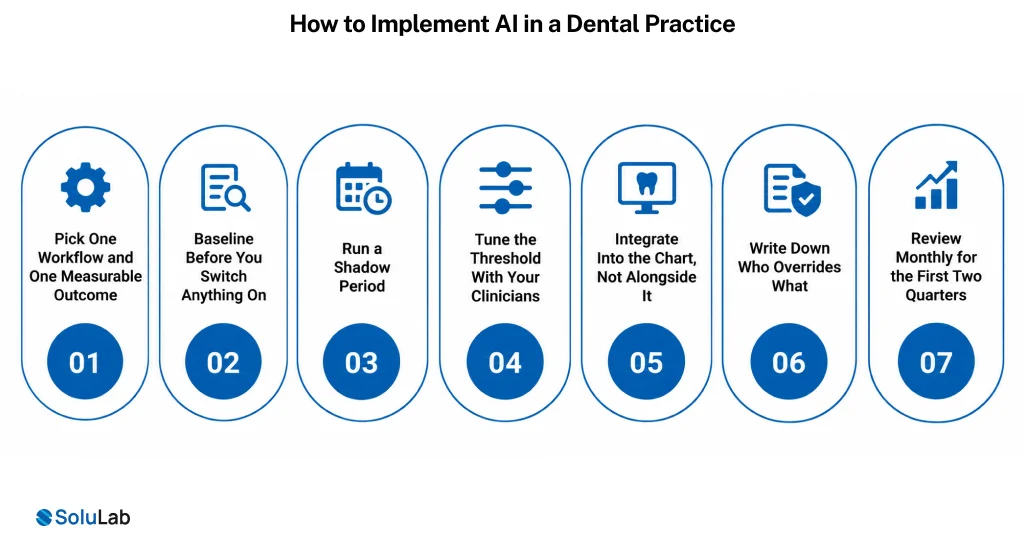
Here’s a step-by-step guide on implementing AI in dentistry:
1. Pick One Workflow and One Measurable Outcome
Start with the workflow where you can already count something: denial rate, charting minutes per patient, or no-show percentage. Vague goals produce pilots that nobody can declare successful. Deloitte’s 2026 Global Health Care Outlook found 51% of health care executives had not measured returns on their AI investments at all, which is the failure mode to avoid from day one.
2. Baseline Before You Switch Anything On
Measure four to six weeks of current performance first. Without a baseline, you will be arguing about impressions in the review meeting.
3. Run a Shadow Period
Let the model run without showing clinicians its output, then compare its findings against what was charted. This gives you a false-positive rate on your own patients and sensors, which is the only number that matters.
4. Tune the Threshold With Your Clinicians
Set sensitivity with the people who will clear the alerts. A threshold handed down from a vendor default is the most common reason a good tool gets switched off in month two.
5. Integrate Into the Chart, Not Alongside It
Detections should write to the periodontal chart and the treatment plan. If a hygienist has to retype anything, the workflow will quietly revert.
6. Write Down Who Overrides What
Document that the clinician confirms every finding, that overrides are logged, and that no AI output alone drives a treatment recommendation. The ADA data makes clear why: 82.6% of dentists do not plan to use AI for treatment recommendations, and a policy that respects that boundary is easier to adopt.
7. Review Monthly for the First Two Quarters
Compare accept and reject rates by clinician and by finding type. Divergence usually signals a threshold problem or a training gap, not a bad clinician.
Teams building their own platform rather than buying one will recognise this sequence from generative AI in healthcare deployments, where the validation work consistently outweighs the model work.
Risks and Limits Worth Naming
Nobody is served by a benefits list with no counterweight.
1. Overtreatment Risk From Low Thresholds
This is the concern dentists raise most, and it is legitimate. A sensitive model that flags every borderline radiolucency, combined with production pressure, pushes toward intervention that a watchful-waiting approach would have avoided. The clinical answer is a conservative threshold and a documented monitoring pathway.
2. Performance Drift Across Populations and Equipment
A model validated in Germany, which led Europe’s 32.4% regional revenue share in 2025, will not necessarily perform the same on a different population with different sensors. Validate locally or accept unknown risk.
3. Narrow Clearance, Broad Marketing
Clearance covers specific findings on specific image types. Using a tool outside that scope and relying on its output is a decision you have made, not one the regulator sanctioned.
4. Clinician Deskilling and Automation Bias
If junior clinicians learn to read radiographs with the overlay always on, their unaided reading may never develop. Periodic unaided reads are a cheap safeguard.
5. Project Failure From Weak Scoping
Gartner expects more than 40% of agentic AI projects to be cancelled by the end of 2027, mostly for unclear business value and inadequate controls. Dental deployments fail the same way: no baseline, no owner, no measured outcome.
6. PHI Exposure Through Cloud Processing
Radiographs are protected health information. Cloud inference means images leave your premises, so retention, residency, and whether your data trains future models all need contractual answers.
Emerging Trends in AI Dental Care Technology
Here are few trends you sound know in AI dentistry:
1. Multimodal Models That Read Images With the Chart
The next generation combines the radiograph with the periodontal chart, medical history, and prior treatment, rather than looking at the image alone. Context changes interpretation. A radiolucency in a patient with uncontrolled diabetes reads differently.
2. Generative AI Moving Into Documentation and Consent
Generative AI is the fastest-growing technology segment in the market forecast. The near-term applications are documentation, claim narratives, and plain-language treatment explanations rather than diagnosis. Deloitte’s 2026 outlook found 54% of health care executives naming clinical decision support as a top AI value area.
3. Agentic Workflows in the Front Office
Scheduling, recall, insurance verification, and follow-up are moving from single-purpose models to agents that complete a sequence of steps and escalate exceptions. The architecture closely mirrors what we describe in AI agents in healthcare.
4. Chairside Real-Time Guidance
Intraoral cameras and scanners with live inference during the exam, rather than post-hoc image review. Latency and operator distraction are the engineering constraints here, not accuracy.
5. Teledentistry Triage at Scale
Patient-submitted photos triaged by a model to decide urgency and routing. This is one of the few places where AI reaches patients who are not already in a chair, which is also why the regulatory questions are sharper.
6. Predictive Risk Scoring for Prevention Programmes
Caries and periodontal risk models built on longitudinal records, used to set recall intervals and target preventive spending. Payers are more interested in this than practices are, which will shape how it arrives.
For product teams, the practical consequence is that a dental AI platform now needs an imaging pipeline, an LLM layer, and an orchestration layer, not just a classifier. Our work on gen AI in the healthcare industry and on healthcare mobile apps covers how those layers fit together.
How SoluLab Can Help
We build and validate dental AI systems for practices, DSOs, and dental software vendors. Typical engagements look like one of these.
1. Model Validation on Your Own Data
Before you commit to a vendor, we run a shadow evaluation against your radiographs and your charted findings, and give you a sensitivity and false-positive profile on your population rather than theirs.
2. Custom Imaging Model Development
Where no cleared product covers the finding you need, we build and document the model, including dataset construction, annotation protocol, and the evidence package a regulatory pathway requires.
3. Practice Management and Claims Automation
Charting, insurance verification, claim narrative generation, and recall automation, integrated into the PMS so nothing gets retyped. This is where most of our AI dentistry app development services work sits.
4. Platform Engineering for Dental Software Vendors
For companies building the products practices buy, we handle the imaging pipeline, LLM orchestration, audit logging, and HIPAA-aligned infrastructure. Teams usually come to us after a prototype works and the compliance and scale questions arrive together.
Conclusion
AI dentistry has reached the stage where the interesting questions are operational rather than technical. The models work well enough that imaging is now the leading clinical application, and cleared products exist for specific findings on specific image types.
The 43.3% adoption figure alongside the sub-5% treatment-recommendation figure is not a contradiction. It is the profession drawing a sensible line, and the products that respect that line are the ones that last.
If you are evaluating tools, building a dental software platform, or trying to work out whether to buy or build, SoluLab, an AI development company, can help your business scope it properly. Book a discovery call and we will work through the decision with you.
FAQs
Neha is a curious content writer with a knack for breaking down complex technologies into meaningful, reader-friendly insights. With experience in blockchain, digital assets, and enterprise tech, she focuses on creating content that informs, connects, and supports strategic decision-making.