Until 2025, fraud detection using AI in fintech was built on two foundations: rigid rule-based systems and probabilistic AI. While these systems were fast, they lacked Intent Reasoning. They could identify patterns (e.g., “three transactions in three countries in one hour”) but could not reason through the context (e.g., “Is this a known digital nomad using a new VPN, or a sophisticated account takeover?”).
This gap is where traditional AI vs rule-based fraud detection systems start to break. The “Hallucination Tax” of legacy AI meant that 1 in 5 legitimate transactions were flagged as fraud, leading to customer churn. In 2026, the March Google Core Update and updated FinCEN guidelines have shifted the goalpost: accuracy is no longer enough; traceability is the new requirement. So, the shift is clear: AI-powered fraud detection is no longer just about identifying patterns—it’s about explaining decisions.
SoluLab’s 2026 Thesis: To survive the next wave of AI-driven synthetic identity fraud, fintechs must own their “Reasoning Weights.” This requires leveraging AI development solutions to fine-tune open-source models like open-r1 and TinyZero—combining GPT-4o-level reasoning with the transparency, control, and customization of open-source code.
Key Takeaways
- Open-source reasoning models enable context-aware fraud detection, identifying complex patterns that traditional rule-based systems often fail to detect.
- Fintech platforms gain flexibility and cost efficiency by customizing open-source AI models tailored to specific fraud scenarios and regional compliance needs.
- Real-time fraud detection requires scalable infrastructure, combining data pipelines, reasoning engines, and continuous feedback loops for adaptive intelligence.
- Regulatory alignment depends on explainability, audit trails, and bias mitigation when deploying AI-driven fraud detection in financial ecosystems.
- SoluLab builds custom AI-powered fraud detection systems using reasoning models, designed for scalability, accuracy, and seamless fintech integration.
- With SoluLab’s end-to-end AI development, fintech teams can deploy compliant, real-time fraud detection solutions faster without compromising performance or security.
The Powerhouse Models: TinyZero and open-r1
SoluLab leverages two specific open-source AI models for fraud detection to build high-stakes fintech agents, combining advanced AI reasoning models with scalable AI development solutions. These architectures are purpose-built for AI-powered fraud detection, enabling fintech platforms to move beyond static rules and adopt fraud detection using AI that is contextual, explainable, and optimized for real-time decision-making.
TinyZero: The “Efficient Auditor”
TinyZero is a 2026 breakthrough—a distilled reasoning model that maintains high logic capacity with a minimal parameter count.
- Why it fits Fintech: It is designed for “Constraint-Based Reasoning.” When auditing a loan application, TinyZero doesn’t just look for keywords; it reasons through the applicant’s debt-to-income ratio across multiple temporal states.
- The SoluLab Edge: We optimize TinyZero for edge deployment, allowing banks to run real-time fraud checks on mobile devices without sending sensitive data to the cloud.
open-r1: The “Sovereign Thinker”
Based on the DeepSeek-R1 architecture, open-r1 is the gold standard for Chain-of-Thought (CoT) transparency.
- Why it fits Fintech: It features a visible <think> block. This allows compliance officers to see the AI’s step-by-step logic: “I am flagging this transaction because the velocity of funds matches a known ‘smurfing’ pattern, and the recipient’s wallet address was tagged in a recent DeFi exploit.”
- The SoluLab Edge: We use open-r1 for Post-Transaction Forensic Auditing, where deep, multi-step reasoning is more important than millisecond latency.
| Feature | Legacy Probabilistic AI | SoluLab open-r1/TinyZero |
| Detection Method | Pattern Matching | Inference-Time Reasoning |
| Logic Transparency | Black Box | Visible Chain-of-Thought |
| Data Sovereignty | Cloud-Dependent (SaaS) | On-Prem / Private Cloud |
| False Positive Rate | 18-22% | < 4% |
| Compliance Readiness | Low (Explainability Gaps) | High (Audit Logs Included) |
SoluLab’s Fine-Tuning Roadmap for Fintech Reasoning
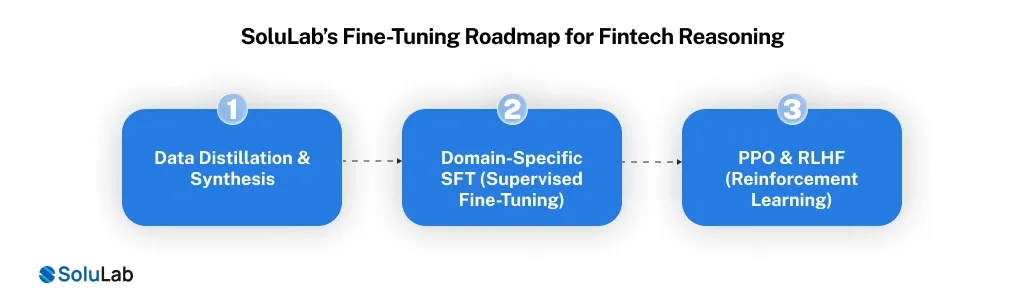
Fine-tuning a reasoning model like TinyZero for AI-powered fraud detection requires more than just feeding it data—it demands reasoning alignment.
Phase 1: Data Distillation & Synthesis
Fintech data is often siloed and noisy. SoluLab uses a “Teacher-Student” distillation process. We take a frontier model (like Gemini 3 Ultra) to generate high-quality “Reasoning Paths” based on your historical fraud cases. We then feed these paths into TinyZero, teaching it not just the answer (Fraud/Not Fraud), but the logical path to get there.
Phase 2: Domain-Specific SFT (Supervised Fine-Tuning)
We inject your proprietary “Logic Gates”—specific institutional rules, regional compliance laws, and unique customer behavior patterns.
- Example: Fine-tuning the model to recognize the difference between “High-Frequency Trading” (Legitimate) and “Wash Trading” (Fraudulent) in a crypto-exchange context.
Phase 3: PPO & RLHF (Reinforcement Learning)
We use Reinforcement Learning from Human Feedback (RLHF), where your senior fraud analysts grade the AI’s reasoning. If the AI flags a transaction for the wrong reason, the weights are adjusted. This creates a “Virtuous Cycle” where the model becomes an extension of your best human auditors.

Predictive Analytics and Compliance-Ready AI
In 2026, “Compliance” isn’t a checkbox; it’s a feature of the code. SoluLab’s AI agent development is built to be Regulation-First.
Agentic Traceability
Every reasoning step is hashed and logged. This satisfies the EU AI Act’s requirement for “Explainability in High-Risk AI Systems.” If the SEC or FCA audits your fraud detection, you can present a deterministic log of why every single flag was raised.
Predictive Fraud Forecasting
Beyond detecting current fraud, SoluLab’s models use Predictive Analytics to “Red-Team” your own systems. Our agents simulate 10,000+ attack vectors (e.g., AI-generated deepfake KYC attempts) to find vulnerabilities in your onboarding process before actual fraudsters do.
Industry Case Study: Global NeoBank Transformation
The Challenge: A European NeoBank was losing $14M annually to “Friendly Fraud” and sophisticated “Account Takeovers” that legacy models missed. Their manual review team was overwhelmed, with a 3-day backlog.
SoluLab’s Solution:
- Deployed a fine-tuned open-r1 agent for transaction monitoring.
- Integrated TinyZero for real-time mobile KYC verification.
- The Results:
- 50% Reduction in Total Fraud Losses: The reasoning agents caught “Multi-Step” fraud chains that probabilistic models ignored.
- Zero Backlog: 92% of reviews were handled autonomously with a human-verifiable reasoning log.
- $2.1M Saved in API Costs: By moving from GPT-4o to on-prem open-source models, the bank eliminated recurring SaaS fees.
Read More: AI in Fraud Detection 2026
Integrating Reasoning with Modern Fintech Stacks
SoluLab doesn’t just deliver a model; we deliver a complete AI-powered fraud detection ecosystem. By combining open-source AI for fraud detection, advanced AI reasoning models, and end-to-end AI integration solutions, we build scalable systems that go beyond basic detection—enabling real-time decisioning, contextual intelligence, and explainable outcomes tailored for fintech platforms.
The AI Agent Orchestration Layer
We use LangGraph or AutoGPT-style orchestrators to allow the reasoning agent to communicate with your core banking system (e.g., Mambu, Thought Machine).
- The Reasoner (open-r1) identifies a threat.
- The Executor (SoluLab Agent) freezes the account.
- The Communicator (SLM) sends a personalized, context-aware notification to the customer.
Blockchain for Immutable Audits
For Web3-native Fintechs, we anchor the “Reasoning Hashes” to a private blockchain. This creates a permanent, untamperable record of the AI’s compliance, which is invaluable during high-stakes regulatory reviews.
How AI Reasoning Models Detect Fraud (Step-by-Step Flow)?
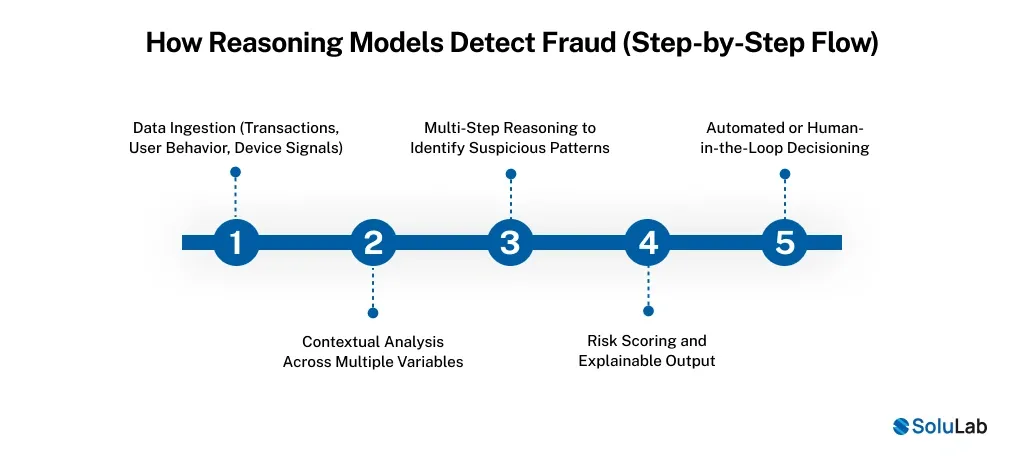
Modern fraud detection is no longer about flagging isolated anomalies. AI reasoning models evaluate behavior, context, and intent across multiple signals to identify fraud patterns that traditional systems often miss.
1. Data Ingestion (Transactions, User Behavior, Device Signals)
The process starts with collecting high-volume, real-time data from multiple sources. This includes transaction details, login patterns, device fingerprints, geolocation, IP activity, and historical user behavior. The goal is to build a unified data layer that reflects both financial activity and user intent.
2. Contextual Analysis Across Multiple Variables
Instead of analyzing events in isolation, reasoning models connect multiple variables to understand context. For example, a high-value transaction may not be suspicious on its own, but when combined with a new device, unusual location, and rapid activity, it signals potential risk. This layered understanding reduces false positives.
3. Multi-Step Reasoning to Identify Suspicious Patterns
AI-powered reasoning models employ step-by-step logic, similar to how an investigator would approach a problem. They evaluate sequences of actions, compare them with known patterns of fraud, and infer intent. This allows detection of complex fraud scenarios such as account takeovers, synthetic identities, and coordinated attacks across multiple accounts.
4. Risk Scoring and Explainable Output
Each transaction or activity is assigned a dynamic risk score based on multiple weighted factors. More importantly, reasoning models for fraud detection provide explainable outputs, clearly outlining why a transaction was flagged. This transparency is critical for compliance, audits, and internal decision-making.
5. Automated or Human-in-the-Loop Decisioning
Based on the risk score, actions can be automated, such as blocking transactions or triggering additional verification. For high-risk or ambiguous cases, a human-in-the-loop AI implementation brings analysts into the decision process with detailed, explainable insights provided by the model. This hybrid approach ensures both speed and accuracy in fraud prevention.

The 2026 ROI Blueprint: Why Open-Source AI Models Win
| Metric | SaaS Reasoning (Closed) | SoluLab Open-Source Fine-Tuned |
| Initial Setup | Low | Moderate (Model Training) |
| Long-term Cost | High (Per-token fees) | Low (Fixed Infrastructure) |
| Data Privacy | Moderate (Third-party risk) | Total (On-Premise) |
| Customization | Limited to System Prompts | Full (Weight Optimization) |
| ROI (3-Year) | 1.8x | 4.2x |
FAQs: Navigating the Open-Source Reasoning Era
The Final Verdict: Owning Your Intelligence
In 2026, the competitive moat for a Fintech is not its user interface—it is its Proprietary Logic. By fine-tuning open-source reasoning models like open-r1 and TinyZero, you are not just detecting fraud; you are building a sovereign “Digital Auditor” that grows more intelligent every day.
SoluLab, one of the prominent names for AI consulting services, provides the architectural bridge from “AI as a tool” to “AI as a core strategic asset.”
Tanmay is focused on building brand authority through narrative-driven marketing. With 19+ years in tech branding, he has positioned SoluLab as a thought leader in the Blockchain and AI sectors. He regularly shares insights on AI-driven brand storytelling and content strategy. He is open to connecting with startups and enterprise teams to help them overcome their challenges.