Key Takeaways
- AI helps sustainability most where there is meter-level data and a control you can act on, such as energy, logistics and industrial process optimisation.
- Carbon accounting is a data problem before it is a modelling problem. Most organisations cannot answer basic emissions questions because the data never existed.
- Scope 3 supply chain emissions are where AI adds the most, because supplier data is patchy and estimation is unavoidable.
- AI has its own footprint. Data centre electricity is on track to roughly double this decade, and ignoring that undermines the whole argument.
- Estimated figures are not measured figures. Regulators and assurance providers increasingly want to know which is which.
- Measure the baseline before deployment, or you will credit AI for a mild winter.
- Start with one site, one meter set and one decision. Enterprise-wide sustainability platforms rarely survive contact with real data.
Sustainability work runs on data that most organisations do not have in usable form. Energy use sits in utility bills rather than meters, emissions arrive as annual estimates, and supplier data turns up as spreadsheets months late. AI and sustainability meet at exactly that gap: forecasting demand, optimising energy use, estimating emissions where measurement is missing, and turning sensor data into decisions someone can act on this week.
The commitment is there. Deloitte’s 2025 C-suite Sustainability Report, based on a survey of 2,106 executives across 27 countries, found 83% had increased sustainability investment over the previous twelve months.
Spending is not the constraint. Usable data is. What follows covers where AI genuinely reduces emissions and cost, which use cases pay back fastest, what implementation actually involves, AI’s own environmental footprint, and the greenwashing risks worth planning around before you start.

What Is AI and Sustainability?
AI and sustainability describes using machine learning to reduce environmental impact: forecasting energy demand, optimising industrial processes, estimating emissions, modelling climate risk and automating the reporting that regulators now require.
1. Where AI Actually Helps
Three conditions have to hold. There must be data, usually from meters, sensors or transaction records. There must be a decision or control you can change as a result. And there must be a way to check whether the change worked. Miss any one and you have a dashboard rather than a reduction.
2. Efficiency, Measurement and Modelling
Most applications fall into three groups. Efficiency work cuts consumption in buildings, factories, fleets and data centres. Measurement work estimates and tracks emissions where direct measurement is absent. Modelling work forecasts weather, demand, yields and climate risk.
3. Where It Connects to ESG Reporting
Sustainability data increasingly feeds disclosure obligations rather than internal dashboards alone. That turns data quality into a compliance question, and it is why generative AI in ESG work has moved from nice-to-have toward mandatory in several markets.
Why Are Businesses Investing in AI for Sustainability?
Because the reporting burden grew, energy costs became volatile, and the cheapest emissions reductions are the ones that also cut operating cost. The commercial and environmental cases have converged.
1. Disclosure Requirements Got Specific
Regulators and exchanges now expect emissions data with methodology and assurance behind it, not narrative commentary. Producing that annually by hand is no longer practical at any scale.
2. Energy Cost Volatility
Energy became a board-level cost line rather than an overhead. Forecasting demand and shifting load to cheaper, cleaner periods saves money whether or not anyone is counting carbon.
3. Customers and Investors Ask for Evidence
Procurement questionnaires now request supplier emissions data, and investors ask for transition plans with numbers. Firms that cannot answer lose contracts, which makes this a revenue question.
4. The Cheapest Reductions Are Efficiency Reductions
Before any capital project, most organisations are wasting energy through poor scheduling, over-provisioned equipment and unnoticed faults. Finding that waste is a data problem, and it is the one AI is best suited to.
What Are the Top Use Cases of AI in Sustainability?
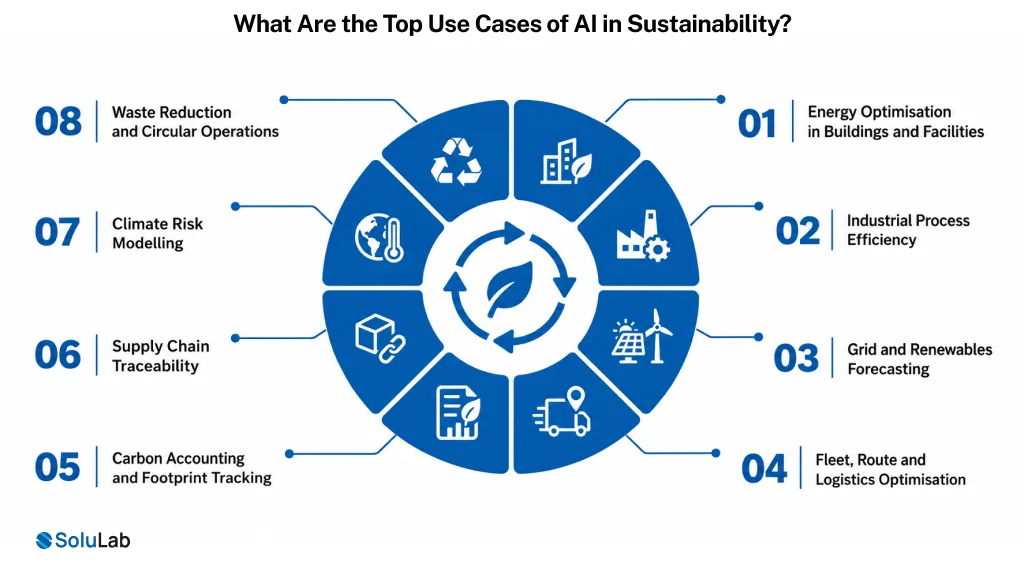
Eight use cases account for most of the measurable value. The first four have the clearest returns because the data already exists and the result is verifiable.
1. Energy Optimisation in Buildings and Facilities
Models learn how a building actually behaves, then adjust heating, cooling and lighting to occupancy and weather rather than to a fixed schedule. Fault detection catches equipment running when it should not, which is a surprisingly large share of the waste in most estates.
2. Industrial Process Efficiency
Optimising set points, batch scheduling and equipment loading in manufacturing to cut energy per unit of output. Predictive maintenance contributes here too, since equipment running out of tolerance usually burns more energy before it fails.
3. Grid and Renewables Forecasting
Predicting solar and wind generation and matching it against demand, so operators can schedule storage and dispatch. Better forecasts directly increase how much renewable generation the grid can absorb. Related agent applications sit in AI agents for energy consumption.
4. Fleet, Route and Logistics Optimisation
Route planning, load consolidation and driver behaviour analysis to cut fuel per delivery. The emissions saving and the cost saving are the same number, which makes the business case simple. Wider patterns appear in AI agents in supply chain and logistics.
5. Carbon Accounting and Footprint Tracking
Classifying spend and activity data against emissions factors, filling gaps where supplier data is missing, and producing auditable calculations. Scope 3 is where this matters most, because supplier data is incomplete almost everywhere and estimation is unavoidable.
6. Supply Chain Traceability
Tracking materials and products through multi-tier supply chains to substantiate origin and impact claims. AI handles the document extraction and matching, while blockchain in supply chain handles the shared record between parties that do not fully trust each other.
7. Climate Risk Modelling
Assessing physical risk to sites and assets from flood, heat, wildfire and storm, and transition risk from policy and market change. Increasingly required for financial disclosure rather than optional scenario work.
8. Waste Reduction and Circular Operations
Computer vision sorting recyclable material, demand forecasting that reduces overproduction, and quality prediction that cuts scrap. Where recovered material needs verifiable provenance, this connects to the tokenised credit models covered in green energy tokenization and carbon credit marketplaces.
What Are the Benefits of AI for Sustainability?
The benefits show up as measurable reductions and less manual reporting work, provided you captured a baseline first. Six are consistently achievable.
1. Lower Energy Consumption Without Capital Spend
Optimisation works on equipment you already own. That makes it the fastest payback available in most estates, ahead of any retrofit or generation project.
2. Better Emissions Data Quality
Automated classification and gap filling produce more consistent, more granular figures than an annual spreadsheet exercise. Granularity is what makes reduction targets actionable rather than aspirational.
3. Faster, Cheaper Reporting Cycles
Disclosure preparation that took a quarter of manual collation compresses considerably when data flows continuously and calculations are reproducible.
4. Earlier Detection of Waste
Anomaly detection catches a chiller running overnight or a compressor leaking within days rather than at the next audit. Small, frequent findings add up faster than occasional large projects.
5. More Renewable Energy Actually Used
Accurate generation and demand forecasting lets operators shift flexible load into clean periods, raising the share of renewable energy consumed rather than curtailed.
6. Defensible Numbers for Assurance
Reproducible calculations with documented methodology and clear separation of measured from estimated data make external assurance far less painful and far more likely to pass.
What Is AI’s Own Environmental Footprint?
Significant and growing, and any honest article on this subject has to say so. AI reduces emissions in some places while adding them in others, and the net position depends entirely on what you deploy it for.
The International Energy Agency estimates global data centre electricity consumption at around 415 TWh in 2024, roughly 1.5% of world electricity use, and projects it to more than double to around 945 TWh by 2030, slightly more than Japan consumes today. AI is the most important driver of that growth.
1. Where the Consumption Sits
Training large models is visible but intermittent. Inference is continuous and, at scale, dominates. Hardware manufacturing, construction and eventual e-waste sit outside the electricity figure entirely and rarely appear in vendor comparisons.
2. Water and Land Are Part of the Picture
Data centre cooling consumes water, sometimes in regions already under stress, and siting decisions carry local land and grid implications. Electricity is the headline number, not the whole footprint.
3. Net Impact Depends on the Application
A model optimising a district heating network can save far more energy than it consumes. A model generating marketing variations does not. The useful question is not whether AI is good or bad for the climate, but whether this specific deployment saves more than it costs.
4. What You Can Control
Model size relative to task, inference efficiency, batching, and where and when workloads run. Running heavy jobs in regions and hours with cleaner grid mix is one of the simplest available levers. Pushing inference to devices through edge AI development also reduces data movement and central load.
5. Measure and Report Your Own Consumption
Gartner predicts that 50% of organisations will adopt sustainability-enabled monitoring to manage energy consumption and carbon footprint metrics across hybrid cloud environments. If you build sustainability AI without measuring its own footprint, expect that question in your next assurance review.
How Do You Implement AI for Sustainability?
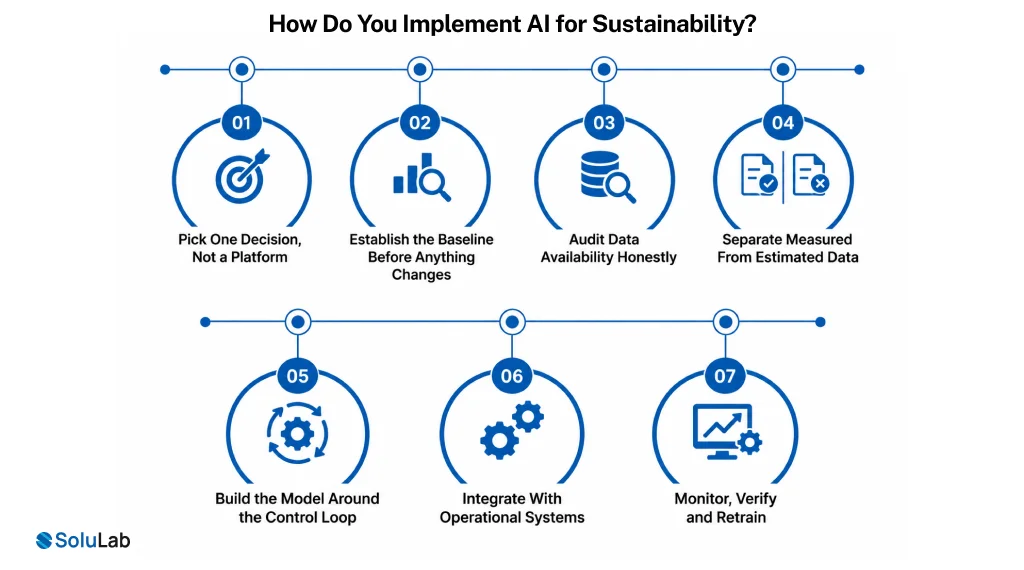
The technical limits are manageable. The credibility risks are not, and they are where most reputational damage in this area originates.
1. Estimated Figures Presented as Measured
Gap-filled emissions data is legitimate and often unavoidable, particularly in Scope 3. Presenting it without disclosing the method is where legitimate estimation becomes greenwashing.
2. Optimisation Without Verification
Claiming a reduction without a baseline, a control period or an independent check is a claim, not a result. Increasingly, regulators treat unsubstantiated environmental claims as a consumer protection matter rather than a marketing one.
3. Rebound Effects
Efficiency gains sometimes get spent rather than banked. A cheaper-to-run fleet gets driven further. Track absolute consumption alongside intensity metrics, because intensity can improve while total emissions rise.
4. Data Gaps in the Supply Chain
Most organisations have no direct visibility beyond their first tier. Models estimate what suppliers will not disclose, and those estimates carry real uncertainty that should be stated rather than smoothed over.
5. Ignoring the Footprint of the Solution
Deploying energy-hungry models to produce sustainability dashboards nobody acts on is a net negative. The net calculation belongs in the business case at the start, not in a later review.
6. Model Drift in Changing Conditions
Climate patterns, tariffs, equipment and occupancy all change. A model trained on pre-retrofit behaviour will misjudge a retrofitted building, so revalidation schedules matter more here than in stable domains.
What Are the Future Trends in AI and Sustainability?
Five shifts are visible now, and most point toward tighter measurement rather than more ambitious modelling.
1. Sustainability Data Becomes Assured Data
As disclosure moves toward audited financial-grade reporting, sustainability data inherits financial controls: lineage, versioning, reproducibility and sign-off. That changes how these systems are architected.
2. Product-Level Footprints
Attention moves from organisational totals to per-product and per-shipment figures, driven by regulation and procurement demands. This needs far more granular data than most systems collect today.
3. GreenOps for AI Itself
Measuring and optimising the energy and carbon cost of running AI workloads becomes a standard engineering practice rather than a research topic, with carbon-aware scheduling as the obvious first move.
4. Grid-Interactive Operations
Buildings, fleets and data centres responding to grid carbon intensity in real time, shifting flexible load toward cleaner hours. Electrified transport makes this larger, which is where systems like an energy management system for EV fit.
5. Verification Technology Grows Faster Than Claims
Satellite monitoring, sensor networks and independent verification of emissions claims are improving quickly. Claims that cannot survive third-party checking will get harder to make.

Conclusion
AI and sustainability work best together in unglamorous places: a chiller schedule, a delivery route, a batch sequence, a supplier emissions estimate. Those are where data exists, a control can change, and the result is verifiable. They are also where the savings show up on both the emissions ledger and the operating budget.
The disciplines that matter are baseline measurement, honest separation of measured from estimated data, and a clear-eyed view of what running the models costs. Organisations that get those right can defend their numbers. Those that skip them end up with dashboards and an awkward assurance conversation.
SoluLab, an AI development company, can help your business identify where AI will cut emissions and cost, build models around controls you can actually change, and connect them to the operational and reporting systems you already run.
FAQs
Neha is a curious content writer with a knack for breaking down complex technologies into meaningful, reader-friendly insights. With experience in blockchain, digital assets, and enterprise tech, she focuses on creating content that informs, connects, and supports strategic decision-making.