Enterprise AI is no longer experimental. Banks are using AI for underwriting. Hospitals rely on AI diagnostics. Retailers depend on AI personalization. Autonomous agents are accessing customer data, internal documents, financial records, and even asset ownership ledgers.
The problem? AI systems need identity access at scale. And identity has become the primary attack surface.
According to multiple industry security reports in recent years, over 80% of enterprise breaches involve compromised credentials or identity misuse. When AI systems interact with sensitive data, traditional identity models are not enough.
This is why identity tokenization for enterprise AI security is becoming foundational in 2026.
- It allows AI systems to function without exposing raw personal or financial identity data.
- It aligns with Zero Trust models.
- It supports governance frameworks.
- Additionally, it creates a scalable path for AI-ready infrastructure.
Key Takeaways
- Identity tokenization replaces real identity data with secure digital tokens. It protects sensitive data when AI systems access customer or enterprise information.
- A secure token vault maps tokens to real identities only when authorized. Banks, hospitals, and platforms use tokens to protect customer records.
- Tokenization supports Zero Trust security and reduces identity-based cyber risks. AI-ready identity tokenization helps build safer digital assets and enterprise platforms.
- AI + blockchain integration is enabling secure, verifiable identity layers, improving trust, auditability, and access control in enterprise ecosystems.
- SoluLab has delivered 100+ AI and blockchain solutions globally, helping enterprises build secure identity frameworks, tokenization platforms, and AI-ready infrastructure.
Why Is Identity Tokenization Becoming Critical for AI-Driven Enterprises in 2026?
AI systems require massive identity access. But enterprises cannot afford exposure. Let’s get to know what exactly makes identity tokenization critical.
1. The Explosion of AI and Machine Identities
Enterprises now manage:
- Human identities (employees, customers, partners)
- Machine identities (APIs, bots, AI agents)
- Application identities
- Third-party SaaS identities
With AI copilots and autonomous systems expanding, machine identities are growing faster than human ones. Each AI model that interacts with data creates a new risk.
Without identity tokenization for AI systems, enterprises expose:
- Customer PII
- Financial identifiers
- Health records
- Ownership records
- Internal credentials
2. Rising Identity-Based Attacks
Identity-based attacks have surged globally. Phishing, credential stuffing, API misuse, and privilege escalation are now more damaging than infrastructure hacks.
AI compounds the risk. If an AI model is trained on raw identity data and that data is breached, exposure multiplies.
Asset tokenization replaces sensitive identity elements with tokens. Even if breached, tokens have no exploitable value.
3. Regulatory and Compliance Pressure
Enterprises in 2026 must comply with:
- Data protection regulations across the US, EU, and APAC
- Financial regulatory standards
- Healthcare data protection frameworks
A privacy-preserving identity tokenization approach reduces compliance risk because sensitive data is not directly processed by AI systems.
Identity tokenization is not just a security decision. It is now a board-level risk management strategy.

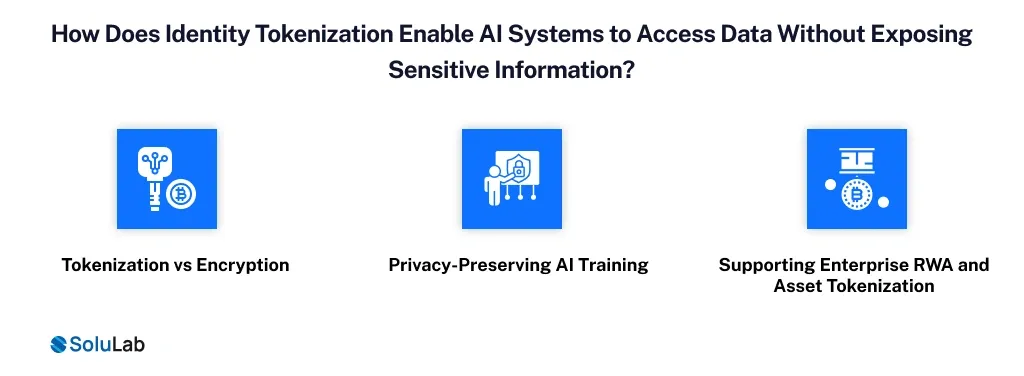
How Does Identity Tokenization Enable AI Systems to Access Data Without Exposing Sensitive Information?
AI needs data. But it does not need raw identity details. Privacy-preserving identity tokenization platforms need strong regulations and verification details.
1. Tokenization vs Encryption
Encryption protects data, but still requires decryption for processing. When decrypted, data becomes vulnerable.
Tokenization replaces data elements with non-sensitive tokens. AI systems process tokens instead of real identifiers.
For example:
- Customer ID → Token ID
- Social Security number → Randomized reference token
- Account number → Secure mapped token
Only a secure token vault can map tokens back to original values.
This makes the identity tokenization platform for enterprises far more secure for AI-driven workflows.
2. Privacy-Preserving AI Training
Enterprises are increasingly training AI on customer interaction data. Tokenization allows:
- Masked identities during training
- Reduced exposure in data lakes
- Safer cross-border AI deployments
- Minimized re-identification risks
This approach supports AI identity security solutions while maintaining data utility.
3. Supporting Enterprise RWA and Asset Tokenization
As enterprises expand into enterprise RWA tokenization and digital asset ownership systems, identity becomes central to asset ownership validation.
With AI tokenization for asset ownership, identity tokenization ensures:
- Ownership verification without exposing raw identity
- Secure investor onboarding
- Controlled access to asset token platforms
Identity becomes programmable and secure.
Read more: Top RWA Tokenization Questions Answered for Enterprises Ask in 2026
What Role Does Identity Tokenization Play in Zero Trust and AI Governance Frameworks?
Zero Trust is no longer optional. AI integration solutions make it mandatory. Let’s see how it is involved in building valuable frameworks.
1. Zero Trust Identity Tokenization Architecture
Zero Trust means: never trust, always verify.
In an AI environment, this requires:
- Continuous identity verification
- Tokenized session identities
- Segmented access layers
- Real-time policy enforcement
A zero-trust identity tokenization architecture ensures that AI agents only access tokenized representations, never raw identity credentials.
2. AI Governance and Identity Security
AI governance frameworks focus on:
- Model accountability
- Data traceability
- Audit trails
- Bias and misuse prevention
Tokenized identity layers allow enterprises to:
- Track which AI system accessed which identity token
- Maintain immutable logs
- Enforce role-based access policies
- Limit model exposure to raw data
This directly strengthens AI governance and identity security posture. However, insider threats remain a top enterprise risk.
Tokenization limits damage by ensuring that even internal access does not reveal sensitive identity information without proper authorization.
How Are Banks, Healthcare Providers, and Enterprises Using AI-Ready Identity Tokenization in Real-World Deployments?
Identity tokenization is already shaping enterprise AI rollouts.
1. Banking and Financial Services
- Fraud detection
- Credit scoring
- Automated compliance monitoring
By implementing identity tokenization for enterprise AI security, banks reduce:
- Exposure of account numbers
- Risk of data breach penalties
- Cross-border compliance issues
Tokenized identity layers allow AI to analyze behavior patterns without accessing real financial identifiers.
2. Healthcare
Healthcare AI supports:
- Diagnostic imaging
- Patient risk scoring
- Predictive treatment modeling
Tokenizing patient identity enables:
- HIPAA-aligned data handling
- Secure AI research collaboration
- Reduced breach exposure
Healthcare data remains among the most valuable on black markets. Tokenization reduces incentive.
3. Retail and Digital Platforms
Retailers use AI for personalization and recommendation engines. Instead of storing full customer profiles, tokenized identity enables:
- Behavioral analytics without direct PII exposure
- Safer data sharing with AI marketing systems
- Improved consumer trust
4. Asset and Ownership Platforms
With rising digital ownership models, enterprises building tokenized asset platforms require:
- Identity validation
- Investor verification
- Secure ownership mapping
Combining an AI-ready identity tokenization platform design with asset tokenization ensures secure ownership governance.
What Infrastructure Stack Is Required to Build an AI-Ready Identity Tokenization Platform?
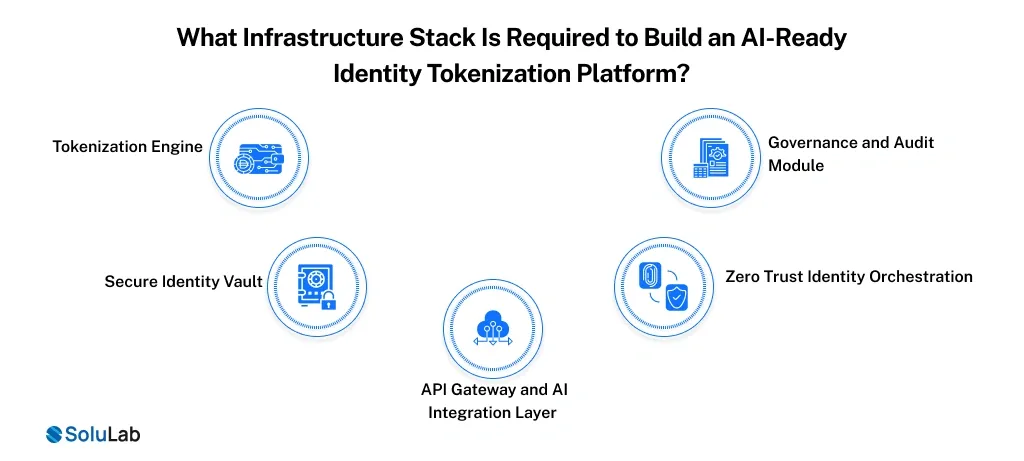
Building this capability requires more than masking fields.
1. Tokenization Engine
A secure engine that:
- Generates non-reversible tokens
- Supports vault or vaultless architecture
- Handles high transaction volumes
2. Secure Identity Vault
Stores original identity mappings securely with:
- Hardware security modules (HSMs)
- Strong key lifecycle management
- Controlled access policies
3. API Gateway and AI Integration Layer
Enables:
- Secure AI model interaction
- Tokenized identity exchange
- Policy enforcement
- Real-time validation
4. Zero Trust Identity Orchestration
Integrates:
- IAM systems
- Role-based access controls
- Continuous verification
- Behavioral analytics
5. Governance and Audit Module
Tracks:
- AI access logs
- Token lifecycle events
- Compliance reporting
Enterprises increasingly seek RWA tokenization development services to build these components in an integrated manner.
For organizations, our asset tokenization guide provides a framework for digital asset platforms.

Conclusion
As discussed above, by replacing sensitive identifiers with secure tokens, organizations can allow AI systems to analyze data, train models, and automate workflows without exposing real identity information.
To enable the following features, you need a tokenization platform development company expertise. SoluLab is always there to aid you in bringing security to you and your customers.
- Zero Trust security models
- privacy-preserving AI training
- Secure asset ownership systems
- stronger compliance with global data regulations
Contact us today for more enterprise-ready solutions!
FAQs
Deepika is a content writer who blends storytelling with strategic thinking. She explores topics across digital innovation, emerging tech, and the evolving blockchain industry. She enjoys breaking down complex ideas into simple, engaging narratives in the growing global markets.