The real-world asset (RWA) tokenization market crossed $24 billion in 2025, growing 380% in just three years, and some projections now put it on track to reach $30 trillion by 2034. Yet most crypto exchanges today are still built like it’s 2019. Currently, most of the platforms are optimized for spot trading, not for tokenized assets, institutional settlement, or compliant on-chain finance.
This mismatch is already creating a divide: platforms that are quietly rebuilding for tokenization, and platforms that will struggle to remain relevant as capital, institutions, and liquidity move on-chain in new forms.
If you’re a founder, CTO, or decision-maker building a crypto exchange, this shift is no longer theoretical. As tokenization is already live, already institutional, and already influencing which exchanges will dominate the next decade.
This article breaks down what’s changing, what building for tokenization actually requires, and where the real architectural and business decisions get made.
Key Takeaways
- The Problem:
- Most crypto exchange platforms were architected for spot crypto trading, which means they’re structurally blocked from the fastest-growing segment of digital assets like tokenized real-world assets (RWAs), securities, commodities, and private credit.
- The Solution:
- Adding a proper tokenization layer to your exchange unlocks new asset classes, new revenue models, and a far more defensible position as institutional capital continues pouring in.
- How Solulab Can Help:
- As a Crypto tokenization platform development company, Solulab has designed and shipped tokenization infrastructure for exchanges across North America, the UAE, and Southeast Asia, covering smart contracts, compliance layers, and trading engine integrations. We’ve done this before, and we know exactly where things break.
What Tokenization Means for Modern Crypto Exchange Platforms
The term gets thrown around loosely, but in the context of exchanges, it means something specific. Asset Tokenization is the process of representing ownership rights for real estate, equity, bonds, commodities, fine art, and carbon credits as blockchain-based tokens that can be issued, transferred, and traded on your platform.
This is fundamentally different from issuing a native coin or deploying a DeFi pool. The role of tokenization in crypto exchange development is structural. It determines what your exchange can list, how settlement works, what compliance infrastructure you need, and ultimately who your users are.
Think of it like the difference between a traditional stock exchange that only lists domestic equities versus a global exchange capable of listing ETFs, commodities, derivatives, and private securities. The underlying rails and the business model built on top of them are completely different. Tokenization in crypto exchanges isn’t just a feature update. It’s closer to a platform-level decision that ripples across your entire stack.
Why Crypto Exchange Platforms Are Moving Beyond Spot Trading Through Tokenization
Spot trading was the foundation. But it’s quickly becoming the floor, not the ceiling.
The numbers back this up. The asset tokenization market was valued at $2.08 trillion in 2025 and is estimated to grow to $18.74 trillion by 2031, at a CAGR of 44.25% mentioned by Mordor Intelligence. Meanwhile, spot crypto volume growth has flattened significantly in mature markets. The delta between where the capital is going and where most crypto exchange platforms are built to receive it, that gap is the opportunity.
By 2026, high-net-worth individuals and institutions plan to allocate 8.6% and 5.6% of their portfolios, respectively to tokenized assets, and over 60% of all investors are already investing or planning to, with real estate as the top preference.
That’s not retail speculation. That’s long-term portfolio allocation by the people who move real capital.
The role of tokenization in launching crypto exchange becomes clear when you look at what stickiness actually looks like. A retail trader chasing yield will move platforms for a 0.02% fee difference. An institutional investor holding tokenized private credit or a family office with tokenized real estate on your platform? They’re not switching for basis points. The economics of user retention change completely.
Regulatory direction is also pointing the same way. MiCA in Europe, VARA in the UAE, MAS frameworks in Singapore, and the US GENIUS Act have all started creating workable paths for exchanges that want to list tokenized securities and RWAs. The regulatory risk is going down. The cost of waiting is going up.

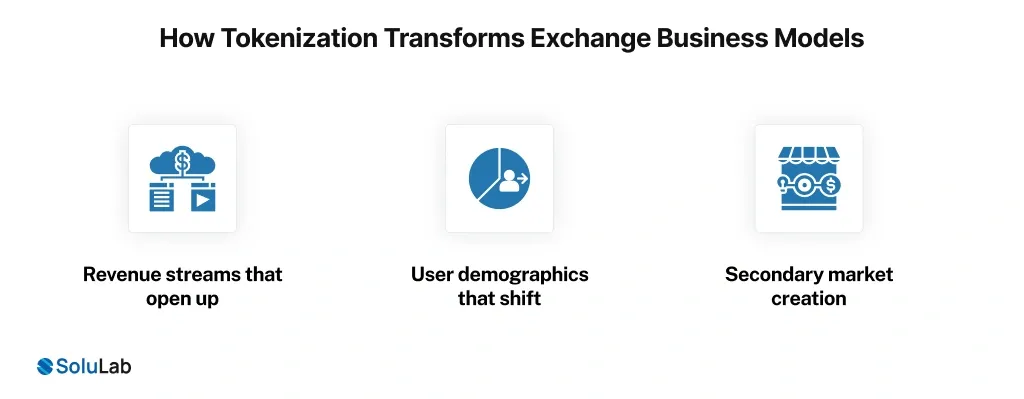
How Tokenization Transforms Exchange Business Models
This is where it gets genuinely interesting for anyone thinking about unit economics.
When you invest in proper Crypto Exchange Tokenization Development, you’re not just adding an asset class. You’re changing the shape of how your business makes money, and that shift compounds over time.
1. Revenue streams that open up:
- Listing fees for tokenized assets (typically higher than standard spot listings due to compliance overhead)
- Custody and settlement fees for institutional token holders
- Compliance-as-a-service revenue, where you function as the regulated on-ramp for asset managers
- Yield products and structured products built on tokenized fixed-income instruments
2. User demographics that shift:
Standard decentralized crypto exchange development attracts retail. But building for tokenized assets starts pulling in family offices, asset managers, corporate treasuries, and pension fund allocators. These users bring larger transaction sizes, lower churn, and very different onboarding expectations, which is both an opportunity and a design challenge.
3. Secondary market creation:
This is the part most people miss. One of the strongest value propositions of Tokenization development services is that they create liquid secondary markets for assets that were historically illiquid, like private equity, real estate, and private credit. When your exchange becomes the infrastructure layer for those secondary markets, the strategic value of your platform increases significantly. You’re not just a trading venue, you’re market infrastructure.
Securitize has crossed $1 billion in issued tokens and now administers $38 billion across 715 funds, positioning itself as an end-to-end provider linking primary issuance and secondary marketplaces.That’s the direction the most sophisticated players are moving.
Tokenized Assets Supported by Modern Crypto Exchange Platforms
Not every exchange needs to support every asset class. But here’s the landscape as it stands in 2026:
| Asset Class | Tokenization Complexity | Regulatory Sensitivity | Market Maturity |
| US Treasuries / Fixed Income | Medium | Very High | High |
| Private Credit | High | High | Growing Fast |
| Real Estate | High | Medium-High | Established |
| Commodities (Gold, Carbon Credits) | Medium | Medium | Growing |
| Private Equity / Venture | Very High | High | Emerging |
| Stablecoins / CBDCs | Low-Medium | High | Mature |
| IP / Royalties | High | Low-Medium | Early |
Private credit made up 61% of tokenized assets as of April 2025, with treasuries at 30%, commodities at 7%, and institutional funds at 2%. These proportions tell you a lot about where institutional appetite actually sits versus where retail attention is focused.
Most of the exchanges we work with start with commodities or tokenized treasuries, like lower legal complexity, strong institutional demand, a clear regulatory path, and expand from there.
Technical Architecture of a Tokenized Crypto Exchange
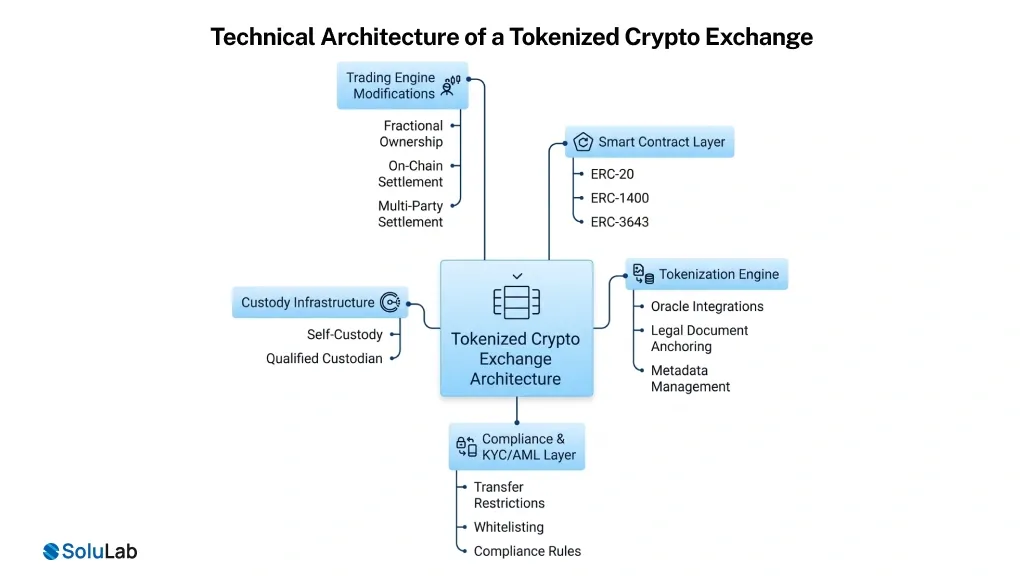
This is where most teams get it wrong. Tokenization gets treated as a feature to bolt on, when it actually needs to be a foundational layer in the architecture. Retrofitting it later is expensive and, in some cases, impossible without a substantial rebuild.
A properly structured Build tokenized crypto exchange platform typically has these layers working together:
1. Smart Contract Layer
ERC-20 handles fungible tokens. But for regulated securities, ERC-1400 (or ERC-3643 for permissioned tokens) is the more appropriate standard, it supports transfer restrictions, whitelisting, and compliance rules at the contract level. The choice of standard here has long-tail consequences.
2. Tokenization Engine
Middleware that handles the conversion of real-world asset data into on-chain representations including oracle integrations for pricing, legal document anchoring, and metadata management. This is where the real world meets blockchain technology handoff actually happens, and it requires careful design.
3. Compliance & KYC/AML Layer
Transfer restrictions need to be enforced at the smart contract level, not just at the UI. This is the piece most teams underestimate. If you’re building compliance as a frontend filter and your smart contracts have no restrictions built in, you have a gap that regulators and bad actors will find.
4. Custody Infrastructure
Are you self-custodying? or Using a qualified custodian? The answer changes your architecture significantly, especially for regulated assets with specific custody requirements.
5. Trading Engine Modifications
Your existing matching engine likely needs updates to handle fractional ownership, on-chain settlement finality, and multi-party settlement flows that don’t exist in standard spot trading.
Centralized Crypto exchange development services that include architecture reviews before writing a single line of code are worth the investment. The decisions made at this layer constrain everything that comes after them.
Regulatory, Compliance, and Security Requirements for Tokenization in Crypto Exchanges
Compliance is the hard part of tokenization in crypto exchange development. Let’s be direct about that. Different asset classes trigger entirely different regulatory requirements:
- Security tokens (equity, bonds, private credit) – require securities licenses in most jurisdictions: Broker-Dealer registration in the US, VASP authorization in the EU, DPIIT/SEBI compliance in India
- Commodity tokens (gold, oil, carbon credits) – Generally lighter but still jurisdiction-specific
- RWA tokens – Vary widely from real estate tokens in the UAE, which operate under a completely different framework than real estate tokens in Germany
The good news is that regulatory clarity has improved substantially. Regulatory progress has advanced across major hubs: the US (GENIUS Act), UK (Digital Securities Sandbox), Singapore and Australia (Project Guardian, Project Acacia pilots), Japan (crypto bill expected by 2026), and Hong Kong (stablecoin licenses expected in early 2026).
The role of tokenization in crypto exchange development in a compliant context means KYC checks, accredited investor verification, jurisdiction-based blocking, and on-chain audit trails are built into the protocol from day one, not appended later.
On security: tokenized exchanges are high-value targets. The architecture needs multi-sig custody for treasury assets, mandatory smart contract audits (not optional), real-time monitoring for on-chain anomalies, and segregated hot/cold wallet infrastructure.
Every single tokenized exchange that has been exploited had at least one of these missing.
Build vs White-Label vs Integrate: Which is right for you?
This is one of the most common questions we get, and it’s the right one to ask early.
1. Build from Scratch
Best for well-funded teams with 12–18 months of runway and a clear need for proprietary differentiation. Full control, but the price is time, $800K to $2.5M and 12+ months to do it properly. As a Crypto development company, we’ve led these projects, and the honest answer is they’re not right for everyone.
2. White-Label Solutions
Best for startups that need to launch fast and prove market fit before committing to a full build. You get to market in 4–8 weeks. But most white-label solutions weren’t built with tokenization in mind, which means you’ll eventually hit architectural walls that force a rebuild anyway.
3. Integrate via APIs
Best for existing exchanges that want to add white label Crypto Exchange capabilities without a full platform overhaul. This is usually the smartest path for mature platforms with existing users and volume. You’re extending what works, not starting over.
The right answer for you comes from a conversation about your specific context – timeline, capital, regulatory jurisdiction, existing user base, and competitive positioning.
But the framework above gives you the starting point.
Cost & Timeline to Build a Tokenization-Ready Crypto Exchange Platform
Here’s an honest breakdown based on crypto exchange development services we’ve delivered:
| Build Type | Timeline | Estimated Cost Range |
| Full Custom Build | 12–18 months | $800K – $2.5M |
| White-Label + Tokenization Layer | 3–6 months | $150K – $400K |
| Integration (Existing Exchange) | 2–4 months | $80K – $250K |
| MVP / Pilot (Single Asset Class) | 6–10 weeks | $40K – $100K |
These are ranges, not quotes, your actual number depends on jurisdiction, compliance requirements, asset classes, team size, and integrations.
But they give you a working mental model for planning.
One thing worth factoring in: the cost of not building is also real. Every month without tokenization capabilities is a month you’re not capturing institutional volume that your competitors are actively pursuing.
Real-World Use Cases Showing the Role of Tokenization in Crypto Exchange Development
The Tokenization trends in crypto exchanges aren’t projections on a slide deck. They’re already showing up in how the biggest platforms are allocating engineering resources.
1. BlackRock + Coinbase (BUIDL Fund)
BlackRock’s BUIDL tokenized money-market fund, built on Ethereum and accessible through Coinbase infrastructure, became one of the fastest-growing tokenized products ever launched. BlackRock’s USD Institutional Digital Liquidity Fund attracted over $550 million within months of launch, showing clear appetite for on-chain treasury alternatives. This isn’t a side experiment, it’s a strategic infrastructure play.
2. JPMorgan Kinexys
JPMorgan’s Kinexys network processed $1.5 trillion in tokenized transactions by the end of 2024 and is piloting on-chain foreign exchange settlement. That scale tells you everything about where institutional settlement is heading.
3. Binance
Binance has adopted tokenized Treasuries in off-exchange settlement, a quiet but significant infrastructure shift toward using tokenized assets as collateral in institutional trading flows.
4. Kraken & xStocks
Demonstrate how tokenization is already live at the exchange layer. Through xStocks, Kraken enables users to gain on-chain exposure to tokenized versions of traditional equities, allowing 24/7 trading, fractional ownership, and blockchain-based settlement.
5. Regional Exchanges in the UAE, Singapore, Southeast Asia
Some of the most interesting real estate tokenization development services work is happening at regionally focused exchanges where regulatory frameworks are clearer, and the addressable market for tokenized local assets (real estate, private equity, commodities) is significant and underserved.
The consistent pattern: exchanges that invest early in tokenization infrastructure build competitive positions that are genuinely hard to replicate once the market consolidates around a handful of platforms per region.
Common Mistakes When Building Tokenized Crypto Exchange Platforms
We’ve seen the same errors come up repeatedly. Worth calling them out directly.
1. Building compliance as a layer instead of a foundation.
Exchanges that get into trouble are the ones that build trading functionality first and try to retrofit compliance later. If your transfer restrictions live in the UI and not in the smart contract, you have a gap.
2. Underestimating custody complexity.
Tokenized RWAs often require coordination between on-chain wallets and off-chain legal structures. Ignoring this creates gaps that both regulators and bad actors will find.
3. Using the wrong token standard.
ERC-20 works for fungible tokens. But for security tokens with transfer restrictions, ERC-1400 or ERC-3643 are more appropriate. Using the wrong standard creates technical debt that’s painful and expensive to fix under production load.
4. Launching without a liquidity strategy.
A tokenized asset with no buyers is worse than no asset at all. Crypto exchange platforms need liquidity built in from day one, whether that’s market makers, institutional anchor partners, or bootstrapped pools. Token listing without a liquidity plan is a credibility problem, not just a volume problem.
5. Ignoring Oracle integrity.
Pricing data for RWAs often comes from off-chain sources. If your Oracle integration fails or gets manipulated, your trading engine can be compromised at scale. Redundancy here isn’t optional.
Is Tokenization the Right Strategy for Your Crypto Exchange Platform?
Honestly, not always. And it’s worth being clear about that.
If you’re running a small retail exchange still working on product-market fit, start crypto exchange platform probably isn’t your next move. Get the core right first.
But if you’re at a point where:
- You have consistent volume and a working exchange
- You’re looking for genuine differentiation that’s hard to copy
- You have institutional users or are actively trying to attract them
- You operate in a jurisdiction with an emerging or established regulatory framework
- You have the engineering and compliance capacity to execute properly
Then, tokenization isn’t a nice-to-have. It’s the logical next phase of your platform.
The Tokenization trends in crypto exchanges are all pointing in one direction. Over 200 institutional RWA projects are already underway, supported by more than 40 leading financial institutions.
The infrastructure is maturing, regulatory clarity is improving across major jurisdictions, and the institutional demand is documented and growing. Tokenization in crypto exchanges is no longer a future bet, it’s a present decision about whether you’re building for where capital is going.
How We Deliver Tokenization-Ready Crypto Exchange Development Solutions
At Solulab, Cryptocurrency exchange Development Solutions has been our core focus since the early years of blockchain. But over the last three years specifically, we’ve doubled down on exchange tokenization infrastructure because that’s where the market is concentrating and where we can add the most real value.
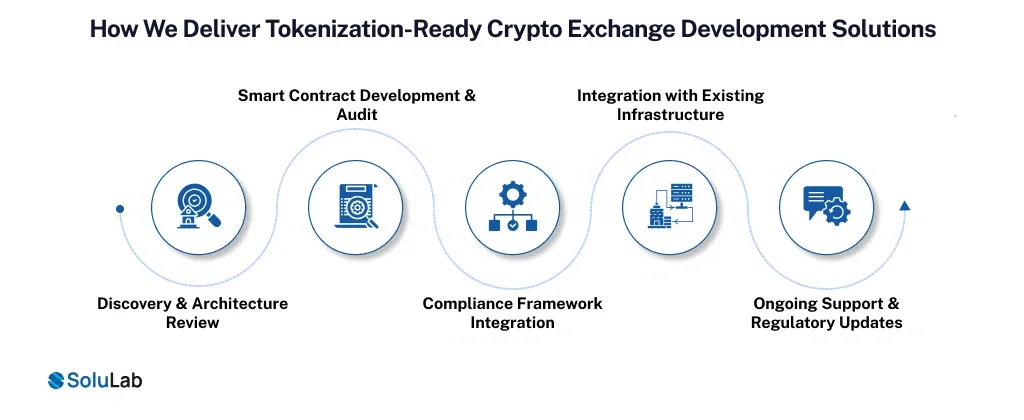
Here’s what working with us looks like:
1. Discovery & Architecture Review
We start by understanding your current platform, your target markets, and your regulatory environment. From there, we design a tokenization layer that fits your context, not a template built for someone else’s problem.
2. Smart Contract Development & Audit
We write, test, and audit the smart contracts governing your tokenized assets. The audit step is non-negotiable; it’s part of our process, not an upsell.
3. Compliance Framework Integration
KYC/AML, accredited investor checks, jurisdiction-based transfer restrictions, built into the protocol at the contract level, not appended at the UI layer.
4. Integration with Existing Infrastructure
If you have a working exchange, we integrate the tokenization layer without requiring a full rebuild. Our experience with p2p crypto exchange development means we know how these systems are constructed and where the cleanest integration points are.
5. Ongoing Support & Regulatory Updates
Regulations change sometimes significantly and on short timelines. We stay current and update your compliance layer accordingly.
As a Crypto tokenization platform development company, we’ve worked with exchanges across three continents. The problems tend to be similar across markets. The solutions are always specific to context.
Our Crypto exchange development services, which include ongoing regulatory support are becoming table stakes as the compliance landscape evolves. That’s built into how we work.

Conclusion
The shift from spot-only trading to tokenized asset exchanges isn’t a trend you can monitor from the sidelines. It’s a structural change in how capital markets operate and the window for building first-mover infrastructure is narrowing.
The global tokenized RWAs market is expected to reach $9.43 trillion by 2030, at a CAGR of 72.8%. The exchanges that build the right infrastructure now, get the compliance layer right, and attract institutional users before the market consolidates, those are the platforms that will matter in the next decade.
Even Tokenization trends in crypto exchanges aren’t pointing in two directions. The regulatory clarity is improving, the institutional demand is documented and growing, and the technology is past the experimental stage. What’s missing for most exchanges is the execution partner who’s done it before and knows where the real complexity sits. Our blockchain Development Solutions are built around AI powered infrastructure, which separates exchanges that scale into the next cycle from those that stay in the current one.
FAQs
With over 3 years of experience, I specialize in breaking down complex Web3 and crypto concepts into clear, actionable content. From deep-dive technical explainers to project documentation, I help brands educate and engage their audience through well-researched, developer-friendly writing.