Key Takeaways
- Narrative, search volume, and deployed capital are three different signals, and in 2026 they point in different directions. Treating them as one number is how teams build into a rotation that has already ended.
- Tokenization is overwhelmingly a stablecoin story. The headline totals that get quoted as real-world asset adoption are dominated by dollar stablecoins, with treasuries, credit and gold a small remainder.
- DePIN shows the clearest split between fundamentals and price. Revenue and funding have grown while tokens from the earlier cohort sit far below their highs.
- The durable clusters share one trait: a paying customer who is not a speculator. Where revenue comes from token emissions rather than users, the narrative has a shelf life.
- Picking a cluster is an architecture decision, not a marketing one. Compliance posture, chain choice and token design all follow from it, and they are expensive to reverse.
Crypto narratives move faster than crypto products, which is why so much engineering effort lands six months after the capital has rotated. The gap between attention and money is the useful thing to measure.
Deloitte’s Center for Financial Services projects more than $4 trillion of real estate tokenized on blockchain networks by 2035, up from under $300 billion in 2024, a compound growth rate above 27%.
That is a genuine decade-long structural trend. It is also not what most of today’s on-chain value actually is, and the difference matters if you are deciding what to build.
This guide maps the six crypto narratives in 2026 clusters drawing both search interest and capital, separates those two signals because they no longer move together, and says plainly which clusters have paying customers underneath them and which are running on attention alone.
Crypto narratives move faster than crypto products, which is why so much engineering effort lands six months after the capital has rotated. The gap between attention and money is the useful thing to measure.
Deloitte’s Center for Financial Services projects more than $4 trillion of real estate tokenized on blockchain networks by 2035, up from under $300 billion in 2024, a compound growth rate above 27%.
That is a genuine decade-long structural trend. It is also not what most of today’s on-chain value actually is, and the difference matters if you are deciding what to build.
This guide maps the six crypto narratives in 2026 clusters drawing both search interest and capital, separates those two signals because they no longer move together, and says plainly which clusters have paying customers underneath them and which are running on attention alone.

Why Narrative, Search and Capital Decoupled in 2026
This is the section most trend pieces skip, and it is the one that changes decisions.
Token Terminal’s September 2026 snapshot put on-chain tokenized assets at $346.1 billion across 47 distinct asset types. The composition is the story. Dollar stablecoins account for roughly $298.5 billion, about 86.2% of the total. Everything else, the treasuries and credit and commodities that dominate tokenization discourse, comes to around $47.6 billion: US
Treasuries at $15 billion, yield strategies at $10.5 billion, credit funds at $6.4 billion, gold at $5.1 billion and tokenized stocks at just $2.4 billion, or 0.7% of the whole. RWA.xyz, using a narrower methodology, counts roughly $38 billion to $39 billion.
So the tokenization narrative is real and the tokenization market is, for now, mostly a stablecoin market.
DePIN shows the opposite divergence. Messari and Escape Velocity’s State of DePIN report recorded $72 million of on-chain revenue across the sector in 2025 and roughly $1 billion raised, up from $698 million in 2024, while tokens from the 2018 to 2022 cohort sat 94% to 99% below their all-time highs.
Helium’s on-chain revenue rose about eightfold between December 2024 and December 2025; its token fell 77% over the same window. Leading projects trade at 10 to 25 times revenue.
1. What the Divergence Tells You
Fundamentals and price are measuring different things. A cluster can have improving revenue and collapsing tokens, which is a buying signal for builders and a warning for anyone whose business model depends on token appreciation.
2. Narrative Heat Versus Capital Deployed
| Cluster | Search and narrative heat | Capital and fundamentals | Honest read |
| RWA and tokenization | Very high | $47.6bn excluding stablecoins; Deloitte projects $4tn real estate by 2035 | Real structural trend, much earlier than the discourse implies |
| Stablecoin rails | Moderate | ~$298.5bn, 86.2% of all tokenized value | The quiet giant. Least hype, most actual volume |
| AI and crypto | Very high | Large token market caps, thin verifiable revenue | Strongest narrative, weakest proof of paying users |
| DePIN | Cooled sharply | 72m2025revenue,~1bn raised, tokens down 94 to 99% | Fundamentals improving while prices fell |
| DeFi reconstruction | Moderate | Institutional entry rising, retail speculation down | Maturing rather than growing loudly |
| Web3 consumer | Low and falling | Funding concentrated in infrastructure, not apps | Narrative has moved on; infrastructure spend continues |
The 6 Crypto Narrative Clusters of 2026
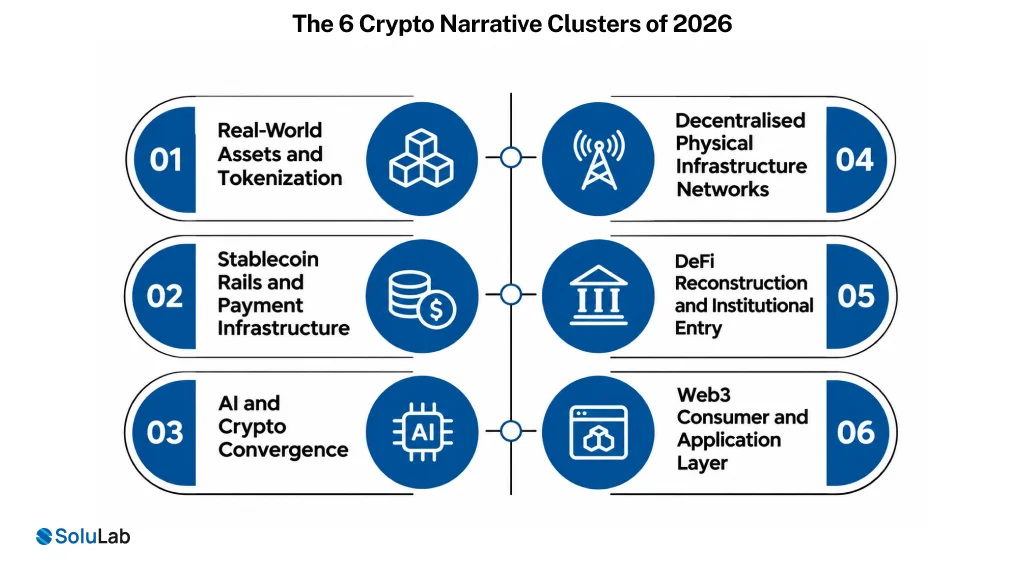
1. Real-World Assets and Tokenization
The cluster with the longest runway and the least mature infrastructure. Treasuries led institutional adoption because they are simple, yield-bearing, and uncontroversial; credit funds, private equity and commodities follow.
Real estate is the largest theoretical prize and the slowest mover, because title, jurisdiction and liquidity problems are legal rather than technical. The bottleneck is not issuance, which is largely solved, but secondary liquidity and transfer-agent plumbing. Teams entering here need tokenization platform development experience that covers compliance registries and investor whitelisting, not just a token contract.
2. Stablecoin Rails and Payment Infrastructure
The least glamorous cluster and the one with the most genuine volume. Regulatory clarity in several jurisdictions turned stablecoins from a crypto-native instrument into a payments primitive, and the growth is now coming from B2B settlement, remittance corridors and treasury operations rather than trading collateral.
The competitive layer has moved from issuing a coin to the orchestration around it: compliance screening, fiat on and off ramps, multi-chain routing and reconciliation. Serious stablecoin development work in 2026 is mostly that orchestration layer.
3. AI and Crypto Convergence
The loudest narrative and the hardest to verify. Three sub-themes behave very differently. Agent payments and machine-to-machine settlement have a plausible, near-term use case. Decentralised compute and inference markets have real demand but compete against hyperscaler pricing.
Tokenised model ownership and data marketplaces remain mostly aspirational. Our work on AI blockchain development and on AI agents in crypto covers where the architecture genuinely holds up. The honest filter is simple: ask who pays, in what currency, for what unit of work.
4. Decentralised Physical Infrastructure Networks
The cluster that already went through its hype cycle, which is why it is interesting. Wireless, mapping, energy and compute networks built real coverage and real revenue, then watched their tokens fall.
What survived is the model where token incentives bootstrap supply and then genuine customers pay for the service. Energy and AI-adjacent compute are setting the pace now. The guide to decentralised physical infrastructure networks covers the mechanics; the commercial lesson is that emissions-funded revenue is not revenue.
5. DeFi Reconstruction and Institutional Entry
DeFi stopped being a growth story and became an infrastructure one. Volumes concentrated into fewer venues, yields compressed toward something defensible, and the interesting work moved to permissioned pools, on-chain credit with real underwriting and compliance-aware liquidity.
Our DeFi development practice sees far more requests for institutional-grade controls than for novel yield mechanics, and our running analysis of DeFi trends tracks that shift in detail.
6. Web3 Consumer and Application Layer
The cluster where narrative heat has fallen furthest, and where honest assessment matters most. Consumer Web3 applications largely failed to retain users who did not arrive for speculation, and funding rotated to infrastructure.
What persists is narrower and more defensible: identity and reputation primitives, in-game economies where the game is good independently, and creator monetisation with genuine off-chain distribution. Most Web3 development demand now comes from existing businesses adding on-chain components rather than from crypto-native consumer startups.
How to Tell a Durable Narrative From a Rotation
Four questions we use with clients before committing an architecture to a cluster.
1. Who Is the Paying Customer, and Are They a Speculator?
If the revenue line traces back to token emissions or trading fees from speculative volume, the business is correlated to the narrative rather than insulated from it. DePIN’s survivors are the ones with customers buying a service.
2. Does Revenue Grow When the Token Price Falls?
The strongest evidence a cluster has real demand. A network whose usage and cash flow keep climbing through a token drawdown is telling you something its price is not.
3. Is the Regulatory Direction Clarifying or Tightening Unpredictably?
Stablecoins moved from ambiguity toward defined rules, and institutional volume followed. Clusters where the regulatory question is still open carry a timing risk no amount of engineering removes.
4. Would the Product Still Make Sense Without a Token?
If the answer is yes, the token is a distribution and incentive mechanism, which is a healthy position. If the product collapses without it, the token is the product and you are in the narrative business.
What to Build in Each Cluster
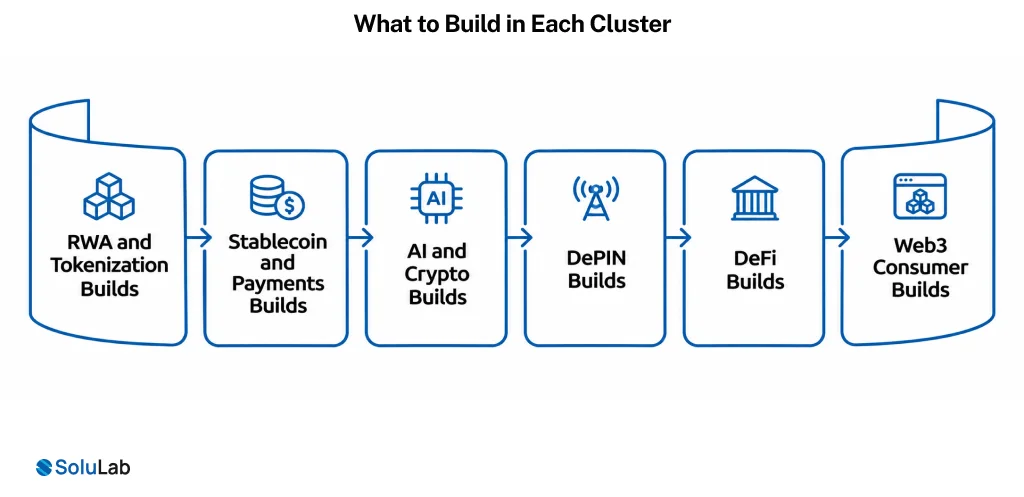
Here’s what you can build in each cluster:
1. RWA and Tokenization Builds
Issuance contracts with transfer restrictions, investor accreditation and whitelist registries, corporate action handling, and a secondary venue or transfer agent integration. The compliance layer is most of the work.
2. Stablecoin and Payments Builds
Multi-chain treasury orchestration, compliance screening, fiat ramp integration, settlement reconciliation and merchant APIs. Issuing the token is the smallest line item.
3. AI and Crypto Builds
Agent wallets with spending limits, verifiable inference attestations, payment channels for micro-settlement, and oracle design for off-chain compute results.
4. DePIN Builds
Device onboarding and attestation, proof-of-coverage or proof-of-contribution mechanics, emissions schedules that taper into real revenue, and hardware supply chain integration.
5. DeFi Builds
Permissioned pool architecture, on-chain underwriting and credit scoring, oracle redundancy, and risk parameter frameworks with monitoring.
6. Web3 Consumer Builds
Account abstraction and gasless onboarding, identity and reputation primitives, and progressive disclosure so a user never has to understand the chain.
Across all six, the constant is that the contract is the smaller half. A blockchain development company worth engaging will spend more time on your compliance posture, key management and integration surface than on the token itself.
Risks and What Could Break Each Narrative
Here are some risks of crypto narrative clusters:
1. Regulatory Reversal in Stablecoins
The cluster carrying 86.2% of tokenized value is also the one most exposed to a single policy change. Concentration is a risk even when the direction of travel looks favourable.
2. AI Crypto Failing the Revenue Test
Gartner expects more than 40% of agentic AI projects to be cancelled by the end of 2027, mostly for unclear business value and inadequate controls. Crypto-AI projects face that plus token market risk, which is a demanding combination.
3. Tokenized Asset Liquidity Never Arriving
Tokenizing an asset is straightforward. Creating a market where someone will buy it at a fair price is not. A tokenized asset with no secondary liquidity is a database entry with extra steps.
4. DePIN Economics Not Closing
Networks that cannot replace token emissions with customer revenue before incentives taper will shed supply. This is a timing problem, and it has already ended several projects.
5. Compliance Cost Outrunning Margin in DeFi
Institutional-grade controls add real operating cost. Protocols that bolt them on without repricing can end up compliant and unprofitable.
6. Consumer Web3 Retention Staying Broken
If users keep arriving for incentives and leaving when they stop, the application layer stays dependent on the next rotation rather than building a base.
How SoluLab Can Help
We have built on-chain systems since 2014, across tokenization, stablecoins, DeFi and AI-blockchain convergence.
1. Cluster and Architecture Strategy
We pressure-test which cluster your product actually belongs in, what that commits you to on compliance and chain choice, and what it would cost to be wrong.
2. Tokenization and RWA Platforms
Issuance, transfer restrictions, investor registries, corporate actions and secondary market integration, built for the jurisdictions you are actually selling into.
3. Stablecoin and Payment Infrastructure
Multi-chain orchestration, compliance screening, ramp integration and reconciliation, delivered as the operational layer rather than a token launch.
4. DeFi and Smart Contract Engineering
Protocol contracts with invariant and fuzz testing, audit coordination, oracle redundancy and post-deployment monitoring.
5. AI and Blockchain Convergence Builds
Agent wallets, machine-to-machine settlement, verifiable compute attestation and the integration work between model infrastructure and on-chain logic.

Conclusion
Stablecoin rails carry the overwhelming majority of actual on-chain value with the least narrative noise around them. Tokenization is a genuine decade-long trend that is far earlier than the discourse suggests.
DePIN is improving underneath prices that fell hard. AI and crypto have the loudest story and the thinnest evidence of paying users. DeFi is maturing into infrastructure, and consumer Web3 is quietly rebuilding on narrower ground. If you are choosing where to build, follow the capital column and the paying customer, not the search volume, because the narrative will have rotated by the time you ship.
If you are deciding which cluster fits your product, or how to architect for it without betting the company on a rotation, SoluLab, a crypto token development company, can help your business scope it properly. Book a strategy call, and we will work through the trade-offs with you.
FAQs
Neha is a curious content writer with a knack for breaking down complex technologies into meaningful, reader-friendly insights. With experience in blockchain, digital assets, and enterprise tech, she focuses on creating content that informs, connects, and supports strategic decision-making.