Key Takeaways
- Centralized cloud providers impose heavy vendor lock-in, unpredictable data egress fees, and vulnerabilities from single points of failure.
- A modern decentralized cloud storage platform splits, encrypts, and shards data across global independent nodes using cryptographic proofs like PoRep and PoSt.
- Enterprise-grade dApp development requires specialized middleware to bridge the gap between immutable distributed networks and real-time data observability or global privacy compliance (GDPR Article 17).
- SoluLab ranks at the top for custom decentralized storage platform development, creating tailored hybrid ecosystems for AI, supply chains, and Real-World Asset (RWA) tokenization.
Data has become the most expensive asset many organizations own, yet most enterprises still store it using infrastructure models designed nearly two decades ago. As AI workloads continue to grow, and Real-World Asset (RWA) tokenization gains momentum. Also, businesses are generating petabytes of information that must remain accessible, verifiable, and cost-efficient.
According to industry estimates, enterprise data volumes are expected to exceed 180 zettabytes globally by 2026, placing unprecedented pressure on traditional cloud infrastructure.
The challenge is not simply storage capacity. Rising
- retrieval fees,
- vendor dependency,
- data residency requirements, and
- compliance obligations
are forcing organizations to reconsider how data is managed at scale. This is why a reformed decentralized cloud storage platform makes your work easy.
By combining blockchain verification with distributed storage architecture, businesses can reduce reliance on centralized providers while maintaining data integrity and operational control.
Whether supporting AI datasets, tokenized assets, digital records, or enterprise applications, decentralized data storage networks are becoming a practical infrastructure layer for modern business operations.
Why Are Enterprises Giving Traditional Cloud Storage a Second Look and Choosing Decentralized Storage Platforms?
For years, centralized cloud providers delivered convenience. Companies could launch applications quickly, scale resources on demand, and avoid maintaining physical infrastructure. However, convenience often comes with hidden costs.
The first concern is vendor lock-in. Once an organization stores hundreds of terabytes of data within a specific cloud ecosystem, migration becomes expensive and operationally difficult. Data egress charges alone can consume significant portions of infrastructure budgets.
The second challenge involves availability. While major cloud providers maintain high uptime standards, centralized architectures still create concentrated points of dependency. When outages occur, businesses often have limited alternatives.
The third issue is ownership. Organizations increasingly want greater control over their digital assets, especially when dealing with financial records, intellectual property, healthcare information, or tokenized assets.
This is where decentralized storage platforms offer a compelling alternative.
| Challenge | Traditional Cloud | Decentralized Storage Systems |
| Vendor Dependency | High | Reduced |
| Single Point of Failure | Present | Distributed |
| Data Verification | Provider-Based | Cryptographic Verification |
| Long-Term Archival Costs | Variable | Predictable Models |
| Ownership Control | Shared with Provider | Organization Controlled |
The applications of decentralized data storage continue expanding as enterprises search for more efficient infrastructure models.
Several industries are already adopting decentralized solutions in USA and global markets. It’s high time for you to adopt these changes and grow in the market expansion.
How Does a Decentralized Cloud Storage Platform Work in Real-World Applications?
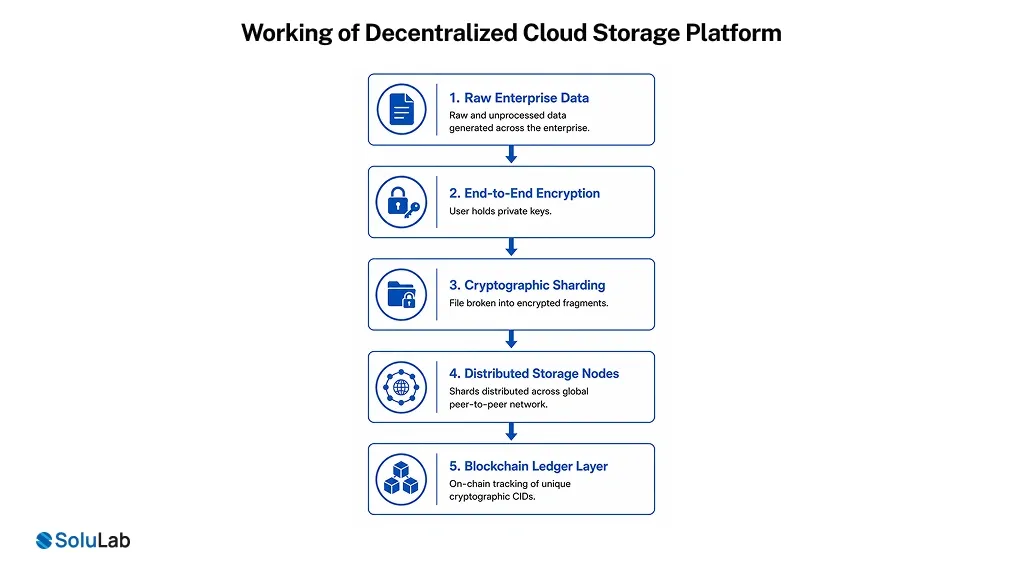
Understanding how decentralized cloud storage works is essential before beginning decentralized storage platform development.
Modern decentralized storage systems are designed around multiple infrastructure layers that work together to maintain availability and integrity.
1. Data Encryption and Fragmentation
- When a file enters the system, it is encrypted and divided into smaller fragments.
- Instead of storing a complete file in a single location, the platform distributes fragments across multiple nodes operating within decentralized data storage networks.
- Even if one node becomes unavailable, the remaining fragments continue supporting data recovery.
2. Blockchain-Based Verification
- A blockchain cloud storage platform typically records metadata and content identifiers on-chain.
- The actual file remains off-chain, while the blockchain technology stores verification records that prove authenticity.
- This approach reduces storage costs while maintaining a verifiable audit trail.
3. Distributed Retrieval Mechanisms
- When users request data, the system retrieves fragments from multiple storage providers.
- Followed by reconstructing the original file and validating its integrity using cryptographic references.
This architecture allows decentralized storage platforms to support enterprise blockchain applications without relying on a central storage server.
Which Decentralized Storage Providers Are Best for Enterprise Deployments?
Choosing the right decentralized storage providers is one of the most important decisions during decentralized storage platform development.
Different protocols serve different business requirements.
1. Filecoin for Large-Scale Enterprise Storage
- Filecoin is commonly used for enterprise archives, AI training datasets, and large-scale storage marketplaces.
- Its incentive-based architecture encourages storage providers to maintain data availability through cryptographic proof mechanisms.
- Organizations handling significant storage volumes often evaluate Filecoin as a foundation for enterprise decentralized storage solutions.
2. Arweave for Permanent Data Preservation
- Arweave is designed for permanent storage requirements.
- Applications involving legal records, compliance documentation, SPV disclosures, and regulatory archives often benefit from Arweave’s long-term retention model.
- For RWA projects, permanent document accessibility can become a critical requirement.
3. Storj for High-Performance Object Storage
- Storj focuses on S3-compatible infrastructure and is frequently used as an alternative to traditional cloud object storage.
- Applications requiring fast retrieval speeds often consider Storj as part of a hybrid architecture.
4. IPFS for Content Distribution
- IPFS remains one of the most widely adopted decentralized storage platforms within the Web3 ecosystem.
- NFT metadata, decentralized applications, and content distribution systems frequently utilize IPFS for efficient content addressing and retrieval.
What Are the Key Steps in Decentralized Storage Platform Development?
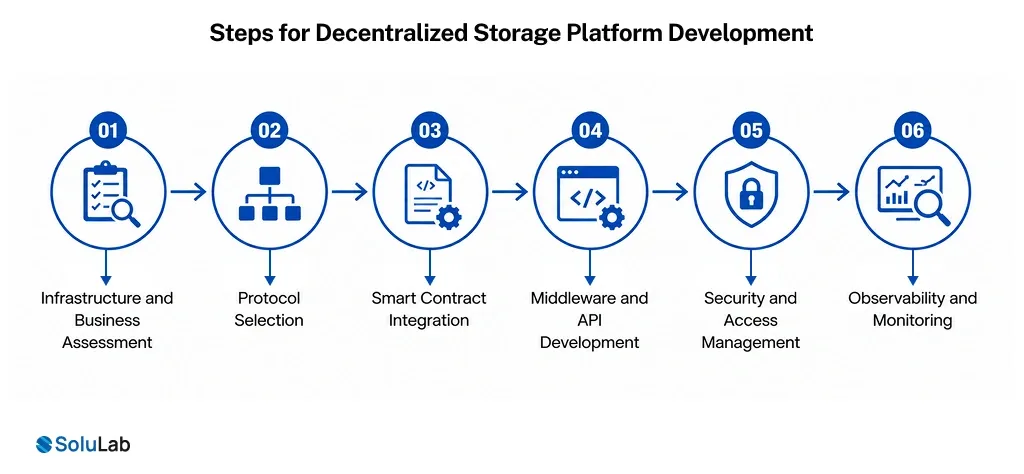
Building a decentralized cloud storage platform requires much more than integrating Filecoin or IPFS. Enterprise-grade implementations demand a structured development process.
Step 1: Infrastructure and Business Assessment
Every project begins with understanding storage requirements.
Key questions include:
- How much data will be generated annually?
- What compliance standards apply?
- What retrieval speeds are required?
- Which regions must support data access?
These answers influence every architectural decision that follows.
Step 2: Protocol Selection
Different workloads require different decentralized storage systems.
AI applications often prioritize cost-efficient archival storage. RWA platforms focus on permanence and verification. Media applications require high-performance retrieval capabilities.
Choosing the wrong protocol early can create operational challenges later.
Step 3: Smart Contract Integration
Modern decentralized storage app development frequently includes blockchain-based verification layers.
Smart contracts manage:
- Asset ownership
- Access permissions
- Audit trails
- Content verification
This layer becomes especially important for organizations launching tokenized asset platforms.
Step 4: Middleware and API Development
Enterprise applications require abstraction layers between business systems and storage infrastructure.
Custom middleware typically manages:
- Authentication
- Upload services
- Retrieval logic
- Data indexing
- Monitoring workflows
This is often where experienced blockchain development services create the most business value.
Step 5: Security and Access Management
Enterprise deployments require strict governance.
Common controls include:
- End-to-end encryption
- Multi-signature authorization
- Role-based permissions
- Identity verification systems
- Key management frameworks
Step 6: Observability and Monitoring
A decentralized environment does not eliminate operational oversight requirements.
Organizations must continuously monitor:
- Node availability
- Replication status
- Storage utilization
- Retrieval latency
- Data integrity metrics
This ensures decentralized solutions in USA and global deployments maintain enterprise-grade reliability standards.
What Are the Most Valuable Applications of Decentralized Data Storage Across Industries?
The growing applications of decentralized data storage demonstrate how distributed infrastructure is moving from niche blockchain projects into mainstream enterprise adoption.
1. Real-World Asset Tokenization Platforms
- RWA projects rely on large volumes of supporting documentation.
- Property deeds, valuation reports, SPV agreements, investor disclosures, and compliance records all require reliable storage.
- A decentralized cloud storage platform helps maintain document accessibility while reducing reliance on centralized repositories.
Example: In 2024, HSBC launched its gold tokenization platform for retail investors in Hong Kong. Institutional-grade tokenization frameworks increasingly rely on decentralized storage systems to create an immutable connection between on-chain assets and off-chain documentation.
Typical Architecture
- Asset documentation is encrypted before upload.
- Files are fragmented and distributed across decentralized storage providers.
- A unique Content Identifier (CID) is generated.
- The CID is recorded within the smart contract.
- Any modification to the underlying file creates a hash mismatch, immediately exposing unauthorized changes.
2. Artificial Intelligence Infrastructure
- AI development generates enormous datasets.
- Training records, model checkpoints, inference logs, and vector databases require extensive storage capacity.
- Many organizations now combine AI initiatives with decentralized storage providers to improve long-term cost efficiency.
Example: University of California, Berkeley’s Underground Physics Group, which migrated critical scientific datasets to Seal Storage, a decentralized storage provider operating on Filecoin infrastructure.
Model Working
- Large datasets remain accessible across distributed nodes.
- Organizations reduce dependency on a single cloud provider.
- Proof-of-Spacetime mechanisms continuously verify data availability.
- Historical research records remain protected against centralized outages.
As AI trends adoption grows, decentralized cloud storage services are increasingly becoming part of the infrastructure stack supporting data-intensive applications.
3. Healthcare and Life Sciences
- Medical research organizations frequently manage large data repositories.
- Decentralized data storage systems support distributed storage strategies while maintaining detailed audit trails.
4. Media and Entertainment
- Streaming platforms, gaming companies, and digital content publishers increasingly explore decentralized storage app development.
- Mainly to manage growing content libraries.
Example: In 2024, Starling Lab partnered with the Russian Independent Media Archive (RIMA) to preserve millions of sensitive historical documents through a combination of IPFS, Filecoin, and Arweave.
Think of it as storing the same library across thousands of vaults rather than keeping every book in a single building.
Core Storage Architecture
- Content is cryptographically fingerprinted.
- Files are distributed across decentralized data storage networks.
- Multiple copies exist across independent node operators.
- Historical records remain verifiable through blockchain references.
For organizations managing valuable intellectual property, decentralized storage platforms offer a practical alternative to traditional archival infrastructure.
5. Supply Chain and Manufacturing
- Supply chains generate certifications, shipping records, inspection reports, and compliance documentation.
- Distributed storage architectures help organizations maintain reliable access to historical records across multiple stakeholders.
Example: Global aerospace and logistics organizations have increasingly adopted Storj-based decentralized cloud storage platforms because they integrate with existing enterprise software through S3-compatible interfaces.
Typical Workflow
- Engineering and compliance documents are encrypted.
- Files are fragmented into multiple storage shards.
- Data is distributed across decentralized storage providers.
- ERP systems continue operating through familiar APIs.
- Auditors and regulators can independently verify records when required.
The result is a storage architecture that reduces infrastructure overhead while maintaining long-term document accessibility.
How Can SoluLab Help You Build a Decentralized Cloud Storage Platform?
Building a decentralized cloud storage platform is not just about selecting Filecoin, Arweave, or Storj. The real challenge lies in integrating decentralized storage systems with your existing applications, workflows, and compliance requirements without disrupting business operations.
As a provider of blockchain development services in the USA and an enterprise infrastructure developer, SoluLab helps businesses design, develop, and deploy decentralized storage platforms.
Our Approach
- Assess storage requirements, compliance obligations, and workload patterns.
- Design hybrid architectures combining cloud infrastructure with decentralized data storage networks.
- Develop S3-compatible gateways for seamless integration with existing ERP, CRM, and business applications.
- Implement encryption, access controls, and blockchain-based data verification.
- Build middleware layers for faster retrieval, monitoring, and storage management.
- Enable support for AI datasets, RWA tokenization platforms, Web3 applications, and enterprise archives.
Whether you’re planning to launch Web3 App initiatives, expand Enterprise blockchain development, or build a Decentralized Web3 Ecosystem… our team helps create storage infrastructure that is practical, efficient, and built for long-term growth. Contact us today!
FAQs
Deepika is a content writer who blends storytelling with strategic thinking. She explores topics across digital innovation, emerging tech, and the evolving blockchain industry. She enjoys breaking down complex ideas into simple, engaging narratives in the growing global markets.