
Running a serious crypto operation in 2026 means one thing is crystal clear: tax compliance is no longer a back-office task – it’s a board-level risk.
| According to The Business Research Company, the global crypto tax software market will grow from $5.04 billion in 2025 to $6.04 billion in 2026 at a 19.8% CAGR, as enterprises rush to handle exploding transaction volumes and stricter reporting rules, and over 60 jurisdictions have already committed to implementing the OECD’s Crypto-Asset Reporting Framework (CARF) by 2026 |
If your team is still piecing together spreadsheets from multiple exchanges, wallets, and DeFi protocols, you’re already behind. The new IRS Form 1099-DA and the EU’s full MiCA enforcement, plus CARF/DAC8 reporting from January 2026, are forcing everyone to get audit-ready fast. That’s exactly why forward-thinking CXOs are turning to Agile AI crypto tax software.
Key Takeaways
- The Problem: Most enterprises working with crypto end up juggling different tax rules across regions, fixing numbers by hand, and still not knowing their real exposure. The tools they use weren’t made for fast, on-chain activity, which means hours are wasted and important reportable events slip through.
- The Solution: AI-powered crypto tax software operates at scale, reading millions of transactions and applying the right rules for each jurisdiction as they happen, then paired it with an immutable, time-stamped ledger and it turns compliance into something predictable.
- How SoluLab Can Help: SoluLab helps teams build AI-driven crypto tax systems that fit into existing ERP and treasury setups without disruption. Because they understand both compliance and blockchain deeply, they ship usable MVPs in weeks, then keep evolving them as regulations change.
Why Enterprises Are Prioritizing Agile AI and Blockchain in Crypto Tax Compliance?
Crypto is no longer fringe. Institutional adoption continues to climb, stablecoin usage for payments jumped sharply in 2025, and tokenized real-world assets are moving into the mainstream.
But with that growth comes scrutiny.
- In the US, brokers must issue Form 1099-DA starting with 2025 transactions (filed in 2026), with cost-basis reporting phasing in from 2026 – making every wallet transfer, DeFi swap, and staking reward reportable.
- In Europe, MiCA’s transitional period ends July 1, 2026, and the Crypto-Asset Reporting Framework (CARF) under DAC8 kicks in January 2026, requiring automatic exchange of transaction data across borders.
Non-compliance penalties are steep, audits are rising, and CFOs are being asked point-blank – Are we ready?
Enterprises holding or transacting significant crypto simply cannot afford manual processes anymore. That’s why Crypto tax software for enterprises built with AI is now table stakes.
What Agile AI and Blockchain Actually Bring to Enterprise Crypto Tax Software?
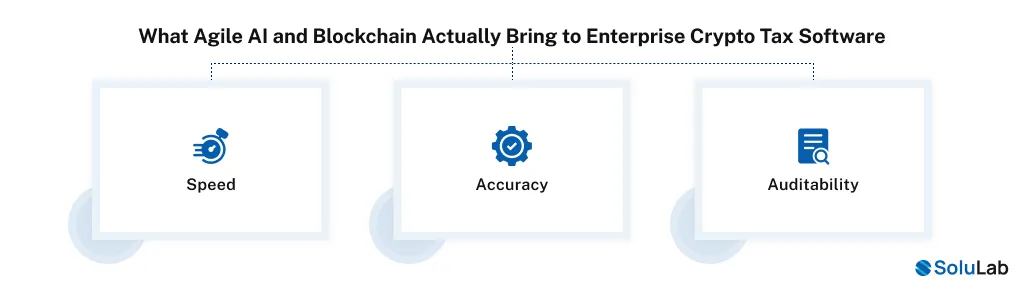
Traditional tax tools break the moment crypto volume, chains, and regulations scale. Agile AI combined with blockchain fixes that by making tax systems fast, accurate, and defensible—in real operations, not just compliance decks.
1. Speed
Agile AI models trained on millions of transactions classify activity in real time. A USDC treasury payment is tagged instantly, FMV is applied, gains are calculated, and it’s queued for filing, no month-end close, no manual cleanup. Because these platforms run on CI/CD, new chains, Layer 2s, or CARF updates ship in weeks, not quarters.
2. Accuracy
AI automation cuts enterprise compliance effort by up to 40% by parsing metadata, mapping wallets to exchanges or DeFi protocols, and applying jurisdiction-specific rules automatically. While 70%+ exchanges offer basic cost-basis exports, enterprises need cross-chain, multi-wallet aggregation that reconciles cleanly with internal accounting and that’s where AI-driven systems outperform.
3. Auditability
Every number ties back to an immutable on-chain record with cryptographic proof, FMV at execution, and the exact smart contract interaction. When auditors question a Q2 gain, you show the transaction, not a spreadsheet assumption, and compliance checks flag missing TINs or threshold breaches before they hit the books.
Enterprises using AI-powered blockchain tax software report an 80–90% reduction in manual reconciliation time and near-zero classification errors. More importantly, when MiCA, CARF, or DeFi guidance changes, teams can test and deploy updates the same day because in crypto tax, waiting a quarter is already too late.

How Enterprises Unlock Real Value with AI and Blockchain in Crypto Tax Systems?
Blockchain technology isn’t just the source of your tax headache; it’s also the solution. Here’s why Blockchain AI tax solutions for enterprises rely on decentralized ledger technology as the backbone of compliance.
1. Real-Time Liability Tracking
Once you deploy Agile AI crypto tax software, the biggest shift is visibility. Your treasury team can see tax exposure in real time, not weeks later. AI and blockchain in tax systems pull live data from every wallet and contract, apply current rules, and show liabilities by country, asset, and transaction type, no quarter-end panic.
2. Automated Cost-Basis Calculation
Cost-basis stops being a manual debate. Whether your advisors want FIFO, LIFO, or specific ID, AI-powered blockchain tax software handles it automatically. Sell 10 BTC, and the system instantly picks the right lots, calculates gains or losses, and prepares clean supporting schedules for filings like Form 8949.
3. Cross-Border Reconciliation
Cross-border compliance is where enterprises usually bleed money. Multinationals spend $50K+ per year just reconciling crypto taxes across regions. Agile AI in crypto tax automates transaction-to-tax-code mapping, so a single ETH payment can trigger VAT in Germany, GST in India, and sales tax in California, calculated separately from one unified feed.
4. DeFi and NFT Classification
DeFi and NFTs are no longer edge cases, but most legacy tools still break here. AI-powered blockchain tax software uses on-chain signals and language context to correctly tag staking rewards as income, LP fees as capital gains, and NFT royalties as collectibles. What used to need manual judgment now scales cleanly.
5. Audit Defense Packages
Audits also feel very different. Instead of stitching spreadsheets together, crypto tax software for enterprises generates audit-ready PDFs with transaction hashes, wallet addresses, timestamps, FMV sources, and applied rules. Everything links back to explorers or exchange APIs, which speeds up audits and reduces back-and-forth.
6. Scenario Modeling
Before making a big move like selling part of a BTC treasury to fund an acquisition, you can model outcomes first. Agile AI financial software for crypto taxation simulates price volatility and regulatory shifts across jurisdictions, so CFOs can choose the timing and structure that minimizes tax drag.
The common thread here is control. If crypto sits on your balance sheet as a strategic asset, you need the same governance and forecasting you expect from fiat systems. That’s what the real benefits of Agile AI and blockchain in crypto tax platforms deliver, not hype, just fewer blind spots.
How SoluLab Delivers Enterprise-Grade Agile AI and Blockchain Crypto Tax Integration?
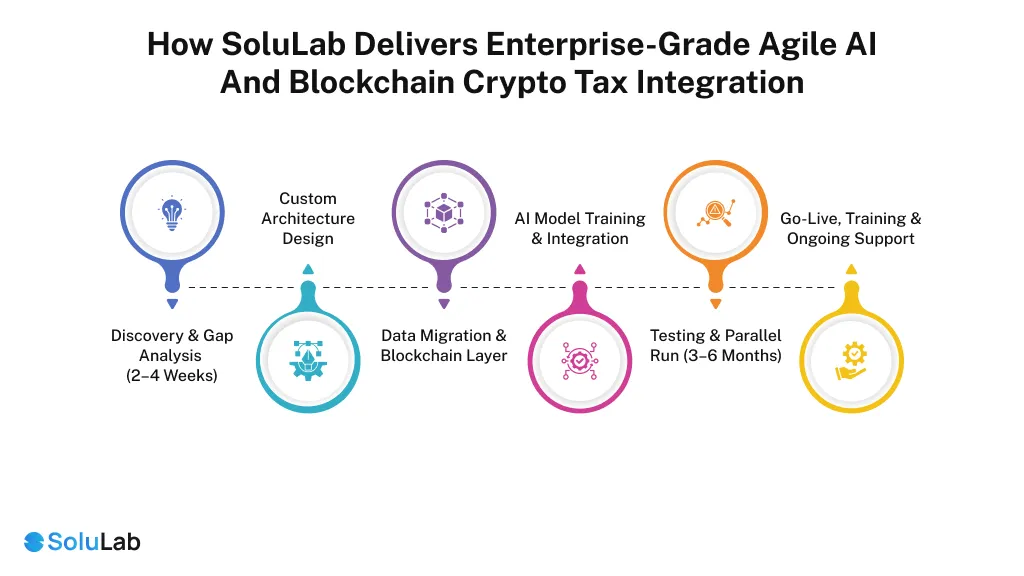
We’ve rolled this out multiple times for large enterprises and fast-moving startups, and the pattern is always the same. You don’t rip out what works; you layer artificial intelligence on top of it, carefully, step by step.
1. Discovery & Gap Analysis (2–4 weeks)
We map every wallet, exchange, DeFi flow, treasury system, and tax process, including the undocumented workarounds teams actually use.
2. Custom Architecture Design
We design around your risk posture on-prem, hybrid, or cloud and integrate Agile AI crypto tax software directly into your ERP, not alongside it.
3. Data Migration & Blockchain Layer
We add an immutable audit layer using a private or permissioned blockchain so every transaction is traceable without exposing sensitive data.
4. AI Model Training & Integration
AI models are trained on your historical data, which sharply improves classification accuracy and reduces manual cleanup during filings.
5. Testing & Parallel Run (3–6 months)
The system runs in shadow mode next to your current process until outputs align and finance teams are fully confident.
6. Go-Live, Training & Ongoing Support
We cut over cleanly, train your teams, and provide 24/7 managed or white-labeled support based on how much you want in-house.
Most clients don’t wait years to see value. ROI usually shows up in the very first tax filing cycle, with less manual effort, fewer surprises, and far more confidence when numbers matter most.
Preparing for MiCA 2.0 and U.S. SEC Regulations with Agile AI Crypto Tax Software
If you touch the EU market at all directly or indirectly, MiCA isn’t something you can postpone. By mid-2026, over 3,000 EU-based crypto firms will need proper licensing or risk being shut out entirely. Stablecoin issuers are expected to hold 100% reserves, run monthly audits, and operate under e-money licenses, while CASPs must collect TINs, self-certification documents, and full transaction histories for every user.
Miss the mark, and penalties can climb to €5 million or 12.5% of annual turnover, plus €350K per EU state under DAC8 for foreign platforms.
On the U.S. side, the picture finally got clearer. Under FIT21, the SEC oversees security tokens, while commodity-based assets fall to the CFTC. For many exchanges, that means dual registration is now mandatory, and the old habit of reacting to enforcement actions no longer works. As Gary Gensler put it in his final-term remarks, clearer rules are meant to end enforcement by interpretation, which gives enterprises room to build, but only if the compliance foundation is already in place.
How Operators Are Getting Ready?
Getting Your Classification Right
The first real step is knowing what you are under the law – CASP, stablecoin issuer, or dual-registered exchange, and locking that down with counsel. Once that’s clear, crypto tax software for enterprises needs to be configured to capture exactly the data each regime expects, not what you think might be useful later.
Reserves, Proof, and Ongoing Audits
If you issue or custody stablecoins, regulators expect proof, not promises. That means real-time reserve visibility and monthly audits, which blockchain AI tax solutions now automate by matching on-chain reserve wallets with off-chain bank balances through APIs.
Cross-Border Reporting Before It’s Mandatory
CARF reporting officially starts in 2027 using 2026 data, but waiting until the deadline is a mistake. Your AI-powered blockchain tax software should already be generating OECD-compliant XML files and pushing them to domestic authorities without manual rework.
Stress-Testing Regulatory Scenarios
Good teams don’t just comply with today’s rules; they test tomorrow’s risk. Whether it’s the SEC reclassifying a token or MiCA lowering systemic thresholds, your AI and blockchain tax systems should adapt overnight, not after months of reengineering.
Working With Builders Who Understand Regulation
This is where execution matters. SoluLab has built MiCA-aligned platforms for EU fintechs and SEC-compliant systems for U.S. funds, translating regulatory language directly into production-grade architecture instead of after-the-fact patches.
The reality in 2026 is simple. Regulators are done giving grace periods, and enterprises that treat compliance as infrastructure, not legal cleanup, will keep their licenses, avoid fines, and move faster than competitors who are still scrambling to catch up.

Conclusion
By 2026, crypto tax compliance isn’t something you “get around to” anymore. It’s become a real edge. Teams that build crypto tax software with AI, backed by blockchain, move faster, make fewer mistakes, and sleep better knowing their numbers will hold up when regulators ask questions. Manual work and generic tools just can’t keep up with how fast crypto businesses actually operate now.
If you’re responsible for treasury, finance, or compliance, it’s about catching up. The rules are already here, enforcement is active, and most serious competitors are already modernizing their stacks, quietly but decisively.
At SoluLab, as a leading Crypto development company, we’ve seen this play out across enterprises. Regulatory pressure doesn’t have to slow you down; with the right systems, it actually forces better operations, cleaner data, and stronger controls across the business.
If you’re thinking about what this could look like inside your own setup, reach out. A short conversation is usually enough to show what’s possible and what you can stop worrying about once it’s done right.
FAQs
With over 3 years of experience, I specialize in breaking down complex Web3 and crypto concepts into clear, actionable content. From deep-dive technical explainers to project documentation, I help brands educate and engage their audience through well-researched, developer-friendly writing.