Key Takeaways
- AI agents in cryptocurrency are autonomous programs that observe data, reason about strategies and execute on‑chain or off‑chain actions within defined risk limits.
- They support trading, DeFi position management, liquidity operations, NFT pricing, risk monitoring and DAO governance, often in parallel.
- The best ai agent crypto setups combine a clear architecture, strong risk controls and continuous monitoring rather than “set and forget” bots.
- Project owners see ROI through better execution quality, lower operational overhead, faster incident response and the ability to support more markets without growing headcount at the same pace.
- Building sustainable value requires disciplined design, staged rollout and a realistic view of data, liquidity and regulatory risk.
AI agents for crypto are autonomous software systems that can read on-chain and off-chain data, reason about market or protocol conditions, and then act across wallets, exchanges, and smart contracts to achieve specific goals. They go beyond traditional bots by combining machine learning, real-time data processing, and custom AI development frameworks to adapt as conditions change, not just follow static rules.
In 2026, project owners face a familiar challenge. Markets run 24/7, liquidity shifts in minutes, narratives change overnight, and communities expect constant responsiveness. Human teams cannot monitor every pool, chain and governance thread at once. AI crypto agents are emerging as a way to scale decision-making while keeping clear guardrails around capital and risk.
What is an AI Agent in the Crypto Context?
An AI agent is an intelligent software system that can understand inputs, maintain context, and perform tasks on behalf of users or systems. In crypto, these assistants evolve into crypto ai agents that combine conversational interfaces with direct access to market data, wallets and smart contracts.
Core components of such assistants include:
- Perception layer
Connectors for price feeds, order books, DeFi protocols, NFT marketplaces, social sentiment and protocol telemetry. This layer turns noisy data into structured signals an agent can reason about. - Reasoning and planning layer
Large language models and other machine learning models that propose strategies, evaluate risk and select actions such as “rebalance this pool,” “hedge exposure,” or “propose a governance vote.” - Execution layer
Interfaces to exchanges, smart contracts, transaction builders, and signing services, usually with multi-step checks and approvals. - Governance and safety layer
Policy engines, risk limits, whitelists, audit logs, and kill switches that control what the agent can do and when human review is required.
In day-to-day operation, an AI assistant for cryptocurrency might summarize positions for a founder, suggest trades, then route approved actions through a more autonomous AI crypto agent that executes according to predefined limits.
Types of AI Assistants and Agents in Crypto
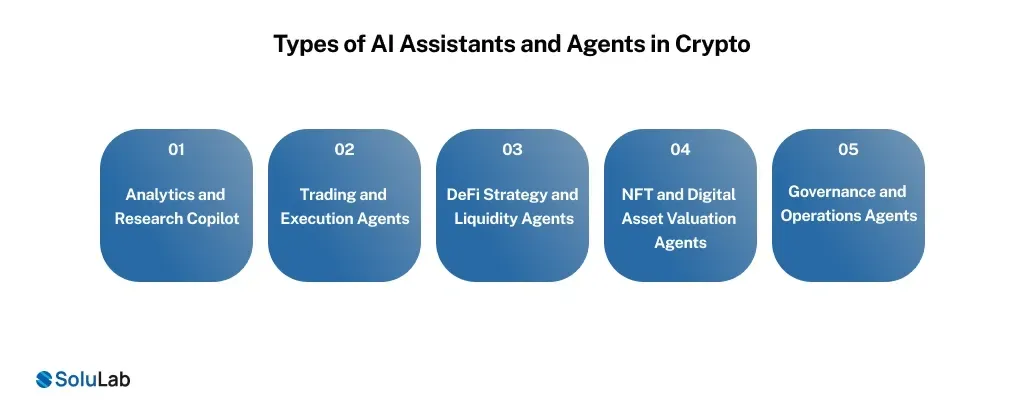
The landscape of AI agents in crypto is diverse. Classifying them by purpose and level of autonomy helps project owners choose where to invest first.
1. Analytics and Research Copilot
These agents focus on understanding markets and protocols rather than executing trades.
- Aggregate on‑chain data, social sentiment, and news, then explain what changed and why.
- Identify unusual flows, large holder movements or liquidity shifts.
- Help founders, analysts, or DAO contributors make sense of noisy data quickly.
They are often the first step, since they do not need direct signing authority, yet still add value.
2. Trading and Execution Agents
AI Crypto Agents in Crypto Trading are among the most visible use cases today.
- Monitor markets across centralized exchanges and DEXs.
- Use machine learning to generate or adapt strategies instead of fixed rule sets.
- Submit, modify and cancel orders, rebalance portfolios and manage leverage based on risk rules.
Reports show that AI agent crypto projects increasingly combine predictive modeling, sentiment analysis and real-time risk assessment to improve execution and portfolio outcomes.
3. DeFi Strategy and Liquidity Agents
These agents focus on yield and liquidity rather than directional trading.
- Manage LP positions, yield farms, staking, and lending markets.
- Decide when to enter or exit pools based on APY, impermanent loss and protocol risk.
- Handle compounding, claim rewards, and migrate liquidity as incentives change.
They essentially act as autonomous treasury and liquidity managers for DeFi development solutions.
4. NFT and Digital Asset Valuation Agents
AI agents in cryptocurrency also extend into NFTs and gaming assets.
- Analyze NFT metadata, rarity, trading history and broader market trends.
- Identify mispriced assets or collections for either accumulation or divestment.
- Automate listing, bidding and portfolio rebalancing within defined constraints.
NFT valuation agents help projects that manage large collections or gaming economies avoid manual, error-prone operations.
5. Governance and Operations Agents
Some AI agents powering crypto projects focus on the operational side.
- Draft governance proposals based on treasury or protocol metrics.
- Simulate different parameter changes and present trade-offs.
- Monitor for anomalies such as abnormal contract calls, TVL drops or oracle issues and trigger alerts or pre-approved responses.
These agents enhance the resilience of protocols and DAOs, particularly in incident detection and response.
AI Agent vs AI Assistant in Crypto
| Dimension | AI Assistant in Crypto | AI Agent in Crypto |
| Primary role | Support user decisions, answer questions, suggest actions | Observe environment, plan strategies, execute transactions |
| Initiation | Triggered by human queries or scheduled reports | Triggered by goals, thresholds, events or continuous monitoring |
| Autonomy level | Low to medium, usually needs explicit approval | Medium to high, may execute within predefined risk budgets |
| Access to capital | Often read only or proposal only | Usually has controlled signing permissions or smart contract rights |
| Interface | Conversational UI, dashboards, alerts | Services, daemons, or state machines operating behind the scenes |
| Learning and adaptation | Limited, tends to use static prompts and rules | Learns from outcomes and market data, updates strategies over time |
| Risk surface | Lower, errors mostly informational or advisory | Higher, requires strong controls to avoid financial loss |
| Typical examples | Portfolio copilot, DAO proposal explainer, compliance Q&A | Trading bot with ML, DeFi rebalancing agent, on chain risk sentinel |
How AI Crypto Agents Differ From Traditional Bots?
Traditional trading bots follow pre-coded rules and do not adapt beyond their initial logic. AI Agents for Crypto incorporate multiple models and feedback loops so they can:
- Update parameters or strategies based on performance.
- Integrate more data types, including social sentiment and cross-chain activity.
- Coordinate multiple objectives, such as maximizing yield while minimizing drawdown.
This flexibility is a major reason why crypto is so focused on AI agents in 2026, but it also increases the need for governance and testing.
Core Technologies Powering AI Agents for Crypto
Building robust AI agents and crypto assistants involves a stack of technologies that span AI, data engineering, and blockchain development.
Large Language Models and Planning
Large language models give AI agents a flexible reasoning and orchestration layer.
- Interpret goals, constraints and natural language instructions.
- Plan multi-step workflows, such as “rebalance treasury across three chains while reducing exposure to a specific token.”
- Generate explanations and reports in human-friendly language for founders, traders and DAO members.
Research and industry practice show that combining LLM planning with domain-specific LLMs for prediction or risk estimation is more robust than using a single monolithic model.
Market and On‑Chain Data Infrastructure
Agents need reliable and timely data.
- Indexers and subgraphs to stream on‑chain events from multiple networks.
- Price feeds, order book snapshots, and funding rates from exchanges and DEX aggregators.
- Sentiment and news feeds, where relevant.
Many AI agent crypto projects emphasize that the quality and latency of data sources heavily influence performance, sometimes more than the choice of model.
Smart Contracts, Wallets, and Account Abstraction
Execution requires safe interfaces to capital.
- Smart contracts that encapsulate strategies and allow parameter updates without redeploying agents.
- Multi-signature wallets or smart contracts that enforce policy checks and spending limits.
- Account abstraction approaches that make it easier for agents to manage gas, batching and meta transactions while keeping signing policies under control.
These tools allow agents to operate without exposing raw private keys.
Risk, Policy and Monitoring Systems
Given the stakes, risk, and governance, AI assistant technologies are core in the crypto setting.
- Policy engines that encode position limits, asset whitelists, slippage thresholds, and circuit breakers.
- Monitoring dashboards that track PnL, risk exposures, and anomalies, with alerts to human operators.
- Logging and replay systems that capture every observation, decision and transaction for audit and improvement.
Without these components, even the best AI agent crypto strategy becomes unmanageable at scale.
Architecture of Modern AI Agents and Assistants in Crypto
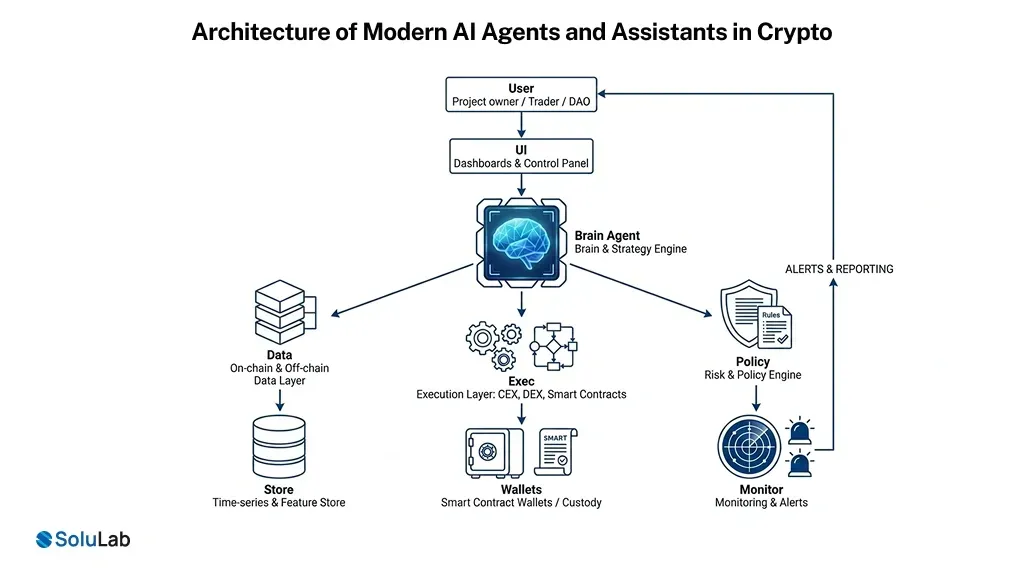
A practical architecture separates concerns so that teams can improve individual components without breaking the entire system.
Layered Architecture
- Interaction and Control Layer
- Web dashboards, command line tools, governance interfaces and notification channels.
- Used by founders, quant teams and DAO members to set goals, adjust policies and review decisions.
- Brain and Strategy Layer
- LLM-based planners, reinforcement learning agents, and rule engines.
- Encapsulates domain strategies such as trading styles, liquidity preferences or risk appetite.
- Data and Observation Layer
- On-chain indexers, off-chain data providers, time series databases and feature stores.
- Provides normalized views of markets, positions, and protocol conditions.
- Execution and Integration Layer
- Connectors to CEX and DEX APIs, smart contracts, bridges and wallets.
- Manages transaction building, routing and submission.
- Governance, Safety and Monitoring Layer
- Risk policies, permission systems, alerting and audit trails.
- Kill switches and sandbox modes for staged rollout
A common anti-pattern is to let each AI agent talk directly to exchanges and chains with its own hard-coded keys and logic. This leads to fragmentation and inconsistent controls. A better pattern is to centralize execution and policy, so many strategies share the same safe infrastructure.
Benefits of AI Agents for Crypto Projects and Businesses
The Benefits of an AI assistant for business translate into specific value drivers for crypto projects and token ecosystems.
1. Improved Execution Quality and Speed
Crypto markets are volatile and fragmented. AI Agents for cryptocurrency can:
- Monitor multiple venues and pairs at the same time.
- React in milliseconds to new information, reducing slippage and missed opportunities.
- Apply risk controls without fatigue or emotional bias.
Industry analyses of AI agent crypto projects highlight improvement in trade execution and portfolio stability when agents manage rebalancing and hedging, especially during high volatility events.
2. Operational Leverage for Project Owners
Project owners often juggle development, community, listings, and treasury. AI crypto agents offer:
- Automation of repetitive tasks such as reward distribution, fee claims, or routine rebalances.
- Continuous monitoring for anomalies, potential exploits and liquidity gaps.
- Standardized reporting that keeps contributors and investors informed.
This leverage lets small core teams operate at a scale that used to require much larger staff or external market-making contracts.
3. Better Risk Management and Incident Response
AI agents can help protect protocols and treasuries.
- Watch for abnormal on-chain patterns, such as sudden TVL drops or suspicious contract calls, and trigger alerts or safe mode actions.
- Enforce diversification and hedging rules based on maximum drawdown or exposure limits.
- Provide simulations that show how different governance decisions might affect risk.
For project owners, this directly improves the risk-adjusted return on capital and reduces the chance of catastrophic events wiping out months of progress.
4. New Product and Revenue Opportunities
AI agents also enable new features:
- Delegated portfolio management for users who prefer rules with oversight rather than pure self-trading.
- White-label AI agents for other projects in the ecosystem.
- Premium analytics and strategy insights based on the agent’s learning.
Reports estimate that the crypto AI market could grow from around 5.1 billion dollars in 2025-26 to over 55 billion by 2035, with AI trading and automation as key growth drivers. For project owners, offering AI-powered features positions the project within this expanding segment.
Real World AI Agent and Assistant Examples in Crypto
Several public projects and platforms illustrate how AI agents and crypto combine in practice-
- Autonomous trading and DeFi agents
Projects like Autonio and Fetch.ai offer agent frameworks for algorithmic trading and DeFi automation, where autonomous economic agents manage assets, execute trades, and interact with protocols using learned behavior. - Portfolio and signal platforms
Solutions such as Numerai Signals and Token Metrics use machine learning to generate trading signals and portfolio suggestions, which can be integrated into agent-based execution systems. - On-chain economy and dApp operations agents
Some ecosystems focus explicitly on AI agents in crypto on-chain economies, where agents discover services, negotiate terms, and settle payments for tasks like routing, data queries or computing. - NFT analysis and trading tools
Platforms that apply AI to NFT rarity and pricing now often expose their models so that agents can act on insights automatically, for example, by buying underpriced assets or rebalancing collections.
These AI assistant examples show patterns rather than a single blueprint. What unites them is the use of data, learning and automation to operate within clear constraints and objectives.
How to Build an AI Agent or Assistant for Crypto?
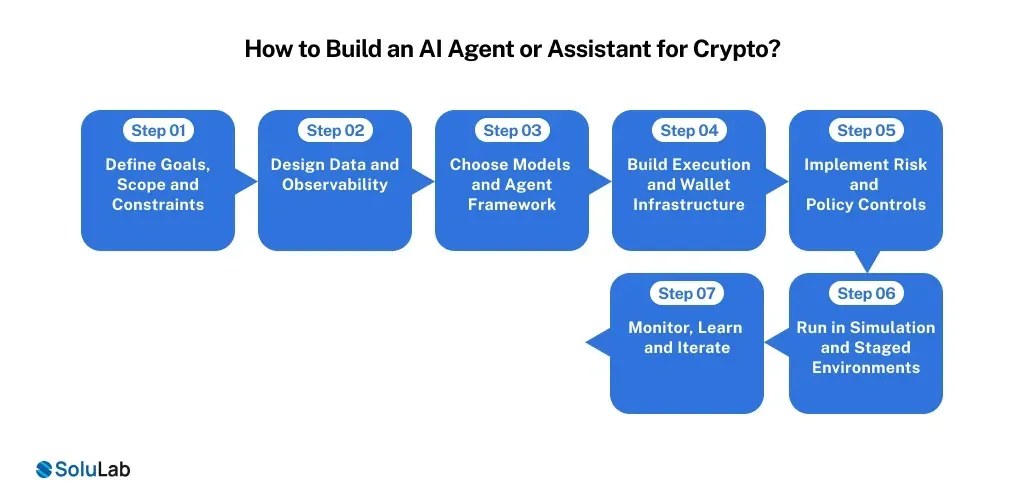
Crypto AI agent development blends AI architecture with Web3 engineering. A practical roadmap helps teams move from idea to controlled deployment.
Step 1: Define Goals, Scope and Constraints
- Decide if the primary focus is trading, DeFi strategy, treasury operations, NFTs or governance.
- Specify measurable goals such as target Sharpe ratio, maximum drawdown, or response time to anomalies.
- Set clear boundaries for capital, supported assets, chains and venues.
Step 2: Design Data and Observability
- Choose on-chain data sources, indexers and off-chain feeds.
- Define the features required for strategies, such as volatility, liquidity, funding rates or social activity.
- Implement logging of all observations and agent decisions in a time series system.
Step 3: Choose Models and Agent Framework
- Select LLMs or other models for reasoning, planning, and explanation.
- Pair them with time series or reinforcement learning models for execution strategies if needed.
- Use an agent framework that supports tool calls, memory and policy integration.
A simple pseudocode sketch of an observation and decision loop:
python
while True:
    state = get_market_state()           # prices, volumes, positions
    signals = model.predict(state)       # forecasts or scores
    action_plan = planner.decide(signals, risk_limits)
    txs = executor.build_transactions(action_plan)
    approved = policy_engine.review(txs)
    if approved:
        executor.submit(txs)
    logger.store(state, signals, action_plan, approved)
    sleep(interval)
Step 4: Build Execution and Wallet Infrastructure
- Implement transaction builders that can interact with CEX APIs and smart contracts.
- Use smart contract wallets or multi-signature setups with spending limits and role separation.
- Ensure that agents never hold raw keys directly.
Step 5: Implement Risk and Policy Controls
- Encode limits on position size, leverage, asset exposure and daily volume.
- Define automatic pause conditions based on losses, volatility spikes or data quality issues.
- Require human sign-off for actions outside the normal envelope.
Step 6: Run in Simulation and Staged Environments
- Backtest strategies using historical market and on-chain data.
- Run in paper trading or sandbox mode to validate end-to-end plumbing.
- Gradually move from a small fraction of capital to larger allocations as confidence grows.
Step 7: Monitor, Learn and Iterate
- Track performance metrics, including PnL, risk, and deviation from benchmarks.
- Analyze mistakes or near misses and feed this back into models and policies.
- Adjust goals as market regimes and project priorities change.
Many teams choose to partner with a Crypto Development company at this stage to accelerate build-out and harden infrastructure.
Best Practices and Implementation Challenges
Best Practices
- Start narrow with strong guardrails
Focus on a single asset class or strategy and limit capital until systems prove themselves in live conditions. - Separate brain and hands
Keep reasoning and planning components separate from execution infrastructure so that changes to prompts or models do not affect transaction safety. - Log everything and review regularly
Detailed logs make it possible to explain behavior to stakeholders and improve models based on real outcomes. - Involve multiple stakeholders
Bring in quant, engineering, security, legal, and community perspectives early to avoid blind spots.
Recurring Challenges
- Data quality and regime shifts
Models trained on one regime can fail when liquidity, volatility or narratives shift. Combining human oversight with robust risk controls is essential. - Overfitting and unrealistic backtests
Backtests that ignore slippage, fees, latency and liquidity can give a false sense of security. Realistic simulation and small-scale live trials are important. - Regulatory and compliance uncertainty
AI agents use cases of crypto intersect with regulations on trading, investment advice and data privacy. Projects need to monitor evolving guidance in their jurisdictions. - Operational complexity
Running agents across multiple chains and venues adds operational load. Tooling, dashboards and documentation are needed so teams can maintain and troubleshoot systems.
Future Trends in AI Agents in Crypto
Several trends are shaping why crypto is increasingly focused on AI agents in 2026.
- Custom and Domain-Specific Models
Domain-specific models trained on on-chain data, order books and crypto-specific text sources are improving the relevance of AI agents for cryptocurrency. These models reduce hallucinations and can reason more accurately about protocol behavior and economic incentives.
- Agent to Agent Coordination
Emerging frameworks explore multiple specialized agents collaborating, for example, one agent for price action, another for risk and a third for sentiment, all coordinating through a shared policy engine. This mirrors how trading desks are organized and can produce more robust outcomes than a single all-purpose agent.
- Deeper Integration with On‑Chain Economies
AI agents will not only trade assets but also participate in on-chain economies.
- Discovering services such as oracles, compute providers, or cross-chain bridges.
- Negotiating fees and service levels.
- Settling payments and rewards automatically.
This moves agents from being thin wrappers over exchange APIs to becoming active participants in decentralized ecosystems.
- Managed Platforms and Agent Marketplaces
As complexity grows, more teams will rely on platforms that provide shared infrastructure for agent hosting, policy enforcement, and monitoring. Some ecosystems already experiment with marketplaces where users can deploy, rent, or share AI Crypto Agents, creating new token utility and business models.

Conclusion
AI Agents for Crypto combine advanced AI, robust data infrastructure, and blockchain execution to give project owners a way to scale decision-making and operations in markets that never sleep. Compared with traditional bots, these AI agents in cryptocurrency observe more data, adapt strategies, and operate within explicit risk frameworks, which makes them better suited to the complexity of DeFi, NFTs and on-chain governance.
For project owners who prefer a partner that understands both AI and blockchain at production scale, SoluLab brings a useful combination of experience and infrastructure. Recognized as a leading enterprise blockchain and Web3 development company, SoluLab has delivered more than 150 blockchain and crypto projects across sectors, including fintech, gaming, supply chain and real estate, often working from PoC and MVP through to full scale deployment.
With dedicated practices in AI agent development, crypto wallet and exchange engineering, asset tokenization, and DeFi platform build out, the team specializes in “AI first” solutions that combine intelligent decision making with audited smart contracts and secure crypto infrastructure. This track record makes SoluLab a strong partner for Web3 teams that want to design, build and operate AI agents for crypto that are not only innovative, but also secure, compliant and aligned with clear ROI goals.
FAQs
Shipra Garg is a tech-focused content strategist and copywriter specializing in Web3, blockchain, and artificial intelligence. She has worked with startups and enterprise teams to craft high-conversion content that bridges deep tech with business impact. Her work translates complex innovations into clear, credible, and engaging narratives that drive growth and build trust in emerging tech markets.