Right now, decentralized social media platforms are crossing the gap from crypto‑native experiment into something that can underpin real products, communities, and even revenue streams. And Farcaster is the conversation you can’t ignore.
| By 2026, the global social media user base is projected to sit around 5.17 billion people, and trust in centralized platforms is eroding fast. At the same time, some reports suggested that the blockchain‑based decentralized social media platform market will grow from roughly $3.55 billion in 2026 to over $7.79 billion by 2030, at a CAGR of around 21.8%. |
In this context, Farcaster has become one of the most credible attempts at a decentralized application development for social media that actually feels like a real product. So if you’re building a startup or a product‑led enterprise, ignoring this shift is like dismissing mobile apps in 2010.
Key Takeaways
- The problem:
- Centralized social platforms own your audience, data, and distribution, leaving builders dependent on opaque algorithms, APIs, and censorship-prone policies.
- The solution:
- Farcaster offers a protocol-first social layer where identities are on-chain, and apps control the user experience, enabling native mini-apps, DeFi actions, and games inside feeds.
- How SoluLab helps:
- SoluLab helps you builds Farcaster like native social apps, integrates with Warpcast, and delivers high-engagement mini-app experiences, so you ship faster without rebuilding identity or social infrastructure from scratch.
What Is Farcaster?
If you’re not deep in the Web3 rabbit hole, Farcaster sounds confusing at first.
In simple terms, Farcaster is a decentralized social media platform built on Ethereum (and now multiple chains), but it’s more accurate to call it a social protocol than a single app.
Every user has a Farcaster ID (FID), registered on-chain, which acts as a portable identity. You can publish casts (like tweets), follow users, and interact, but the data and identity live in a way that’s not owned by any single company.
So, when someone asks, What is the Farcaster social media platform?, the clean answer is:
- It’s an open, decentralized social network that lets users own their accounts and data.
- It’s built on Farcaster’s decentralized architecture, which anchors identity on-chain and stores content off‑chain in a hybrid model.
Why Was Farcaster Created as a Decentralized Social Media Platform?
Farcaster emerged because the existing social stack is fundamentally broken for builders and power users.
Centralized platforms:
- Kick apps off their APIs when those apps threaten their own revenue.
- Change feed algorithms overnight, killing product hockey sticks.
- Gate access to audiences, monetization, and data.
Farcaster’s impact comes from shifting the balance:
- Instead of one company controlling the social graph, the protocol is open.
- Apps plug into the same identity layer, so a user can move between apps without losing followers or data.
This is exactly why decentralized social media platforms are gaining mindshare among product‑focused founders and executives who want to build defensible network effects.
Is Farcaster a Decentralized Social Media Platform or a Protocol Layer?
Here’s where people get confused.
Warpcast is the Farcaster app development services company’s flagship client, but Farcaster itself is the protocol.
- Farcaster protocol – the underlying identity, social graph, and data format.
- Warpcast – the most popular UI that sits on top of it.
This is similar to email:
- SMTP is the protocol; Gmail, Outlook, and Apple Mail are the apps.
- Farcaster is the protocol; Warpcast, Base, and others are the Farcaster Social Media network clients.
This separation is why Farcaster’s Flagship App (Warpcast) can focus on user experience while other teams build niche verticals without competing on identity.
How Farcaster’s Decentralized Architecture Powers the Future of Blockchain Social Media
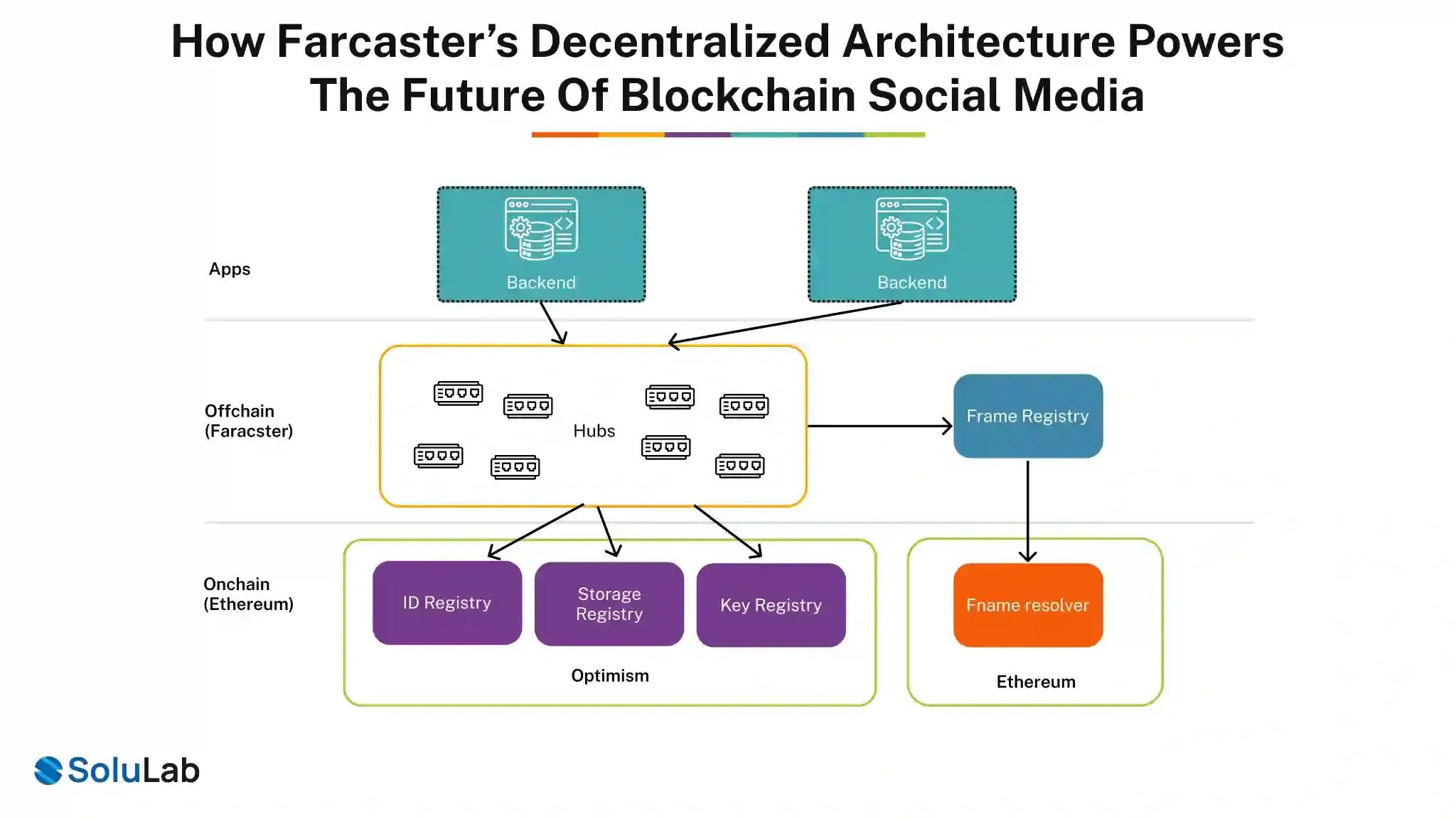
At a high level, Farcaster’s decentralized architecture looks like this:
- On-chain layer (Ethereum / L2s)
- Users register a Farcaster ID through a smart contract on Ethereum (often on Optimism).
- This gives you a verifiable, portable identity that can’t be taken down by a single company.
- Offchain “hub” layer
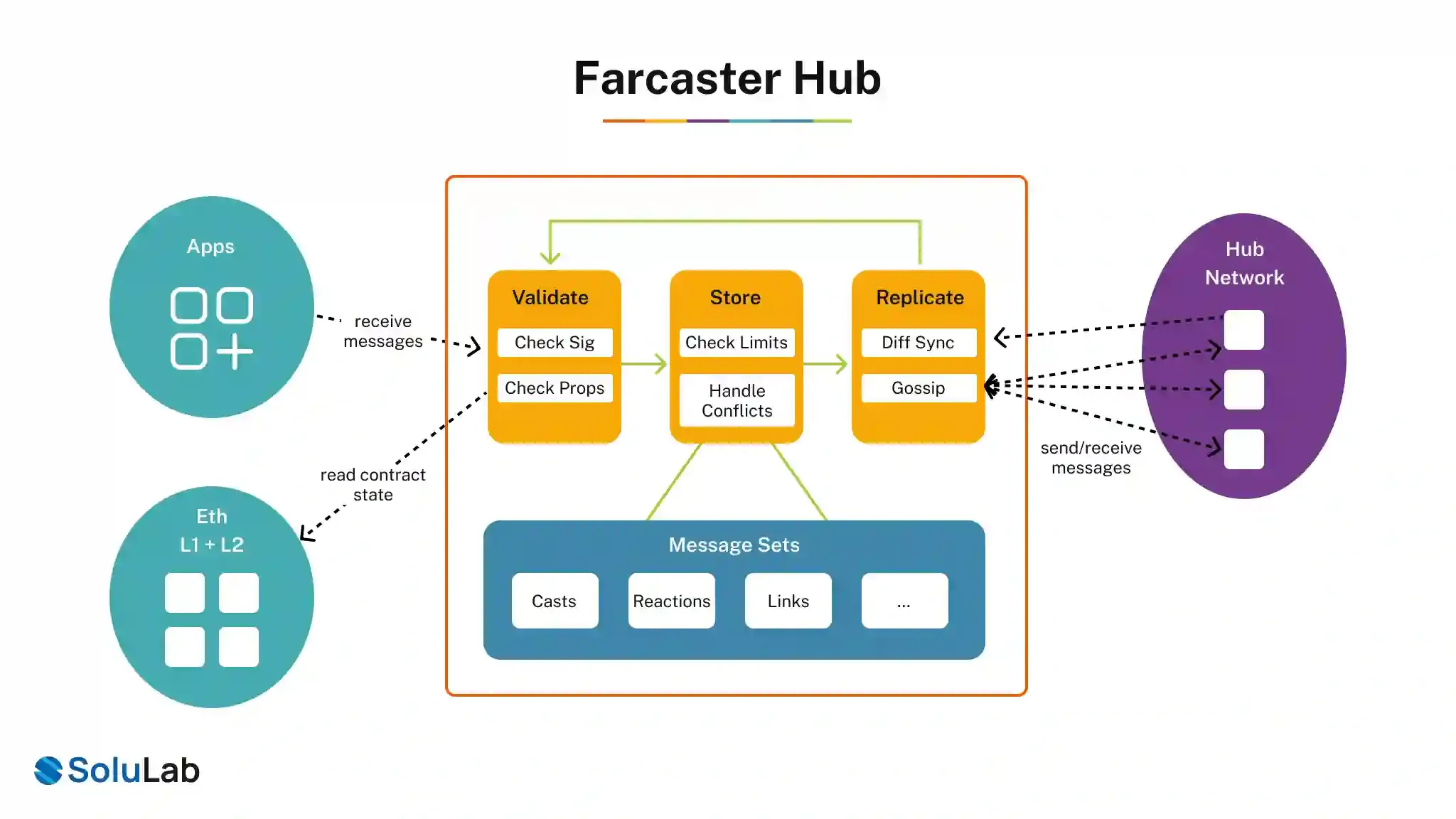
- The bulk of content (casts, follows, etc.) is stored in offchain hubs, which are independent servers synced via a peer‑to‑peer style protocol.
- This keeps costs low while still giving you censorship resistance and decentralization.
- Client/app layer
- Apps like Warpcast, Base, and others read from the hubs and the onchain state, then render feeds, DMs, and UIs.
- This is where Farcaster app development services and Farcaster mini app development come in.
The result is a Blockchain Social Media model that feels fast enough to use every day but still rooted in Web3 app development solutions.
How Warpcast is Related to Farcaster?
Warpcast is the Farcaster’s Flagship App and the most widely used client for interacting with the protocol.
Think of it like this:
- Farcaster – the social protocol.
- Warpcast – the default app most people use to post, follow, and engage.
This is important for founders because:
- Many users will discover your Farcaster ecosystem and use cases through Warpcast first.
- You can piggyback on its user base while still building your own branded client or mini app on top of the Farcaster protocol.
Core Features That Differentiate the Farcaster Social Media Network
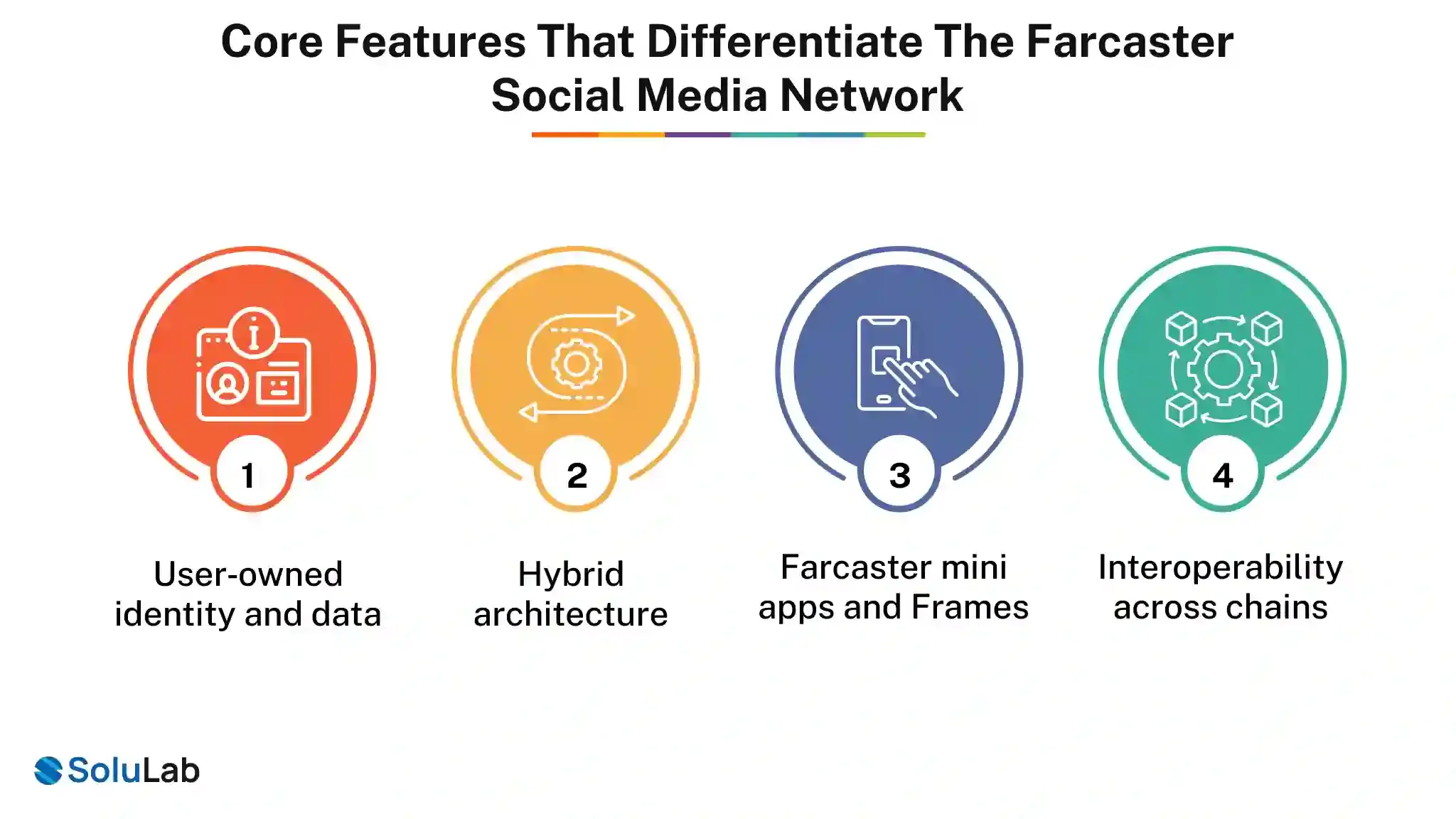
When you line up Farcaster against traditional social media and even other decentralized social protocols, several things stand out.
- User‑owned identity and data
- No single company owns your audience or data. You can move between apps and keep your social graph.
- Hybrid architecture
- Identity onchain, content offchain, which keeps performance and UX at a level that can compete with centralized stacks.
- Farcaster mini apps and Frames
- Mini apps let you ship full‑screen web apps inside the Farcaster environment.
- Frames let you embed interactive buttons and actions directly in posts.
- Interoperability across chains
- Farcaster has expanded support to multiple chains (Ethereum, Arbitrum, Solana, etc.), so you can build Web3 app development solutions that span ecosystems.
All of this feeds into the future of decentralized social media platforms, where the social layer is just infrastructure, and apps are where differentiation happens.
Farcaster vs Traditional Social Media Platforms
If you’re comparing Farcaster with Meta, X, or TikTok, here’s what changes for businesses:
| Aspect | Traditional social platforms | Farcaster (decentralized social media platform) |
| Ownership of data | Platforms own user data and social graphs. | Users own their identity and data; apps read the graph. |
| Audience control | You can be rate‑limited, throttled, or demonetized. | Your audience moves with your identity; the platform can’t strip it away. |
| Monetization | Ads, creator funds, and platform‑controlled payouts. | On-chain revenue models, token rewards, and composability with DeFi. |
For founders, this means you can design decentralized social media platforms that are less fragile to platform risk and more aligned with user incentives.
Farcaster vs Other Decentralized Social Protocols
There are other decentralized social media platforms like Lens, but Farcaster’s impact comes from its architecture and ecosystem.
- Farcaster leans heavily on hybrid architecture and a strong, developer‑focused ecosystem.
- Many decentralized social protocols are either fully on-chain (expensive) or fully on IPFS (harder to index and discover).
By sitting in the middle, Farcaster has attracted a lot of tooling, SDKs, and third‑party apps, which is why Web3 development companies are starting to treat it as a serious social layer.
Farcaster Use Cases Shaping the Future of Decentralized Social Media Platforms
For founders and product teams, the Farcaster ecosystem and use cases fall into a few buckets:
- Community‑driven products
- Build a niche client or mini app for traders, DAO members, or creators, plug into the existing graph, and let users bring their followers.
- On-chain engagement engines
- Use mini apps and Frames to embed voting, NFT minting, token swaps, and analytics directly into the feed.
- Social‑first DeFi and gaming
- Run in‑feed games, leaderboards, and rewards programs that convert social activity into on-chain actions.
- Enterprise identity and engagement
- Enterprises can use Farcaster as a Web3 social media layer to connect with Web3‑native users without relying on centralized social platforms.
This is exactly why the benefits of decentralized social media platforms include reduced platform risk, better user ownership, and stronger network effects when you build on a shared graph.
How Developers Can Build Decentralized Social Apps on Farcaster?
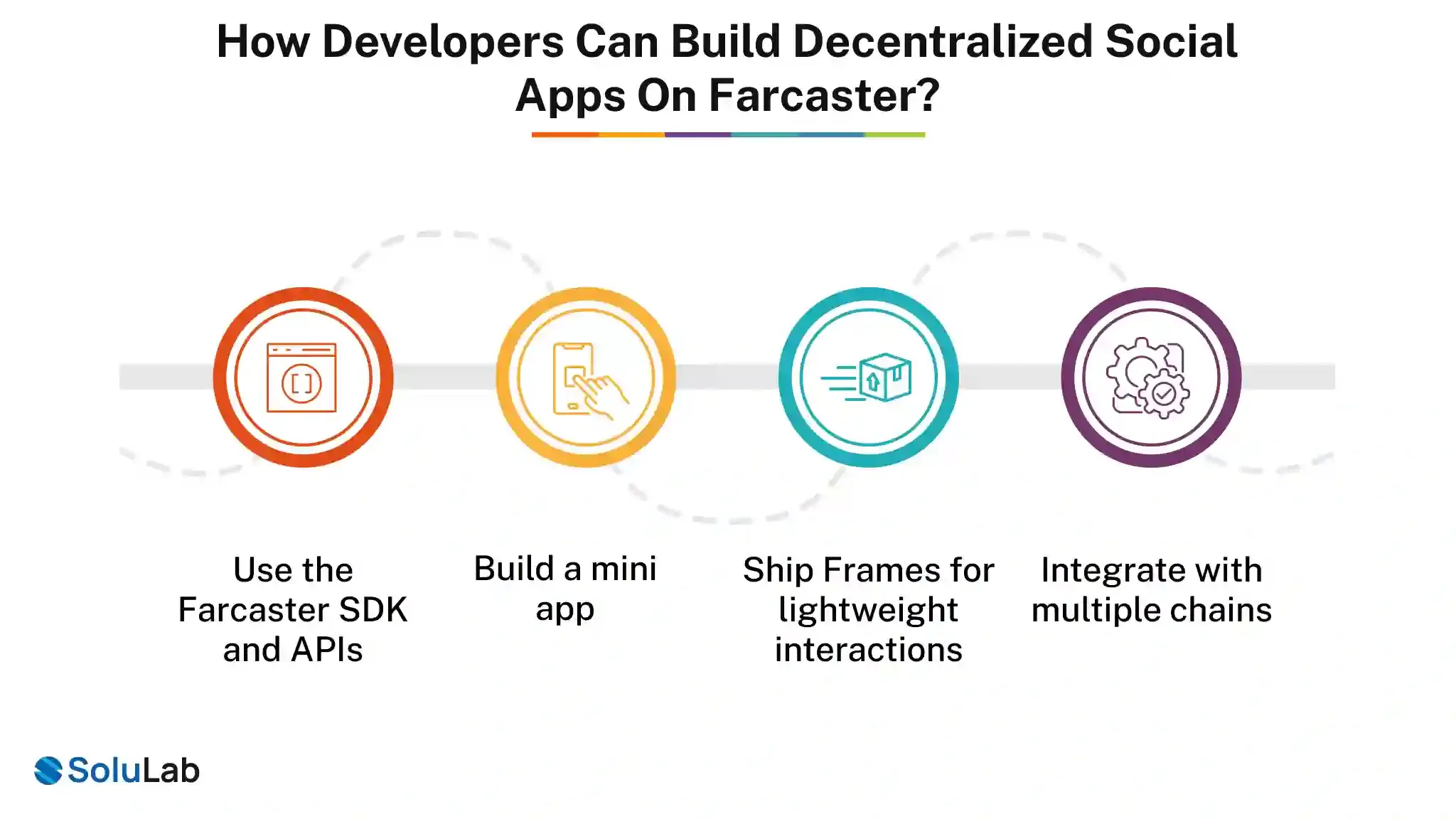
If you’re technically oriented, here’s how you can engage with Farcaster to launch your Web3 app–
- Use the Farcaster SDK and APIs
- SDKs let you authenticate users, read the graph, and post casts programmatically.
- Build a mini app
- A Farcaster mini app is a web app bundled to run inside the Farcaster clients.
- You ship HTML, CSS, and JS, and the Farcaster runtime handles authentication and wallet integration.
- Ship Frames for lightweight interactions
- If you don’t need a full UI, Frames let you add buttons, forms, and simple flows directly in posts.
- Integrate with multiple chains
- Given Farcaster’s interoperability, you can route actions to Ethereum, Arbitrum, Solana, etc., depending on your product needs.
For you, this opens up work in mini app development and custom Blockchain Social Media products.
Challenges and Limitations Shaping the Future of Decentralized Social Media Platforms
No platform is perfect, and Farcaster is no exception.
- User growth and retention have been bumpy. After a high‑valuation period, daily active users and revenue dropped sharply in late 2025, raising questions about long‑term sustainability.
- Mixing sufficient decentralization with a good UX is still hard; the average user doesn’t care about the protocol, only the app.
- The on-chain social space is still early, which means standards, tooling, and regulatory clarity are evolving.
For businesses, this means you should treat Farcaster as a strategic layer rather than a guaranteed winner.
But if you move early, you can lock in communities and integrations before incumbents react.
How Farcaster’s Decentralized Architecture Is Shaping the Future of Blockchain Social Media
Zooming out, what the Farcaster social media platform is pointing toward is simple: a decentralized future for social media on blockchain, where the social graph is open infrastructure, and apps compete on experience.
Key signals:
- Decentralized social media platforms are moving from “crypto hobby” to real products with real users and revenue.
- Enterprises are starting to explore Web3 app development solutions that sit on these graphs, not just consumer apps.
- Farcaster’s impact is forcing the entire decentralized Web3 ecosystem to rethink how to build social apps that are composable, not siloed.
For CXOs, this is not about decentralized social as a trend; it’s about anticipating where your next audience and engagement layer will live.
How SoluLab Can Help You Build a dApp Like Farcaster?
If you’re reading this as a founder or product leader, you’re probably thinking:
- Can we build a decentralized social media platform on top of Farcaster?
- Can we integrate Farcaster mini apps into our existing product?
The answer is yes, and this is where SoluLab, as a top Web3 development company in USA with 250+ Devs, can help you build a Farcaster mini app, a Decentralised Social Platform, and Blockchain dApps in a few weeks.
Don’t miss out on this Narrative.
Conclusion
Farcaster is not the perfect social network. But it is one of the most credible attempts at a decentralized social media platform that feels like a real product, not a lab demo.
The core principles of Farcaster, user‑owned identity, open data, and composability, fit perfectly into the Future of decentralized social media platforms and the decentralized future for social media on blockchain.
So, if you’re operating in a world where Blockchain development services are becoming part of the toolkit, then Farcaster is a layer you should at least be testing right now.
FAQs
With over 3 years of experience, I specialize in breaking down complex Web3 and crypto concepts into clear, actionable content. From deep-dive technical explainers to project documentation, I help brands educate and engage their audience through well-researched, developer-friendly writing.