Key Takeaways
- You’ll see why Arbitrum RWA tokenization is getting real adoption and where it fits in the Ethereum RWA stack.
- You’ll get a practical breakdown of the building blocks: legal wrappers, on-chain design, and Arbitrum smart contract development choices that actually matter.
- You’ll walk through a step-by-step process for how to tokenize real world assets on Arbitrum, from asset scoping to deployment and secondary markets.
- You’ll see what a production-grade tokenization platform development architecture looks like on Arbitrum, including where AI-powered tokenization platform capabilities plug in.
- And you’ll understand when it’s smarter to work with a RWA tokenization development company that offers end-to-end real world asset tokenization services, instead of trying to glue everything together yourself.
If you’re building in Web3 in 2026 and you’re not thinking about real-world assets on Layer 2, you’re missing the main show.
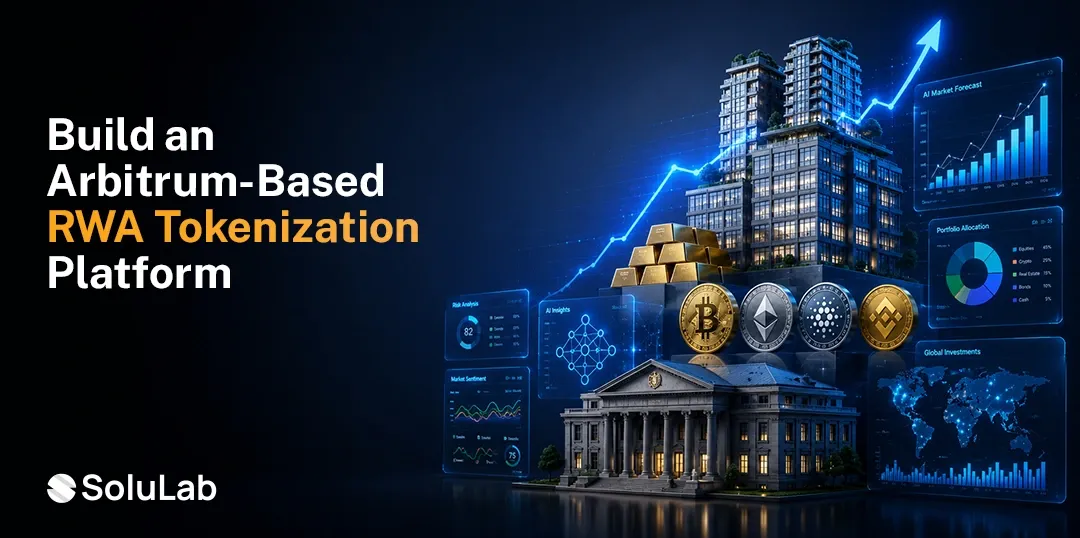
The RWA tokenization wave is no longer theoretical. On Arbitrum alone, tokenized RWAs have crossed the billion-dollar mark and keep climbing, with treasuries, private credit, real estate, and other off-chain assets quietly moving onto Ethereum rails via this L2. In parallel, serious institutions are finally showing up: asset managers, fintech lenders, and RWA-native platforms are all treating Arbitrum as a venue for real production flows rather than experimental side projects. arbitrum+3
If you’re a developer, product owner, or fund, this creates a straightforward question: how do you actually tokenize real world assets on Arbitrum in a way that is technically sound, compliant, and scalable?
That’s what this guide is about.
Why Real-World Asset Tokenization Is Moving to Arbitrum in 2026?
RWAs have been “the next big thing” for years. The difference now is that the infrastructure and capital are finally on the same page.
On the capital side, you have:
- Asset managers launching tokenized treasury and money-market products.
- Private credit platforms tokenizing loans to SMEs and fintech borrowers.
- Real estate and infrastructure teams are experimenting with digital shares and notes.
On the infrastructure side, Arbitrum has quietly become one of the main venues for this activity:
- Arbitrum has processed billions of transactions and reached multi-billion TVS, making it the largest L2 by many activity metrics.
- RWA value on Arbitrum has grown into the hundreds of millions and then crossed into the billion-plus range, with multiple RWA protocols choosing it as their home or expansion chain.
- The ecosystem includes major DeFi protocols (Aave, Uniswap, and others) plus RWA-focused initiatives backed by ArbitrumDAO funding, giving RWAs both liquidity and incentives.
Why does that matter for you?
Because tokenizing on a quiet ghost chain with low fees but no liquidity is a different game than deploying to a network where actual capital and users already exist. Arbitrum hits that sweet spot: low fees, high throughput, mature tooling, and real liquidity around RWAs and stablecoins.
What Does It Mean to Tokenize Real-World Assets on Arbitrum?
Let’s strip it down.
Tokenizing real-world assets on Arbitrum means you are:
- Wrapping legal rights to some off-chain asset (equity, debt, revenue share, claim, etc.) in a compliant legal structure.
- Representing those rights as tokens on Arbitrum, governed by smart contracts you control.
- Wiring those contracts into a broader system: KYC/AML, custody, oracles, investor dashboards, and secondary trading venues.
Arbitrum’s role is to give you:
- EVM compatibility and access to the Ethereum tooling you already know.
- Lower fees and higher throughput than mainnet, which matters when you’re settling yields, redemptions, or secondary trades.
- A growing RWA and DeFi ecosystem that your tokens can plug into.
When does Arbitrum make more sense?
- When you want Ethereum security and ecosystem but can’t justify mainnet gas costs per transaction.
- When you’re expecting frequent on-chain operations (coupons, rebalancing, re-collateralization, secondary activity).
- When your target users are already active on Arbitrum or can be onboarded there more easily than to a more exotic chain.
You’re not replacing legal work or infrastructure. You’re choosing Arbitrum as the execution and settlement layer for your on-chain representation of the asset.
Core Building Blocks: Legal Wrapper, Asset Model, On-Chain Design
This is where a lot of teams cut corners and regret it later.
You can’t just “mint a token” and claim it represents a bond, a building, or a pool of loans. You need three coherent layers.
1. Legal Wrapper
Some typical patterns:
- SPV / SPE (Special Purpose Vehicle) that holds the asset and issues tokens as digital securities.
- Note or debt instrument where the token represents a claim on repayment and interest from an underlying loan pool.
- Fund or feeder fund structure where tokens represent shares or units in a regulated vehicle.
You’ll handle this with legal counsel, not Solidity. But the contract design must reflect the legal reality: what rights are you encoding? Who can hold them? Under what conditions?
2. Asset Model
Decisions you need to make:
- Fungible vs non-fungible vs partitioned tokens.
- One token per asset or one token per pool.
- Simple “1 token = 1 unit of value” or more complex tranching (senior/junior).
For example, a tokenized treasury product on Arbitrum will usually use a fungible (ERC-20-like) token, whereas a single large real estate asset might use partitioned tokens with different rights.
3. On-Chain Design
Here you decide:
- Which token standard you want to follow (basic ERC-20 for access tokens vs securities-style standards with partitions/whitelists).
- How issuance, redemptions, lockups, and transfers are controlled.
- How you’ll enforce KYC/AML, jurisdiction rules, and investment limits.
This is where a RWA tokenization development company or experienced protocol engineer prevents you from reinventing costly mistakes.
Arbitrum Smart Contract Development for RWA
Now we get into the part you probably came for: Arbitrum smart contract development itself.
Because Arbitrum is EVM-compatible, you’re mostly working with Solidity and familiar tooling. What changes is the way you design for RWA constraints.
Token standards that matter
In practice, most RWA teams on Arbitrum use:
- ERC-20 variants with additional compliance hooks for fungible RWAs (for example, tokenized treasuries, funds, lending pools).
- Securities-style standards inspired by ERC-1400 / ERC-3643 families, adding partitions, whitelists, and role-based permissions for regulated tokens.
- Custom contracts that wrap base ERC-20 logic with KYC checks, transfer restrictions, and pausing/freezing abilities.
You’re not forced to pick a formal “security token standard,” but you will need:
- Transfer hooks that check whether the sender and receiver are allowed.
- Role-based access control for issuers, admins, and compliance officers.
- Events that make on-chain activity auditable and indexable.
Key modules in your contracts
At minimum, your RWA token contracts on Arbitrum should handle:
- Issuance & burning
Minting to whitelisted addresses, redeeming to reduce supply when assets are sold or redeemed off-chain. - Transfer control
Whitelists, blacklists, jurisdiction flags, lockup enforcement, and maybe throttling of volume for certain investor categories. - Lockups & vesting
Time-based restrictions for primary buyers, team allocations, or tranches. - Admin and emergency functions
Pause, freeze, and recovery options in case of mistakes, regulatory interventions, or security incidents.
Yes, you can make this composable and modular. But if you skip these basics, you’re building a DeFi token, not a serious RWA instrument.

Step-by-Step: How to Tokenize Real World Assets on Arbitrum
Let’s break down a practical, buildable flow. Think of this as your checklist for how to tokenize real world assets on Arbitrum.
Step 1: Define the asset and jurisdictional context
- What are you actually tokenizing (treasuries, private loans, real estate, revenue share, etc.)?
- Who are your target investors (retail, qualified, institutional)?
- Which jurisdictions are in play (US, EU, others)?
You don’t need a 200-page memo to start, but you do need a clear one-page summary of rights and constraints.
Step 2: Choose Arbitrum environment and infra
- Decide whether you’re targeting Arbitrum One or another Arbitrum chain, depending on your audience and liquidity targets.
- Pick your infra: RPC providers, indexers, wallets, custody partners, KYC vendors.
- Decide if you need test deployments or a separate “sandbox” environment for pilots.
Developers usually treat Arbitrum as “Ethereum, but faster and cheaper,” which is mostly true from a tooling point of view.
Step 3: Design the token model and permissions
With your legal and business map, decide:
- Token type (ERC-20-like, partitioned, etc.).
- Roles (issuer, compliance admin, oracle updater, pauser).
- How KYC/AML and jurisdiction checks will be enforced (on-chain registry vs external compliance engine).
This is where you write a simple spec doc: what functions exist, who can call them, and what invariants need to hold.
Step 4: Implement the smart contracts (Arbitrum-ready)
You now implement:
- The token contract(s) using Solidity, taking care with upgradeability (for example, using proxy patterns if you need them).
- Access control using established libraries (for example, OpenZeppelin patterns adapted to your compliance logic).
- Events for all key lifecycle actions (mint, burn, transfer, pause, whitelist updates, etc.).
Test heavily on a testnet or dev environment first. Then run audits. For RWA, audits are not optional; they’re table stakes.
Step 5: Connect to off-chain data and compliance systems
Asset tokenization without correct off-chain data is just a UX layer. You need:
- Oracles or scheduled jobs that reflect asset state (NAV, interest accrual, repayment status).
- Integration with KYC/AML providers so only eligible wallets can hold or receive tokens.
- If necessary, integration with custodians that hold either the underlying asset or the tokens or both.
Some teams maintain an off-chain “investor registry” that syncs with on-chain whitelists. Others embed more of that logic directly into contracts. The right answer depends on your regulatory setup.
Step 6: Build the primary issuance flows
This is where AI-native tokenization platform development really starts to feel like a product.
You’ll likely need:
- An investor onboarding front end: sign up, KYC, investor questionnaire.
- Subscription flows: choose an offering, sign necessary docs (off-chain or on-chain), send funds, receive tokens.
- Admin tools: approve investors, trigger mints, reconcile cash vs tokens.
You can do this as a custom dApp, a white-labeled platform, or a deeper integration into an existing investment portal.
Step 7: Plan and implement secondary market mechanics
Even if you don’t offer open secondary markets from day one, you need a plan.
Options include:
- Permissioned marketplaces where only whitelisted investors can trade.
- OTC transfers with admin approval.
- Integrations with RWA-focused platforms on Arbitrum, where your tokens can be listed, subject to rules.
Your smart contracts and compliance logic should support this from the start. Retrofitting liquidity is painful.
Designing a Production-Grade Tokenization Platform on Arbitrum
At this point, you’re not just deploying a token; you’re building or plugging into top tokenization platforms.
A typical architecture for tokenization platform development on Arbitrum looks something like this:
The moving parts:
- Backend & APIs to orchestrate onboarding, payments, and contract interactions.
- Dashboards for investors, admins, and maybe issuers.
- Monitoring and analytics to keep an eye on flows, positions, and risks.
This is where a seasoned RWA tokenization development company earns their fee: not just in writing contracts, but in making the whole machine usable and resilient.
Where AI Fits: AI-Powered Tokenization Platform on Arbitrum
Now to the “2026” part of the story.
An AI-powered tokenization platform isn’t about slapping a chatbot on your dashboard. It’s about using AI in the right places:
- Onboarding and KYC
AI-powered document extraction and risk scoring can speed up KYC, detect anomalies in ID documents, and flag higher-risk profiles. - Asset and portfolio monitoring
AI models can monitor underlying asset performance, detect early signs of deterioration in loan portfolios, or spot irregular cash flows. - Liquidity and pricing
AI can help recommend pricing bands, market-making strategies, or rebalancing actions based on demand, volatility, and macro signals.
When you combine Arbitrum’s low fees and DeFi depth with an AI-powered tokenization platform, you’re not just issuing static tokens. You’re building intelligent rails around how those tokens are issued, managed, and traded.
Working with an RWA Tokenization Development Company
Could you build all of this in-house? Maybe. Will it distract your team from everything else? Definitely.
A good RWA tokenization development company offering real world asset tokenization services should bring:
- Experience with multiple asset classes and legal setups (not just one niche product).
- A reusable tokenization stack for Arbitrum and potentially other chains.
- Security and audit experience for Arbitrum smart contract development.
- Integrations with KYC providers, custodians, and RWA marketplaces.
- An opinionated view on what works and what breaks in production.
You don’t want a team that says “everything is possible.” You want a team that says, “we tried X before, here’s where it failed, here’s what we’d do instead on Arbitrum.”
Common Pitfalls When Tokenizing RWAs on Arbitrum
Some mistakes you should avoid right away:
- Legal and tech drifting apart
Tokens that don’t actually match the legal rights spelled out in documents will come back to haunt you. - Ignoring oracles and data quality
If your NAV, rates, or performance metrics are wrong or stale, everything built on them is suspect. - Overcomplicating the first release
Trying to handle every asset type, every jurisdiction, and every liquidity scenario from day one almost guarantees delays. - Underestimating UX
A clunky investor or admin experience kills adoption faster than any gas fee.
Most of these pitfalls are not Arbitrum-specific. But they show up faster in production because the network makes high-frequency operations cheap enough that bad assumptions get stress-tested in weeks, not years.
Arbitrum RWA Patterns to Watch in 2026–2027
To ground this in reality, it’s worth looking at the types of RWAs already gaining traction on Arbitrum:
- Tokenized treasuries and money market products using fungible tokens with strict whitelisting.
- Private credit pools where loans to SMEs or fintechs are tokenized into senior/junior tranches.
- Real estate and infrastructure plays that use Arbitrum to handle investor onboarding, cap tables, and distributions, even if liquidity remains relatively controlled.
The trend is clear: Arbitrum is positioning itself as a serious venue for RWA liquidity and experimentation, with DAO resources and ecosystem programs backing that direction.
If you’re designing a new RWA product, there’s no need to guess in a vacuum. You can study these patterns and then decide where you want to deviate and innovate.
FAQs
Conclusion
Tokenizing real-world assets on Arbitrum in 2026 isn’t about “doing something with RWAs” for the sake of a narrative. It’s about using the network’s scale, economics, and ecosystem to build products that can realistically handle institutional expectations and real-world constraints.
If you’re serious about this space, you now know the broad strokes:
- Start from legal and asset reality, not from a token template.
- Treat Arbitrum smart contract development as one piece in a larger tokenization platform development puzzle.
- Think about oracles, compliance, UX, and secondary liquidity from day zero.
- Look hard at where an AI-powered tokenization platform can give you an edge in onboarding, monitoring, and liquidity management.
- And be honest about whether you need an RWA tokenization development company to help you ship instead of just talk.
The opportunity is very real. Trillions in off-chain value will not move to a single chain or a single platform. But if you want your slice of that to live on Arbitrum, the best time to design a proper, future-proof stack is before everyone else is forced to catch up.
If you’re ready to move from “we should do RWAs on Arbitrum” to a concrete, buildable roadmap, SoluLab, a top blockchain solution development company, can help you define the asset model, architect the system, and launch a production-grade RWA platform that’s built to last.
Shipra Garg is a tech-focused content strategist and copywriter specializing in Web3, blockchain, and artificial intelligence. She has worked with startups and enterprise teams to craft high-conversion content that bridges deep tech with business impact. Her work translates complex innovations into clear, credible, and engaging narratives that drive growth and build trust in emerging tech markets.