Key Takeaways
- With Arbitrum Token Development, businesses can launch scalable blockchain apps with significantly lower transaction fees than on Ethereum mainnet.
- Projects often use the Arbitrum ERC-20 standard for building compatible decentralized applications.
- A well-designed tokenomics is crucial for Arbitrum Token Development along with secure smart contracts, auditing, testing, and deployment.
- Industries like DeFi, gaming, asset tokenization, and enterprise blockchain solutions are choosing Arbitrum for scalable Web3 infrastructure.
- SoluLab is a leading Arbitrum Token Development Company providing end-to-end development and launch support for Web3 projects.
Arbitrum token development has become the go-to path for businesses that want to launch on a decentralized network without watching gas fees eat into every transaction. Ethereum is still the gold standard for smart contract development, but network congestion and high gas costs make it rough for mid-level companies and startups that need real scalability. So they look elsewhere.
Arbitrum runs on optimistic rollups. That means transactions process off-chain and settle on Ethereum, so you get lower costs and faster confirmations without giving up Ethereum’s security. In practice, that combination is hard to beat.
This guide walks through how to develop a token on Arbitrum, what you need to plan for, and the practices that actually matter when you want a token project that holds up over time.
What Is Arbitrum Token Development?
Arbitrum Token Development is the process of building and deploying blockchain tokens on the Arbitrum Layer 2 network. These tokens are compatible with the ERC-20 standard and work across wallets, decentralized exchanges, and blockchain protocols.
Arbitrum’s optimistic rollup architecture processes transactions off-chain and then settles them on Ethereum. The result: higher throughput at a fraction of the cost, while Ethereum’s security layer stays intact underneath.
For a business, that translates to faster transactions, lower operating costs, and users who aren’t dropping off because fees are too high. Arbitrum blockchain token development works across a wide range of token types:
- Utility tokens
- Governance tokens
- Stablecoins
- Gaming assets
- DeFi ecosystems
- Loyalty and reward programs
- Enterprise blockchain applications
Why Are Businesses Choosing Arbitrum for Token Development?
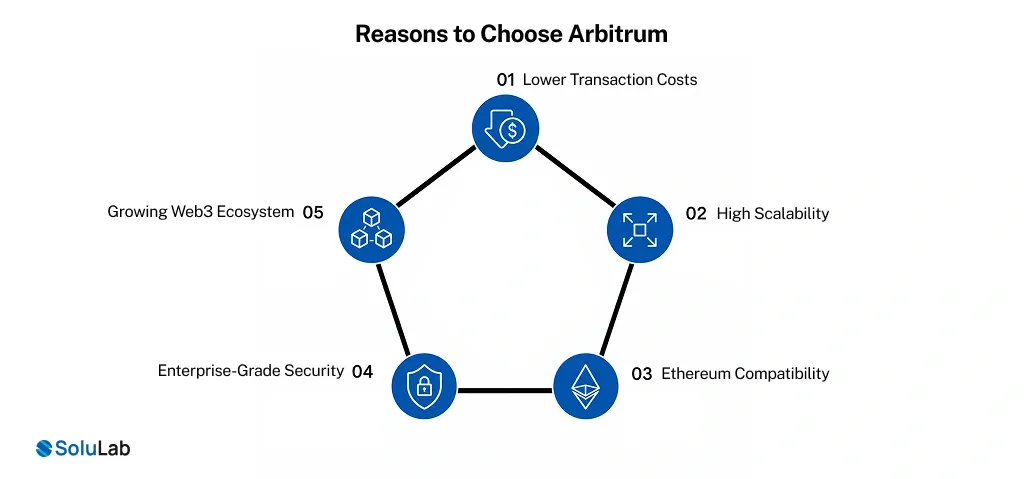
Unlike other blockchain networks, Arbitrum Token Development directly addresses scalability problems that held earlier projects back. Here are the reasons businesses actually pick it.
Lower Transaction Costs
Gas fees on Arbitrum are dramatically lower. Transactions process on Layer 2 blockchains before settling to Ethereum, which cuts cost without cutting security. For applications with heavy user activity, frequent staking, or high-volume trading, that difference in operating cost is real money.
High Scalability
Arbitrum can handle thousands of transactions without slowing down. That makes it worth serious consideration for any project expecting user growth.
Arbitrum Layer 2 Token projects can absorb significantly higher transaction volumes without performance dropping off. You grow the user base without being forced into constant infrastructure re-engineering.
Ethereum Compatibility
Arbitrum Blockchain Development is fully EVM-compatible. Every Ethereum tool, wallet, framework, and developer library you already know runs on Arbitrum without significant changes. That means teams can:
- Reuse existing Solidity code
- Deploy familiar ERC-20 contracts
- Integrate with MetaMask and WalletConnect
- Connect with Ethereum bridges
- Expand existing blockchain ecosystems
Enterprise-Grade Security
Because Arbitrum settles on Ethereum, it inherits Ethereum’s security model. That matters for any project handling digital assets, financial transactions, governance, or sensitive business operations.
Industries where trust isn’t optional, like finance or regulated markets, will find Arbitrum’s security posture adequate for serious production deployments.
Growing Web3 Ecosystem
Arbitrum has become one of the largest Layer 2 networks in production. Its growing set of applications covers DeFi protocols, NFT marketplaces, cross-chain bridges, DAOs, and gaming platforms.
For teams building with a long time horizon, that kind of active ecosystem matters. There are real integration partners, real liquidity, and real users already there.
Key Features of Arbitrum Token Development
Arbitrum Token Development supports a wide range of blockchain functionalities while keeping operational costs under control.
Low Gas Fees
Arbitrum cuts transaction costs compared to Ethereum mainnet. Lower fees bring more users in, which is why payment platforms, DeFi protocols, and gaming projects keep ending up here.
Fast Transaction Processing
Confirmations happen much faster than on Ethereum. For applications handling thousands of interactions daily, that speed gap translates directly to user experience.
Ethereum Compatibility
Because Arbitrum is fully EVM-compatible, developers can reuse existing Solidity contracts and Ethereum development tools without major changes to the codebase.
Advanced Smart Contract Capabilities
Modern Arbitrum smart contracts go well beyond basic token transfers. That depth is what separates a feature-rich product from a simple utility token. Built-in support covers:
- Token staking
- Vesting schedules
- Governance voting
- Yield farming
- Treasury management
- Cross-chain interoperability
Enterprise Scalability
Whether you’re a startup shipping your first product or running an enterprise blockchain network at scale, Arbitrum handles growing transaction volumes without performance falling apart.
How To Develop a Token on Arbitrum?
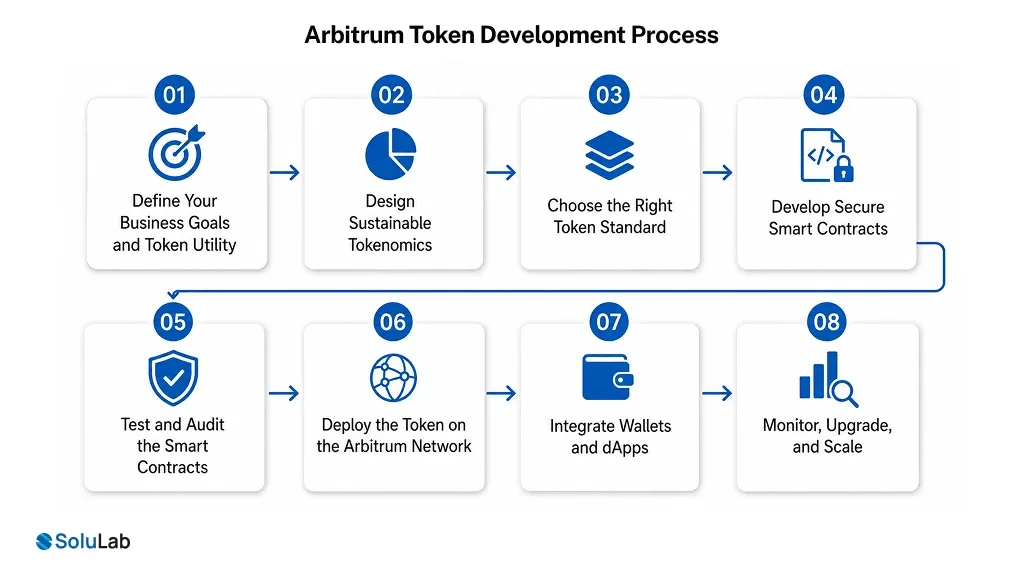
A solid Arbitrum token launch requires more than writing a contract. You’re combining technical development, economic design, security work, and ecosystem integration. Here’s how it actually comes together.
Step 1: Define Your Business Goals and Token Utility
Before writing a single line of code, answer one question: why does this token exist? The answer shapes everything downstream. A clearly defined utility attracts early users and makes long-term adoption easier to build. Common token utilities include:
- Platform payments
- Governance voting
- Staking rewards
- Community incentives
- Access to premium services
- Digital ownership
- Loyalty programs
Step 2: Design Sustainable Tokenomics
Tokenomics is how your blockchain economy actually functions. If you want Arbitrum DAO Governance, for example, you need to define the voting models, proposal mechanisms, and community incentives at this stage, not after deployment. Key decisions to nail down for Arbitrum Token Development:
- Total token supply
- Initial distribution
- Vesting schedules
- Treasury allocation
- Staking rewards
- Burn mechanisms
- Governance rights
Step 3: Choose the Right Token Standard
Pick your standard early. Getting this right upfront simplifies exchange listings and future integrations considerably. ERC-20 Token Development on Arbitrum gives you universal compatibility across the Ethereum ecosystem. The Arbitrum ERC-20 standard covers the core functions:
- Token transfers
- Balance management
- Allowance approvals
- Supply tracking
- Wallet compatibility
Depending on what the project needs, developers can layer in additional capabilities:
- Minting
- Burning
- Transaction taxes
- Pausable contracts
- Blacklisting
- Staking integration
Step 4: Develop Secure Smart Contracts
The smart contract controls how tokens are created, transferred, stored, and managed throughout their lifetime. During Arbitrum smart contract development, teams typically build in:
- Mint and burn functionality
- Ownership controls
- Access permissions
- Security safeguards
- Emergency pause mechanisms
- Upgradeable architecture (if required)
Please note: Every contract must undergo rigorous testing before deployment, as even minor coding errors can expose projects to security vulnerabilities or financial losses.
Step 5: Test and Audit the Smart Contracts
Do not skip this step. Before you launch a Token on Arbitrum, security testing is the one investment that pays for itself many times over. Professional audits check contracts against known vulnerability patterns:
- Reentrancy attacks
- Integer overflow
- Access control flaws
- Business logic errors
- Gas optimization issues
Step 6: Deploy the Token on the Arbitrum Network
Once testing and auditing are done, you deploy. This is when your token goes live for users, investors, and decentralized applications (dApps).
There are two primary Arbitrum networks to pick from:
- Arbitrum One – Ideal for DeFi platforms, enterprise applications, and large-scale blockchain projects.
- Arbitrum Nova – Designed for gaming, social platforms, and applications requiring extremely low transaction costs.
Step 7: Integrate Wallets and dApps
Wallet integration is where the product becomes real for your users. They need a clear way to store, transfer, and interact with the token. Supported wallet options include:
- MetaMask
- Trust Wallet
- WalletConnect
- Coinbase Wallet
- Rabby Wallet
Beyond wallets, connect the token to dApps so users can trade, access platform features, and participate in governance without friction.
Step 8: Monitor, Upgrade, and Scale
Post-launch is not a maintenance phase. It’s where most of the actual product work happens. Track performance, collect user feedback, ship updates. Your DeFi ecosystem stays competitive only if you keep at it. The ongoing workload typically covers:
- Ecosystem partnerships
- Performance monitoring
- Liquidity management
- Governance updates
- Security monitoring
- Smart contract upgrades (when using upgradeable contracts)
- Ecosystem partnerships
Top Use Cases of Arbitrum Token Development
Arbitrum’s flexibility makes it genuinely useful across very different industries. Here’s where it actually gets deployed.
Decentralized Finance (DeFi)
Many DeFi platforms pick Arbitrum because lower fees make lending, borrowing, staking, liquidity mining, and yield farming viable for a much wider user base, not just high-value wallets.
DAO Governance
Community-driven organizations use DAO Governance to give token holders a direct say in protocol upgrades, treasury allocation, and ecosystem decisions.
With ARB tokens or custom governance assets, teams can build transparent decision-making structures that don’t require a central authority to operate.
Asset Tokenization
Asset tokenization is one of the fastest-moving areas in blockchain right now, and asset tokenization on Arbitrum is increasingly practical. Organizations can tokenize real-world assets to improve ownership transparency, increase liquidity, and reduce administrative overhead across categories like:
- Real estate
- Commodities
- Investment funds
- Precious metals
- Intellectual property
- Carbon credits
Gaming and Metaverse
Gaming platforms use blockchain tokens for in-game economies, digital collectibles, marketplace payments, and governance. Arbitrum’s low fees make microtransactions economically viable, which changes the math for both players and developers.
Enterprise Blockchain Solutions
Enterprises are adopting blockchain for loyalty programs, supply chain management, digital identity, and internal payment rails. With Custom Arbitrum Token Development, organizations can build token systems matched to their specific operational requirements, rather than shoehorning a generic solution into a complex business context.
How Much Does Arbitrum Token Development Cost?
Cost depends on what you’re actually building. A basic ERC-20 token is a very different project from a full enterprise blockchain with governance, staking, and cross-chain bridges. The complexity gap is real, and so is the price gap.
Below is a general cost estimate:
| Project Type | Estimated Cost |
| Basic ERC-20 Token | $5,000-$15,000 |
| Custom Token with Advanced Features | $15,000-$40,000 |
| Enterprise Blockchain Ecosystem | $40,000-$100,000+ |
Factors That Influence Development Cost
Several factors determine the overall investment required to create a Token on Arbitrum.
Smart Contract Complexity
Staking, governance, vesting, token burns, or cross-chain bridges each add development and testing time. The more of these you stack, the more thorough the engineering work needs to be.
Security Audits
Professional audits catch vulnerabilities before deployment. Skip this and you’re transferring that risk onto your users and your project’s reputation.
Third-Party Integrations
Connecting wallets, exchanges, payment gateways, analytics tools, or blockchain bridges takes more development time. But it also makes the product genuinely usable, so the tradeoff is usually worth it.
Cross-Chain Compatibility
Operating across multiple networks requires extra infrastructure and bridge development. Not every project needs it on day one, but planning for it early is smarter than retrofitting it later.
Governance Features
Building decentralized governance with proposal management and voting mechanisms is its own engineering problem. It adds complexity, and that shows up in the timeline and the budget.
Should You Hire Arbitrum Developers or Build an In-House Team?
The right approach depends on your budget, timeline, and where you want to be in two years. Most startups and growing businesses outsource to an experienced Arbitrum Token Development Company because it gets them to market faster with a team that already knows the stack. The practical benefits:
- Faster development timelines
- Lower infrastructure costs
- Experienced blockchain engineers
- Security-focused development
- End-to-end project support
If speed and low technical risk matter, professional blockchain token development services are typically the smarter move.
Large enterprises building long-term blockchain products sometimes prefer an in-house team. More control over architecture and product direction. The tradeoff: significant investment in hiring, tooling, and ongoing maintenance that doesn’t go away.
The Future of Arbitrum Token Development
Layer 2 adoption keeps reshaping how blockchain products get built, and Arbitrum is near the center of it. The trends driving the next wave of growth:
- Increased institutional adoption of Layer 2 networks.
- Expansion of asset tokenization across real estate, finance, and supply chains.
- Greater adoption of DAO governance using Arbitrum’s ARB token and custom governance assets.
- Growth of AI-powered blockchain applications.
- Improved interoperability through cross-chain infrastructure.
- Continued expansion of enterprise Web3 ecosystems.
As blockchain moves from experimental to operational for more businesses, Arbitrum is positioned to be a practical foundation rather than a speculative bet.
Conclusion
Arbitrum Token Development gives businesses a faster, more cost-efficient path to scalable Web3 solutions without trading away Ethereum’s security model. But deploying a smart contract is just the start. What actually determines whether a token project succeeds is the work that surrounds it: the tokenomics design, the security audit, the integration layer, and the ongoing maintenance after launch.
Get those right, and Arbitrum gives you a solid foundation. Skimp on them, and no amount of low gas fees will save the project from itself.
Build a Token on Arbitrum With SoluLab!
SoluLab is a top Arbitrum Token Development Company that helps startups and enterprises turn blockchain ideas into production-ready Web3 products. Our end-to-end Token development services cover custom Arbitrum token builds, smart contract engineering, wallet and dApp integration, DAO governance, security audits, and cross-chain interoperability.
With over 11 years of experience, 1,500+ successful projects, 250+ technology experts, and 500+ global clients, we bring deep blockchain expertise and a business-first approach to every engagement, so what ships is secure, scalable, and built to last.
Whether you’re building a utility token, a governance asset, or a full enterprise blockchain platform, SoluLab has the technical depth and strategic experience to help you launch with confidence.
FAQs
Shipra Garg is a tech-focused content strategist and copywriter specializing in Web3, blockchain, and artificial intelligence. She has worked with startups and enterprise teams to craft high-conversion content that bridges deep tech with business impact. Her work translates complex innovations into clear, credible, and engaging narratives that drive growth and build trust in emerging tech markets.