
Key Takeaways
Before we go into the questions, here’s what you’ll walk away with:
- Most blockchain projects don’t go off the rails during development. They go wrong much earlier during discovery when the scope is fuzzy, assumptions aren’t challenged, and everyone is too eager to move fast instead of asking hard questions.
- In practice, the best partners are the ones who push back. If a vendor is willing to slow you down, question your thinking, and say this won’t work as stated, that’s usually a good sign, not friction.
- Security and compliance also aren’t things you bolt on later. Teams that have shipped real systems treat them as part of the foundation, not optional extras once the build is done.
- Early cost clarity matters for the same reason. When a team can explain where the blockchain development cost comes from upfront, it usually means they understand the problem, not just the build.
- Taken together, these 27 questions are a practical way to compare vendors side by side and see who actually thinks like a long-term partner.
Let’s be blunt for a second. If you’re evaluating a blockchain vendor right now, odds are you’re about to make a very expensive mistake. Not because you’re careless, but because almost everyone does the first time.
Here’s the stat that should stop you cold: 77% of enterprise blockchain pilots never make it past proof-of-concept, according to Gartner. Not delayed. Not iterated on. Byt dead, buried, and quietly forgotten once the budget is gone.
And no, most of those didn’t fail because blockchain wasn’t ready. They failed because the wrong people were hired. The ones who talk well, show great diagrams, and disappear the moment real constraints show up.
If you’re a founder or CTO, this part will feel uncomfortably familiar.
- Everyone sounds competent.
- Every proposal promises scalability.
- Every vendor says they’ve done this before.
And somehow, six months later, you’re staring at a half-built system, unclear ownership, no real ROI story, and a team that keeps saying “one more sprint.”
That’s not bad luck. That’s bad vetting.
This article isn’t here to explain blockchain development on the whole. You already know what it could do. This is about the questions most founders don’t ask until it’s too late, the ones that expose whether a blockchain partner can actually ship, integrate, and survive contact with reality.
There are 27 of those questions below. Miss them, and you’ll join the 77%. Ask them, and you’ll save yourself months of burn and a very awkward internal post-mortem.
Read this before you sign anything
Why Most Blockchain Projects Fail After Choosing the Wrong Development Partner?
The World Economic Forum estimated that blockchain-enabled systems could underpin more than 10% of global GDP by 2027. Even Statista projects the global blockchain market growing to $94 billion by that same year.
That’s a real market and a real opportunity. But the gap between opportunity and outcome sits almost entirely in vendor selection.
Companies developing blockchain solutions are multiplying fast, and quality varies enormously.
- Some are excellent at demos, decks, and discovery calls.
- Far fewer have the depth to handle enterprise-grade architecture, audit-ready contracts, and regulated-industry compliance simultaneously.
Forbes’ analysis of enterprise blockchain adoption found that teams who succeeded consistently treated vendor selection as a due diligence process, not a procurement exercise.
Here’s what the failure pattern usually looks like when a blockchain app development company isn’t the right fit:
- They agreed to build before truly understanding the problem
- Smart contracts went to production without a proper audit
- The architecture couldn’t handle real user load
- IP ownership was never formally defined and became a legal dispute
- The team disappeared after the first deployment
None of these are edge cases. They happen on projects that started with genuine excitement. And they’re almost always avoidable if you slow down at the start.

27 Questions to Ask Before Hiring a Blockchain Development Company
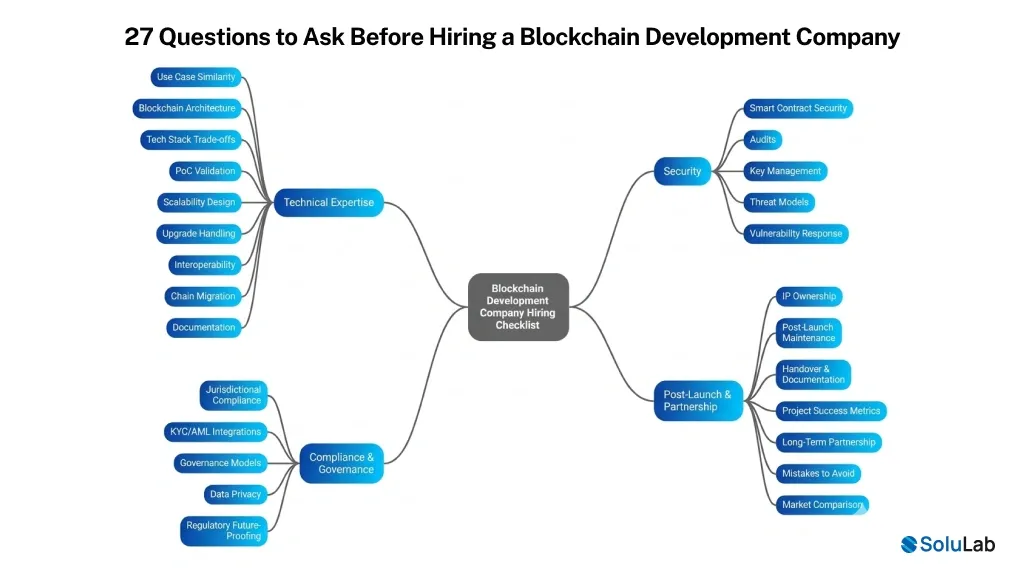
Use these as a blockchain project requirements checklist across every vendor conversation. Group them by category, it gives you a structured signal across different stakeholders evaluating the same answers.
Section 1 — Architecture & Technical Fit
Question 1. Have you built blockchain systems similar to our exact use case?
Answer: This isn’t about a long portfolio; it’s about depth of relevant experience. A team that’s built supply chain traceability systems thinks completely differently from one that lives in the DeFi ecosystem. What you want is someone who can walk you through a project that actually looks like yours with the same scale, similar edge cases, and ideally similar regulatory pressure.
If they can’t do that without pulling up a deck, you’re probably not their ideal client. Push for specifics: What chain? What was the transaction volume? What broke during testing? That conversation will tell you more than any case study page ever will.
Question 2. Which blockchain architecture would you recommend and why?
Answer: The answer here matters less than how they get there. A strong blockchain platform development team won’t just say Ethereum or Hyperledger- they’ll explain the trade-offs specific to your situation.
- Why public vs. permissioned, given your user base?
- Why this consensus mechanism at your expected throughput?
If they jump straight to a recommendation without first asking about your users, your data model, and your compliance needs, they’re not thinking with you; they’re selling to you. That’s a meaningful distinction when you’re about to spend serious money.
Question 3. What trade-offs are we making with this tech stack?
Answer: Every stack trades something like speed for decentralization, low gas cost for ecosystem maturity, and developer availability for chain performance. A good custom blockchain development company is upfront about what you’re giving up, not just what you’re getting.
The teams we’d be cautious about are the ones where everything sounds perfect. Real technical decisions involve real compromises, and if they’re not surfacing those in the first conversation, you’ll discover them in month four, which is a much worse time.
Question 4. How do you validate a project before writing code?
Answer: This is really the Blockchain PoC question in disguise.
- What you want to hear is that they run a structured discovery and prototyping phase, like pressure-testing your core assumptions before any smart contract code gets written.
- What you don’t want is a team that goes quiet for two weeks and comes back with a deployment.
Discovery should surface ambiguity in your requirements, challenge your volume assumptions, and give both sides a shared view of what done actually means. If they skip this, budget overruns and scope creep are almost guaranteed.
Question 5. What assumptions are you making about our users and volume?
Answer: This is where projects quietly blow up on cost. If they’ve quoted you without deeply understanding your peak transaction load, your geographic distribution, and how your users actually behave, that quote is fiction.
Ask them to show their assumptions explicitly. A serious blockchain development company treats this like a financial model, not a ballpark. You want to see the numbers behind the number, because that’s what determines whether your architecture holds up at scale or collapses when you actually launch.
Question 6. How do you design for scalability from day one?
Answer: Scalability isn’t something you add later; it’s baked into every architectural decision early on. Ask them specifically:
- What’s the plan if transaction volume 10x’s in year two?
- Are they thinking about blockchain Layer 2 solutions, off-chain computation, or sharding strategies from the start?
- Vague answers like we’ll cross that bridge when we come to it should concern you.
The teams that design for scale upfront cost more initially, but they’re the ones whose systems actually survive contact with real users. The ones who don’t will hand you a rewrite bill.
Question 7. How do you handle upgrades without breaking contracts?
Answer: This is one of the most practically important questions on this list. Smart contracts are immutable by default, so upgrades, which will happen, require deliberate architectural choices made at the start. Proxy patterns, migration logic, versioned interfaces: a team doing serious custom blockchain software development should be able to explain their upgrade strategy in plain terms.
If they look surprised that you asked, that’s a real risk signal. You want to know exactly what happens when a bug is found post-launch and how upgrades get deployed without disrupting live users.
Question 8. How do you approach interoperability and integrations?
Answer: Real enterprise systems are never islands. You’re almost certainly going to need to connect to a legacy ERP, pull data from an Oracle, or eventually communicate with another chain.
- Ask how they’ve handled these integrations in actual blockchain solutions development work, not theoretically.
- Who did they use for oracles?
- How did they bridge chain data to off-chain databases?
- What broke during the integration phase, and how did they fix it?
Teams with real experience here have specific stories, and teams without it will give you a general answer about flexibility.
Question 9. What happens if we need to migrate chains later?
Answer: This sounds hypothetical, but it happens more than people expect, like regulatory guidance shifts, a chain gets deprecated, and performance doesn’t hold up at scale. A mature blockchain development services company doesn’t assume the chain you start on is the one you’ll always use; they design with portability in mind from the start.
Ask how they’ve handled chain migrations before and what the architectural decisions were that made it easier or harder. If they’ve never been asked this, and have no plan for it, that’s the kind of thing that becomes a $200k problem three years from now.
Question 10. How do you document architecture for future teams?
Answer: The engineer who built your system may not be there when something breaks at 2 am two years from now. Documentation isn’t glamorous, but it’s what protects your investment once the build phase ends. Ask to see a real architecture document from a previous engagement. Ask them
- How is the smart contract logic explained?
- How are the integration points mapped?
A team that documents well is a team that’s thinking about your long-term ownership of the system, not just their short-term delivery.

Section 2 — Security & Risk
Question 11. What is your smart contract security process?
Answer: This question deserves a specific, repeatable answer, not a philosophy. You want to hear about their actual workflow: which static analysis tools they run, how code review cycles are structured, and whether they use formal verification for critical contracts.
A trustworthy blockchain development solutions provider can walk you through this process step by step because they’ve done it the same way on every serious project. We review it before we ship is a liability waiting to happen. The cost of a proper security process is small compared to the cost of a single exploit.
Question 12. Do you use internal audits, third-party audits, or both?
Answer: For anything going to production with real value at stake, third-party audits aren’t optional; they’re table stakes. If a blockchain application development company relies only on internal review, ask directly why and what their justification is.
The credible firms will have a list of audit partners. They’ll have worked with firms like CertiK, Trail of Bits, and OpenZeppelin, and they’ll be willing to share past audit reports or at least confirm they exist. If they get evasive about which firms they’ve worked with, that tells you something important about how seriously they treat security.
Question 13. How do you handle key management and access control?
Answer: Private key loss or theft is how projects lose real money, sometimes all of it. Multi-sig setups, hardware security modules, and tiered access roles with defined key holders are all things that should come up naturally in a serious vendor conversation. If you have to prompt them on this, it means it’s not part of their standard process.
- Ask who holds the keys,
- Under what conditions can they be used
- What happens if a key holder leaves the team or the company?
The answer tells you a lot about whether they’ve actually thought through the operational security of what they’re building.
Question 14. What threat models do you design against?
Answer: Reentrancy attacks, front-running, oracle manipulation, flash loan exploits – these aren’t exotic theoretical risks. They’re the actual attack vectors that have cost the blockchain industry billions of dollars. A team with real security depth brings these up before you do.
They’ll describe specific threat scenarios they designed against in past projects and how they mitigated them architecturally. If they’re waiting for you to name the threats before they engage, you’re looking at a team that integrates DeFi protocols without deeply understanding the security implications of what they’re deploying.
Question 15. How do you respond to post-launch vulnerabilities?
Answer: No production system is perfect on day one. What separates good partners from bad ones is how they handle it when something goes wrong. Ask for a real example:
- Have they ever dealt with a live vulnerability or exploit
- What did that look like?
- How fast did they respond?
- How did they communicate with the client?
- What was the patching process?
Teams that have been through this have a story and a protocol. Teams that haven’t should at least be able to articulate a clear incident response plan. Vague reassurances aren’t acceptable here, as this is your risk exposure.
Section 3 — Compliance & Governance
Question 16. How do you approach compliance by jurisdiction?
Answer: If your product touches users in the US, EU, or any regulated market, compliance is something you design in from the start. This is especially critical when evaluating a blockchain development company in USA or any team working across jurisdictions.
GDPR, FinCEN requirements, MiCA in Europe — these have real technical implications for your data architecture, your smart contract logic, and your onboarding flows. A team that treats compliance as a legal team’s problem rather than an engineering problem will cost you significantly in rework when you get to regulated markets.
Question 17. What experience do you have with KYC/AML integrations?
Answer: For any Enterprise blockchain solution operating in financial services, payments, or asset management, KYC and AML integrations aren’t optional; they’re load-bearing infrastructure.
- Ask specifically which providers they’ve worked with: Jumio, Onfido, Sumsub, and Chainalysis.
- Ask whether they understand the regulatory logic behind the integration, not just how to connect the API.
Teams that have done this before understand why certain data flows need to be structured a certain way, and that understanding shows up in how they architect the system.
Question 18. How do you design governance models?
Answer: Governance is where a lot of blockchain projects quietly create future legal and operational risk.
- Who can upgrade the contracts?
- Who holds the admin keys?
- Who votes on protocol changes?
- What happens when there’s a dispute?
For DAOs, consortium chains, and enterprise tools, governance design is as important as the technical architecture itself. A strong team asks these questions early, documents the decisions formally, and builds the governance model into the contract structure, not as an afterthought but as a core design requirement. If they’ve never raised this with you, raise it yourself
Question 19. What data privacy considerations are built into the design?
Answer: On-chain data is transparent by default, which is fine for some use cases and catastrophic for others. Ask how they handle data that shouldn’t be public: zero-knowledge proofs for identity verification, private state channels for sensitive transactions, and off-chain encrypted storage with on-chain hash anchors.
If your product is going to serve enterprise clients, especially in healthcare, finance, or legal, Enterprise risk detection platforms’ design principles need to be part of the conversation from discovery. Teams that haven’t thought about this will hand you a system that your enterprise customers’ legal teams will reject.
Question 20. How do you future-proof against regulatory changes?
Answer: The regulatory landscape across blockchain development use cases is still being written.
- MiCA in Europe just came into force.
- The SEC’s posture on tokenized assets keeps shifting.
New jurisdictions are introducing frameworks every quarter. A good development partner designs with this in mind, building flexibility into the architecture so that compliance changes don’t require full rewrites.
Ask specifically: if the regulatory requirements in your primary market change significantly in year two, what does that remediation look like? Teams that have thought about this have a real answer, but teams that haven’t will quote you a full rebuild.

Section 4 — Business & Partnership Terms
Question 21. Who owns the IP and codebase?
Answer: This is a question that feels awkward to ask, but becomes enormously important the moment something goes wrong. Work-for-hire, licensing arrangements, and open-source components all carry different implications for what you can do with the code after the engagement ends.
Get this defined in the contract before a single line of code is written, as a primary clause. We’ve seen situations where founders assumed they owned everything and discovered they had a licensing arrangement with their vendor baked in. That conversation is a lot harder to have after you’ve already shipped.
Question 22. How do you handle post-launch maintenance?
Answer: A lot of blockchain app development service providers are excellent builders and difficult partners the moment the deployment is done. Ask directly:
- What does your support model look like after launch?
- What are the SLAs for critical issues?
- Is there a retainer structure, and what does it include?
- Who is actually on-call on a Saturday night when something breaks?
The firms that are serious about long-term relationships have clear, documented answers to these questions. The ones that aren’t will give you a vague we’re always available – which means nothing and protects you against nothing.
Question 23. What does handover and documentation look like?
Answer: At some point, you may want to bring development in-house, switch vendors, or hand the system to an internal team. The quality of the handover documentation determines whether that transition takes two weeks or six months.
Ask to see a real handover package from a past engagement.
- What’s included?
- How is the smart contract logic documented?
- How are the integration points described?
- How is the environment setup explained?
If they’ve never been asked this question before, or if the answer is we’ll figure it out at the time, that’s a signal about how they think about your long-term ownership of what they build.
Question 24. How do you measure project success?
Answer: We shipped on time is not a success metric; it’s a delivery milestone. A results-oriented blockchain development company thinks about success in terms of the outcomes that actually matter to your business: transaction throughput hitting target numbers, user adoption tracking against projections, cost reduction versus the legacy system you replaced, and uptime against agreed SLAs.
Ask them to describe how they’ve measured success on past projects and what the numbers actually looked like. If they can’t answer this with specifics, you have a useful data point about how aligned they are to your actual business outcomes.
Question 25. What does a long-term partnership actually look like with you?
Answer: You’re not just buying a build, you’re evaluating whether this is a team you want in your corner for the next three to five years as your product evolves.
- Ask how they’ve supported clients beyond the initial delivery.
- How have they grown with past clients as requirements have changed?
- Are there clients who’ve been with them through multiple projects over multiple years?
The answer to this question tells you whether they’re a project shop or a genuine partner. Both can be the right answer depending on what you need but knowing which one you’re working with is important before you sign anything.
Question 26. Any mistakes to avoid when hiring a blockchain development company?
Answer: Flip the dynamic. This question is one of the most revealing things you can ask, and you’re asking a vendor to be honest with you about patterns in your industry, including the ones their own competitors might fall into.
Vendors who answer this with real specifics and genuine candor are usually the ones worth continuing the conversation with. The ones who pivot to a pitch, or give you a generic, don’t communicate requirements clearly, are telling you something important about how they’ll behave when things get difficult. Honesty under low-stakes conditions is your best preview of honesty under high-stakes ones.
Question 27. How do you compare to other blockchain development service providers in your market?
Answer: You’re not looking for a competitive teardown that would actually make you trust them less. What you want is a team that can clearly and confidently articulate what they’re genuinely better at and where their depth really lives. Specific chains, specific industries, team composition, audit partners, and client tenure.
If they can’t describe their own differentiation without either deflecting or taking shots at competitors, that’s a meaningful data point. The best teams know exactly why a certain kind of client should work with them, and they’re equally clear about when someone else might actually be a better fit.
How to Use These Answers to Score Vendors Objectively?
Once you’ve run these questions across two or three firms, you need a structured way to compare. Gut feel doesn’t work well when multiple stakeholders are involved.
Build a simple scorecard. Rate each answer from 1 to 5 across four dimensions:
- Clarity — Did they explain it without jargon?
- Specificity — Real examples, not hypotheticals
- Honesty — Did they acknowledge trade-offs and limitations?
- Depth — Did the answer show they’d actually thought about this before?
This converts a seemingly good decision into something your CTO, legal counsel, and finance lead can all align on. It’s particularly valuable when figuring out how to choose a blockchain development company with mixed internal opinions on the shortlist.
On pricing: the cost to hire a blockchain development company should be your last filter, not your first. Based on Clutch.co’s 2024 developer rate data, blockchain development costs typically run $50–$80/hr for offshore teams and $150–$250+/hr for senior engineers at established US firms. Neither range is inherently wrong, as it depends on complexity, compliance requirements, and your internal team’s ability to absorb the handover.
But, if you’re still early in the process, we recommend that you work with Blockchain consultants before issuing an RFP, as it can save weeks and help you shape requirements before vendors start shaping your thinking for you.
It’s also worth staying current on Top blockchain Trends like real-world asset tokenization, account abstraction, and ZK rollup adoption because a vendor’s familiarity with what’s happening now tells you where their team’s skills actually live.
Conclusion
Choosing the right Blockchain Development Services partner shapes everything that comes after your architecture, security posture, regulatory standing, and whether your product reaches users or quietly dies in a dev environment.
These 27 questions are designed to surface real signals from how a team thinks, not just what they say. The firms that give clear, specific, honest answers to hard questions are worth talking to further. The ones who pivot to case studies and decks at the first sign of friction are giving you equally useful information.
The best Hire Blockchain developers decisions we’ve seen all share the same trait: they were deliberate, slow in the right places, and fast where it mattered.
Use these questions to score your vendors, and don’t let timeline pressure shortcut a decision you’ll live with for years.
FAQs
With over 3 years of experience, I specialize in breaking down complex Web3 and crypto concepts into clear, actionable content. From deep-dive technical explainers to project documentation, I help brands educate and engage their audience through well-researched, developer-friendly writing.

![How to Choose a Blockchain Development Company [2026 Edition]](https://www.solulab.com/wp-content/uploads/2026/09/Banner-Before-You-Hire-Check-These-Blockchain-Essentials.webp)