Key Takeaways
- 2027 is the year tokenization moves from pilots to production plumbing inside banks, brokers and fund managers.
- Tokenized Treasuries and money market funds stay the anchor asset class, while tokenized equities grow fastest from a small base.
- Regulated stablecoins become the default settlement leg for tokenized trades as US stablecoin rules take effect.
- Secondary liquidity, not issuance, is the real test. Many tokenized assets will still trade thinly.
- Every prediction needs a signal to track and a clear sign it’s failing. Treat forecasts as hypotheses, not certainties.
- Businesses that pick their compliance model and token standard in 2026 will launch faster than those that start with the chain.
Asset tokenization predictions for 2027 point to one shift above all: tokenized assets stop being experiments and start running inside mainstream financial infrastructure. Treasuries, funds, private credit and listed equities are moving on-chain first.
The growth curve supports that view. Grand View Research estimates the asset tokenization market at $2.1 trillion in 2026 and projects it will reach $24.5 trillion by 2033, a 42.1% CAGR. North America held 38.4% of revenue in 2025, while Asia Pacific is growing the fastest.
But big tokenization forecasts have missed the mark before. That’s why this guide does something the usual trend lists simply don’t. Each prediction comes with a signal you can track through 2027 and a bear case that would prove it wrong. If you’re planning real world asset tokenization in the next 12 months, this is the checklist worth planning against.
Where Does the Asset Tokenization Market Stand Going Into 2027?
The asset tokenization market enters 2027 with roughly $40 to $46 billion of real-world assets on public blockchains, excluding stablecoins. That’s small next to global capital markets, but the tokenization of real-world assets has grown fast. The bigger change in 2026 was who showed up: market infrastructure, large banks, and the SEC.
1. On-Chain Value Today
As of October 2026, Token Terminal tracked about $46.2 billion in tokenized real-world assets across 35 to 36 networks, while rwa.xyz counted $38.61 billion. US Treasury bills were the largest category at about $13.9 billion. The two numbers differ because each tracker counts cross-chain and distributed assets differently. That gap is worth remembering whenever you read a single headline figure about tokenized assets.
2. What Changed in 2026
Three moves stand out. DTCC processed US trades using DTC-tokenized assets in July 2026. The SEC issued a five-year Innovation Exemption on September 17, 2026, allowing on-chain trading of tokenized NMS stocks under volume and ticker caps. And Morgan Stanley said it expects to support tokenized equities on its ATS in Q1 2027. When clearing houses, regulators and wirehouses move in the same year, the conversation shifts from “if” to “how.”
3. Why 2027 Fits the Hype Cycle
Gartner’s 2022 Hype Cycle for Blockchain and Web3 placed tokenization five to ten years from the plateau of productivity. By that clock, 2027 sits right at the start of the window where mainstream use becomes realistic. It also explains why the hype phase of 2021 and 2022 didn’t produce lasting volume. The infrastructure simply wasn’t ready. If you want the 2026 baseline in more detail, our roundup of RWA tokenization trends for enterprises covers it.
What Is the Asset Tokenization Market Forecast for 2027?
Our asset tokenization market forecast for 2027 is grounded in current run rates rather than 2030 headline numbers. We expect on-chain RWA value (excluding stablecoins) to roughly double from late-2026 levels, landing somewhere between $80 billion and $100 billion by the end of 2027. That’s our estimate, based on the pace seen through 2026.
1. On-Chain RWA Value Roughly Doubles
DeFiLlama data showed tokenized RWAs rising about 66% between January 1 and March 11, 2026, from $14.1 billion to $23.6 billion. Asset tokenization growth has slowed in percentage terms since then, which is normal as the base gets larger. A doubling over the next 12 to 15 months is ambitious but consistent with that trend.
2. Treasuries and Funds Stay the Anchor
Tokenized funds holding Treasury bills, bonds, and money market products made up about 44.5% of DeFiLlama’s tracked RWA market in March 2026. Chainalysis put tokenized US Treasuries at $15.42 billion as of mid-2026, up 125% year on year. Expect tokenized funds to remain the largest category of tokenized financial assets through 2027, because they solve a clear problem: idle on-chain cash that wants a regulated yield.
3. Forecast Ranges Will Narrow
Today’s 2030 forecasts span from about $2 trillion to more than $16 trillion depending on the source. Morgan Stanley’s head of digital asset strategy said the market will land in a $3 trillion to $10 trillion range by 2030. As real issuance data piles up in 2027, expect analysts to converge on the lower half of the older estimates. That’s not bad news. It’s what a maturing market looks like.
Which Tokenized Assets Will Grow Fastest in 2027?
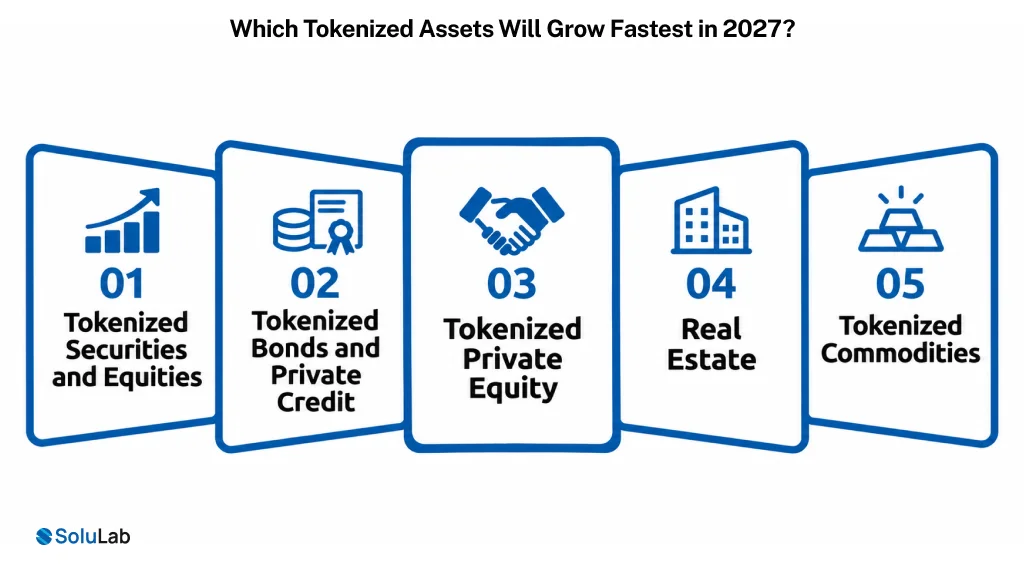
Tokenized equities will grow fastest in percentage terms in 2027, while Treasuries and funds will add the most dollar value. Private credit, real estate and commodities will grow steadily but unevenly, held back by valuation, custody and secondary-market limits.
1. Tokenized Securities and Equities
The SEC’s Innovation Exemption gives venues a legal path to trade tokenized shares that carry the same rights as the underlying stock. Tier 1 names are capped at 75 tickers and 0.25% of prior-month average daily volume, so growth will be visible but bounded. Expect issuers to standardize on permissioned token standards such as ERC-3643, which builds identity and transfer rules into the token itself.
2. Tokenized Bonds and Private Credit
Tokenized bonds will gain from faster settlement and smaller ticket sizes. Private credit is where tokenization saves the most manual work, because loan servicing, waterfall payments and investor reporting can be automated in smart contracts. Expect more mid-market credit funds to launch tokenized share classes in 2027.
3. Tokenized Private Equity
Tokenized private equity will grow slowly but meaningfully. Morgan Stanley singled out private shares and private fund access as areas where tokenization could cut paperwork. The constraint is investor eligibility. Most of these products will stay limited to accredited and institutional buyers through 2027.
4. Real Estate
Real estate is the long-term giant. Deloitte projects tokenized real estate will grow from under $300 billion in 2024 to about $4 trillion by 2035, a 27% compound annual growth rate. For 2027, though, most activity will be fund-level and debt tokenization rather than single-property sales. If you’re exploring this space, our guide to real estate tokenization explains the main structures.
5. Tokenized Commodities
Tokenized gold already makes up a large slice of on-chain RWA value, with DeFiLlama tracking about $6.5 billion in gold and commodities in March 2026. Expect tokenized commodities to expand into copper, carbon credits and energy, mainly as collateral and trade-finance instruments rather than retail investments.
How Will Tokenization Infrastructure Change in 2027?
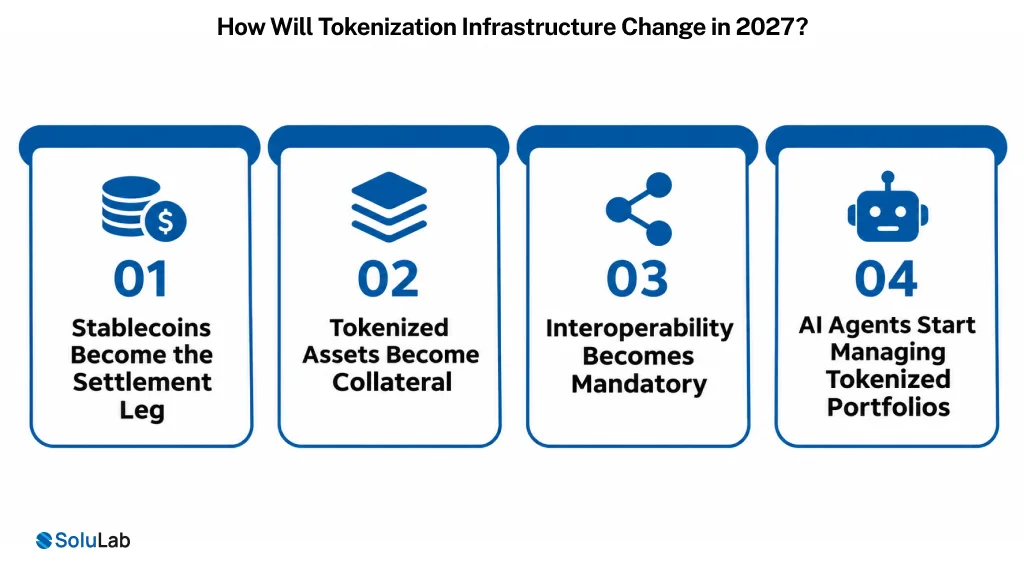
Infrastructure will change in three ways in 2027: regulated stablecoins will handle settlement, tokenized assets will be used as collateral, and interoperability will become a must-have rather than a nice-to-have. AI agents will start acting on tokenized assets too.
1. Stablecoins Become the Settlement Leg
The US GENIUS Act takes effect in January 2027, giving banks and fintechs clear rules for payment stablecoins. That matters because a tokenized bond is only as fast as the cash leg that pays for it. Gartner’s 2024 Hype Cycle for Blockchain and Web3 expected stablecoins to reach the plateau of productivity within two years, and 2027 is when that timeline meets regulation. Expect more teams to pair asset issuance with stablecoin development or integrate an existing regulated coin for delivery-versus-payment.
2. Tokenized Assets Become Collateral
The next wave of value comes from what tokenized assets can do, not just from owning them. A Statista survey conducted in February and March 2026 across North America, MENA, Europe and APAC found product building blocks were the leading use case for tokenized assets, followed by balance-sheet collateral. In practice, that means tokenized Treasuries posted as margin, intraday repo and fund units used inside other products. This is where on-chain asset management starts to beat legacy workflows.
3. Interoperability Becomes Mandatory
Today, RWAs sit on more than 35 networks. Liquidity split across that many chains stays thin. In 2027, expect issuers to demand assets that can move between networks without losing compliance controls, using messaging standards and secure cross-chain bridge infrastructure. Bridges remain a major attack surface, so security reviews will matter as much as reach.
4. AI Agents Start Managing Tokenized Portfolios
Machine-readable assets suit software buyers. Expect AI agents to rebalance tokenized fund holdings, monitor collateral ratios, and flag compliance breaches. The guardrails matter more than the models here: agents should act inside permissioned wallets with spending limits and human sign-off on large moves.
The 2027 Prediction Scorecard: Signals to Watch and What Could Go Wrong
A prediction is only useful if you can check it. The table below lists each 2027 prediction, the signal that would confirm it, and the bear case that would prove it wrong. Use it to revisit your plans quarterly.
| Prediction for 2027 | Confidence | Signal to Watch | Bear Case |
| On-chain RWA value roughly doubles | Medium | RWA trackers show $80B+ by Q4 2027 | Growth stalls below $60B as yields fall and issuers pause |
| Treasuries and funds stay the largest category | High | Fund products keep 40%+ share of tracked RWA value | Equities or private credit overtake funds |
| Tokenized equities grow fastest | Medium | Venues hit Innovation Exemption volume caps | Issuers object to third-party tokenization and venues stay quiet |
| Stablecoins become the default cash leg | High | Banks launch GENIUS-compliant coins for settlement | Rules delay bank issuance and firms fall back to tokenized deposits |
| Tokenized assets used widely as collateral | Medium | Major venues accept tokenized Treasuries as margin | Legal uncertainty over collateral enforceability slows adoption |
| Interoperability becomes standard | Low to Medium | Leading issuers support two or more networks per asset | A major bridge exploit pushes issuers back to single chains |
What Should Businesses Do Before 2027?
Businesses should decide their compliance model, asset structure and token standard before choosing a blockchain. That applies to every digital asset tokenization project, from a fund share class to a carbon credit. The firms that launch in 2027 will be the ones that settled these decisions in late 2026.
1. Start With One Asset and One Investor Type
Pick an asset with clear valuation and steady cash flows, such as a fund share class, receivables or a bond. Define who can hold it. That single decision drives KYC depth, transfer rules and custody.
2. Design for Compliance and Collateral Use
Build identity-aware tokens, whitelisted transfers and corporate-action handling into the smart contracts. Then think one step ahead: could this token be posted as collateral or used inside another product? Designing for that now avoids a rebuild later. Our comparison of on-chain vs off-chain asset tokenization helps decide what belongs on the ledger.
3. Plan Liquidity Before Launch
Line up a transfer agent, an ATS or exchange partner, and at least one market maker before issuance. A token with no exit route is a harder sell than the paper version it replaced.
4. Get the Contracts Audited
Tokenized assets hold real investor money. An independent smart contract audit before launch protects both investors and your license.
Should You Build, Buy or White Label a Tokenization Platform?
Use a white-label asset tokenization platform to test one asset class quickly. Choose a custom asset tokenization platform when you need your own compliance logic, multiple asset types or integrations with core banking and custody systems.
1. When White Label Works
White-label and tokenization-as-a-service platforms suit a first issuance, a pilot fund or a proof of concept with a regulator. Check who owns the code, which token standards are supported and how easily you can migrate later. Our overview of tokenization as a service covers the trade-offs.
2. When Custom Development Pays Off
Custom asset tokenization platform development pays off when tokenization is part of your core business, not a side project. Think multi-asset issuance, investor portals, secondary trading, collateral management and reporting under one roof. That’s where an experienced asset tokenization development company earns its fee.
3. The Hybrid Route
Many institutional asset tokenization programs start on a white-label core, then replace modules (compliance engine, custody integration, investor portal) one at a time as volume grows. It’s slower to finish but cheaper to start, and it keeps options open while 2027 regulation settles.
Conclusion
The clearest of all asset tokenization predictions for 2027 is that tokenization becomes infrastructure. Treasuries and funds lead, equities grow fastest, stablecoins carry the cash leg and regulators set clear but capped paths. The open questions are liquidity, interoperability and how quickly forecasts turn into real trading volume.
Track the signals in the scorecard, not the headlines. And make your compliance and token design decisions now, before the market forces them on you.
If you’re planning a tokenized fund, bond or real-world asset platform, SoluLab, an tokenization development company, can help your business design, build and launch compliant asset tokenization solutions, from smart contracts and investor onboarding to AI-driven compliance monitoring. Book a free tokenization workshop with our blockchain team to map your 2027 roadmap.
FAQs
Neha is a curious content writer with a knack for breaking down complex technologies into meaningful, reader-friendly insights. With experience in blockchain, digital assets, and enterprise tech, she focuses on creating content that informs, connects, and supports strategic decision-making.