Key Takeaways
- AI tools vs custom AI is not a technology debate. For startups, it is a runway, speed, and defensibility decision.
- Off-the-Shelf AI Tools work well for quick experiments, internal productivity, and early workflow automation.
- A custom AI solution makes sense when AI becomes part of your product, customer experience, data moat, or revenue engine.
- SoluLab helps funded startups with AI strategy consulting services, AI development solutions for startups, integration, and custom AI product development.
AI tools vs custom AI- which one should a startup choose? This is the question that most companies are looking for! Off-the-Shelf AI Tools can be useful in quick experimentation, and a custom AI platform development makes more sense when the workflow is core to the product.
This guide explores custom AI vs off the shelf AI, which solution is best for the business. Also, find out how SoluLab helps founders make the right AI build decision.
AI Tools and Custom AI: Understanding The Difference
AI tools help you use existing capabilities. Custom AI helps you build capabilities around your own product, data, users, and workflows. This difference matters for startups because early decisions become hard to unwind later.
What Are Off-the-Shelf AI Tools?
Off-the-Shelf AI Tools are ready-made platforms that help teams complete common AI tasks without building from scratch. These tools may support content creation, customer support, meeting summaries, coding assistance, lead research, workflow automation, analytics, or chatbot setup.
But there is a limit. A ready-made tool usually works around its own rules, not your product logic. The AI native strategy helps shape products where intelligence is built into the core system.
What Is a Custom AI Solution?
A custom AI solution is designed for your startup’s specific workflow, data, product experience, and growth goals. It may include a custom recommendation engine, product copilot, AI agent, predictive analytics system, document automation layer, customer intelligence engine, or a full custom AI platform.
Custom AI development services help businesses integrate AI into their operations.
AI Tools vs Custom AI: Why Startups Get This Decision Wrong
Off-the-Shelf AI Tools are useful when a startup needs quick execution. Whereas a custom AI solution can create strong value when the use case needs validation and is directly associated with the revenue, retention, and user experience. If the business hasn’t defined the workflow or has unclear data sources and user requirements, custom AI Solution development is not the solution.
Here, comparing the AI tools and custom AI solutions becomes a strategic decision. Tools can help teams move faster, but disconnected tools can create data silos, duplicated work, and weak visibility across the business.
Before investing in AI-led development services, founders should confirm whether the problem is frequent enough, painful enough, and valuable enough to justify a custom build.
When Should Startups Use Off-the-Shelf AI Tools?
Startups must use custom AI tools when teams are still testing workflows, learning customer behavior, and proving demand. This includes:
Internal Productivity
If your team needs help with meeting notes, research, content drafts, design ideas, coding support, or basic automation, ready-made tools are usually enough.
Early Experiments
If the startup is testing whether customers even want an AI feature, start lightweight. A tool-based prototype can help validate demand before serious AI app development begins. This is useful for founders who need evidence before spending on custom AI development Services.
Workflow Is Not Core
If the workflow does not create product differentiation, competitive advantage, or customer lock-in, buying a tool may be smarter. For example, a startup probably does not need to build its own AI meeting summarizer.
When Should Startups Choose Custom AI Solutions?
Startups should choose custom AI solutions when AI directly affects product value, customer experience, data advantage, or operational scalability.
1. Product Experience
Choose a custom AI solution when shaping how users interact with your product.
This applies to AI copilots, recommendation engines, intelligent search, personalization layers, onboarding assistants, and customer-facing automation where generic tools cannot deliver a native product experience.
2. Competitive Advantage
Custom AI becomes valuable when your startup has product usage data, customer behavior data, transaction history, support patterns, or industry-specific datasets. Custom AI development Services can turn it into proprietary workflows, smarter predictions, and stronger product defensibility.
3. Generic AI Tools
Startups should move beyond ready-made tools when workflows need deeper integration, role-based access, security controls, audit trails, or business-specific logic. AI development solutions for startups help build systems that fit the company’s roadmap instead of forcing teams to work around tool limitations.
For startups ready to build, SoluLab provides AI development services, custom AI development, AI agents, copilots, predictive systems, AI product development, and platform engineering.
Off-the-Shelf AI Tools vs Custom AI Solutions: Quick Comparison
Here is a practical view of Off-the-Shelf AI tools vs. custom AI Solutions for startup founders.
| Startup Question | Off-the-Shelf AI Tools | Custom AI Solutions |
| Need speed? | Best for quick setup | Takes longer but fits deeper workflows |
| Need low upfront cost? | Usually better early | Higher initial investment |
| Need product differentiation? | Limited | Stronger fit |
| Need proprietary data advantage? | Weak | Strong |
| Need control over workflows? | Limited | High |
| Need deep integrations? | Often limited | Built for your systems |
| Need investor-ready AI roadmap? | Good for experimentation | Better for defensibility |
| Need enterprise-grade security? | Depends on the vendor | Can be designed into the system |
Benefits of Custom AI Solutions for Funded Startups
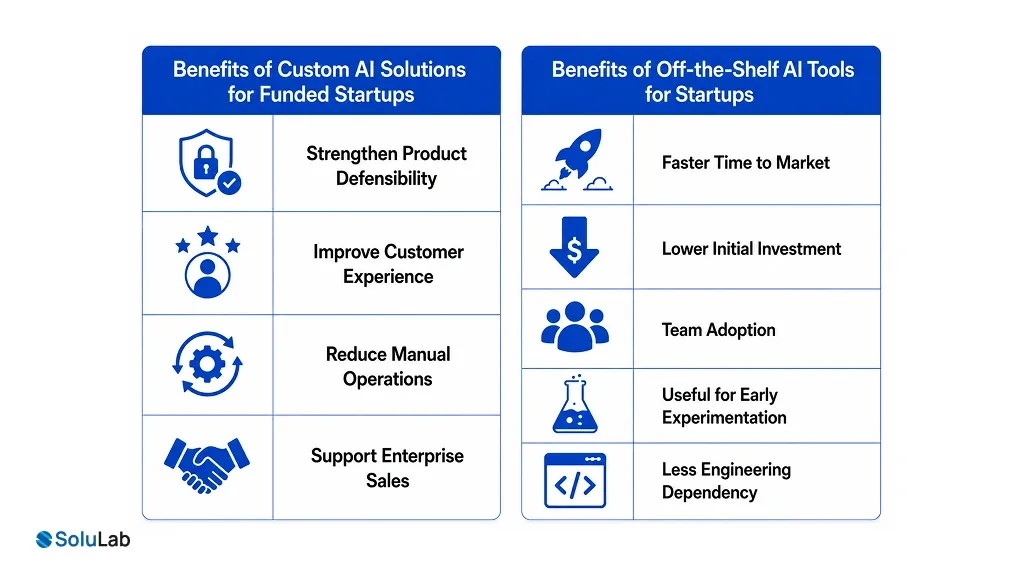
The benefits of custom AI-powered solutions are strongest when the startup is ready to build around a real business advantage.
1. Strengthen Product Defensibility
Investors are not impressed by generic AI wrappers anymore. They want to know why the product becomes stronger over time.
A custom model, proprietary workflow, data-driven personalization layer, or AI-native product experience can support that story better than a third-party tool.
2. Improve Customer Experience
A custom AI system can match your product journey, customer behavior, tone, data, and workflows. This is a crucial AI feature that is customer-facing.
3. Reduce Manual Operations
Startups often hide operations behind people. Manual review. Manual onboarding. Manual customer routing. Manual reporting.
A custom AI platform can automate these workflows without forcing the team to patch together tools.
4. Support Enterprise Sales
Enterprise buyers ask harder questions. A custom system can be designed for these requirements earlier. For startups selling into large companies, this is not optional for long.
Benefits of Off-the-Shelf AI Tools for Startups
Off-the-Shelf AI Tools help startups move quickly when teams need practical automation, faster testing, and lower upfront investment before building custom AI.
1. Faster Time to Market
Off-the-Shelf AI Tools help startups launch faster by avoiding long development cycles, making them useful for testing workflows, improving productivity, and validating early AI use cases.
2. Lower Initial Investment
Ready-made AI tools usually cost less than custom AI development Services, helping startups protect their runway while testing whether AI can improve operations, support, sales, or product workflows.
3. Team Adoption
Most AI tools for business are designed for quick onboarding, allowing non-technical teams to use AI for content, research, reporting, customer support, and daily workflow automation.
4. Useful for Early Experimentation
Off-the-Shelf AI Tools allow founders to test AI ideas before committing to a custom AI solution, reducing the risk of building features users may not need.
5. Less Engineering Dependency
Ready-made AI platforms reduce pressure on engineering teams, allowing developers to stay focused on core product work while business teams test automation through existing AI tools.
Cost of Custom AI Development for Startups
The cost of custom AI development for startups depends on how much the system needs to do. A simple AI feature costs less than a platform with multiple models, integrations, dashboards, user roles, monitoring, and compliance controls.
What Drives Custom AI Cost?
Common cost drivers include data preparation, model selection, API usage, backend development, frontend design, AI integrations, testing, security, monitoring, and ongoing optimization. The bigger cost driver is usually uncertainty.
- If the use case is unclear, the budget moves.
- If the data is messy, the timeline expands.
- If integrations are not scoped early, development slows.
How Can Startups Control AI Development Costs?
Start with one high-impact use case. Do not build the full custom AI platform on day one. Prove one workflow. Measure value. Expand after the first system works.
This is also where an enterprise AI consulting framework can help founders think beyond the first feature and plan the roadmap without overbuilding early.
AI Tools vs Custom Software for Business: The Startup View
The debate around AI tools vs custom software for business becomes clearer when founders think in stages.
Pre-Seed and Seed Stage
Move fast. Test workflows. Learn what customers want. Avoid heavy builds unless AI is central to the product. At this stage, speed and learning matter more than architectural elegance.
Post-Seed and Series A Stage
Start identifying which AI workflows deserve ownership. If a tool is supporting a core product function, customer retention, or operational scale, it may be time to evaluate custom AI. AI consulting for startups can help decide what to build first.
Scaling Stage
Custom AI becomes more important when the startup needs consistency, governance, system integration, security, and product defensibility. The startup may need enterprise AI development services even if it is not a large enterprise yet.
Where Custom AI Creates the Most Startup Value?
Not every startup use case deserves custom AI product development. The strongest ones usually sit close to product, revenue, or operations.
- AI Product Features
Custom AI can power copilots, recommendation engines, intelligent search, onboarding assistants, personalization systems, and customer-facing AI workflows.
- Customer Support Automation
Custom AI can connect support tickets, customer history, product data, billing records, and escalation logic. That is a different level of usefulness.
- Sales and Lead Intelligence
A custom system can score leads, summarize accounts, enrich CRM records, recommend next actions, and surface sales risks.
- Document and Data Processing
Startups in fintech, healthcare, legaltech, insuretech, logistics, and real estate often deal with documents. Custom AI can extract, classify, validate, and route information with business-specific rules.
- Operational Decision Support
Custom AI can help teams forecast demand, detect anomalies, route tasks, monitor risks, and improve decision speed. This becomes valuable when the startup has enough data and repeatable operations.
How to Build Custom AI for Startups: 6-Step Guide.
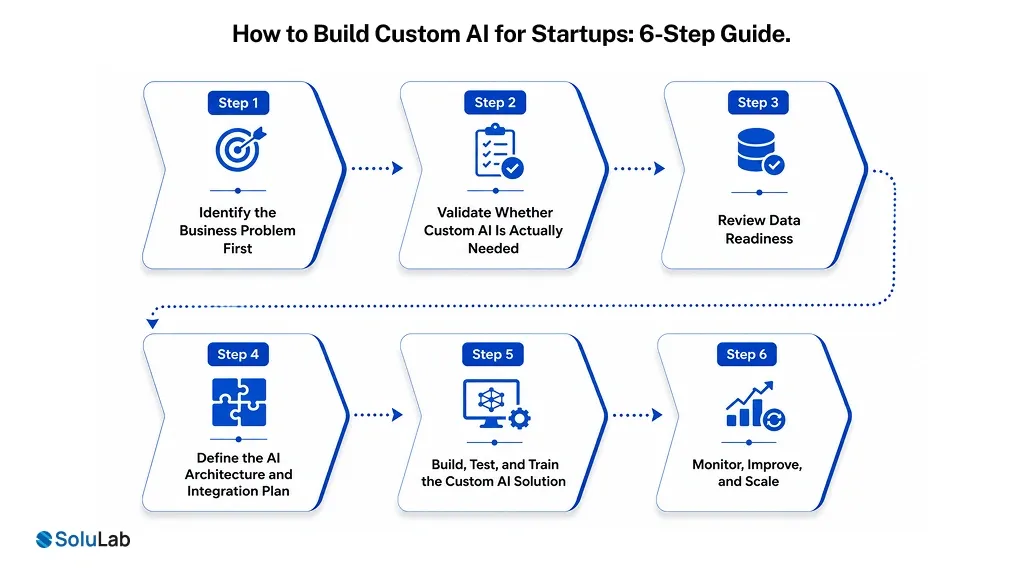
Building a custom AI solution should start with business clarity. Startups need a focused roadmap before investing in development.
Step 1: Identify the Business Problem First
Start by defining the workflow. Find the problem statement and customer gaps that the AI system needs to work upon. Custom AI development must improve something measurable.
Step 2: Validate Whether Custom AI Is Actually Needed
Before you move to the development process, analyse AI tools vs custom AI solutions. Choose the one that fits best for your business model.
Step 3: Review Data Readiness
A successful custom AI platform development highly depends on usable data. Poor data can turn a promising AI idea into a slow and expensive build. Review the AI readiness before you begin.
Step 4: Define the AI Architecture and Integration Plan
Define the AI architecture and integration plan to build a successful solution. Choose AI integration services to work inside the systems your team already uses.
Step 5: Build, Test, and Train the Custom AI Solution
Choose data, build pipelines, deploy APIs, automate processes, and test your solution. Start with one high-impact use case before expanding into a larger system.
Step 6: Monitor, Improve, and Scale
After a successful launch, continuously monitor your Custom AI needs. Once the first use case proves value, startups can expand the system into new workflows, product features, or customer-facing experiences.
To launch a smart AI development solution for startups, avoid building everything at once. Go for the use case that proves value first, and then scales with confidence.
Build Custom AI Solutions With SoluLab!
At SoluLab, we help startups move from scattered AI ideas to custom AI solutions that support real product and business goals. Our team works with founders to validate use cases, assess data readiness, design the right architecture, and build AI systems that fit existing workflows instead of forcing teams to work around generic tools.
Whether you need AI consulting, AI integration, or end-to-end custom AI development services in USA, we focus on building solutions that improve speed, customer experience, operational efficiency, and long-term scalability.
FAQs
Shipra Garg is a tech-focused content strategist and copywriter specializing in Web3, blockchain, and artificial intelligence. She has worked with startups and enterprise teams to craft high-conversion content that bridges deep tech with business impact. Her work translates complex innovations into clear, credible, and engaging narratives that drive growth and build trust in emerging tech markets.