Key Takeaways
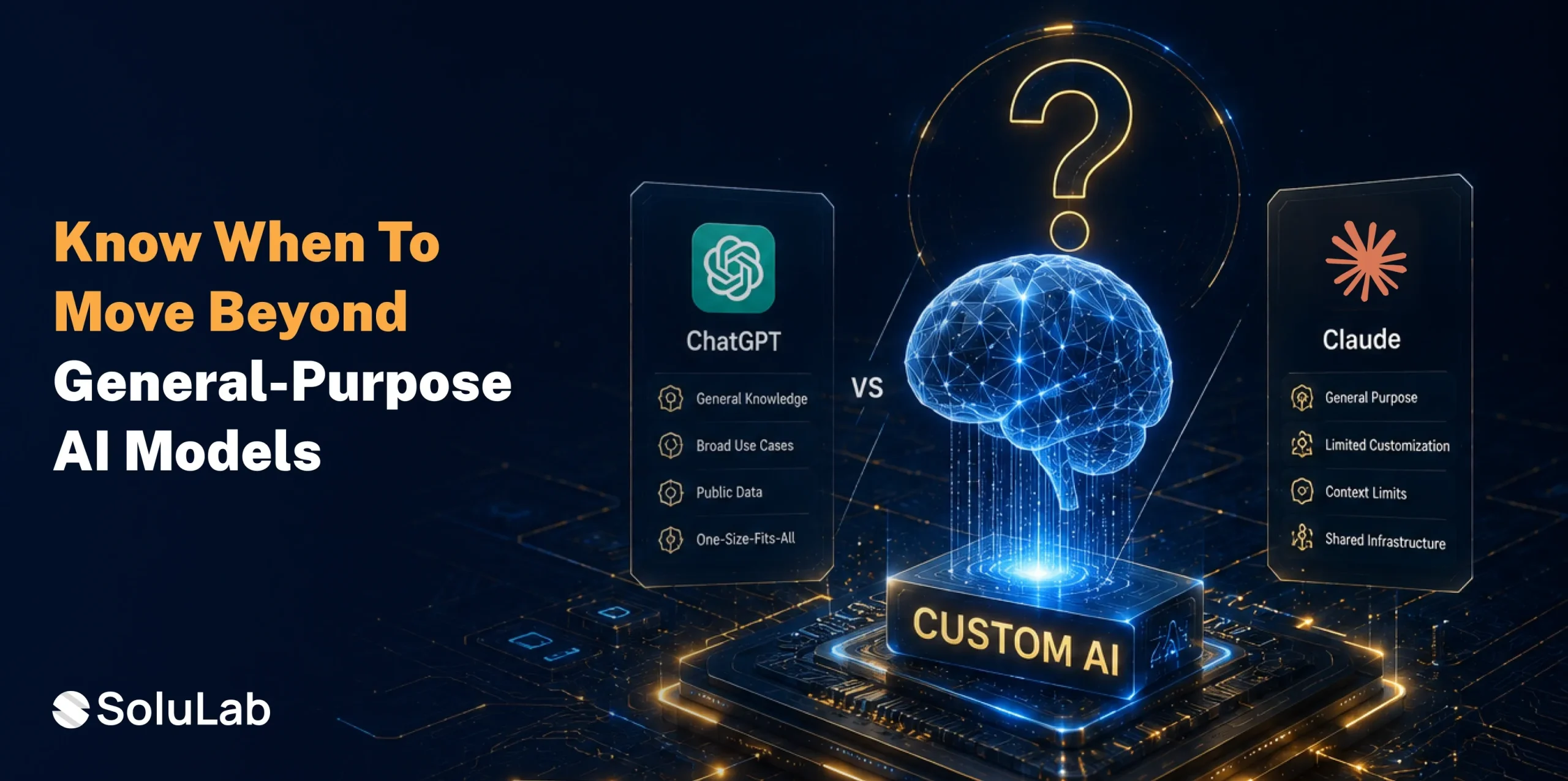
- ChatGPT and Claude are genuinely great starting points. They just weren’t built to know your business, your data, or your internal systems.
- Custom AI starts making sense once proprietary data, deep system integration, or strict compliance requirements enter the picture.
- Pricing and rate limits on public models can shift with little warning. That unpredictability turns into a real business risk once an app depends on them every day.
- Most companies don’t have to pick one path forever. A lot of them start on ChatGPT or Claude, then migrate specific workflows to custom AI once the need’s actually proven.
- The right call usually comes down to a handful of things: how many users, how much you’re spending monthly on API calls, security needs, and how deeply the AI needs to understand your business.
Building AI has never been easier. Tools like ChatGPT and Claude help businesses create content, automate tasks, and improve productivity within minutes.
But as AI development solutions become part of daily operations, many organizations discover that these general-purpose models cannot fully meet their business needs
Instead of relying on one-size-fits-all solutions, businesses can build AI tailored to their proprietary data, industry regulations, and unique processes.
But custom AI development isn’t the right choice for everyone. In this guide, we’ll explore when it’s smarter to invest in custom AI instead of using ChatGPT or Claude, the key factors to consider, and how to determine which approach delivers the best long-term value for your business.
Why Are Businesses Starting with ChatGPT and Claude?
There’s a reason almost every company’s AI journey starts here instead of a custom build. It’s the path of least resistance, and honestly, for a lot of AI use cases, that’s completely fine.
A BearingPoint survey found that 73% of C-level executives worldwide list data privacy and security as their top AI concern, and that’s exactly where public models start showing their limits.
- Easy deployment. No infrastructure to stand up, no model to train, just an API key, and you’re testing within the hour.
- Low upfront cost. Usage-based pricing means there’s no six-figure bill sitting there before anyone even knows if the idea works.
- Powerful reasoning. Both models handle complex, open-ended tasks surprisingly well right out of the box.
- API availability. Wiring one into an existing app or workflow takes days, not months.
- Minimal development effort. A small team, sometimes just one person, can ship something usable without hiring a dedicated AI team.
They’re a great fit for content creation, internal productivity tasks, research, early customer support pilots, and AI in software development tasks like coding assistance, basically anywhere that doesn’t need deep knowledge of your specific business to be useful.
What Are the Limitations of Using Public AI Models?
1. Limited Business Context
A public model has no idea what your pricing tiers are, what your last product recall looked like, or how your support team actually talks to customers, not unless someone spells all of that out in every single prompt.
2. Data Privacy Concerns
Sensitive enterprise data often needs stricter governance than a public API can promise. It’s a real worry, too; a BearingPoint survey found data privacy and security top the list of AI concerns for 73% of C-level executives worldwide.
3. Limited Workflow Automation
Generic models don’t understand your internal systems, so anything beyond a simple chat interaction usually needs custom AI integration services layered on top just to make it actually work.
4. Vendor Dependence
Pricing, rate limits, and even model behavior can change without much warning, and an app that depends on a public model every day inherits that risk whether it wants to or not.
5. Generic Outputs
Without deep customization, responses tend to sound like they came from anywhere. Not specifically from your brand, not tuned to your workflow.
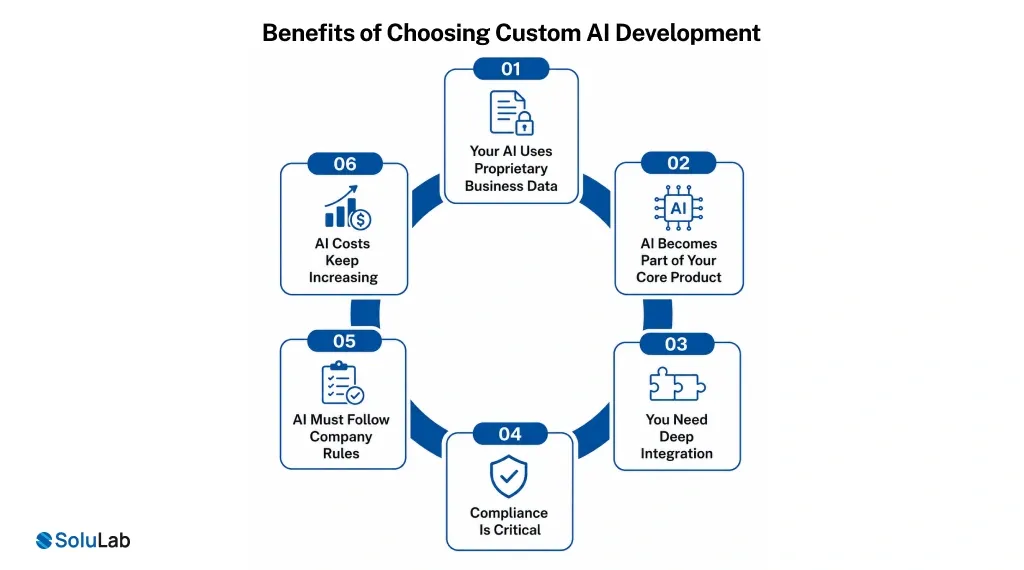
When Should You Build Custom AI?
Custom AI development isn’t the default for every business, but a handful of situations make it the obviously better call. Here’s roughly when that shift tends to happen.
1. Your AI Uses Proprietary Business Data
Once your AI needs to reason over internal documents, historical records, or customer data that can’t leave your systems, a public model stops being a realistic long-term fit.
- Data must stay in-house
- Answers depend on internal records
- Generic models can’t access it
2. AI Becomes Part of Your Core Product
If AI is the actual product you’re selling, not just an internal helper, it needs to be built and owned, not rented from someone else’s roadmap.
- AI drives core product value
- Differentiation matters competitively
- Roadmap control becomes essential
3. You Need Deep Integration
Connecting AI directly into CRMs, ERPs, or proprietary internal tools usually takes more than an API call. It takes real, custom AI integration services built around your actual stack.
- AI touches multiple internal systems
- Real-time data access required
- Off-the-shelf tools fall short
4. Compliance Is Critical
Healthcare, finance, and other regulated industries often can’t lean on a public model’s default data handling and audit practices, not without real risk.
- Strict regulatory requirements apply
- Audit trails must be verifiable
- Data residency rules matter
5. AI Must Follow Company Rules
Some businesses need their AI to strictly follow internal policy, tone, and decision logic, not just whatever general best practices happen to be baked into a public model.
- Custom guardrails are non-negotiable
- Brand voice must stay consistent
- Decision logic needs to be exact
6. AI Costs Keep Increasing
Once usage climbs into the thousands of daily calls, per-token public API pricing can end up costing more long-term than just owning the infrastructure outright.
- Usage volume keeps climbing
- Per-call costs add up fast
- Owned infrastructure gets cheaper at scale
Steps to Build Custom AI Solutions For Specific Business Problems
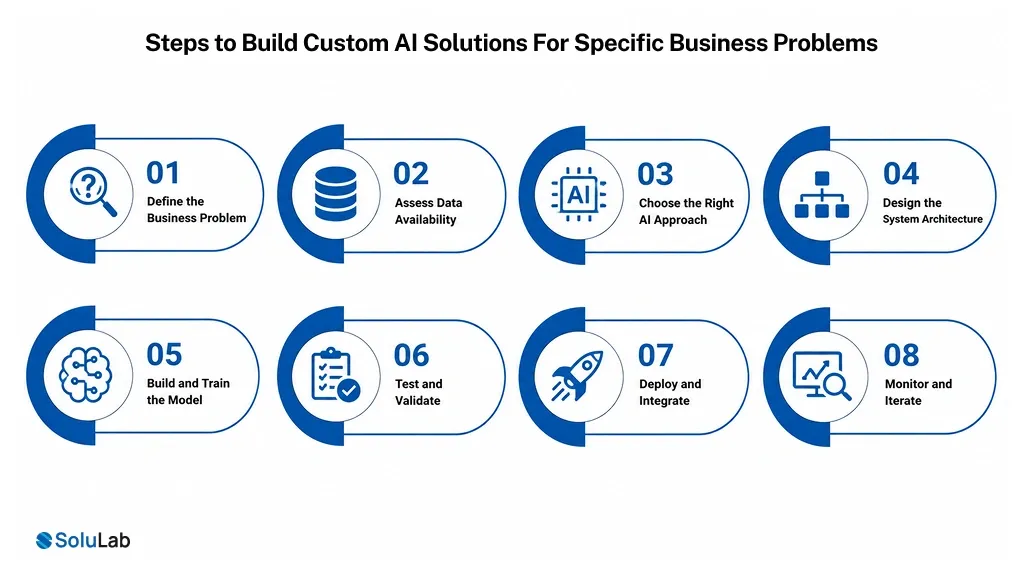
Once the decision leans toward building, the process itself matters just as much as the choice did, and skipping a step here is usually where budget quietly starts slipping away.
1. Define the Business Problem
Start with the exact problem the AI needs to solve, not a vague sense that “AI could help here somehow.”
- Write one clear problem statement
- Set a measurable success metric
- Confirm it’s worth solving
2. Assess Data Availability
Check what data already exists, where it lives, and how usable it actually is before any real building starts.
- Audit existing internal data
- Identify missing or messy pieces
- Estimate the cleanup effort
3. Choose the Right AI Approach
Decide whether a fine-tuned foundation model, a fully custom model, or a hybrid setup actually fits the problem at hand.
- Compare foundation vs custom options
- Match approach to complexity
- Factor in ongoing maintenance cost
4. Design the System Architecture
Map out how the AI will connect to existing tools, data sources, and workflows before writing a single line of code.
- Plan integration points early
- Define data flow end-to-end
- Account for scale from day one
5. Build and Train the Model
Develop the core AI component and train or fine-tune it against real, relevant business data.
- Use clean, representative data
- Iterate on early results fast
- Involve domain experts throughout
6. Test and Validate
Run the system against real-world scenarios before anyone outside the project touches it.
- Test edge cases thoroughly
- Validate accuracy against benchmarks
- Fix issues before rollout
7. Deploy and Integrate
Roll the solution into production, connected to the actual systems it needs to work alongside.
- Start with a limited rollout
- Monitor early usage closely
- Keep a fast rollback plan
8. Monitor and Iterate
Treat launch as the beginning, not the finish line, since real usage always surfaces things a pilot never could.
- Track performance over time
- Retrain on fresh usage data
- Iterate based on real feedback
Custom AI vs ChatGPT vs Claude
Public models and custom AI aren’t really fighting for the same job, and the table below lays out where each one actually wins.
| Factor | ChatGPT / Claude | Custom AI |
| Setup time | Minutes to days | Weeks to months |
| Upfront cost | Low to none | Moderate to high |
| Business context | Limited, prompt-dependent | Deep, built into the system |
| Data privacy control | Vendor-dependent | Fully controlled |
| System integration | Basic API-level | Deep, native integration |
| Customization | Prompt engineering only | Full architectural control |
| Long-term cost at scale | Rises with usage | Flattens out over time |
| Ownership | Rented capability | Owned asset |
Build vs Buy Decision Framework
Before committing budget in either direction, it helps to run through a short checklist instead of just deciding on gut feel.
- Number of AI users
- Monthly API costs
- Security needs
- Regulatory requirements
- Custom workflows
- Competitive differentiation
- Long-term ownership
If most of these lean toward “high” or “critical,” custom AI is probably worth it, and it’s worth comparing a few custom AI development companies before committing either way. If most of them stay low or moderate, a public model is likely still the smarter call for now.
What Types of Businesses Benefit Most from Custom AI?
Here are some businesses that benefit most, including SaaS, healthcare, finance, and manufacturing:
1. SaaS
Products that embed AI as a core feature need full control over behavior, pricing, and roadmap, none of which a rented model can really guarantee.
2. Healthcare
Patient data sensitivity and compliance requirements make custom AI, built with proper safeguards from day one, closer to a necessity than a nice-to-have.
3. Finance
Fraud detection and underwriting decisions demand a level of precision and auditability that a general-purpose model just wasn’t designed to provide out of the box.
4. Manufacturing
Predictive maintenance and quality systems lean on proprietary sensor and production data no public model has ever seen.
5. Logistics
Route optimization and demand forecasting depend on live, proprietary operational data that needs to stay tightly wired into existing systems.
6. Ecommerce
Personalization at scale, tied to real purchase history and inventory, usually outgrows what a generic model can meaningfully do.
7. Education
Adaptive learning tools need to track individual student progress over time, and that requires persistent, structured data, which a public model simply doesn’t retain.
What Does It Cost to Build Custom AI?
Cost scales with how much of the system is genuinely proprietary versus how much can lean on existing infrastructure, and the ranges below reflect that split across three common tiers.
| Tier | Typical Cost | Best For |
| MVP | $30,000 – $80,000 | Validating a single custom AI feature before scaling further |
| Mid-size enterprise | $80,000 – $250,000 | Businesses needing proprietary data pipelines and deeper integration |
| Large enterprise | $250,000+ | Multi-system deployments with heavy compliance and governance needs |
Future Trends in Custom AI Development
Here are some future trends you’ll see in the next few years:
1. Vertical AI
Industry-specific models built around real domain data are increasingly beating general-purpose tools on specialized tasks.
2. Private LLMs
More enterprises are running models entirely inside their own infrastructure, trading a bit of raw capability for full data control.
3. AI Agents
Beyond single responses, autonomous agents are starting to plan and execute multi-step tasks with a lot less human oversight required.
4. On-Device AI
Processing that shifts closer to the edge cuts latency and eases some of the privacy worries tied to sending data off to external servers.
5. Multi-Model Architectures
Businesses are increasingly combining several models, each handling whatever it’s actually best at, instead of betting everything on one.
6. Enterprise AI Platforms
Unified platforms for managing multiple models, agents, and data sources are becoming the backbone that ties custom AI initiatives together.

Conclusion
There’s no universally right answer between ChatGPT, Claude, and custom AI. Only the right answer for whatever a specific business actually needs right now.
Public models are still a smart, low-risk way to test an idea fast. Custom AI earns its cost once proprietary data, deep integration, compliance, or scale show up.
The businesses that get this decision right treat it as a real build-vs-buy question, not a default they never revisit, and they check back in on it as usage and requirements grow.
SoluLab, an AI development company in the USA, can help your business figure out exactly where that line sits and build the right solution once you’re past it.
FAQs
Neha is a curious content writer with a knack for breaking down complex technologies into meaningful, reader-friendly insights. With experience in blockchain, digital assets, and enterprise tech, she focuses on creating content that informs, connects, and supports strategic decision-making.