Key Takeaways
- Most AI pilots stall out not because the technology fails, but because there was never a real AI implementation roadmap behind the project in the first place.
- An AI readiness assessment before you start building tells you whether your data, teams, and systems can actually support the use case you’re chasing.
- AI strategy and AI implementation are two different things, and confusing them is one of the fastest ways to end up with a demo that never ships.
- Cross-functional ownership, defined KPIs, and integrated workflows separate deployments that scale from pilots that quietly disappear after six months.
- Working with experienced AI consultants can shorten your AI implementation timeline considerably, since they’ve already seen where these projects tend to break.
AI implementation is the path from an idea to a system people depend on: readiness assessment, use case selection, technique choice, a proof of concept measured against real cases, production build, and monitoring. Most pilots fail not on accuracy but on integration, data access and the absence of an owner after launch.
Somewhere around 70 to 80 percent of enterprise AI pilots never make it past the proof-of-concept stage. That number gets thrown around a lot, and it should, because it says something uncomfortable about how most companies approach AI implementation in business right now.
This is the gap between having an AI strategy and actually executing an AI implementation process. AI strategy consulting is a direction. A roadmap is the actual sequence of decisions, budgets, timelines, and ownership that gets you from idea to something running in production.
In this guide, we’ll break down what an AI implementation roadmap actually is, why skipping it causes so many pilots to fail, and how to build one that gives your project a real shot at making
What Is an AI Implementation Roadmap?
An AI implementation roadmap is a structured plan that maps out how a business moves from an AI idea to a working, scaled solution. It covers the AI readiness assessment, technology choices, budget, timelines, governance, and the people responsible at each stage.
Think of it less as a slide deck and more as a working document. A good roadmap for enterprise AI implementation answers specific questions: which use case are we solving first, what data do we already have versus what we need to collect, which AI models fit the problem, who owns the outcome, and how do we know if it worked.
Without this structure, teams tend to jump straight into building. That’s usually where things go sideways. A roadmap forces the harder conversations about cost, about ownership, about what “success” actually looks like, before anyone writes a line of code.
The readiness assessment
Four things determine whether an organisation can implement AI at all, and none of them are about models.
Data. Does the data exist, is it accessible without a six-week approval, and is it accurate enough to learn from? Most stalled projects stall here.
Systems. Can the AI reach the systems it needs to read from and write to? An API and a service account, or a locked legacy system nobody may touch?
Process clarity. Can somebody describe what actually happens today, step by step? If three people describe the process differently, you are automating an argument.
Ownership. Who will own this in production? Not the sponsor. The person who reviews the escalation queue in month four.
Score each use case on all four before ranking them by value. A high-value use case with no data and no owner is worth less than a modest one with both.
Why Businesses Need a Roadmap Before Implementation?
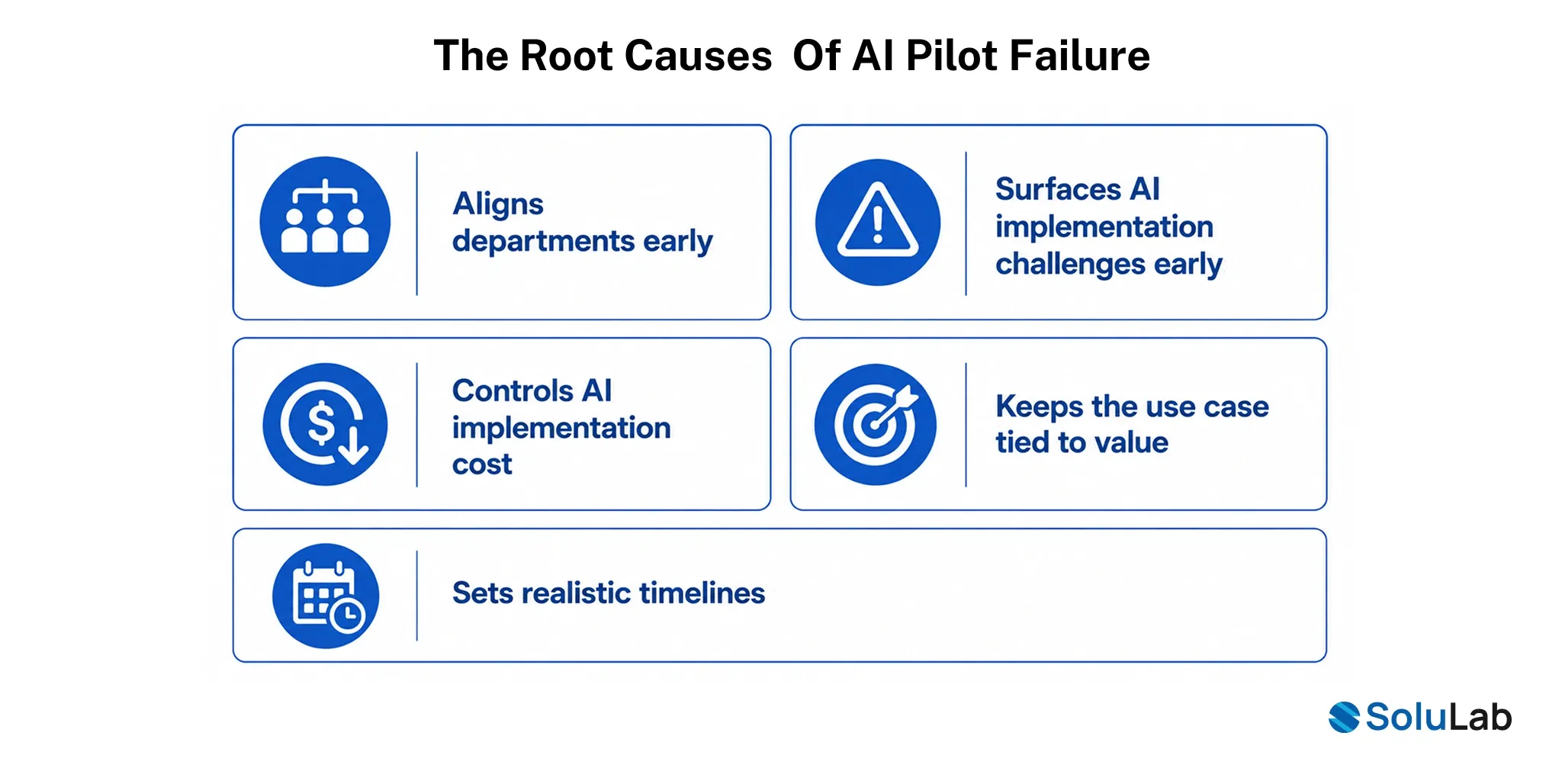
Skipping the roadmap doesn’t save time. It just moves the cost to later, when fixing misalignment is far more expensive than planning for it upfront. 73% of mid-market firms have deployed AI, but around 90% of those deployments remain in the pilot phase.
- Aligns departments early: Gets IT, operations, and leadership agreeing on priorities and ownership before any budget gets committed to the project.
- Surfaces AI implementation challenges early: Exposes data gaps, unclear ownership, and infrastructure limits early, when fixing them still costs little.
- Controls AI implementation cost: Prevents the budget creep that comes from rebuilding infrastructure or switching vendors halfway through a project.
- Keeps the use case tied to value: Forces teams to confirm the AI project actually moves a metric leadership cares about, not just a technical curiosity.
- Sets realistic timelines: Replaces guesswork with actual milestones, so leadership knows what to expect and when, instead of an open-ended “we’ll see.”
What Are the Key Components of an AI Roadmap?
A solid roadmap isn’t just a timeline. It’s built from a handful of components that each answer a different question about how the project will actually succeed.
- Business objectives: Clear, specific goals the AI initiative is meant to support, tied to metrics the business already tracks rather than vague ambitions like “innovation.”
- Use case prioritization: A ranked list of potential AI use cases based on feasibility, data availability, and expected business impact, so teams aren’t chasing the flashiest idea first.
- Data and infrastructure audit: An honest look at what data exists, where it lives, and whether current systems can support the AI tech stack the project will need.
- Governance framework: Defined rules for AI governance implementation, covering data privacy, model accountability, and who signs off on decisions the AI makes.
- Timeline and milestones: Realistic AI implementation timelines broken into phases, with checkpoints that let teams course-correct instead of finding out at the end that something’s off.
- Budget and resourcing: A clear picture of AI implementation cost, including people, tools, and the ongoing spend required after launch, not just the pilot phase.
Choosing the first use case
The first one sets the organisation’s opinion of AI, so it is chosen for learning as much as for value.
Good first candidates: high volume, so the effect is visible quickly; tolerant of error, so a wrong output is corrected rather than costly; data already exists and is accessible; a single team owns the process; and a baseline can be measured today.
Bad first candidates, however attractive: anything touching money movement, anything customer-facing with no human in the loop, anything requiring data from four systems nobody has integrated, and anything where the sponsor’s expectation is a transformation rather than an improvement.
The best first project is usually smaller than the one the board asked for.
Which technique for which problem
Implementation plans fail when the technique is chosen by fashion rather than by problem shape.
Machine learning for prediction and classification from structured data: forecasting, scoring, ranking, anomaly detection. Fast to train, cheap to run, explainable.
Deep learning where the input is unstructured and large: images, audio, video, long sequences. More data, more compute, less explainable.
Computer vision for inspection, counting, capture and video analysis. The hard part is capture conditions and annotation, not architecture.
Natural language processing for classification, extraction, search and summarisation. Now mostly served by pre-trained models rather than by training from scratch.
Generative and retrieval systems where the output is language grounded in your own content.
Agents where the output is an action in a system of record, which brings permissions, approval gates and audit requirements that none of the others need.
See ai and machine learning consulting for the selection work, and ai integration services for the connection work.
Risk management
The risks worth managing, and what managing them actually looks like.
Wrong output reaching a customer. Confidence thresholds, human review queues, and approval gates on anything consequential.
Data exposure. Retrieval filtered by the requesting user’s permissions before generation, not after. Personal data minimised at the boundary.
Cost overrun. Inference cost modelled at real volume before launch, monitored per workflow afterwards, with a budget alert rather than a quarterly surprise.
Vendor dependency. A thin abstraction between your application and the model provider, so a price or quality change is a configuration decision rather than a rebuild.
Regulatory exposure. Decisions materially affecting a person stay recommendations to a human, with the inputs and the reasoning retained.
Organisational risk. The one nobody lists: the team quietly stops using it because it was never better than what they did before. Measured by the human correction rate, not by the usage dashboard.
Monitoring and feedback loops
Implementation does not end at launch. Four loops run continuously.
A fixed evaluation set rerun on every change to prompts, models, retrieval or data. Sampled production outputs scored against it. Feedback captured in the interface, writing the input, the output and the context into a review queue so a failure can be reproduced rather than described. And drift monitoring on input distributions, because the questions people ask move away from what the system was built for.
Each of those loops feeds the next iteration. A system without them degrades quietly, and the first signal is usually a person saying they have stopped trusting it.
Scaling after the first success
What changes when the second and third use cases arrive.
Shared infrastructure rather than three parallel stacks: one retrieval layer, one evaluation suite, one monitoring surface, one model abstraction. Shared guardrails, so the approval policy is set once. Cost attribution per business unit, which becomes a real question at the third deployment. And a review process for new use cases, so the pipeline is prioritised rather than first come first served.
The organisations that scale well are the ones that treated the first project as infrastructure plus a use case, rather than as a use case alone.
How to Conduct an AI Readiness Assessment?
Before any roadmap gets built, it’s worth figuring out honestly whether your organization is actually ready to run with an AI project or still has groundwork to lay first.
- Evaluate data quality and access: Check whether the data needed for your use case is accurate, accessible, and structured well enough to train reliable AI models without months of cleanup work.
- Assess technical infrastructure: Review current systems, cloud capacity, and integration points to see if they can support new AI-powered solutions without a costly overhaul.
- Review team skills and capacity: Identify whether internal teams have the skills to support AI development, or whether an AI development company should fill the gap.
- Examine organizational readiness: Look at whether leadership, budget, and cross-functional buy-in actually exist, since misalignment here derails more projects than bad technology ever does.
- Identify quick-win use cases: Pinpoint smaller, lower-risk use cases that can prove value fast, building the internal case for bigger AI investments later on.
How to Create an AI Implementation Roadmap: Step-by-Step
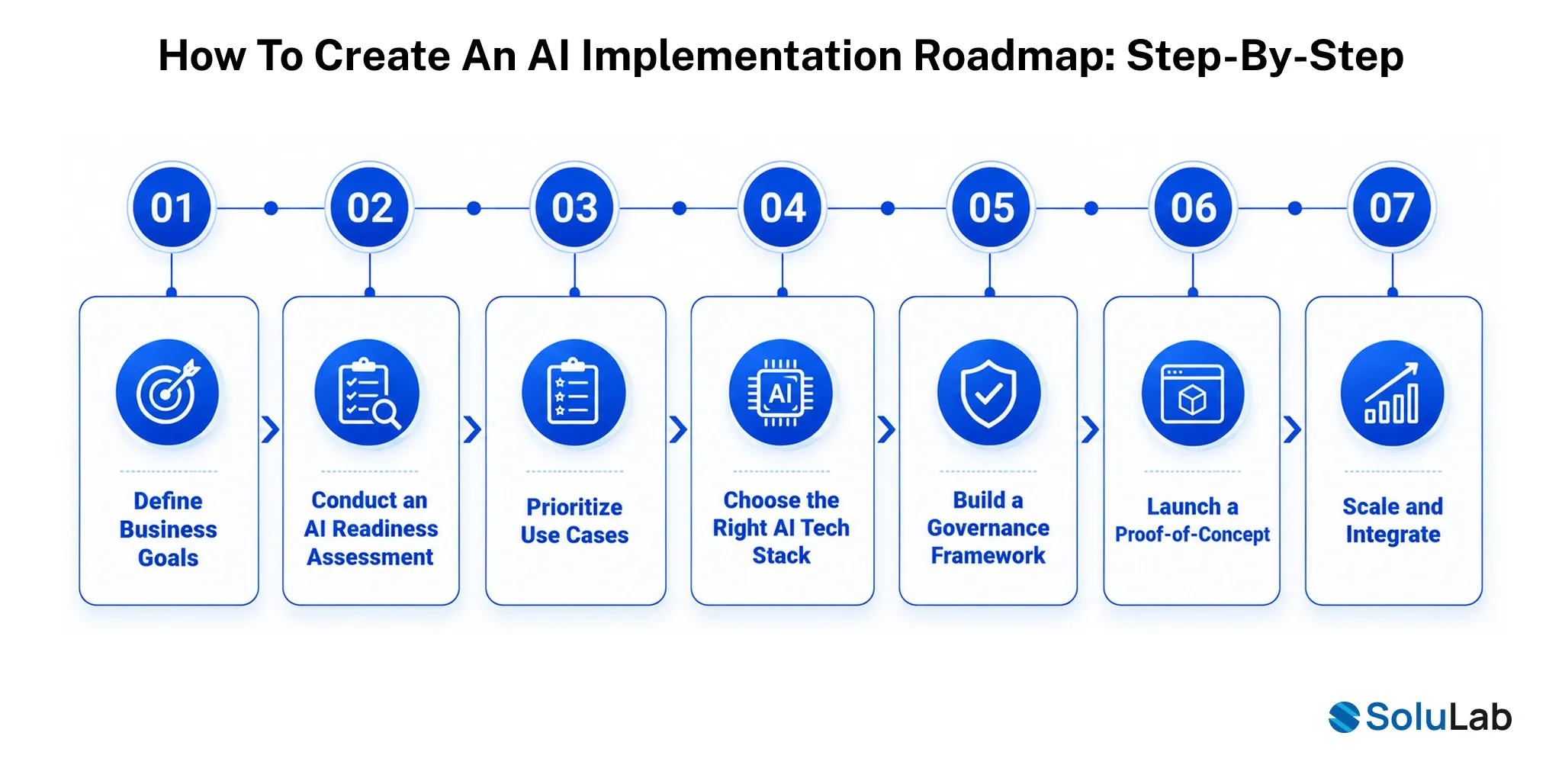
Building a working AI implementation roadmap for business doesn’t require months of planning. It comes down to a sequence of deliberate, well-scoped steps.
1. Define Business Goals
Start by pinning down what the business actually needs, not what AI technology sounds impressive to deploy.
- Identify core business problems
- Align goals with leadership priorities
- Set measurable success metrics
2. Conduct an AI Readiness Assessment
Before choosing tools, get a realistic read on your data, systems, and team capacity.
- Audit existing data quality
- Evaluate current infrastructure
- Assess internal AI skills
3. Prioritize Use Cases
Not every idea deserves to be first, so rank them by impact and feasibility.
- Score use cases by ROI
- Weigh implementation complexity
- Select a pilot use case
4. Choose the Right AI Tech Stack
Match tools and models to the actual problem, not the other way around.
- Evaluate AI models and vendors
- Consider build versus buy options
- Plan for future scalability
5. Build a Governance Framework
Set the rules before AI deployment, not after something goes wrong.
- Define data privacy policies
- Assign model accountability owners
- Establish approval workflows
6. Launch a Proof-of-Concept
Test the idea small enough that failure is cheap and lessons are fast.
- Limit scope to one team
- Track performance against KPIs
- Gather structured user feedback
7. Scale and Integrate
Once the AI proof-of-concept holds up, expand it into real workflows.
- Integrate with existing systems
- Train teams on new processes
- Monitor and refine continuously
What Separates Successful AI Deployments From Failed Pilots?
The difference between a pilot that dies quietly and one that becomes core infrastructure usually comes down to a handful of decisions made early on.
| Aspect | Failed AI Pilot | Successful AI Deployment |
| Approach | Technology-first, focused on testing AI capabilities | Business-first, aligned with strategic objectives and measurable outcomes |
| Vision | Built as a short-term proof of concept or demo | Guided by a long-term AI implementation roadmap with scalability in mind |
| Ownership | Managed by a single team, often IT or innovation | Driven by cross-functional collaboration across business, IT, operations, and leadership |
| Success Measurement | Unclear or undefined ROI and success criteria | Clearly defined KPIs tied to business value and performance |
| Workflow Integration | Operates as a standalone solution with manual processes | Fully integrated into existing business systems and automated workflows |
| Scalability | Limited to a small pilot group with no expansion plan | Designed to scale across departments and enterprise-wide |
| Data Readiness | Relies on fragmented or low-quality data | Built on reliable, well-governed, and production-ready data |
| Governance | Minimal focus on security, compliance, or monitoring | Includes governance, security, compliance, and continuous model monitoring from the start |
| User Adoption | Little stakeholder engagement or employee training | Strong change management, user training, and executive sponsorship to drive adoption |
How Does AI Consulting Help With Roadmap Development?
Building a roadmap alone isn’t impossible, but most companies underestimate how much faster and cheaper it is with someone who’s already made the mistakes elsewhere.
- Bring outside expertise: AI consultants have seen dozens of AI implementation processes play out and know which patterns tend to fail before a project sinks time and budget into them.
- Accelerate use case selection: A good AI consulting service can cut through internal debate quickly, using frameworks that score use cases objectively instead of by who argues loudest.
- Reduce technical risk: Consultants help choose the right AI tech stack and architecture, avoiding the common trap of over-building for a use case that didn’t need it.
- Support change management: Roadmaps fail almost as often from people problems as tech ones, and consultants help manage the internal buy-in that makes adoption actually stick.
- Speed up time to value: With the right AI implementation services in place, businesses often cut months off the path from idea to a working, scaled solution.
The stages of AI implementation
| Stage | What happens | Typical duration | What kills it |
| Readiness assessment | Data, systems, process and ownership scored per candidate | 2 to 4 weeks | Scoring on value alone |
| Use case selection | A shortlist with baselines captured | 1 to 2 weeks | Picking the board’s favourite |
| Proof of concept | Real data, real examples, measured against a held-out set | 4 to 6 weeks | No evaluation set, so “it works” is an opinion |
| Production build | Integration, guardrails, monitoring, handover | 3 to 6 months | Access provisioning delays |
| Adoption | Shadow mode, then supervised, then measured autonomy | 4 to 8 weeks | No owner, no training, no feedback loop |
| Scale | Shared infrastructure, guardrails and cost attribution | Ongoing | Three parallel stacks built by three teams |
Why Choose SoluLab for an AI Implementation Roadmap?
Most companies don’t fail at AI because the technology doesn’t work. They fail because no one built a realistic plan connecting the idea to the business. SoluLab, an AI development company, works with enterprises to design AI implementation roadmaps that are grounded in actual business goals, not just technical possibilities.
- AI Readiness Assessment and Strategy
- Enterprise AI Implementation Planning
- Custom AI Development Services
- AI Governance Implementation Frameworks
- AI Proof-of-Concept Development
- AI Consulting Service for Roadmap Design
- End-to-End AI Solution Implementation
As a company built around enterprise AI development, SoluLab, an AI native company, helps businesses move past the pilot stage and into AI-led development that actually changes how operations run day to day.
Conclusion
Most AI pilots don’t fail because the models are bad. They fail because no one built a real roadmap connecting the technology to a business outcome someone was accountable for.
An AI implementation strategy that skips the readiness assessment, the governance framework, or the cross-functional ownership piece is a strategy built to stall out around month three.
Getting this right in 2026 means treating AI implementation as a business initiative first and a technical project second. SoluLab, an AI development company in USA, can help you build that roadmap and carry it through to something that’s actually running in production, not sitting in a slide deck.
FAQs
Neha is a curious content writer with a knack for breaking down complex technologies into meaningful, reader-friendly insights. With experience in blockchain, digital assets, and enterprise tech, she focuses on creating content that informs, connects, and supports strategic decision-making.