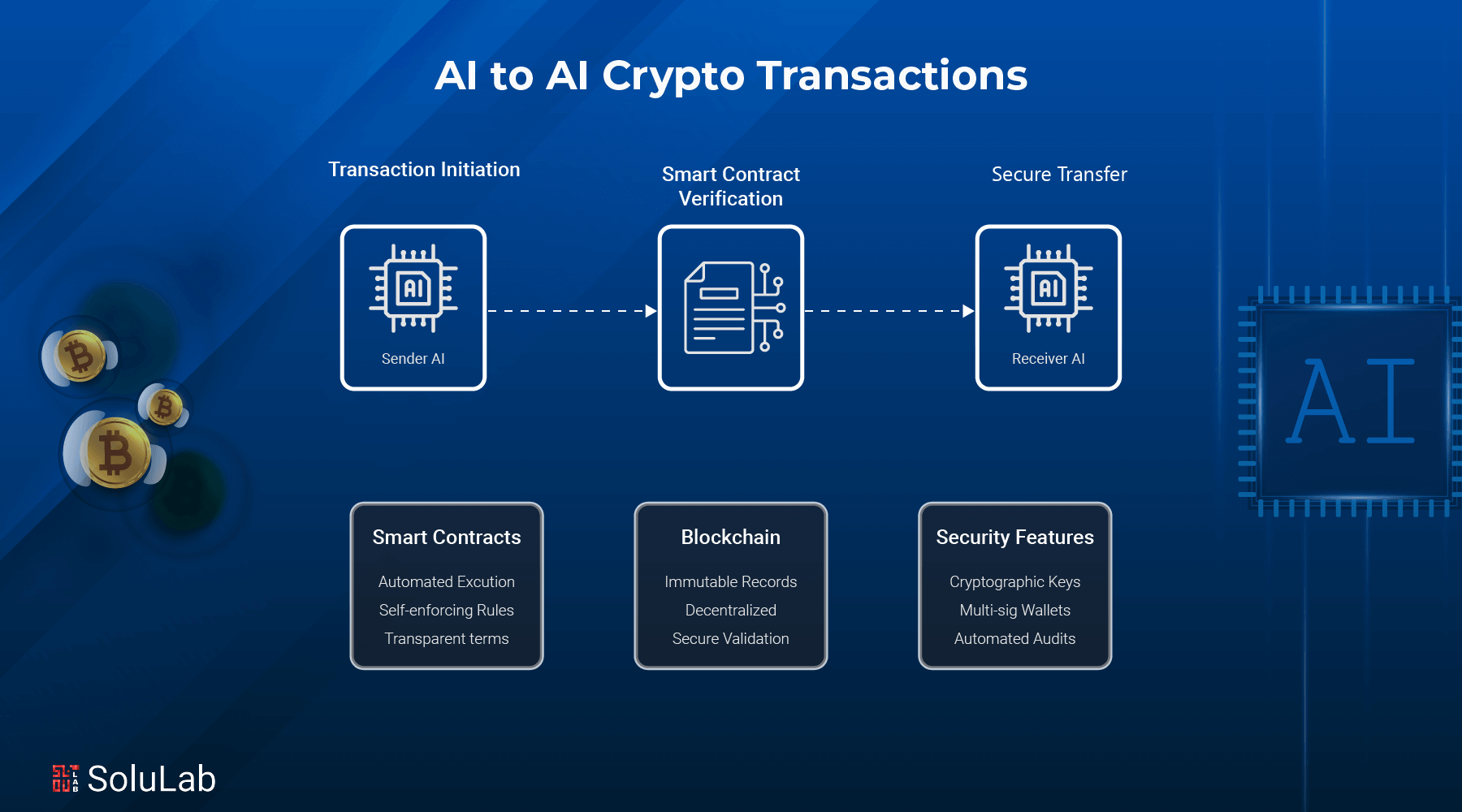
Two machines. One trade. Nobody at the keyboard. That is the whole idea behind AI-to-AI crypto transactions: two artificial intelligence systems buying and selling assets from each other, settling on a blockchain, with no human clicking confirm. The AI agents make the call. The chain records it.
Projections put the combined AI and blockchain market at more than $703 million by 2025, growing roughly 25.3% a year across the 2020 to 2025 window.
What do these systems actually buy you? Speed you cannot match by hand, for one. They read market data, decide, and fire the order before a human has finished reading the chart. They do not sleep, which matters in a market that never closes. And they do not panic, which matters more. If you have ever sold a position at 3am because the candle looked scary, you already understand the pitch for an AI-to-AI trading blockchain platform.
Most crypto traders lose money to the same three things: violent price swings, decisions made on emotion, and the simple fact that you cannot watch a screen around the clock. This piece walks through how AI-to-AI transactions chip away at each of those, and where they might change the way you trade.
What are AI-to-AI Crypto Transactions?

AI-to-AI crypto transactions are financial exchanges that happen between artificial intelligence (AI) systems, with cryptocurrency as the settlement layer and nobody supervising the handshake. Smart contracts hold the rules. Blockchain keeps the record. AI algorithms decide what to trade and when. Strip out the human and what is left is a stack of models, machine learning weights, and contract code that agrees to terms and then executes them.
Think of it as a conversation. Two or more intelligent systems compare notes on market conditions, size up the risk, and act inside the parameters someone set for them ahead of time. The conversation happens in milliseconds, across more data than a person could skim in a week, and it catches patterns a human trader would walk right past.
How AI Bots Drive AI-to-AI Crypto Transactions?
Rewind to the early decentralized exchanges. On something like EtherDelta, crypto trading bots existed for one reason: they were precise and they were fast. They parsed order books, watched prices twitch, and got orders in well before a person could. That head start was the entire edge.
Those bots had nothing resembling modern AI. No learning, no adaptation, just rules. Still, they hinted at what AI in blockchain transactions could become. Today’s bots handle multistep workflows, rewrite their own strategy as conditions shift, chew through far more data, and react to a moving market with accuracy that hardcoded scripts never had.
The Role of Trading Bots in AI-to-AI Crypto Transactions
Trading bots are the quiet partner in most crypto portfolios now. They run algorithms, read the market, place orders, and say nothing about it. They also happen to be the groundwork everything else sits on, the connective tissue between artificial intelligence and blockchain technology.
Deploy one and you have hired a trader who can:
- Watch several markets at the same moment
- Fill orders at the price you actually wanted
- Run trading strategies that get genuinely complicated
- Perform the same way at 4am as at noon
- Take feelings out of the decision entirely
- Comb historical data for repeating patterns
- Shift tactics when the market shifts under it
- Handle high-frequency strategies
- Keep a detailed record of every transaction
- Apply risk management protocols without being reminded
The point of a crypto trading bot is unglamorous: fewer mistakes, faster fills, less clicking.
Benefits and Limitations of AI to AI Crypto Transactions
Every tool has a bill attached. Here is what you get when you fold AI into your trading, and what it costs you.
Benefits:
- Enhanced Speed and Efficiency: In a fast market, milliseconds are money. An AI system weighs many data points at once and gets the order in within microseconds, which is not a margin a human hand or a manual workflow can compete with.
- Emotional Neutrality: Fear and greed cost traders real money, usually at the worst possible moment. An AI has neither. It follows the strategy it was given and the data in front of it, and it makes the same call in a crash that it makes in a rally.
- 24/7 Market Monitoring: You sleep. Crypto does not. AI systems sit on every time zone at once, which means the 2am liquidation cascade or the sudden breakout is not something you find out about the next morning.
- Advanced Pattern Recognition: Pattern-finding across huge volumes of historical and live market data is exactly what these systems are good at. Trends that are invisible on a chart, or buried too deep for a standard indicator to surface, tend to show up here.
- Automated Risk Management: AI-powered chatbot systems can run risk protocols on their own, trimming position sizes and placing stop-loss orders as conditions change. When volatility hits, that discipline is what protects the capital you still have.
- Multi-Market Analysis: One system can track dozens of cryptocurrency pairs across several exchanges and spot arbitrage gaps and entry points in the gaps between them. No human is tracking that many order books at once. Nobody.
Limitations:
- Complex Initial Setup: Standing one of these up is not a weekend project. You need real technical depth and patient configuration, and you need to actually understand what each parameter does before it starts trading your money against your risk tolerance instead of with it.
- Substantial: Cost Investment Good AI trading systems are expensive up front and expensive to keep running. Budget for software licenses, compute, and very likely consulting help to get the setup and the ongoing tuning right.
- Market Adaptation: Challenges Black swan days are where these systems break. A market event with no precedent looks like nothing in the training data, and the model has no good answer for it. Which means constant retraining as conditions drift away from what it originally learned.
- Regulatory Uncertainties: Rules around AI trading in crypto markets are still being written. Whatever is true this quarter may not hold next year, so you carry an ongoing obligation to track what changes and keep your operation compliant with it.
- Data Quality Issues: Feed it garbage and it will trade garbage, confidently. Stale prices, a broken feed, a bad tick: any of it can push the system into decisions that quietly drain the portfolio.
- System Maintenance Requirements: This is where most teams underestimate the workload. Monitoring, updates, strategy tuning, performance reviews. A bot you set up and forget about stops being a good bot fairly quickly.
Applications Of AI-To-AI Crypto Transactions
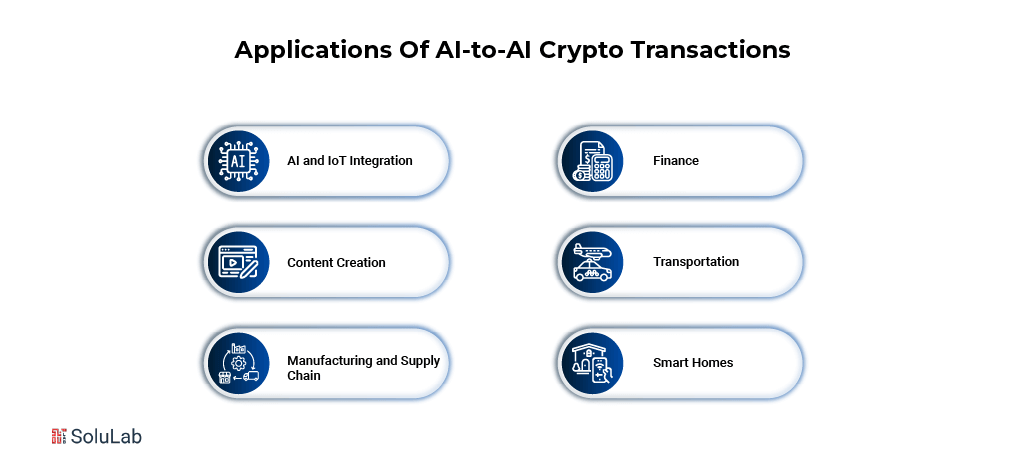
The interesting part starts when AIs trade with each other rather than with us. Micropayments clear fast through AI agents, and once payments get small enough and quick enough, business models that were never viable suddenly are. Picture it: AI use case systems paying other AI agents a fraction of a cent for a dataset, a burst of compute, or a specialized skill they do not have. Resources go where they are needed, pricing gets granular, and the economics move faster than any invoicing cycle allows today.
1. AI and IoT Integration
Hook AI agents up to IoT devices over decentralized infrastructure networks and the devices start managing themselves: allocating resources, tuning processes, paying for what they use. Whole categories of industrial operations could work differently.
2. Finance
AI in finance could flatten a lot of financial busywork. You might run your money through plain text instructions and let the AI handle the payment, the budget adjustment, the recommendation on which product to move into. A personal AI assistants would do the advising and the execution in one place.
3. Content Creation
An AI could write the thing, publish it, charge for it, and split the proceeds with whoever else contributed. No human in the loop at any step of that chain.
4. Transportation
Self-driving vehicles could end up running the transport business rather than just doing the driving. A car takes fares, collects payment, and books its own service appointment when something wears out. It pays for that too.
5. Manufacturing and Supply Chain
Procurement is an obvious candidate: an AI agent sources raw materials, compares suppliers, and buys, without a purchase order crossing anyone’s desk. On the HR side, AI in manufacturing systems could handle hiring and payroll on their own schedule.
6. Smart Homes
Your house reorders the things it knows you are out of, and books the services it knows are due. You stop thinking about any of it
Read Also: AI in Crypto Banking
Interaction with Other AI Bots for AI-to-AI Crypto Transactions
Bots talk to each other, and now they pay each other. Coinbase, a major cryptocurrency exchange, put AI and blockchain together and went first.
Coinbase CEO Brian Armstrong ran the first cryptocurrency transaction handled end to end by AI bots. No human hand anywhere in it. Small event, large signal: AI can now originate and settle a blockchain transaction by itself, and manage the deal around it.
The First AI-to-AI Cryptocurrency Exchange
Here is what actually changed hands. One AI agent, a specialized build crypto arbitrage bot, spent crypto tokens to buy AI tokens off a second AI agent. Those AI tokens exist so a system can learn from the data it processes and adjust itself on the back of that learning.
Armstrong’s point was that an AI agent has no bank account and no way to get one. What it can have is AI Agents in Crypto held in a crypto asset wallet on Coinbase’s Base platform. That gets it instant, global, fee-free payments to people, to merchants, or to other AI agents.
Why Does This Matter?
Armstrong has since floated the idea that AI systems like ChatGPT and Claude should have their own cryptocurrency wallets. Give a model a wallet and it can pay for what it needs, settle what it owes, and run its own small economy without asking anyone for a card number.
Risks and Challenges of AI-to-AI Crypto Transactions
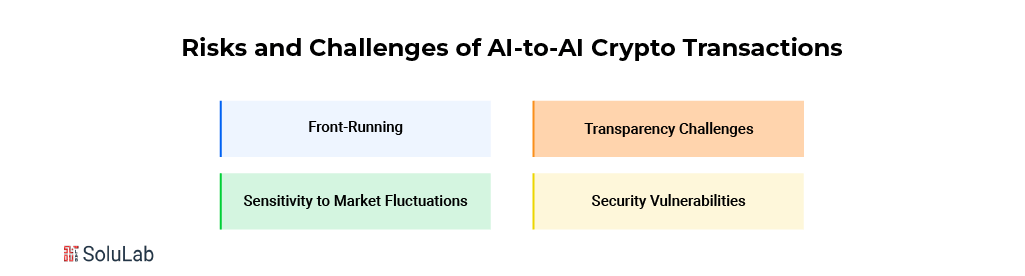
Now the unflattering part. responsible AI is getting plenty of attention, and it is nowhere near finished. The tools are powerful and they are awkward, and if you are putting money behind them you need to know precisely what can go wrong.
1. Front-Running
Start with front-running, because it is the one that will cost you first. A bot sees your pending transaction, jumps the queue with its own, and pockets the price move you created. Ethereum makes this easy: ordering follows gas fees, so a bot with deep pockets simply outbids you to get in front. You pay for the privilege of being early.
2. Transparency Challenges
Then there is the black box problem. Most AI bots run on proprietary algorithms, so you cannot see why the thing did what it did. That is uncomfortable at small size and genuinely alarming at large size. Regulators in financial services want “explainable AI” and expect a company to justify its decisions. Try producing that explanation when the bot weighed thousands of market signals to reach an answer. Compliance teams are still working out how.
3. Sensitivity to Market Fluctuations
Speed cuts both ways. A bot that reacts instantly also reacts instantly to noise, and in a violent stretch it can execute a run of trades that lose real money before anyone notices. decentralized finance (DeFi) markets, where price can move hard in a minute, are the worst place for that failure mode.
4. Security Vulnerabilities
Security never stops being a concern. Blockchain systems are strong and they still get hacked, and AI bots are not exempt from any of it. Crypto arbitrage flash loan bot attacks, along with a long list of other weaknesses, prove that a sophisticated system can still be opened up, and the losses when it happens are not small.
None of this makes the technology a bad bet. It does mean you build the guardrails first and the strategy second. Stay skeptical, keep watching, and assume something will eventually go wrong in a way you did not plan for.
What Does the Future Hold for AI-to-AI Crypto Transactions?
The trajectory is not subtle. Bots started out as a convenience for traders in blockchain’s early years, a faster pair of hands. They are turning into independent agents with a much wider job description.
AI-powered decentralized platforms are building the rooms where those agents can operate unsupervised. As AI-driven chatbot development gets sharper, the interactions between agents get correspondingly tangled. Cross-chain transactions and real-time liquidity optimization spread across several platforms are early examples, not endpoints. And this is spilling well past banking: AI’s applications are turning up in logistics and healthcare too. Faster settlement plus stronger security tends to pull more users onto a chain, and that scale compounds.
The hard problems have not gone away. But the direction of travel points at autonomous systems that decide, trade, and deal with other hybrid AI agents with no person involved at any stage. A fully AI-managed blockchain system is no longer a thought experiment, and it would change what a transaction even means operationally.
AI Bots in AI-to-AI Crypto Transactions
If you spend time in the crypto exchange space, it pays to know what these bots are actually doing under the hood. They act as your delegates: placing trades and moving assets according to rules you set and conditions they read.
A current-generation bot reads market sentiment, tracks price action, and trades across several platforms in parallel. Its algorithms hunt for openings, cap exposure, and rebalance the portfolio. The machine learning layer is what makes it interesting over time, because the bot learns from the trades that worked and, more usefully, from the ones that did not.

Conclusion
Trading is getting handed over to machines, gradually and then all at once. AI plus blockchain buys you speed, tighter security, and a shot at better returns, and it does it in a market that has always punished human limits harder than most.
The risks are real and worth respecting. They are also, on balance, smaller than what the technology offers back. Pay attention, adjust as it moves, and you get to use this rather than compete against it.
AI-Build, a construction tech company, wanted better CAD product development through generative AI and machine learning. SoluLab automated the design work, tightened accuracy, and built systems that could grow with them. The sticking points were familiar ones: manual design steps that ate hours, repetitive tasks nobody wanted, and datasets too large to handle by hand. The AI solution we built lifted productivity and slotted into what they already ran, with room to extend later.
SoluLab is an AI development company, and our team has spent years deep in these problems. We have shipped solutions for businesses stuck on things that looked unsolvable from the inside. If something in your operation fits that description, get in touch and tell us what you are up against.
FAQs
Shipra Garg is a tech-focused content strategist and copywriter specializing in Web3, blockchain, and artificial intelligence. She has worked with startups and enterprise teams to craft high-conversion content that bridges deep tech with business impact. Her work translates complex innovations into clear, credible, and engaging narratives that drive growth and build trust in emerging tech markets.