
Crypto prices move. Sometimes they move in seconds. And when the same coin trades cheaper on one exchange than another, there’s money sitting in that gap, buy low here, sell high there, pocket the difference. That’s arbitrage. The catch? Try catching one of those gaps by hand and it’s gone before you’ve finished clicking. The window is just too short, and the logistics of watching a dozen exchanges at once are more than any person can handle.
This is the problem crypto arbitrage bots were built to solve. They watch many exchanges at the same time, place trades almost instantly, and factor in the annoying details, fees, liquidity, the stuff that quietly eats your margin. And traders have noticed. More than 65% of retail traders now lean on automation to some degree, and up to 99% of institutional investors’ activities.
Manual trading has two stubborn enemies: slow execution and fat transaction costs. Bots sidestep both, which is a big reason their use jumped 127% in 2023. That’s not a rounding error. It’s a shift. And it keeps going: NLP applications now read market sentiment and news trends too, so the trading logic isn’t just reacting to price, it’s reading the room.
So here’s what this post covers: how you actually build a crypto arbitrage trading bot, what features matter, what you get out of it, and what it costs. Let’s dig in.
What is a Crypto Arbitrage Bot?
Strip away the jargon and a crypto arbitrage bot is just software that hunts for price gaps. It runs algorithms that compare what a coin costs across different exchanges, then buys where it’s cheap and sells where it’s dear. The whole point is speed. These price differences are small and they don’t last, so the bot pounces before anyone else does.
Why Create a Crypto Arbitrage Bot?
Recent numbers suggest traders park roughly 86% of their money in crypto arbitrage bots, and plenty of them trust these bots to make the call without second-guessing. Why the confidence? A few reasons. Bots are good at squeezing profit out of tiny market inefficiencies, the kind a human would blink and miss. When the market gets choppy, a single bot can spot and execute dozens of winning trades in a day, moving with a speed and accuracy no manual trader will ever match.
And there’s a leveling effect too. Arbitrage bots, including triangular arbitrage trading bots, hand smaller traders the same automated strategies the big players run. Suddenly the little guy can compete. That’s a real shift in who gets to play.
- Multiple trading pairs simultaneously
- Various exchanges and markets
- Increasing trade volumes as your capital grows
- Different arbitrage strategies
Bots also cut certain risks, mostly by taking the human out of the loop. No emotional decisions. Tighter timing on execution. Smarter risk-management logic running underneath. Automatic sizing of each position. Put those together and a trader stops sweating every swing in this fast-moving market, because the bot has already decided what to do.
How to Create a Crypto Arbitrage Trading Bot?
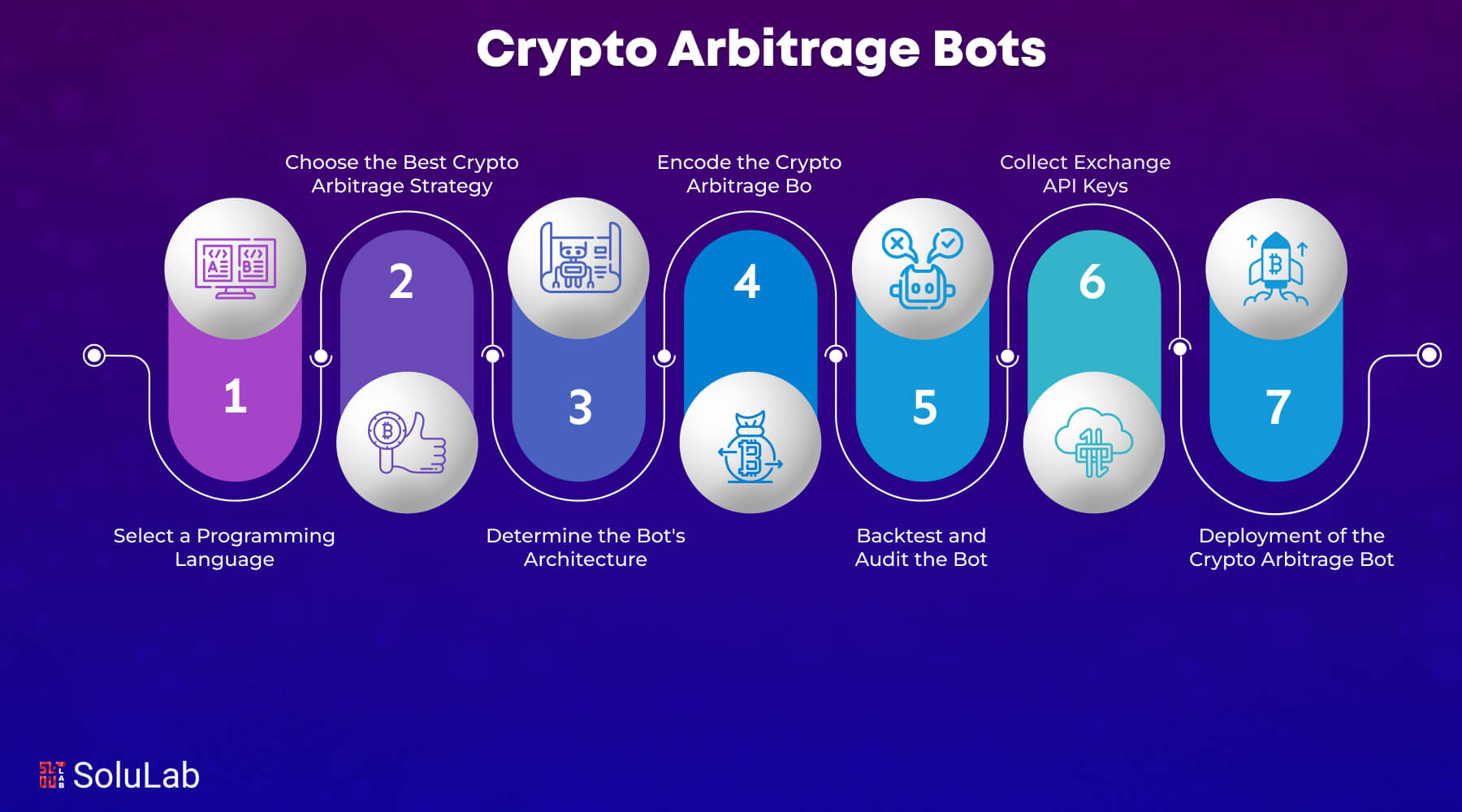
Creating a crypto arbitrage trading bot comes down to a handful of steps. Here’s how they stack up:
Select a Programming Language
Pick a language you already know and one that suits financial work. Java, C#, and JavaScript all fit, but Python tends to win here, easy to write and packed with libraries you’ll actually use. Then tune your parameters around your capital. Cap the maximum trade amount. Set the profit margins you’ll accept. Add stop-loss thresholds so a bad run doesn’t drain the account.
Choose the Best Crypto Arbitrage Strategy
Don’t just start coding on a whim. Do the market research first, then decide what your bot will actually do: spatial arbitrage, triangular arbitrage, or statistical arbitrage. Match that choice to current market conditions and your own goals. Get this right up front and you won’t have to tear the thing apart and rebuild it later.
Determine the Bot’s Architecture
Strategy locked in? Now sketch the architecture. You’ll need pieces for pulling market data, making the trading decision, and executing it. The whole thing has to keep up with real-time data and fire off trades fast. And feed it current information, because a bot working off stale data makes confident, wrong decisions.
Encode the Crypto Arbitrage Bot
Language chosen, strategy set. Time to write the actual code against your architecture plan. Build the logic for collecting data, running the strategy, and executing trades. Keep it lean, and keep it secure, since this is money moving through it.

Backtest and Audit the Bot
Building the bot isn’t the finish line. Before it touches real money, run it against historical data and see how it holds up across different market conditions. Then audit it. Hunt down the bugs and the slow spots, and fix them.
Check whether the dataset you fed it is behaving, and compare results if you’re unsure. Try running the trade across a few exchanges, not just one.
Collect Exchange API Keys
Grab API keys from every exchange you plan to trade on. Those keys are what let the bot pull market data and place transactions. Pick your exchange, sign in, find the API keys section, and wire your trading up to your account.
Deployment of the Crypto Arbitrage Bot
You’ve done the work. Now put the bot on a dependable server or cloud platform and let it run. Watch it closely, tweak as you go, and tune the strategy where the numbers tell you to. And keep backtesting, again and again, because a bot that isn’t re-tested slowly drifts out of step with the market.
Features of the Crypto Arbitrage Trading Bot
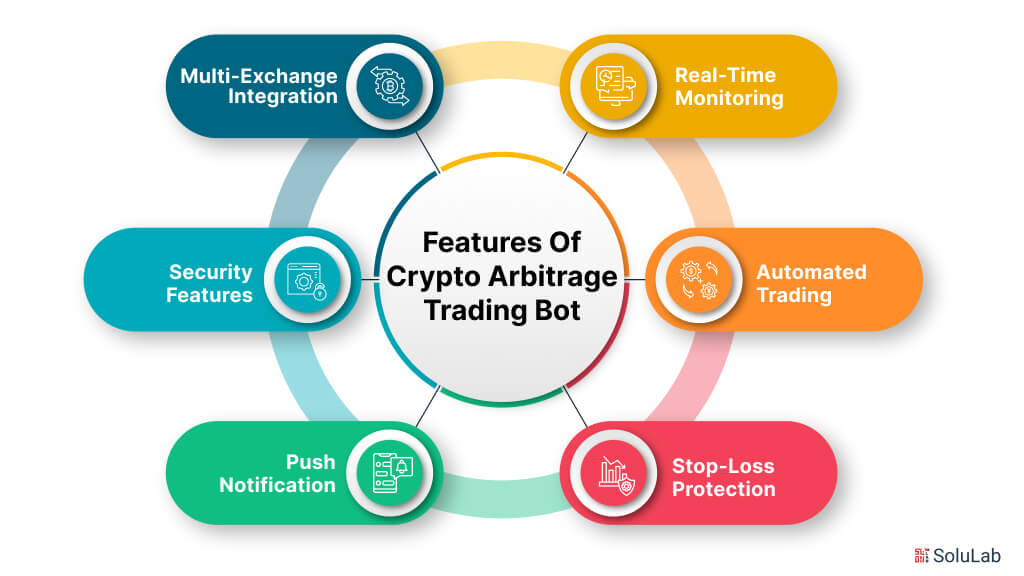
Here’s what a solid crypto arbitrage trading bot brings to the table:
1. Real-Time Monitoring: The bot never stops scanning. It sweeps across exchanges looking for price gaps, pulling instant updates through WebSocket connections so it’s working off the freshest numbers with barely any lag.
It also reads order book depth to check whether a trade is actually viable, and watches trading volume to make sure there’s enough liquidity to pull the arbitrage off. On top of that, it tracks spread percentages and works out the real profit margin once fees are subtracted. No guessing, just clean numbers to decide on.
2. Automated Trading: This is the headline feature. The moment a profitable gap shows up, the bot trades on it across exchanges, on its own, no hand on the button.
Smart order routing picks the most efficient path to execution. You can set your own rules too, like a minimum profit threshold before it fires. It handles the trickier plays as well: triangular arbitrage inside one exchange, cross-exchange arbitrage across several. Position-sizing algorithms split your capital based on available liquidity, and a trade queue keeps things orderly when several opportunities land at once.
3. Stop-Loss Protection: Risk control is baked in. Emergency stop features exist for one reason: to slam the brakes and stop big losses when the market turns ugly.
Stop-loss levels flex with volatility, and maximum drawdown limits add another safety net underneath. If the network starts acting up, the bot can close positions on its own. And you can set different stop-loss rules for different trading pairs, which is handy when some pairs behave nothing like others.
3. Push Notification: The bot keeps you in the loop. It pings you when a trade goes through and when your profit or loss shifts. It’ll also flag the important system stuff, a dropped connection, a balance change.
Want alerts only for certain market conditions? You can set that. Notifications reach you however you like, email, SMS, or Telegram. And each one carries the details that matter: trade summaries, performance metrics, a clear read on what your bot has been up to.
4. Security Features: Security sits near the top of the list, and for good reason. API keys get encrypted and stored safely so your sensitive data stays locked down. IP whitelisting means only devices you’ve approved can touch the exchange APIs, and two-factor authentication guards any changes to the bot’s setup.
Rate limiting keeps the API from being hammered, and detailed audit logs record everything the system does. Automated security checks run on a schedule, quietly keeping the whole thing honest and the trading environment safe.
5. Multi-Exchange Integration: A good bot plugs into several major cryptocurrency exchanges at once and smooths over their differences, so their varied APIs all look the same from your side. It respects each exchange’s rate limits and trading rules, keeps things running clean, and handles currency conversion and balance juggling across platforms without you babysitting it.
One interface shows you every exchange account in a single view. And if an API connection drops, the bot reconnects on its own and carries on.
Benefits of Creating a Crypto Arbitrage Bot
People overthink. We hesitate, we second-guess, we sit on a decision until the moment passes. A bot doesn’t. That’s the whole appeal, it acts the instant it should, with none of the dithering. Here’s where that pays off.
1. Speed: A bot trades faster than any human ever could. It reads price differences across exchanges in milliseconds and executes before the gap closes. And it has to be that quick, because these openings often last only seconds, sometimes a fraction of one. On top of that, it can track thousands of trading pairs at once. No person is doing that.
2. Emotionless: Fear, greed, anxiety, the usual suspects behind bad trades. A bot feels none of them. It follows its logic and its preset parameters, full stop, no matter what the market throws at it. So it won’t panic-sell into a dip or cling to a losing position out of stubborn hope.
3. Diversification: A well-built arbitrage bot spreads itself across many coins and exchanges at once, so diversification comes almost for free. It can:
- Monitor different types of arbitrage opportunities (triangular, cross-exchange, statistical)
- Trade various cryptocurrency pairs
- Adjust strategies based on market conditions
How Much Does it Cost to Develop a Crypto Arbitrage Bot?
Before a single line of code, do the groundwork: market analysis, competitor analysis, and design. The bill for building a crypto arbitrage bot flows straight into those pieces, which is exactly why planning isn’t optional. So let’s break the cost down by what you’re actually paying for:
- Market Data Research: This phase means studying trading volumes, digging into liquidity, and figuring out which trading pairs are worth chasing and which carry too much risk. Not an expert? Then get one. Lean on a blockchain company or service provider rather than guessing.
- Design: Aim for an architecture that’s both efficient and secure. Your bot needs a risk-management system to guard against sudden market swings. And the interface should lay out trading opportunities and performance metrics clearly, so whoever’s using it can read the situation at a glance.
- Development: Building a crypto arbitrage bot runs somewhere around $10,000 to $75,000. And that range can shift as you go, so treat it as a starting figure rather than a fixed quote.
How do Crypto Arbitrage Trading Bots Work?

Under the hood, a crypto arbitrage bot runs on three parts: the Signal Generator, Risk Allotment, and the Execution Module. Here’s what each one does.
1. Signal Generator: Think of this as the bot’s brain. It’s the piece that spots the opportunity. It lines up the price of the same pair, say BTC/USDT, across platforms, then does the math on what you’d really make once fees, spreads, and transfer times are counted in. Out the other end come clean buy and sell signals.
2. Risk Allotment: This part decides how much to bet. It sizes each position against your available capital and the liquidity on offer, and caps trade sizes so you don’t get eaten by slippage in thin markets. It also sets the guardrails, stop-loss levels, drawdown limits, and nudges you on when to buy or sell. If you’re weighing a crypto arbitrage flash loan bot, it works off those tuned parameters to keep risk in check when the market gets wild.
3. Execution Module: The execution piece is where the trade actually happens, buying and selling with precision. It works across exchanges and adjusts orders as conditions shift underneath it. In short, it turns the signal into the API calls the exchanges understand and act on.
How SoluLab Excels in Creating Arbitrage Trading Bots?
Token World, a crypto launchpad platform, came to us with a clear ask: a secure, scalable place to run token sales that stayed compliant and transparent. SoluLab, the crypto trading bot development company, built them a launchpad from the ground up, submission forms, review systems, secure transactions, dashboards, multi-language support, and full blockchain integration. The result? Token World could simplify its processes, stay on the right side of regulation, earn user trust, and handle heavy traffic without breaking a sweat. Token launches that ran smoothly, worldwide.

Conclusion
A crypto arbitrage bot is a serious tool for anyone who wants to automate their trading and turn market inefficiencies into profit. Yes, it costs you time and money up front. But in a market this crowded, that edge can be worth it. Whether it pays off comes down to three things: careful planning, clean technical work, and the willingness to keep tuning it as the market moves.
One warning, though. An arbitrage bot is not a “set and forget” machine. It can make real money, sure, but only if you keep watching it, updating it, and refining it. Walk away and its edge fades.
Our blockchain developers at SoluLab have built cryptocurrency arbitrage bots before, hands-on, not in theory. They follow a clear plan to walk you through developing your own trading bot and ship a crypto arbitrage bot development solution that hands you a real competitive edge.
Want to talk through your business case? get in touch with our specialists.
FAQs
Shipra Garg is a tech-focused content strategist and copywriter specializing in Web3, blockchain, and artificial intelligence. She has worked with startups and enterprise teams to craft high-conversion content that bridges deep tech with business impact. Her work translates complex innovations into clear, credible, and engaging narratives that drive growth and build trust in emerging tech markets.