Key Takeaways
- AI for Quality Control combines computer vision and machine learning to catch defects that manual checks routinely miss.
- Some manufacturers using AI Quality Control have cut error rates by as much as 90 percent, with fewer defects slipping through undetected.
- AI Automation for Quality Control in Manufacturing removes the inconsistency that comes from tired inspectors, small sample sizes, and human judgment calls.
- Companies like BMW, Siemens, and Bosch already rely on Industrial AI for Quality Control to bring down scrap rates and improve yield.
- A successful rollout comes down to clean training data, a small pilot first, and someone reviewing edge cases before you scale up.
Ask any plant manager what keeps them up at night, and quality slip-ups are usually near the top of the list. A part that looks fine on the line but fails three months later. A batch that passes inspection because the person checking it was on hour ten of their shift. These aren’t rare events. They happen often enough that manufacturers have quietly accepted a certain error rate as the cost of doing business.
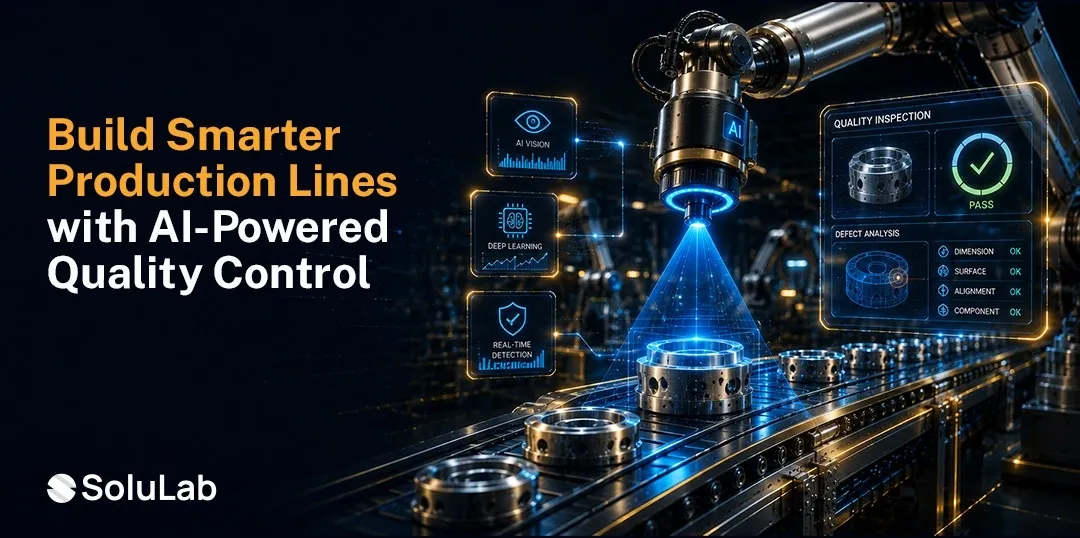
That’s starting to change. AI for Quality Control can flag defects that are genuinely too small or too fast for a person to catch reliably.
AI for manufacturing quality Control isn’t just for companies with massive R&D budgets anymore. Mid-sized manufacturers are running it too, often because the payback period turns out to be shorter than expected.
This blog walks through how AI actually improves quality control, why manual inspection is running out of road, how the two approaches stack up side by side, and what a real implementation looks like from assessment to scale.
How AI Technology Enhances Quality Control?
At a basic level, AI for Quality Control Automation works by feeding a model thousands of images (good parts, bad parts, borderline cases) until it learns what “normal” looks like well enough to flag what isn’t.
Once trained, the AI Model for Quality Control runs continuously, scanning units in real time rather than pulling a handful off the line every hour. AI-powered quality assurance can increase manufacturing productivity by up to 50% by automating inspection and defect identification.
It’s that these systems keep learning. A model trained on one product line can be retrained as new SKUs, materials, or tolerances get introduced, without starting from scratch each time. That adaptability is a big part of why Industrial AI for Quality Control has stuck around rather than fading as a trend.
There’s also the integration piece, which honestly gets less attention than it deserves. A vision system sitting in isolation doesn’t help much. The value shows up when it’s wired into your MES or ERP, so a flagged defect triggers an alert, pauses a line, or gets logged automatically instead of waiting for someone to notice.
Why Traditional Quality Control Is No Longer Enough?
Manual inspection worked fine for decades, and to be fair, it still catches plenty of obvious problems. But it was never designed for the volume and precision modern manufacturing demands, and the cracks show up in a few predictable places.
- Human error: Even a sharp, experienced inspector will miss things, especially on tasks that repeat hundreds of times a shift.
- Inspector fatigue: Focus drops off a cliff after a few hours, and defect detection drops with it.
- Sampling limitations: Checking one unit out of every ten (or fifty) leaves a lot of room for problems to slip through.
- Labor shortages: Good inspectors are hard to hire right now, and harder to keep.
- Inconsistent decisions: Ask three inspectors to judge the same scratch and you’ll sometimes get three different answers.
- Slow production lines: Manual checkpoints are often the actual bottlenecks holding back throughput.
- High rework costs: A defect caught after shipping costs far more to fix than one caught on the line.
Put together, these gaps are why more manufacturers are looking at AI applications in Quality Control for Manufacturers instead of trying to patch a system that was never built for this scale.
AI Quality Control vs Manual Quality Inspection
Once you put the two side by side, the gap becomes obvious pretty fast. AI automation quality control manufacturing wins on nearly every axis that matters, though manual inspection still has a role for judgment-heavy or low-volume checks.
| Factor | AI Quality Control | Manual Inspection |
| Speed | Milliseconds per unit | Minutes, depending on complexity |
| Accuracy | Consistent, catches micro-defects | Varies with fatigue and experience |
| Scalability | Add cameras and compute | Requires hiring more people |
| Cost | Higher upfront, lower per-unit | Lower upfront, higher ongoing |
| Consistency | Same standard, every shift | Shifts with the inspector |
| Downtime | Flags issues before failure | Usually reactive |
| Maintenance | Periodic model updates | Ongoing training and turnover |
| ROI | Often positive within 1-2 years | Rarely improves over time |
Measuring the ROI of AI Quality Control
If you’re trying to justify the investment (or prove it’s working after the fact), a handful of metrics tend to tell the real story better than a vendor’s sales deck.
- Defect rate: The most obvious one. Track units flagged as defective as a percentage of total output, and watch it trend down.
- First-pass yield: How many units clear inspection the first time, without needing rework. This is often where the biggest early wins show up.
- Scrap reduction: Less wasted material once problems are caught earlier in the process.
- Rework cost: Fewer hours and less material spent fixing things that shouldn’t have shipped in that state.
- Downtime: Predictive flags mean fewer surprise stoppages.
- Inspection speed: Real-time checks instead of batch sampling, which speeds up the whole line.
- Customer complaints: A lagging indicator, but a telling one once the numbers start moving.
- Warranty claims: Fewer defects reaching customers mean fewer claims down the road.
How to Implement AI for Quality Control in Your Business?
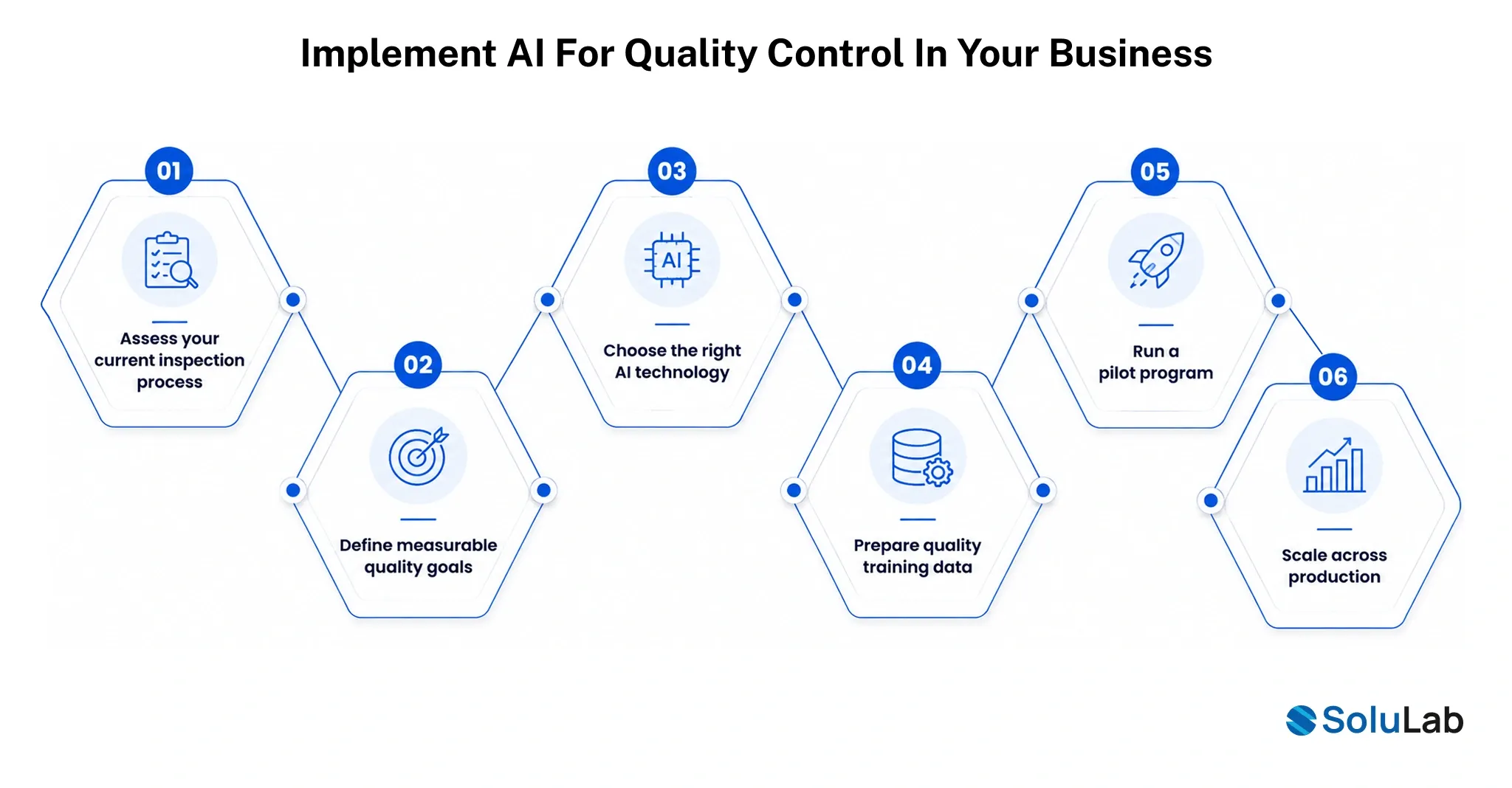
Rolling out AI-powered solutions for quality control doesn’t have to mean overhauling your whole line at once. Most successful projects follow a fairly similar path, starting small and expanding once the results hold up.
1. Assess your current inspection process
Look honestly at where defects actually happen, not just where you assume they do.
- Review existing inspection points
- Track recurring defect types
- Flag your worst bottlenecks
2. Define measurable quality goals
Vague goals lead to vague results, so pin down numbers you can actually track.
- Set a defect reduction target
- Define a first-pass yield goal
- Tie goals to existing production KPIs
3. Choose the right AI technology
Not every vision system fits every product, so match the tool to what you’re actually inspecting.
- Compare computer vision options
- Match tools to your defect types
- Check integration with current systems
4. Prepare quality training data
This is the unglamorous part, but it matters more than almost anything else.
- Collect labeled defect images
- Clean up messy or duplicate data
- Have someone validate accuracy
5. Run a pilot program
Start small enough that a misstep doesn’t cost you a whole production run.
- Pick a single line to start
- Track early performance closely
- Ask operators what they’re seeing
6. Scale across production
Once the pilot proves itself, expand it in stages rather than all at once.
- Roll out to additional lines
- Document what worked
- Keep monitoring after launch
Real-World Applications of AI in Quality Control
Some of the clearest examples of AI quality control for the automotive industry and beyond come from companies that have been public about their results.
1. BMW
Catching subtle paint imperfections and surface defects across high vehicle volumes without slowing the line down. BMW brought in AI-powered computer vision to inspect surfaces and components as vehicles moved through production. Faster detection and more consistent quality checks, with less reliance on manual spot-checking at each station.
2. Siemens
Micro-defects in electronic components that were genuinely difficult for a person to catch consistently, even under a microscope. Siemens trained AI for quality control models on thousands of component images to flag anomalies automatically. Higher detection accuracy alongside a meaningful drop in time spent on manual review.
3. Bosch
Getting consistent inspection standards across multiple product lines and factories spread across different regions. Bosch rolled out AI automation for quality control in manufacturing to standardize the process globally. More consistent defect detection, with far less dependence on manual sampling from site to site.
These are just a few AI for quality control in manufacturing examples, but they point to the same pattern: this isn’t experimental anymore. It’s becoming standard practice on serious production lines.
Best Practices for Successful AI Deployment
A few things separate AI deployments that stick from ones that quietly get abandoned after six months.
- Data quality: Garbage in, garbage out still applies. Clean data matters more than a fancier model.
- Pilot projects: Test on one line before betting the whole factory on it.
- Edge deployment: Running inference on-site cuts latency and keeps inspection genuinely real-time.
- Human-in-the-loop: Let people review the edge cases. It builds trust and catches the model’s blind spots.
- Continuous monitoring: Models drift as products change, so keep an eye on performance, not just at launch.
- Model retraining: Update the model as new defect types or materials show up.
- Governance: Someone needs to own this. Without clear accountability, things slip.
The Future of Quality Control
Where this is headed gets interesting fast, and some of it is already showing up in early deployments.
- Agentic AI inspectors: Systems that don’t just flag a defect but can pause a line or trigger a fix on their own.
- Vision-language models: AI that can describe what’s wrong in plain language, which speeds up root cause analysis considerably.
- Autonomous factories: Environments where quality control runs end-to-end without much human intervention at all.
- Digital twins: Virtual versions of a production line used to test quality changes before touching the real thing.
- Multimodal AI: Combining visual, audio, and sensor data for a fuller picture of what’s actually going wrong.
- Foundation models: Large, general-purpose models fine-tuned for a specific factory’s needs.
- Edge AI: Faster on-device processing that doesn’t depend on a round trip to the cloud.
Why Choose SoluLab for AI Quality Control Solutions?
Cutting production errors takes more than plugging in a piece of software. It takes a partner who actually understands how a factory floor works. SoluLab, an AI native company, builds AI Quality Control systems designed around how your production line actually runs, not a generic template.
- AI-Powered Visual Inspection Systems
- Custom AI Model for Quality Control Development
- Predictive Maintenance Solutions
- AI Quality Control for Automotive Industries
- Industrial AI for Quality Control Integration
- Edge AI Deployment for Real-Time Inspection
- AI Analytics and Quality Dashboards
SoluLab helped RetailPro transform retail operations by implementing generative AI for personalized marketing, automated inventory, and data integration. This improved customer engagement, reduced costs, enhanced decision-making, and increased conversions across 500+ stores, delivering a seamless and data-driven shopping experience.
As one of the established AI development companies in the USA, SoluLab also handles the data prep to deployment and everything in between.

Conclusion
Quality control is quietly shifting from something you check after the fact to something you predict and prevent. AI in manufacturing for quality Control helps catch defects earlier, cuts down on rework, and keeps standards consistent, no matter who’s on shift.
As margins tighten and customers get less forgiving of mistakes, this isn’t really optional anymore for manufacturers trying to stay competitive.
SoluLab, an experienced AI-led development company, can help you figure out where to start and build an AI Quality Control system that actually fits your production line.
FAQs
Neha is a curious content writer with a knack for breaking down complex technologies into meaningful, reader-friendly insights. With experience in blockchain, digital assets, and enterprise tech, she focuses on creating content that informs, connects, and supports strategic decision-making.