Key Takeaways
- AI strategies are for businesses that have no use case clarity and no idea of business outcomes.
- If businesses have indefinite ideas and a framework, they can move forward with an AI implementation plan.
- SoluLab is a leading AI development company that helps businesses move from AI planning to deployment through AI strategy consulting, custom AI development, and AI implementation services.
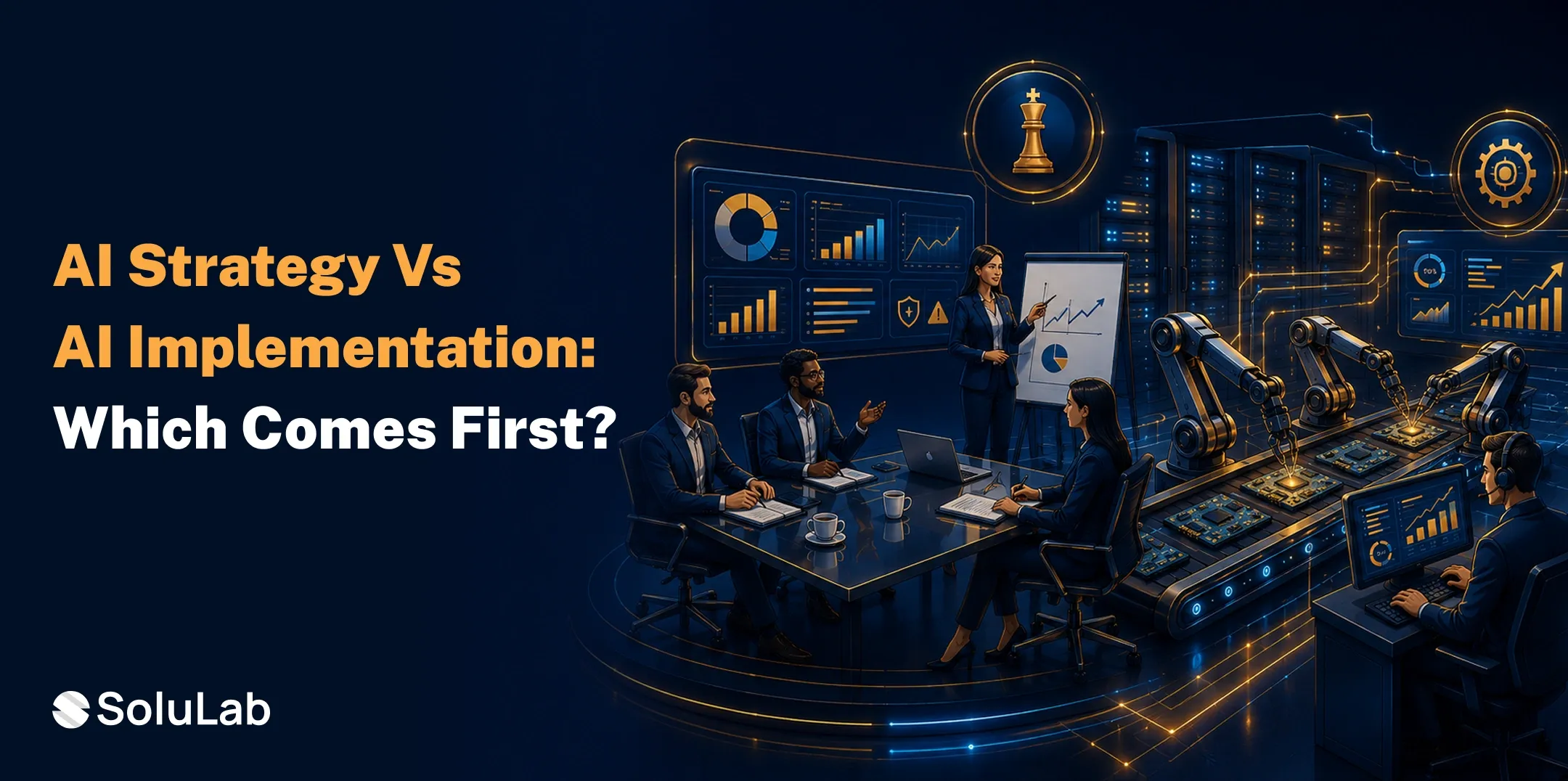
AI initiatives are often ambitious but mostly fail due to poor strategy and implementation. While strategy helps to figure out what to build, AI implementation works towards the execution. One wrong move can fail both, and for the right implementation, businesses must understand the commonalities and differences between AI strategy vs. AI implementation.
Whether you’re partnering with an AI development company or building AI capabilities in-house, a clear roadmap is critical to achieving measurable business outcomes. This guide explores the role of AI strategy and AI implementation services in businesses and how they contribute to achieving the expected business outcomes.
Strategy vs Execution: Understanding the Gap
The gap between AI strategy and AI implementation often appears when AI strategy and AI execution are not interrelated. Leadership may approve an AI idea without checking data quality. Technical teams may build a strong model that does not solve a real business problem. AI development companies may also launch pilots that work in one team but fail when they try to scale them across departments. It slows delivery, weakens ROI, and creates frustration between business and technical teams.
What Is AI Strategy and AI Implementation?
Before comparing AI strategy vs implementation, understand what each side actually means in business terms.
AI strategy
It defines the business goal, use case priority, data needs, technical direction, governance rules, budget range, and expected ROI. If the AI strategy is clear, businesses can avoid the expensive mistake of building AI. It gives direction before execution begins.
Key Features of AI Strategy
- Clear Business Goal: A strong AI strategy framework defines the exact problem AI should solve, such as faster support, better forecasting, lower costs, or stronger product engagement.
- Use Case Prioritization: AI strategy helps leadership choose the most valuable use case first, instead of spreading budget across disconnected AI experiments with unclear returns.
- Data and System Readiness: A practical AI business strategy checks whether the company has clean data, connected systems, and the right infrastructure before development starts.
- Risk and Governance Planning: AI strategy identifies privacy, security, compliance, bias, approval, and monitoring needs early, so the business does not fix critical gaps later.
- ROI and Success Metrics: Through AI strategy consulting, the business defines how it will measure success through revenue, productivity, accuracy, cost savings, or customer experience.
AI implementation
This process turns the approved strategy into a working AI solution. It covers architecture, development, integration, testing, deployment, monitoring, and adoption. If strategy decides the direction, implementation proves whether the idea works in real business conditions.
Key Features of AI Implementation
- Solution Architecture: An AI implementation strategy defines the technical structure, model approach, data flow, integrations, security layers, and user experience before the build begins.
- Custom AI Development: Custom AI development turns the approved use case into AI agents, automation systems, predictive models, chatbots, or workflow-specific AI applications.
- System Integration: AI integration services connect the AI solution with CRMs, ERPs, support tools, dashboards, finance platforms, or internal business systems.
- Testing and Deployment: AI implementation services test model output, workflow fit, security, performance, and user experience before the AI solution goes live.
- Monitoring and Optimization: After deployment, the team tracks performance, user adoption, output quality, and business impact to improve the AI system over time.
Which One Is More Important?
For a successful AI implementation in a business, both are equally important. Strategy without implementation becomes a document. Implementation without a strategy becomes expensive guesswork.
Difference Between AI Strategy and AI Implementation
The difference between AI Strategy and AI Implementation is simple: strategy decides the right AI direction, while implementation turns that direction into a working, tested business solution.
| Area | AI Strategy | AI Implementation |
| Main Role | Decides what AI should solve. | Builds and launches the AI solution. |
| Core Focus | Goals, use cases, ROI, risks, and roadmap. | Development, integration, testing, deployment, and monitoring. |
| Best Time to Use | When the AI opportunity feels unclear. | When the AI plan looks ready for execution. |
| Key Question | What should the business build, and why? | How will the business build and improve it? |
| Business Value | Reduces wrong investments and unclear planning. | Turns approved AI plans into real outcomes. |
| SoluLab Support | AI strategy consulting and AI planning support. | AI implementation services and custom AI development. |
When Does a Business Need an AI Strategy First?
A business needs a strategy first to bring clarity to current processes. This helps to design a use case for AI based on current business problems, so the enterprise can move forward with the AI app development process.
Mostly, the AI Strategy is required by the funded startups and SMBs as they want to add AI to a product while still needing a stronger product-market logic. The team may have investor pressure, but users need a feature that solves a real problem.
An AI strategy helps the startup decide whether it should build. The AI-native solution development strategy fits this stage because startups need architecture and product direction before they invest heavily in development.
When Does a Business Need AI Implementation First?
A business needs implementation when it already knows what AI should solve and wants to build the solution. This includes having a clear use case, available data, defined users, system requirements, budget approval, and success metrics.
Startups and SMBs may need implementation when they have validated the AI feature and need to build an MVP or production-ready product. This must contribute to the AI adoption, retention, revenue, or differentiation. With AI-led development business can bring the discipline to the execution process. The best AI projects usually start with a narrow goal.
AI Strategy and AI Execution: Why Both Must Stay Connected
When the AI strategy and AI execution are connected throughout implementation, it keeps business goals aligned from the first meeting to deployment. While the strategy should guide the build, the execution contributes to testing the strategy.

AI Strategy Framework: What Businesses Must Include
A practical AI strategy framework should give leadership enough clarity to make a confident investment decision. It helps the business decide what deserves investment now and what should wait. It should include:
- Business Goal: The strategy should define whether AI must improve revenue, reduce cost, increase speed, improve accuracy, or enhance customer experience.
- Use Case Priority: The business should rank AI opportunities by impact, feasibility, risk, data readiness, and time to value.
- Data Readiness: The framework should check whether the company has clean, accessible, secure, and relevant data for the selected use case.
- Technology Fit: The strategy should review current systems, APIs, infrastructure, security tools, and integration needs before development starts.
- ROI Metrics: Leadership should define how it will measure success through cost savings, conversion improvement, faster processing, accuracy, or productivity.
AI Implementation Plan: What Businesses Must Include
An AI implementation plan turns the strategy into a clear delivery path. It should include:
- Clear Project Scope: The clear expectations must be defined along with the expected business outcome.
- Right Technical Architecture: A strong AI implementation strategy must outline the right technical architecture and long-term scalability.
- Data and Integration Plan: For the execution, it is important to confirm data sources, access rules, and required AI integration services before AI deployment.
- User Workflow Design: The plan must define the user workflow design for daily activities performed on the ground.
- Testing and Quality Checks: Teams should test accuracy, speed, user experience, security, and output quality before implementation.
- Deployment and Monitoring: AI implementation services should cover launch and improvements after the system goes live.
Adoption and Ownership:
The company should assign process owners, train users, set human review points, and explain how AI powered solution will support better decisions.
Common Mistakes To Avoid While Considering AI Strategy vs Implementation
Even strong teams make mistakes when they move too quickly.
Mistake 1: Starting With Tools Instead of Problems
Some companies choose a model, platform, or vendor before they define the business problem. This creates scope confusion and weak ROI.
Mistake 2: Treating Data Readiness as a Technical Detail
Data quality affects every AI outcome. If teams ignore data readiness early, they may discover expensive problems during implementation.
Mistake 3: Building Without Workflow Ownership
AI needs a process owner. Without ownership, employees may not know who reviews outputs, updates rules, or measures results.
Mistake 4: Measuring Activity Instead of Impact
A company should not measure AI success by usage alone. It should measure cost saved, time reduced, revenue improved, or accuracy gained.
Mistake 5: Separating Strategy From Development
When one team plans and another team builds without continuity, the final solution may miss the original business goal.
AI Strategy vs Implementation for Different Buyers
Different buyers need different entry points. Here is how both contribute to that:
Funded Startups
Funded startups need an AI strategy and implementation when they want to build AI features without wasting runway. Strategy validates the opportunity. Implementation turns it into an MVP or scalable product.
CTOs
CTOs usually need a clear AI implementation strategy when the business already knows the direction. They need technical planning, development capacity, integration support, and deployment discipline.
Innovation Leaders
Innovation leaders need a strategy when they must prove AI’s business value. They need implementation when leadership approves the pilot and expects measurable results.
SMBs
SMBs should start with a strategy when they feel unsure. They should move into implementation after they choose one practical use case with clear ROI.
This buyer-specific view makes AI strategy vs implementation easier. The right answer depends on clarity, budget, data, ownership, and urgency.

Final Words
The AI strategy vs. AI implementation decision starts with one question: Does the business know exactly what it wants AI to achieve? If the answer is no, the company needs a strategy first. If the answer is yes, the company needs implementation. And, if the business wants to reduce risk and move from planning to production, it needs both. Together, they turn AI from an idea into a working business capability.
Connect AI Strategy and Implementation With SoluLab!
At SoluLab, the top AI development company in USA, we help businesses move from an AI idea to a working solution without losing the business purpose along the way.
Our team supports AI strategy consulting, custom AI development, AI integration services, AI development services, and AI implementation services under one connected process. Our focus is on building AI systems that fit real workflows, existing systems, customer needs, and growth goals.
Partner with our experts to build AI that has a purpose, a plan, and a measurable result!
FAQs
Shipra Garg is a tech-focused content strategist and copywriter specializing in Web3, blockchain, and artificial intelligence. She has worked with startups and enterprise teams to craft high-conversion content that bridges deep tech with business impact. Her work translates complex innovations into clear, credible, and engaging narratives that drive growth and build trust in emerging tech markets.