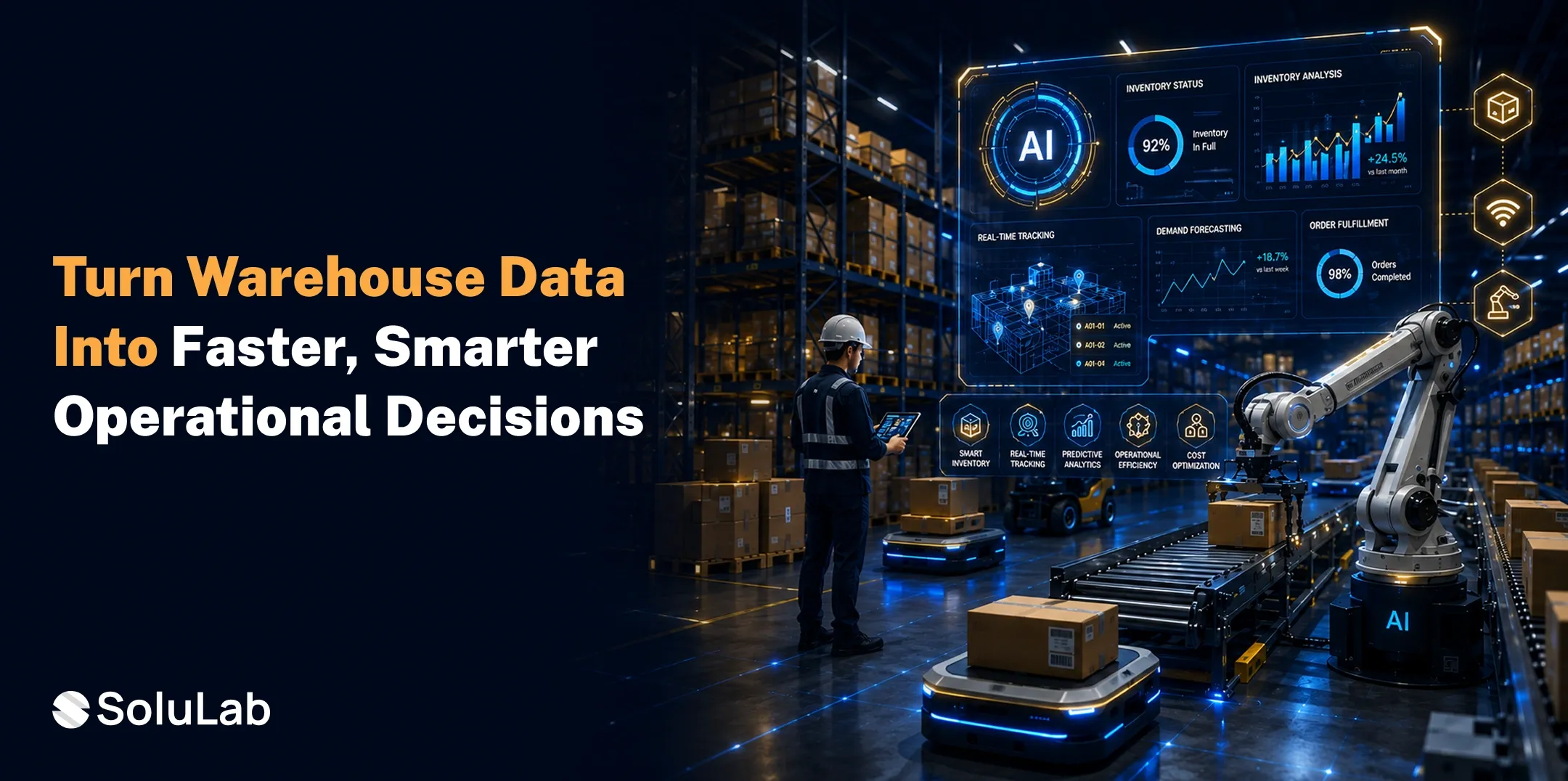
Running a warehouse today is more challenging than ever. Rising customer expectations, labor shortages, inventory inaccuracies, and increasing operational costs make it difficult to maintain efficiency while ensuring timely order fulfillment.
This is where AI development services are changing the way businesses operate. By using technologies such as machine learning, computer vision, predictive analytics, and robotics, AI enables warehouses to automate repetitive tasks.
From reducing stockouts to streamlining fulfillment workflows, AI empowers businesses to build smarter and more agile warehouse operations.
In this guide, we’ll explore how AI works in warehouse management, its key benefits, real-world use cases, implementation costs, and why it’s becoming an essential investment for modern supply chains.
Key Takeaways
- It automates repetitive tasks, optimizes workflows, and improves inventory accuracy, enabling faster and more reliable warehouse operations.
- AI predicts demand, prevents stockouts and overstocking, and maintains optimal inventory levels through real-time insights.
- By optimizing labor, equipment usage, and warehouse processes, AI helps businesses lower costs while increasing productivity.
- From e-commerce and retail to manufacturing and 3PL logistics, AI-powered warehouse solutions deliver measurable improvements in fulfillment and supply chain performance.
- Businesses adopting AI-driven warehouse management gain faster order fulfillment, better customer satisfaction, and data-driven decision-making that supports sustainable growth.
What Is AI in Warehouse Management?
Artificial Intelligence in warehouse management refers to the use of Artificial Intelligence (AI) technologies to automate, optimize, and improve warehouse operations. By analyzing real-time data from warehouse management systems (WMS), IoT sensors, cameras, and inventory records, AI helps businesses make faster, data-driven decisions with minimal human intervention.
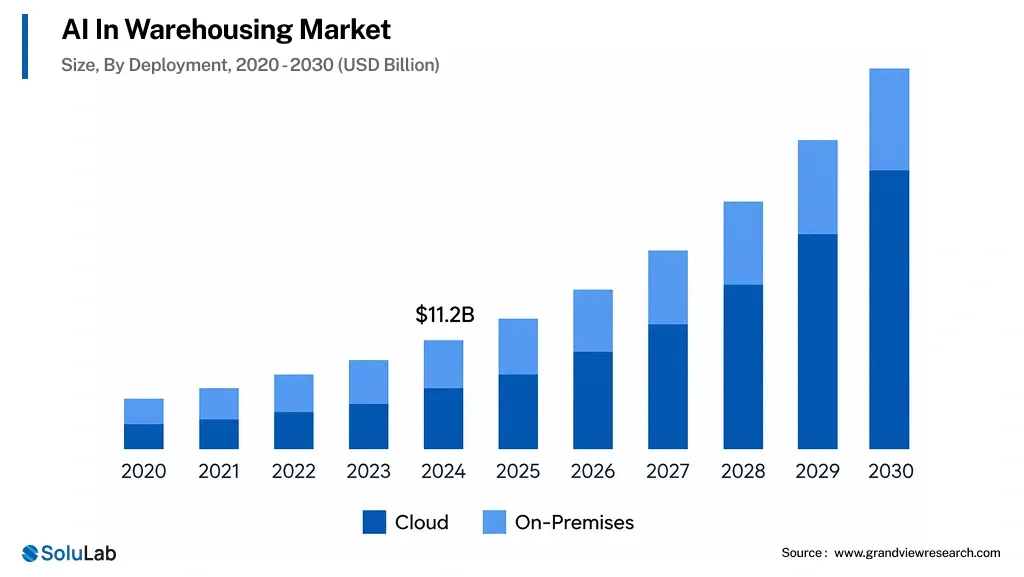
The global AI in warehousing market is projected to reach USD 45.12 billion by 2030, growing at a CAGR of 26.1% (2025–2030).
AI-powered warehouse management combines technologies such as machine learning, computer vision, predictive analytics, robotics, and natural language processing (NLP) to enhance efficiency across every stage of the warehouse lifecycle—from receiving and storage to order fulfillment and shipping.
How Does AI In Warehouse Management Work?
AI and warehouse management transform traditional warehouse operations by analyzing real-time data, automating repetitive tasks, and making decisions that improve efficiency, inventory accuracy, and order fulfillment across the supply chain.
AI in smart warehouse solutions continuously learns from operational data to optimize workflows and boost productivity.
- Collects real-time warehouse data: AI gathers information from WMS, IoT sensors, RFID tags, cameras, and ERP systems to build a unified operational view.
- Analyzes operational patterns: Machine learning identifies trends in inventory movement, order volumes, and workflows, enabling smarter forecasting and operational planning with greater accuracy.
- Predicts inventory demand: AI forecasts future stock requirements using historical sales, seasonal trends, and customer demand, helping minimize stockouts and excess inventory.
- Streamlines order picking: Intelligent algorithms calculate the fastest picking routes, minimizing worker movement, accelerating fulfillment, and improving overall warehouse productivity.
- Monitors equipment performance: Predictive analytics detect early signs of equipment failures, enabling proactive maintenance that reduces downtime and extends machinery lifespan.
- Continuously improves operations: AI learns from every transaction and operational outcome, refining recommendations over time to enhance efficiency, accuracy, and warehouse performance.
Why Modern Warehouses Need AI-Powered Solutions?
Modern warehouses must process thousands of inventory movements, orders, and fulfillment tasks daily. Rising customer expectations, labor shortages, and operational complexity make AI-driven warehouse automation essential. As the AI in the warehousing market expands rapidly, businesses are adopting AI powered solutions to improve efficiency, reduce costs, and build resilient supply chains.
- Rising order volumes: Growing e-commerce demand requires warehouses to process orders faster while maintaining high fulfillment accuracy and operational efficiency.
- Inventory inaccuracies: Manual inventory tracking often results in stock discrepancies, causing stockouts, overstocking, delayed shipments, and dissatisfied customers.
- Higher operating costs: AI optimizes labor allocation, warehouse layouts, and resource utilization, helping businesses reduce unnecessary operational expenses and improve profitability.
- Limited operational visibility: Traditional warehouses struggle with fragmented data, while AI provides real-time visibility into inventory, equipment, and warehouse performance for informed decisions.
- Equipment downtime: Predictive AI identifies potential equipment failures before breakdowns occur, minimizing disruptions and improving warehouse uptime and maintenance efficiency.
- Future-ready warehouse operations: Gartner predicts 50% of new warehouses in developed markets will be robot-centric by 2030, highlighting AI’s growing role in next-generation fulfillment centers.
How To Implement an AI-powered Warehouse Management System?
Implementing an AI-powered warehouse management system requires a strategic approach that aligns technology with business goals. With proper planning, businesses can improve efficiency, automate workflows, and scale warehouse operations with confidence.
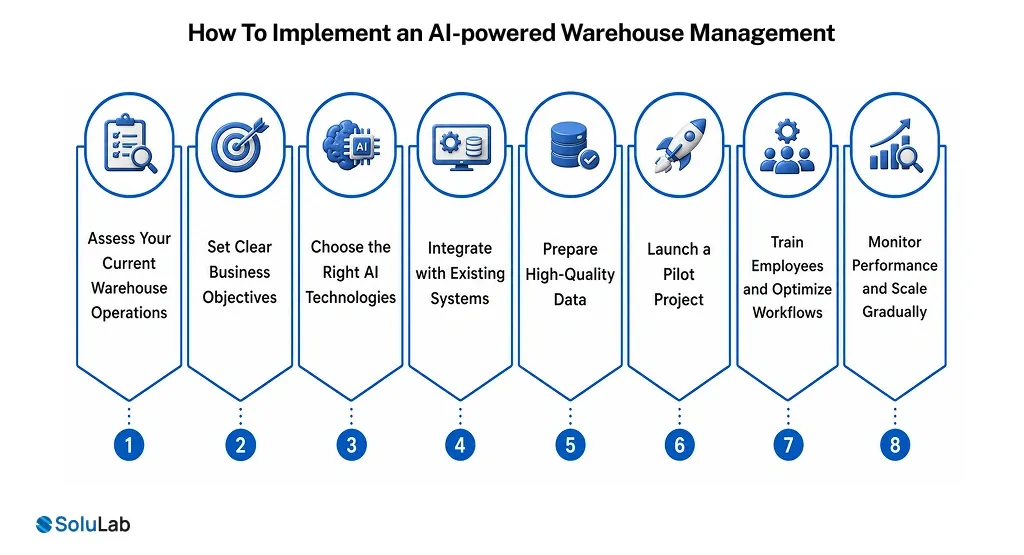
1. Assess Your Current Warehouse Operations
Evaluate existing workflows, inventory processes, and operational bottlenecks to identify where AI can deliver the greatest impact. A thorough assessment lays the foundation for successful warehouse management with AI integration.
- Analyze existing warehouse workflows
- Identify operational bottlenecks
- Define automation opportunities
2. Set Clear Business Objectives
Establish measurable goals such as improving inventory accuracy, reducing fulfillment times, or lowering operational costs to guide your AI implementation strategy.
- Define measurable performance goals
- Prioritize business challenges
- Align AI with objectives
3. Choose the Right AI Technologies
Select AI solutions based on your operational needs, including machine learning, computer vision, robotics, and AI inventory management capabilities.
- Evaluate suitable AI technologies
- Match tools to requirements
- Consider future scalability
4. Integrate with Existing Systems
Connect AI solutions with your Warehouse Management System (WMS), ERP, IoT devices, and inventory platforms to enable seamless data exchange.
- Integrate WMS and ERP
- Connect IoT-enabled devices
- Ensure smooth data flow
5. Prepare High-Quality Data
Clean, organize, and standardize warehouse data to ensure AI models generate accurate insights and reliable recommendations.
- Eliminate duplicate records
- Standardize inventory data
- Improve data quality
6. Launch a Pilot Project
Begin with a small-scale deployment to validate AI performance, identify challenges, and refine processes before expanding across the warehouse.
- Start with one warehouse
- Measure pilot performance
- Gather stakeholder feedback
7. Train Employees and Optimize Workflows
Equip warehouse teams with the knowledge and skills to effectively use AI-powered tools while adapting operational workflows for maximum efficiency.
- Conduct employee training sessions
- Update warehouse procedures
- Encourage technology adoption
8. Monitor Performance and Scale Gradually
Track key performance indicators, continuously optimize AI models, and expand implementation across additional warehouse operations as results improve.
- Monitor warehouse KPIs
- Refine AI recommendations
- Scale implementation strategically
Benefits of AI in Warehouse Operations
A well-implemented AI-powered warehouse transforms day-to-day operations by improving efficiency, reducing manual effort, and enabling data-driven decision-making.
From faster fulfillment to AI for inventory optimization, businesses gain greater control over warehouse performance while lowering operational costs.
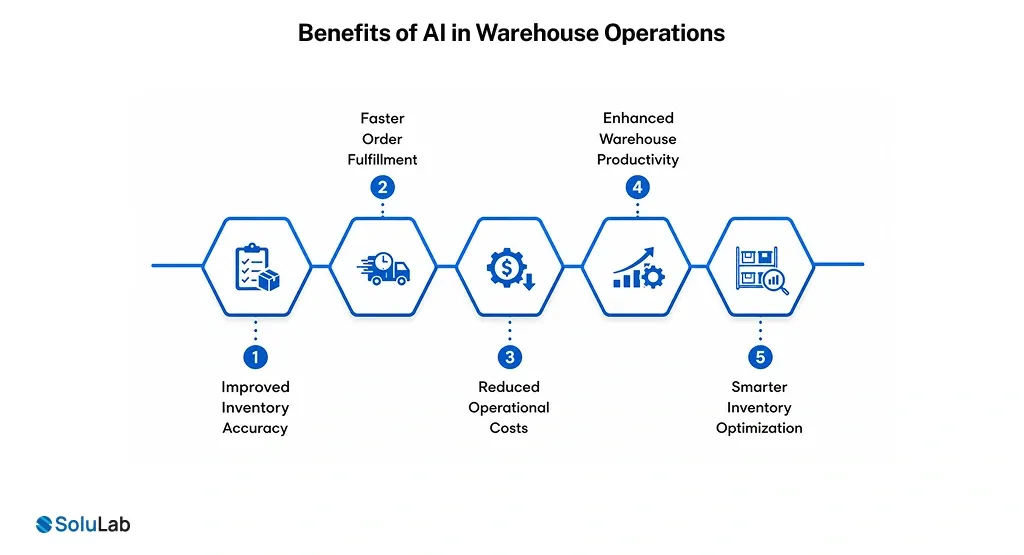
1. Improved Inventory Accuracy
AI tracks inventory in real time, minimizing stock discrepancies, preventing inventory mismatches, and ensuring accurate stock levels across warehouse operations.
2. Faster Order Fulfillment
AI led development optimizes picking routes and warehouse workflows, enabling quicker order processing, reduced fulfillment times, and improved customer satisfaction.
3. Reduced Operational Costs
By automating repetitive tasks and improving resource allocation, AI lowers labor costs, minimizes waste, and enhances overall warehouse efficiency.
4. Enhanced Warehouse Productivity
AI streamlines inventory movement, workforce scheduling, and equipment utilization, helping employees complete tasks faster with fewer operational bottlenecks.
5. Smarter Inventory Optimization
Using AI warehouse solutions, businesses accurately forecast demand, prevent stockouts, reduce excess inventory, and maintain optimal inventory levels throughout the supply chain.
Use Cases for AI in Warehouse Management
AI native strategy is transforming warehouses by automating complex processes, improving inventory visibility, and enabling faster decision-making. With AI inventory management, businesses can streamline operations, reduce costs, and deliver exceptional customer experiences.
1. Inventory Forecasting
AI analyzes historical sales data, seasonal trends, and demand patterns to predict future inventory requirements. This helps businesses maintain optimal stock levels and avoid costly inventory issues.
- Predict future inventory demand
- Minimize stockouts and overstocking
- Improve replenishment planning
2. Intelligent Order Picking
AI determines the most efficient picking routes and sequences, reducing travel time for warehouse workers while increasing order accuracy and fulfillment speed.
- Optimize warehouse picking routes
- Reduce manual picking errors
- Accelerate order fulfillment
3. Predictive Equipment Maintenance
AI continuously monitors warehouse equipment to detect performance issues before failures occur, helping businesses reduce downtime and maintenance costs.
- Detect equipment issues early
- Prevent unexpected machine failures
- Increase operational uptime
4. Automated Inventory Tracking
AI-powered systems monitor inventory movement in real time using sensors, RFID, and computer vision, ensuring accurate stock visibility across the warehouse.
- Track inventory in real time
- Improve stock visibility
- Eliminate manual inventory counts
5. Workforce and Labor Optimization
AI evaluates workloads, order volumes, and employee productivity to allocate resources efficiently, improving workforce utilization and warehouse performance.
- Optimize labor allocation
- Improve workforce productivity
- Balance daily warehouse workloads

Examples of AI in warehouse management
Modern warehouses are increasingly using AI to automate repetitive tasks, improve inventory accuracy, and accelerate order fulfillment. The following real-world examples demonstrate how leading companies leverage AI to build smarter, faster, and more efficient warehouse operations.
1. Amazon
Amazon uses AI-powered robotics, computer vision, and predictive analytics across its fulfillment centers to automate picking, sorting, and inventory management. AI also optimizes storage locations and fulfillment workflows, enabling faster deliveries while improving warehouse productivity and operational efficiency.
2. Ocado
Ocado operates highly automated warehouses where thousands of AI-controlled robots coordinate inventory retrieval and order picking. Intelligent algorithms optimize robot movement, ensuring accurate, high-speed fulfillment while minimizing manual intervention across warehouse operations.
3. DHL
DHL leverages AI-powered autonomous drones and predictive analytics to perform inventory checks, monitor warehouse stock, and optimize supply chain operations. These AI-driven systems improve inventory visibility, reduce manual counting, and enhance warehouse efficiency.
Cost of Implementing AI in Warehouse Management
Implementing AI in warehouse management involves upfront and ongoing investments across software, hardware, integration, and maintenance. Costs vary based on warehouse size, AI capabilities, and the level of automation required.
| Cost Component | Typical Cost (USD) | Description |
|---|---|---|
| AI Software & Licensing | $10,000–$100,000/year | AI-powered WMS and analytics platforms. |
| Cloud Infrastructure | $500–$10,000/month | Cloud storage, computing, and AI processing. |
| IoT Devices & Smart Sensors | $5,000–$50,000 | RFID tags, sensors, cameras, and scanners. |
| Warehouse Robotics (AMRs/AGVs) | $25,000 | Robots for picking, transport, and sorting. |
| System Integration | $20,000–$150,000 | Integrating AI with WMS, ERP, and IoT systems. |
| Custom AI Model Development | $30,000–$250,000+ | Building AI models for forecasting and automation. |
| Implementation & Deployment | $15,000–$100,000 | Installation, testing, and production rollout. |
| Employee Training | $2,000–$15,000 | Staff onboarding and AI tool training. |
| Maintenance & Support | 15–20% of project cost/year | Updates, monitoring, and technical support. |
| Cybersecurity & Compliance | $5,000–$50,000/year | Data protection and regulatory compliance. |
Why Choose SoluLab for AI Warehouse Management Solutions?
Managing a modern warehouse requires more than automation, it demands intelligent, scalable AI solutions tailored to your business. SoluLab, an AI development company, helps organizations streamline warehouse operations, optimize inventory, and accelerate fulfillment with end-to-end AI expertise.
- AI-Powered Warehouse Management Solutions
- E-commerce AI Warehouse Management Services
- Custom AI Model Development
- Inventory Forecasting Solutions
- Intelligent Order Picking & Route Optimization
- Predictive Maintenance Solutions
- Warehouse Robotics Integration
- AI-Driven Demand Forecasting
- IoT-Enabled Smart Warehouse Solutions
- AI Analytics & Performance Dashboards
SoluLab also offers comprehensive AI development services to design, build, and deploy custom AI solutions tailored to your unique warehouse and supply chain requirements.
Our AI consulting services help businesses identify high-impact AI opportunities, create implementation roadmaps, and maximize ROI from intelligent warehouse transformation.
Conclusion
Warehouses are evolving from manual, reactive operations to data-driven fulfillment centers powered by AI. From inventory forecasting and demand planning to automated picking, predictive maintenance, and real-time inventory visibility, AI helps businesses improve operational efficiency.
As customer expectations continue to rise, investing in AI-powered warehouse management is becoming a strategic advantage rather than an option.
SoluLab, an AI development company in USA, can help your business design, implement, and scale tailored AI solutions that drive measurable operational success and long-term growth.
FAQs
Neha is a curious content writer with a knack for breaking down complex technologies into meaningful, reader-friendly insights. With experience in blockchain, digital assets, and enterprise tech, she focuses on creating content that informs, connects, and supports strategic decision-making.