Key Takeaways
- Wallet whitelisting for tokenized securities is a control that lets only verified, approved wallet addresses hold or receive a security token. An issuer links each wallet to a KYC-checked investor and records the approval, and the token contract blocks any transfer to an address that is not on the list. It is how compliance moves on-chain.
Public blockchains are open by design. Anyone can create a wallet and receive a token. Securities law works the other way round: the issuer has to know who holds the asset, where they live and whether they are allowed to hold it. Whitelisting closes that gap. This guide explains how it works, which design to choose and where teams go wrong, whether you are running a security token offering or a wider tokenization platform.

What Is Wallet Whitelisting?
Wallet whitelisting is a control that approves specific blockchain addresses to hold, receive or send a particular security token. The approved addresses form a security token whitelist. It lives in the token’s smart contract, or in a registry the contract reads before every transfer. If an address is not on the list, the transfer fails.
Two details matter. First, whitelisting approves a wallet, not a person, so each wallet has to be tied to a verified investor before it counts. Second, the list belongs to one token. The same investor can be approved for one offering and blocked from another, because each has its own rules.
Whitelisting is often confused with two neighbouring controls:
| Control | Question it answers | When it runs |
| KYC and AML | Who is this investor, and are they clean? | At onboarding, then on a schedule |
| Wallet whitelisting | Which wallet may hold this token? | At approval, then on every transfer |
| Transfer restrictions | What may this holder do with the token? | On every transfer |
In practice the three work as one chain. KYC feeds the whitelist, and the whitelist feeds the transfer rules.
Why Do Tokenized Securities Need Wallet Whitelisting?
Securities are regulated by who may buy them and when they may be resold. Investor type, country of residence, holding periods and holder caps can all apply, and the exact rules depend on the exemption an offering uses. A plain ERC-20 token cannot enforce any of that. It sends tokens to any address that asks. Our comparison of ERC-3643, ERC-1400 and ERC-20 shows where each standard stands.
Addresses are also pseudonymous. A regulator reading the chain sees a string of characters. The issuer still has to know who holds the asset, screen holders against sanctions lists, and keep a holder register that matches the chain. Wallet whitelisting is the technical backbone of tokenized securities compliance because it links those two worlds.
The cost of skipping it is concrete. A token can land in an unknown or sanctioned wallet, and the issuer owns the problem. Dividends and votes also need an accurate list of eligible holders.
Whitelisting is not a law in itself. It is how teams meet transfer restrictions and KYC and AML duties in code. Which duties apply depends on your jurisdiction and exemption, so involve counsel early.
How Does the Wallet Whitelisting Process Work Step by Step?
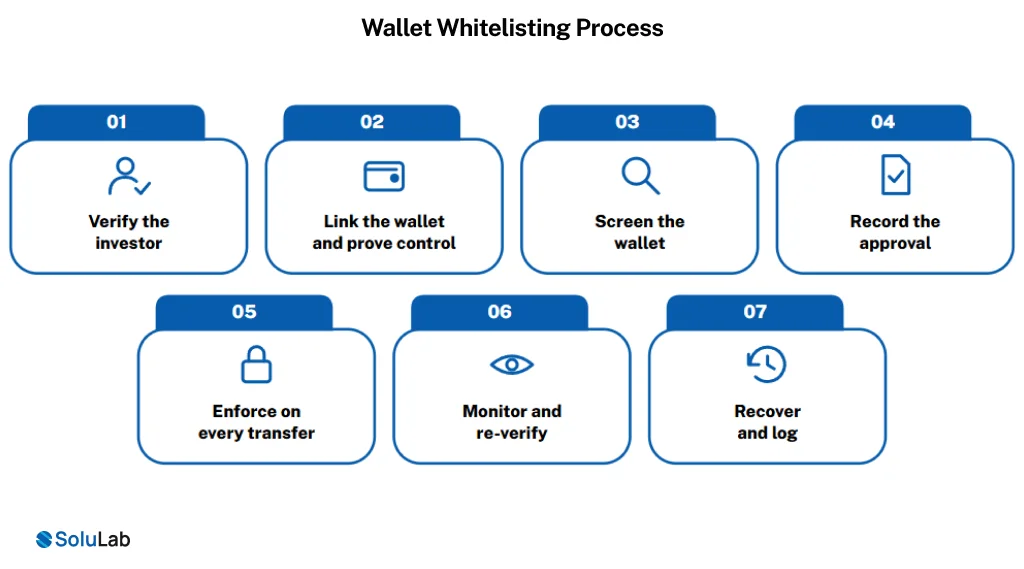
Here is the wallet whitelisting process most regulated platforms follow.
- Verify the investor: Run KYC, AML and sanctions screening. Check eligibility too: investor type, residency and any accreditation rule the offering uses.
- Link the wallet and prove control: The investor signs a one-time message with the wallet’s private key. That proves ownership without exposing the key. Platforms that issue custodial or MPC wallets skip this step because they create the wallet themselves.
- Screen the wallet: Check the address against sanctions lists and blockchain analytics for links to flagged activity. A clean investor can still bring a tainted wallet.
- Record the approval: An authorized compliance agent writes the approval on-chain. It can be a simple allowlist entry or an identity claim in a registry. Store flags such as country code, investor class and lock-up end date. Keep personal data off-chain.
- Enforce on every transfer: The token contract checks the sender, the receiver and the rules before any balance moves. A failed check reverts the transaction.
- Monitor and re-verify: KYC expires, sanctions lists change and investors move country. Re-screen on a schedule, and freeze or remove wallets when status changes.
- Recover and log: If an investor loses a key, an authorized agent can freeze the old wallet and move the balance to a newly approved one. Every change goes to an audit log.
How to test it: on a testnet, send tokens from an approved wallet to an unapproved one. The transaction should revert with a reason code. If it succeeds, the check is not wired into the transfer function.
How Is the Whitelist Enforced On-Chain?
The token contract calls a check inside its transfer function. If the check fails, the contract reverts. What differs between designs is where the check gets its answer.
In ERC-3643, the token asks an Identity Registry whether each wallet belongs to a verified identity, then asks a compliance contract whether the transfer meets the rules. Each investor’s on-chain identity (ONCHAINID) holds signed claims such as KYC status and country. ERC-3643 reached Final status in the Ethereum standards process, as its EIP-3643 specification shows. For a full walkthrough, read our guide to ERC-3643 tokenization.
In ERC-1400, transfer validation functions tell the caller whether a transfer is allowed and return a status code, and the issuer’s own validator decides. ERC-1400 remains a draft proposal rather than a finalized EIP. See our ERC-1400 token standard guide.
Many teams also write a custom allowlist, which is a simple mapping of approved addresses inside the token contract. It works, but every rule becomes custom code that needs its own audit.
One rule applies to every design. Never write names, documents or birth dates to a public chain. Store a flag or a signed claim on-chain and keep the evidence in your KYC system.

Which Wallet Whitelisting Approach Should You Choose?
| Approach | How it works | Strengths | Limits | Fits |
| Simple on-chain allowlist | A mapping of approved addresses in the token contract | Easy to build and audit, low cost | Flags are public, rules are basic, no identity layer | Pilots, one jurisdiction |
| Identity-claim registry (ERC-3643) | Each investor has an on-chain identity with signed claims, and the token checks them | Reusable across tokens, rich rules, built-in recovery | More contracts to deploy and govern | Several offerings or jurisdictions |
| Off-chain signed attestations | A compliance service signs an approval and the contract verifies the signature | Keeps data off-chain, fast to update | Depends on the signer’s uptime and key security | Primary issuance, changing rules |
| Permissioned network | Only approved participants can transact at network level | Control at the base layer | Less open liquidity and integration | Closed institutional ecosystems |
A few rules of thumb. Pick the simple allowlist for a pilot with one jurisdiction and a few hundred holders. Pick an identity registry when you expect several offerings, several jurisdictions or a need for recovery. Pick signed attestations when approvals change often and you want data off-chain. Pick a permissioned network only when the whole ecosystem is closed.
Most teams start simple and regret it when the second offering arrives. If you expect more than one, start with a registry.
How Does KYC for Tokenized Securities Connect to the Whitelist?
KYC for tokenized securities is the identity and eligibility check that gates the whitelist. Nothing should reach the registry until it passes. Three checks run in sequence: identity (document and liveness), AML and sanctions screening, and eligibility (investor class and residency).
Blockchain wallet verification adds two more. The investor proves control of the wallet with a signature, and the address itself is screened. Together they answer a question KYC alone cannot: is this particular wallet clean and controlled by this particular person?
Decentralized identity verification can cut the repeat work. An investor verifies once and reuses a signed credential across offerings, so the issuer reads a claim instead of storing documents. Learn more in our guides to blockchain KYC and AML solutions, AI in KYC and blockchain identity management. For the wider rules on virtual assets, see the FATF virtual assets guidance.
How Do Wallets and Custody Affect Whitelisting?
Whitelisting works the same on every wallet type, but the meaning of the approved address changes.
- Self-custody wallets. The approved address is the investor. Proof of control matters most here, and lost keys need a recovery process.
- Qualified custodian or omnibus wallets. The approved address is the custodian, which holds for many clients. The platform needs a sub-ledger of beneficial owners, and the custodian must run KYC on them. Without that, the whitelist says little about who really owns the tokens.
- MPC and institutional wallets. Keys are split across parties, and approval policies can require several signers. Whitelisting is unchanged. See our work on MPC wallet development and cryptocurrency wallet development.
- Exchanges, DEX pools and bridges. These are contract addresses, not people, so each needs an explicit decision. An open liquidity pool breaks transfer restrictions, so use a permissioned venue or an approved wrapper. For tokens on several chains, replicate the whitelist on every chain, as our multichain tokenization platform guide explains.
What Operations Run Between Issuance and Investors?
Whitelisting sits inside a longer chain of investor operations. Each stage leans on the list in a different way.
| Stage | What happens | Where the whitelist matters |
| Subscription and issuance | Investor funds the order and tokens are minted | Only approved wallets can receive tokens |
| Servicing | Distributions, votes, corporate actions | Payouts and ballots go only to eligible holders |
| Transfers | Secondary trades between investors | Both sides are checked and lock-ups enforced |
| Redemption | Tokens are burned and cash is paid | The wallet must still be eligible |
| Reconciliation | On-chain balances matched to the transfer agent record | Every whitelist change is logged against the register |
The step teams underrate is reconciliation. The on-chain record and the legal register have to agree every day. A whitelist change that is not mirrored off-chain is a compliance gap.
What Mistakes Break a Whitelist?
- Checking only at onboarding. Secondary transfers need both sides checked every time.
- Forgetting contract addresses. DEX pools, bridges, escrow and custodians are wallets too.
- Relying on one admin key. Use multi-signature or role-based approval, plus a delay on sensitive changes.
- Putting personal data on-chain. A public chain is permanent. Store flags and claims only.
- Skipping a recovery path. Decide how lost keys are handled before launch, not after the first call.
- Letting registers drift. Reconcile on-chain balances to the transfer agent record daily.
- Leaving stale approvals. Expired KYC or a new sanctions hit should trigger a freeze.

How Do You Build Wallet Whitelisting Into a Tokenization Platform?
Treat it as a platform feature, not a contract patch. A production build usually includes:
- Token contracts with transfer hooks, built through smart contract development
- An identity and KYC integration that feeds the registry
- An admin console with role-based approvals and multi-signature on sensitive actions
- A wallet layer for self-custody, custodial or MPC investors
- Monitoring, alerts and an audit log
- An independent review before launch, such as a smart contract audit
If you are scoping a build, SoluLab’s engineers handle security token development services, tokenization platform development and real-world asset tokenization, alongside our wider blockchain development services.
FAQs
Shipra Garg is a tech-focused content strategist and copywriter specializing in Web3, blockchain, and artificial intelligence. She has worked with startups and enterprise teams to craft high-conversion content that bridges deep tech with business impact. Her work translates complex innovations into clear, credible, and engaging narratives that drive growth and build trust in emerging tech markets.