Key Takeaways
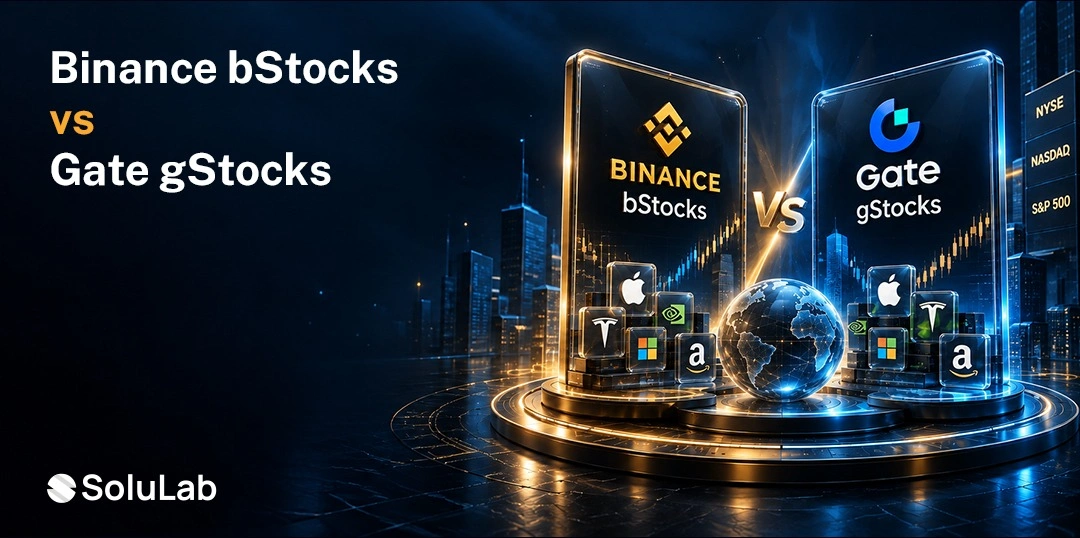
- bStocks and gStocks look similar on the surface and differ sharply underneath, in legal wrapper, conversion model and DeFi surface area.
- Binance lets users tokenize equities they already hold. Gate issues tokens against a reserve. That single choice reshapes the whole architecture.
- Both exchanges use the same brokerage infrastructure partner for the underlying shares, so custody plumbing is not the differentiator anyone assumes it is.
- Neither product gives holders legal share ownership. Both are structured as claims or certificates tracking price.
- Gate’s public disclosures on dividend treatment have been inconsistent across documents, which is a governance lesson more than a product flaw.
- Both exclude US persons, leaving the largest retail equity market open to anyone who solves the regulatory problem properly.
- The legal wrapper is decided before any code is written, and everything downstream inherits it.
A tokenized stock platform converts exposure to listed equities into blockchain tokens that trade continuously, settle on-chain, and plug into DeFi. Binance bStocks and Gate gStocks are the two most instructive live examples, and they solved the same problem with meaningfully different architectures. Comparing them is the fastest way to understand what building one actually involves.
The institutional thesis behind this is not speculative anymore. The Deloitte Center for Financial Services projects that tokenized real estate alone will reach $4 trillion by 2035, up from under $300 billion in 2024, a compound annual growth rate above 27%.
Equities are moving on the same rails, and the two launches below are the clearest evidence of it. This guide breaks down both platforms, extracts the design decisions worth copying, and shows where the gaps still sit.
What Are bStocks and gStocks?
Both are tokenized representations of US-listed equities, issued by a major crypto exchange, backed one-to-one by real shares held with a regulated custodian, and tradable around the clock. Neither makes the holder a shareholder.
Binance bStocks
Binance activated bStocks in June 2026 with five listings: Nvidia, Tesla, Circle, Micron and SanDisk, ticker-suffixed as NVDAB, TSLAB, CRCLB, MUB and SNDKB. They run on BNB Chain and can be withdrawn to compatible BNB Smart Chain wallets.
BTech Holdings Limited, a Binance affiliate structured as an Abu Dhabi Global Market special-purpose vehicle, issues the tokens. Legally, they are certificates that track the performance of the underlying stock rather than representing direct share ownership. The underlying equities are traded through Nest Trading Limited, an ADGM-regulated introducing broker, with Alpaca Securities handling clearing, custody, dividends and corporate actions.
Binance expanded through batches across July, adding Apple, Amazon, Goldman Sachs, PayPal, Coinbase, Alphabet, Robinhood, IBM and Nokia.
Gate gStocks
Gate launched gStocks on 3 July 2026, a month after launching Gate Stocks, its direct brokerage product covering more than 10,000 US-listed stocks and ETFs. gStocks operates on a fully collateralised one-to-one reserve model, with each circulating token backed by an equivalent amount of the underlying share.
Gate leaned harder into crypto-native mechanics. gStocks trade on an order book with fractional entry from 1 USDT, can be posted as collateral for margin lending, folded into yield products, and traded through bots, grid strategies, and APIs. Dividend-equivalent payments settle automatically in USDT, and Gate distributed a Micron-linked payment in July with more than 70 tokenized stocks live at that point.
The Shared Foundation Nobody Mentions
Here is the detail most coverage misses. Both exchanges rely on Alpaca for the brokerage layer holding and settling the underlying shares. The custody plumbing is effectively the same. Everything that actually differs between these two products sits above that layer, in the legal wrapper, the conversion model, and the on-chain surface. That is worth internalising before you assume custody is your hard problem.
bStocks vs gStocks: How the Two Models Actually Differ
The sharpest difference is who initiates tokenization. Binance built a conversion mechanism. Gate built an issuance mechanism. Almost every other divergence follows from that.
| Dimension | Binance bStocks | Gate gStocks |
| Launch | June 2026 | July 2026 |
| Tokenization trigger | User converts equities they already hold, 1:1, no fee or lock-up | Platform issues tokens against a maintained reserve |
| Issuer | BTech Holdings Limited, an ADGM special-purpose vehicle | Not publicly identified in launch materials |
| Legal form | Certificate tracking performance of the underlying | Token against a 1:1 collateralised reserve |
| Underlying brokerage | Nest Trading Limited, with Alpaca for clearing and custody | Alpaca for custody and settlement |
| Chain | BNB Chain, withdrawable to BSC wallets | Multi-chain expansion stated as a roadmap item |
| Dividend handling | Dividend reinvestment; splits reflected in balances | Dividend-equivalent payments auto-settled in USDT |
| DeFi and yield surface | On-chain transfer to compatible wallets | Collateral for margin, yield products, bots and APIs |
| Minimum entry | Trade-value fee structure with a fixed component | Fractional from 1 USDT |
| Conversion back | 1:1, no lock-up, no conversion fee | Fee-free bidirectional conversion with Gate Stocks |
| US persons | Excluded | Excluded |
1. Why the Conversion Model Matters
Binance’s design puts tokenization in the user’s hands. You buy the share through the brokerage, then choose to convert it. That means the token supply is demand-driven rather than issuer-defined, and the platform never has to forecast which tokens to mint.
Gate’s model pre-issues against a reserve, which gives cleaner order-book liquidity from day one but puts inventory risk on the platform. Neither is wrong. They are different businesses wearing the same label.
2. Why Gate’s DeFi Surface Is the More Ambitious Bet
Letting a tokenized equity serve as margin collateral and feed yield products is genuinely new capability, not repackaging. It is also where the risk concentrates, because a liquidation cascade on an asset whose underlying market is closed on a Saturday is a scenario nobody has fully stress-tested in production.
What the Two Launches Reveal About Platform Architecture
Read as engineering documents rather than press releases, both launches expose the decisions that determine whether a platform works. Five are worth extracting.
1. The Wrapper Is Chosen Before the Chain
Binance settled on an ADGM special-purpose vehicle issuing certificates, then built on BNB Chain. The sequence is not accidental. Jurisdiction and legal form constrain what the token can promise, who can hold it and what transfer restrictions the contract must enforce. Picking a chain first and a wrapper later produces a rewrite.
2. Compliance Belongs in the Contract, Not the Interface
Eligibility and transfer restrictions enforced at the token level survive a user finding a way around the front end. This is standard practice in security token offering development and it is exactly why these products can enforce geographic exclusion on-chain rather than just in terms of service.
3. Corporate Actions Are the Unglamorous Hard Part
Splits, dividends, mergers and delistings all have to reflect on-chain accurately and promptly. Both platforms handle this by delegating to the brokerage layer, which is the sensible call. Building corporate action logic yourself is a multi-quarter project most teams underestimate completely.
4. Price Oracles Determine Whether Arbitrage Eats You
The token has to track the underlying closely enough that the spread is not free money. When the real market is closed, your oracle is effectively setting the price, and the failure modes there are subtle. Robust smart contract development for this layer includes fallback behaviour for feed outages, not just the happy path.
5. Disclosure Is a Product Surface
Gate’s public documentation on dividends has not been consistent. A December 2025 FAQ stated tokenized stocks do not pay dividends or carry dividend rights, while a July 2026 article described dividend-equivalent payments in USDT. Both may be accurate for different token generations. That is precisely the problem. If a user has to reconcile two pages to learn what they own, your disclosure layer needs versioning and a single source of truth, the same way your contracts do.
The Legal Wrapper Decides Everything Else
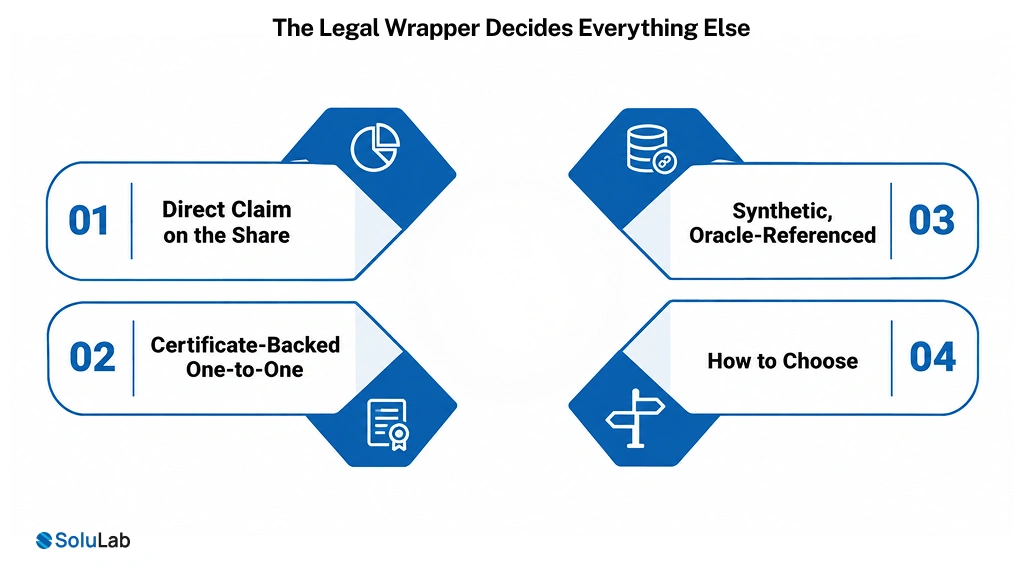
Three wrapper models dominate the market, and the one you choose sets your licensing burden, your token holder rights and your entire compliance architecture.
1. Direct Claim on the Share
The issuer is a registered broker-dealer or transfer agent, buys the real security and records ownership on-chain. This model can pass through dividends and, in some implementations, proxy voting. It carries the heaviest licensing requirement and delivers the strongest holder protections.
2. Certificate-Backed One-to-One
The issuer holds the share and issues a token that is legally a certificate over it rather than the share itself. This is the bStocks structure. Lighter regulatory lift, economic exposure passed through, no shareholder rights.
3. Synthetic, Oracle-Referenced
No underlying share is held. Smart contracts and price oracles replicate the price movement. Fastest to launch, cheapest to operate, and a fundamentally different risk profile that sophisticated buyers will recognise immediately.
4. How to Choose
Match the wrapper to the buyer. Retail traders seeking exposure will accept a certificate. Institutions requiring auditable ownership will not. If you are unsure, the wrapper decision is the single highest-value thing to resolve in a blockchain consulting engagement before any development budget is committed, because reversing it means rebuilding the contracts, the disclosures and often the entity structure.
Where Both Models Leave Gaps a New Platform Can Fill
The two largest exchanges in this category left obvious room. That is the useful finding for anyone considering building.
1. US Persons Are Excluded From Both
The largest retail equity market on earth cannot touch either product. Platforms structuring as registered broker-dealers have started serving US investors with tokenized equities, which proves the path exists. It is expensive and slow, and it is also the biggest available prize.
2. Non-US Equities Are Barely Covered
Both focus on US listings. Gate has moved into Hong Kong and Korean stocks on its direct brokerage side, but tokenized coverage of European, Japanese and emerging-market equities remains thin. Regional platforms serving their own markets have a genuine opening here.
3. Shareholder Rights Are Almost Never Passed Through
Voting rights go unimplemented across nearly the entire category. For retail price-exposure traders that is fine. For anyone building toward institutional or employee-equity use cases it is a hard blocker, and solving it properly is a differentiator rather than a feature.
4. Reserve Transparency Is Inconsistent
“Backed 1:1” is a claim. Verifiable, continuously published, independently attested reserve reporting is a product. The gap between those two is where trust is won, and it is engineering work more than it is marketing. The broader patterns here are covered in our asset tokenization guide.
What You Actually Need to Build a Tokenized Stock Platform
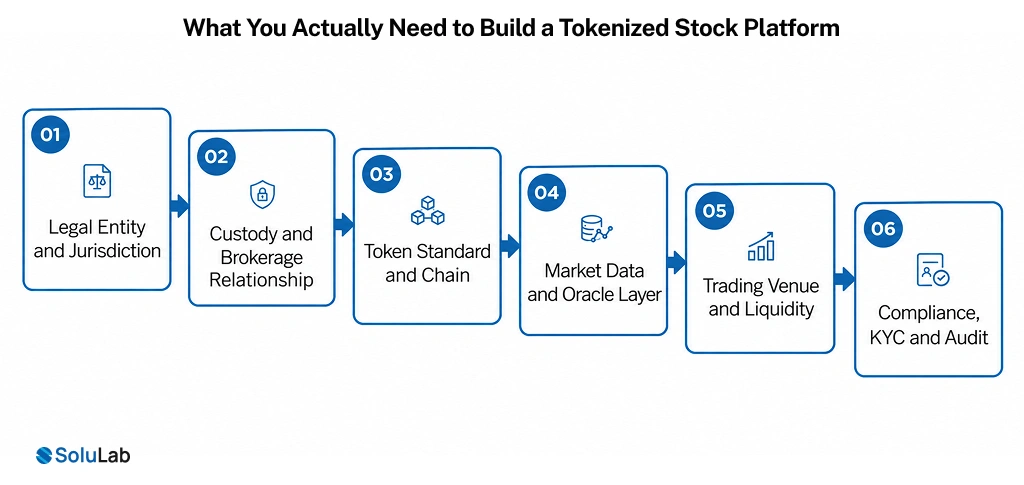
Six components. None are optional, and the order matters because each one constrains the next.
1. Legal Entity and Jurisdiction
An SPV or issuing entity in a jurisdiction whose regime fits your target market. ADGM, Switzerland, Liechtenstein and several others have workable frameworks. This is a legal engagement, not a technical one, and it gates everything else.
2. Custody and Brokerage Relationship
A licensed custodian holding the underlying shares, with auditable reserve reporting and a defined reconciliation cadence. Both bStocks and gStocks outsourced this rather than building it, which tells you how most teams should approach it.
3. Token Standard and Chain
Transfer restrictions, eligibility gating and freeze capability need to live in the contract. Chain choice follows from where your liquidity and users are. bStocks running on BNB Chain naturally involves BEP20 token development patterns, while an Ethereum or Solana deployment implies different tooling entirely.
4. Market Data and Oracle Layer
A reliable real-time feed for the underlying, with documented fallback behaviour for outages and for periods when the underlying market is closed.
5. Trading Venue and Liquidity
Order book, AMM pool or both. This is where cryptocurrency exchange development work overlaps heavily with tokenization work, and the distinction between the two is thinner than most teams expect.
6. Compliance, KYC and Audit
Onboarding checks, transfer-level eligibility enforcement, and an independent smart contract audit before launch rather than after.
Our full step-by-step walkthrough of how to build a tokenized stock platform covers the complete ten-stage process, and the underlying blockchain development and tokenization platform development capabilities behind each stage.
2. Where Estimates Break
Legal structuring, consistently. Teams budget for engineering and treat the entity, licensing and custody negotiation as a parallel workstream that will sort itself out. It does not. On most builds it is the critical path, and the contracts cannot be finalised until it resolves.
Why Do Tokenized Stock Platforms Fail?
Rarely on the smart contracts. Almost always on structure, liquidity or disclosure.
1. Building Before the Wrapper Is Settled
Writing contracts before the legal form is final means writing them twice. The wrapper determines transfer restrictions, holder rights and eligibility logic, all of which are contract-level concerns.
2. Launching Without Liquidity
A tokenized share nobody can exit at a fair price is worse than no product. Both Binance and Gate launched into existing order books with millions of active users. A new platform without that has to solve market making before it solves anything else, and the honest answer is often a partnership rather than a build.
3. Vague Reserve Claims
Asserting one-to-one backing without publishing verifiable attestation invites exactly the scrutiny that kills these products. Build the reporting before you need it.
4. Underestimating Regulatory Change
Tokenization does not suspend securities law. Regimes are moving quickly in several jurisdictions, and a structure that is compliant at launch may need amendment within a year. Architect for change rather than for a snapshot. Teams without in-house depth here typically hire blockchain developers with securities experience rather than training generalists on the job.
5. Confusing a Tokenization Platform With an Exchange
These are related but distinct businesses with different licences, different risk and different engineering. Our comparison of CEX vs DEX models covers the trading side, and running both under one roof is a strategic decision rather than a technical default.
Conclusion
bStocks and gStocks prove the model works at scale and show two legitimate ways to build it. Binance bet on user-initiated conversion and a clean ADGM certificate structure. Gate bet on a pre-issued reserve and the deepest DeFi integration in the category. Both outsourced custody to the same partner, which should tell you where your real engineering effort belongs.
If you are evaluating a build, resolve the wrapper and the jurisdiction first. Everything else, the chain, the contracts, the trading venue, is downstream of that decision and considerably easier to change later. The gaps are real: US persons, non-US equities, genuine shareholder rights and verifiable reserve reporting are all open.
SoluLab, a tokenization platform development company, can help your business choose the right wrapper for your target market, integrate custody and market data, and build compliance into the contracts rather than around them. We will also tell you plainly when a white-label route or a partnership beats a custom build for your scope.
FAQs
Neha is a curious content writer with a knack for breaking down complex technologies into meaningful, reader-friendly insights. With experience in blockchain, digital assets, and enterprise tech, she focuses on creating content that informs, connects, and supports strategic decision-making.