Key Takeaways
- The ERC-1400 token standard was designed specifically for regulated digital assets, unlike traditional ERC-20 tokens.
- It combines ERC-1410, ERC-1594, ERC-1643, and ERC-1644 to create a complete security token framework.
- Partitioned balances enable different investor rights, lock-up periods, and ownership structures within a single token contract.
- Built-in compliance validation prevents unauthorized transfers before transactions occur.
- Reason codes improve investor experience by clearly explaining failed transactions.
U.S. Treasuries, real estate funds, private equity instruments, and institutional securities now represent billions of dollars in on-chain value.
As demand for token development services continues to grow, enterprises require more than basic token functionality. Leaders such as Trevor Koverko and the team behind Polymath introduced the ERC-1400 Token Standard to address a problem that ERC-20 never intended to solve: regulated ownership.
Enterprises need compliance controls, investor restrictions, audit trails, and legal documentation attached to assets. Regulators expect transparency. Investors expect clarity. The ERC-1400 Ethereum Standard brings these requirements directly into smart contracts. If asset tokenization is the destination, ERC-1400 is the infrastructure quietly powering the journey.
Why Is the ERC-1400 Token Standard Becoming Critical for Asset Tokenization?
When enterprises begin evaluating digital securities, the first challenge usually appears during compliance reviews rather than Ethereum development.
- A standard cryptocurrency token can move freely between wallets. Securities cannot.
- A private equity fund may require accredited investors.
- Similarly, a real estate investment vehicle may impose lock-up periods.
- A bond issuance may carry jurisdiction-specific restrictions. These conditions demand enforcement at the protocol level.
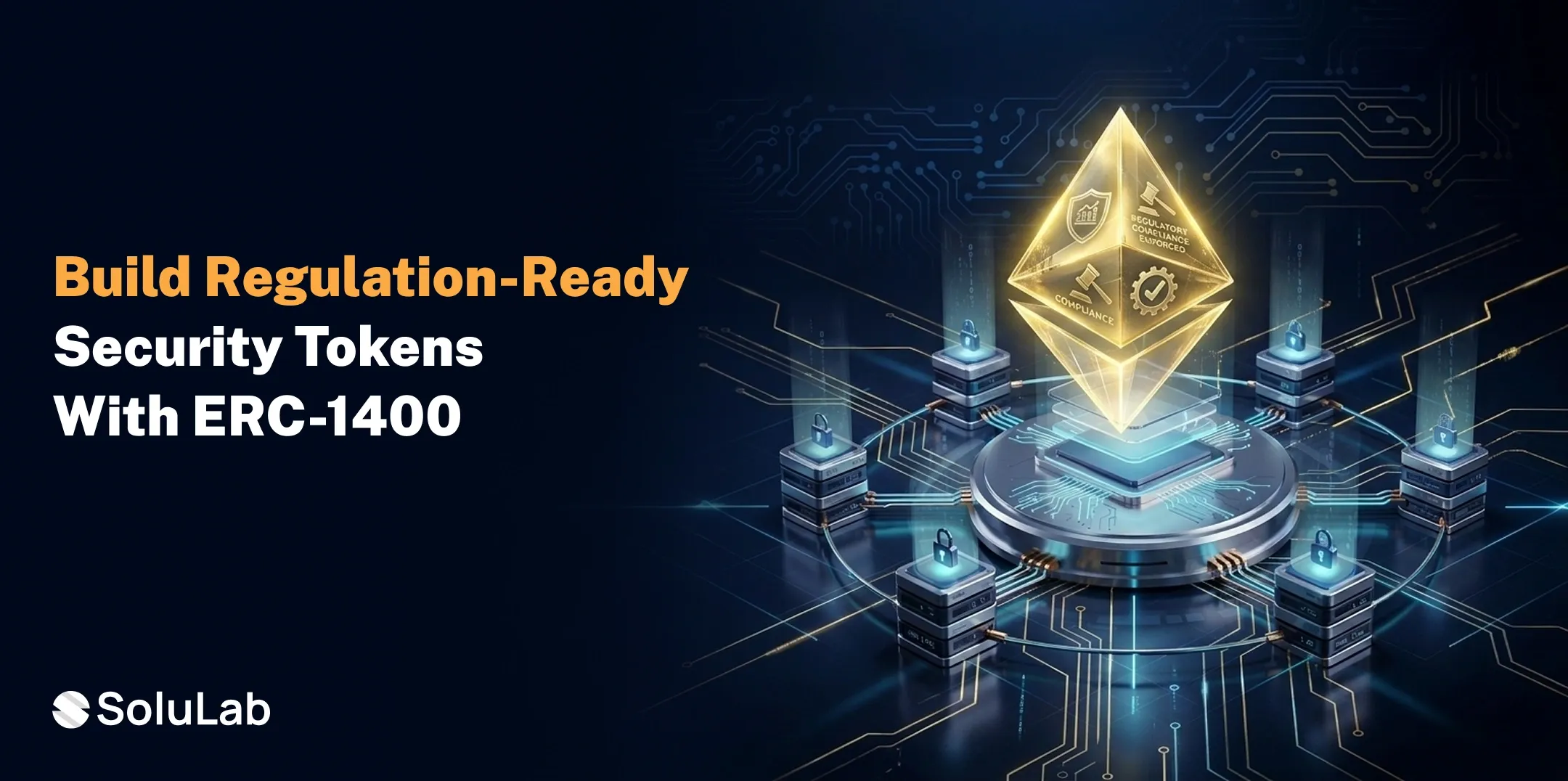
The ERC-1400 security token Standard was designed specifically for these scenarios. Unlike traditional token models, the framework embeds compliance, ownership rights, transfer validation, and document management directly into the token architecture.
As ERC-1400 asset tokenization gains adoption across finance, real estate, and alternative investments, enterprises are choosing a framework that reflects how regulated assets actually operate.
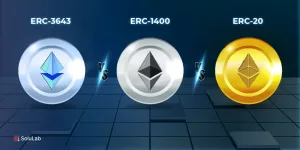
ERC-1400 vs. ERC-3643: Which Standard Should Enterprises Choose?
As the security token market matures, enterprises increasingly compare ERC-1400 with ERC-3643 (formerly T-REX Protocol).
| Area | ERC-1400 | ERC-3643 |
| Compliance Model | Certificate-based validation | On-chain identity registry |
| Ownership Structure | Partitioned balances and tranches | Identity-centric permissions |
| Corporate Actions | Strong support for multiple asset classes | More identity-focused |
| Investor Rights Management | Advanced partition controls | Registry-based controls |
| Complex Security Offerings | Highly flexible | Moderately flexible |
Still want to explore ERC 3643 vs ERC 1400 deeply? Read our blog here!
What Problems Did the ERC-1400 Security Token Standard Solve That ERC-20 Could Not?
ERC-20 accelerated the growth of blockchain ecosystems. However, it was never built for regulated financial assets.
An ERC-20 token cannot natively answer critical enterprise questions:
- Is the investor authorized?
- Has the lock-up period expired?
- Does the transfer violate securities laws?
- Can regulators intervene if required?
- Where are the legal documents stored?
The ERC-1400 compliance token standard addresses these concerns through built-in controls.
Instead of treating every token identically, ERC-1400 introduces ownership structures that mirror real-world securities. This makes the framework suitable for equities, bonds, structured products, private placements, and modern asset tokenization initiatives.
For organizations pursuing digital securities, the ERC-1400 blockchain standard eliminates several compliance gaps that previously required expensive custom development.

How Does the ERC-1400 Token Standard Architecture Actually Work?
One reason enterprises prefer the Ethereum ERC-1400 Standard is its modular architecture.
Instead of creating an entirely new framework, ERC-1400 combines four specialized standards.
- ERC-1410 introduces partitioned balances and partial fungibility.
- ERC-1594 handles issuance validation and transfer restrictions.
- ERC-1643 manages legal documentation and compliance records.
- ERC-1644 enables controller operations and forced transfers.
Together, these components create a complete framework for regulated digital assets.
ERC-1410: Managing Partitions and Partial Fungibility
At the core of the architecture is ERC-1410, which introduces partitioned token balances.
Unlike ERC-20 tokens, where every unit is identical, ERC-1410 allows a single token supply to be divided into separate partitions or tranches. Each partition can represent different ownership rights, lock-up schedules, voting privileges, dividend structures, or regulatory conditions.
For example, a real estate tokenization platform may issue:
- Tokens reserved for institutional investors
- Tokens allocated to retail investors
- Tokens subject to lock-up periods
- Tokens carrying enhanced governance rights
All of these can exist within a single contract while maintaining clear separation between investor categories.
This capability makes the ERC-1400 security token standard particularly effective for representing real-world ownership structures.
ERC-1594: Enforcing Compliance Before Transfers Occur
Compliance enforcement is handled through ERC-1594.
Rather than validating transactions after execution, ERC-1594 verifies whether a transfer should be allowed before it takes place. This includes checks related to investor eligibility, jurisdiction restrictions, lock-up periods, accreditation requirements, and internal compliance rules.
The standard introduces functions such as:
- canTransfer()
- canTransferFrom()
These functions evaluate transfer conditions and return standardized reason codes if a transaction cannot proceed.
Before approving a transaction, the smart contract evaluates:
- Investor eligibility
- Jurisdiction requirements
- Lock-up periods
- Accreditation status
- Regulatory restrictions
Instead of failing silently, the framework returns reason codes.
For example:
- 0x52 = insufficient balance
- 0x56 = invalid sender
For enterprises involved in ERC-1400 asset tokenization, this functionality reduces compliance risks while providing investors with clear explanations for failed transactions.
ERC-1643: Linking Legal Documentation to Digital Assets
Security tokens represent legal ownership interests, making documentation a critical requirement.
ERC-1643 introduces document management capabilities that allow issuers to associate legal records directly with token contracts.
- Documents such as offering memorandums,
- shareholder agreements,
- subscription agreements, and
- compliance disclosures
can be referenced using a document name, URI, timestamp, and cryptographic hash. This creates a verifiable connection between the token and its supporting legal framework.
For organizations providing ERC-1400 tokenization platform development, ERC-1643 simplifies audits, regulatory reviews, and investor due diligence processes.
ERC-1644: Supporting Regulatory and Administrative Actions
In regulated financial markets, there are situations where authorized entities must intervene.
Court orders, regulatory directives, account recovery requests, and corporate restructuring activities may require token transfers without direct investor initiation.
ERC-1644 introduces controller functions that enable these actions through controlled and auditable mechanisms.
Using functions such as:
- operatorTransferByPartition()
Authorized controllers can execute forced transfers when legally required.
Every action is recorded on-chain, creating a transparent audit trail that satisfies both operational and regulatory requirements.
This capability has become a key reason enterprises choose ERC-1400 security Tokens over conventional token standards.
This architecture gives developers flexibility during ERC-1400 security token development projects because businesses can configure features based on regulatory requirements, asset classes, and investor structures.
Why Are Partitions and Tranches Essential in ERC-1400 Security Tokens?
Most security assets are not fully fungible. A real estate fund may grant voting rights to one investor group while imposing holding restrictions on another. Private equity allocations often contain different lock-up schedules.
This is where ERC-1400 security tokens introduce a powerful concept called partitions.
Consider a token holder with:
- 30 tokens locked for three years
- 40 tokens locked for one year
- 50 unrestricted tokens
Traditional token standards struggle to represent these ownership conditions.
The ERC-1400 token solves this through partitioned balances. Each partition can carry its own rights, restrictions, maturity schedules, and governance privileges.
For enterprises involved in ERC-1400 real estate tokenization, partitioning provides a practical way to represent ownership structures without deploying multiple token contracts.
It also improves transparency because investors can clearly understand the status and rights associated with every token allocation.
How Does ERC-1400 Manage Legal Documents and Regulatory Requirements?
A security token is more than code.
Every regulated asset includes offering memorandums, investor agreements, disclosures, shareholder documents, and legal contracts.
The ERC-1400 Tokenization framework addresses this challenge through the ERC-1643 standard.
Each document can be linked to the token contract using:
- Document identifier
- URI reference
- Cryptographic hash
- Timestamp
The actual files remain stored on platforms such as IPFS or enterprise storage systems. The blockchain stores proof of authenticity rather than the full document.
| Legal Scenario | ERC-1400 Capability |
| Asset Freeze | Temporarily restrict transfers |
| Court Orders | Execute ownership changes |
| Asset Seizure | Reassign ownership after judgment |
| Investor Recovery | Restore ownership after lost keys |
| Regulatory Enforcement | Apply mandated restrictions |
| Estate Transfers | Support inheritance settlements |
This capability is particularly valuable for ERC-1400 asset token development projects because auditors, regulators, and investors can verify documentation integrity without relying solely on centralized databases.
What Are the Most Common ERC-1400 Implementation Mistakes Enterprises Make?
Practical deployments often reveal challenges that technical documentation rarely discusses.
One common mistake involves partition design.
- Teams launch tokens before fully defining ownership categories. Later modifications create governance complications and migration costs.
- Another issue appears when developers skip transfer reason codes. Transactions fail, support tickets increase, and investor confidence declines.
- Organizations pursuing ERC-1400 blockchain development should also pay close attention to controller permissions.
- Poorly designed controller roles can create security concerns or prevent regulatory actions when needed.
- Document management mistakes are equally common.
- During ERC-1400 security token offering development, failing to maintain accurate document hashes can create audit inconsistencies.
- A final issue involves contract migration planning. Ignoring ERC-1820 registry integration often makes upgrades significantly more expensive later.
Successful deployments treat compliance architecture as a foundational requirement rather than a post-launch feature.
How Is ERC-1400 Used for Real Estate, RWAs, Equity, and Bond Tokenization?
The growth of real-world assets has elevated the importance of the ERC-1400 for the asset tokenization framework.
- Real estate platforms use ERC-1400 to represent fractional ownership while enforcing investor restrictions.
- Private equity issuers leverage partitions to manage vesting schedules and shareholder rights.
- Bond issuers benefit from structured ownership tracking and compliance controls.
- Commodity-backed instruments gain transparency through on-chain audit trails.
This versatility has positioned ERC-1400 RWA Tokenization Services as a preferred choice for enterprise blockchain development.
The framework supports both liquid and traditionally illiquid assets while maintaining investor protections.
Can ERC-1400 Access Institutional Liquidity Networks?
Tokenization delivers limited value if assets cannot be traded efficiently.
Modern security token platforms must connect with broader financial ecosystems.
Integration Opportunities
- Alternative Trading Systems (ATS)
- Digital Asset Exchanges
- Institutional Custodians
- Settlement Networks
- Security Token Marketplaces
- Regulated Secondary Markets
Future Interoperability Layer
Emerging technologies such as:
- Cross-chain bridges
- Interoperability protocols
- Chainlink CCIP
- Institutional liquidity networks
are creating pathways for ERC-1400 assets to access liquidity beyond a single blockchain.
What Should Businesses Look for in an ERC-1400 Token Development Company?
Choosing technology is important. Choosing implementation expertise is even more important.
An experienced ERC-1400 token development company should understand both blockchain architecture and regulatory workflows.
Key evaluation areas include:
- Security token architecture expertise
- Compliance workflow implementation
- Partition design experience
- Smart contract auditing
- Document management integration
- Upgradeability planning
- Regulatory reporting support
Strong ERC-1400 Token Development Services extend beyond coding. They help enterprises align blockchain technology decisions with operational and compliance requirements.
Businesses pursuing large-scale tokenization initiatives should also evaluate providers offering ERC-1400 asset tokenization services alongside legal and infrastructure support.
Why Is ERC-1400 Positioned as the Future Standard for Regulated Digital Assets?
The future of blockchain is increasingly tied to regulated assets rather than speculative experimentation.
- Financial institutions want compliance.
- Investors want transparency.
- Regulators want accountability.
The ERC-1400 security token development ecosystem addresses all three requirements through a single framework.
Its combination of transfer controls, partitioned ownership, legal documentation management, controller operations, and interoperability creates a practical foundation for digital securities.
As enterprises continue exploring tokenized real estate, private markets, bonds, and institutional investment products, the ERC-1400 enterprise blockchain solutions model provides a proven framework for secure deployment.

Final Words
The ERC-1400 token standard is not simply another Ethereum specification. It represents a structured approach to bringing regulated assets onto blockchain networks without sacrificing compliance, governance, or investor protection. For organizations preparing the next generation of digital asset platforms, choosing the right implementation partner becomes critical. SoluLab, an ISO 27001-certified blockchain development company in USA, combines deep expertise in
- security token development,
- smart contracts, and
- enterprise blockchain solutions
to deliver scalable ERC-1400 ecosystems. With experience across tokenization, Web3, and digital asset platforms, SoluLab helps businesses launch secure, compliant, and future-ready tokenization solutions with confidence. Contact us Today!
FAQs
Deepika is a content writer who blends storytelling with strategic thinking. She explores topics across digital innovation, emerging tech, and the evolving blockchain industry. She enjoys breaking down complex ideas into simple, engaging narratives in the growing global markets.