Key Takeaways
- Fine wine tokenization represents ownership of a physical bottle, a case, or a share of a larger cellar holding as a digital token on a blockchain, verified against provenance and storage records.
- It solves three problems that have kept casual investors out of the wine market for decades: high entry costs, counterfeiting, and near-zero liquidity.
- A working platform needs custody of the physical asset, a smart contract layer for ownership rules, and a compliant marketplace where tokens can actually change hands.
- Wine sits inside a much larger shift toward tokenizing real-world assets, alongside real estate, gold, and private credit, all running on similar underlying infrastructure.
- Institutions and collectors exploring this space should start small, one cellar or one vintage, rather than trying to tokenize an entire portfolio on day one.
Buying a case of first-growth Bordeaux has never been simple. You need a merchant you trust, climate-controlled storage, insurance, and ideally some paper trail proving the bottles never sat in a garage through a heatwave.
Then, if you want to sell, you wait for an auction slot or hand it to a broker who takes a cut off the top. None of that has really changed in fifty years. What has changed is the technology sitting underneath it.
Fine wine tokenization, a growing application of asset tokenization, takes that same bottle, case, or fractional slice of an entire cellar and represents ownership as a digital token on a blockchain. The wine itself doesn’t move. It stays in a bonded warehouse in Bordeaux or London, exactly where it should.
But ownership, provenance, and the right to trade that ownership now live on-chain, checkable in seconds instead of weeks. Here’s what fine wine investment blockchain platforms actually do, why investors are paying attention right now, and what a real build looks like once actual money is involved.
What Is Fine Wine Tokenization: From Cellar Asset to Digital Token
What is fine wine tokenization, in practice? It’s the process of issuing a blockchain token that represents legal or economic ownership of a specific wine asset. That could be a single bottle with documented provenance, a full case still in original wood, or a fraction of a larger holding split across several investors.
Each token ties back to real records: who made the wine, where it’s been kept, condition reports, and the chain of custody since bottling. This matters more here than in almost any other collectible category, because value falls apart fast once storage slips. A bottle that’s spent a decade in a proper cellar at 55 degrees is worth a lot more than an identical bottle that’s bounced between a retail shelf and someone’s kitchen counter for the same stretch of time.
Wine-Backed Tokens vs. Simply Digitizing a Certificate
Worth drawing a clear line here. Wine-backed tokens aren’t a scanned authenticity certificate turned into a PDF. A certificate gets forged, or reused, or quietly edited. A properly minted token is cryptographically signed and sits on an immutable ledger, so its history can’t be rewritten after the fact. That’s really the whole point. The token isn’t just a record describing the wine. It’s a verifiable claim on it.
How Fine Wine Investment Blockchain Platforms Actually Work
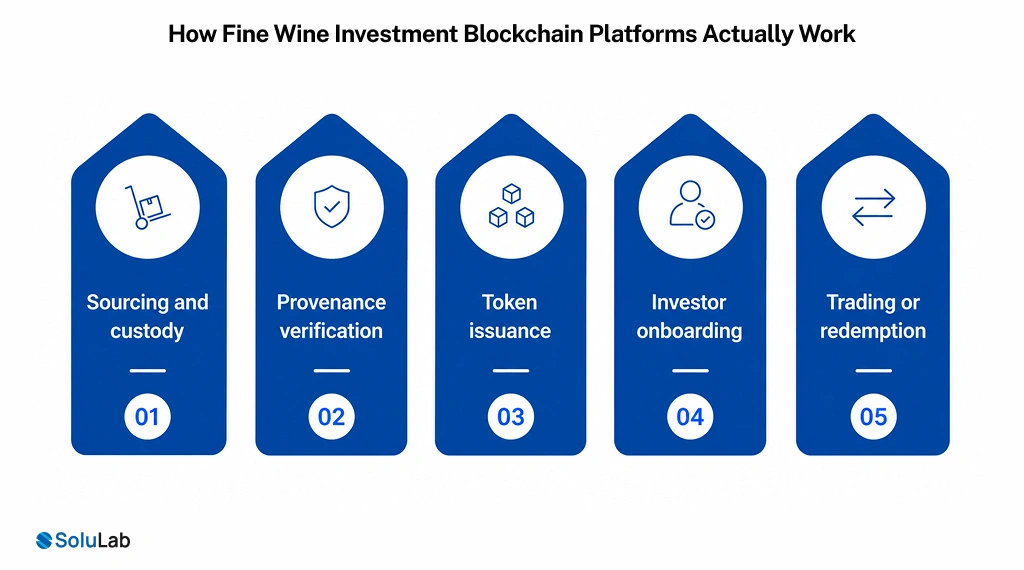
The mechanics borrow heavily from other forms of RWA tokenization, just adapted for something physical, perishable, and unusually sensitive to provenance.
- Sourcing and custody: the platform, or a merchant it partners with, acquires or verifies ownership of the physical wine and places it in bonded, insured storage where conditions can be monitored and audited.
- Provenance verification: condition reports, temperature logs, and chain-of-custody documentation get digitized and attached directly to the asset record before any token gets minted.
- Token issuance: a smart contract mints tokens representing full or fractional ownership, usually fungible tokens when a case gets split across investors, or unique tokens for a single high-value bottle.
- Investor onboarding: buyers complete identity and compliance checks, then receive tokens into a digital wallet tied to their verified account, not an anonymous address floating on-chain.
- Trading or redemption: token holders sell on a secondary marketplace, or, depending on the platform’s model, redeem the token and have the actual bottle shipped to them.
Smart Contracts and Provenance: Why Authentication Matters
This is where blockchain wine authentication earns its keep. A smart contract can be written so a token only transfers cleanly if the underlying provenance record stays intact, flagging any break in the custody chain on its own instead of relying on a person to catch it days later.
That kind of automatic checking separates a serious platform from a website with a nice wine catalog and not much else underneath. Getting this right usually comes down to careful smart contract development, built around the specific custody and condition-tracking rules wine requires, not a template borrowed wholesale from a real estate deal.
Why Investors Are Turning to Tokenized Wine Investments
The appeal of tokenized wine investments isn’t just novelty for its own sake. It’s a fairly direct response to three friction points that have kept fine wine smaller and more exclusive than it probably needs to be.
- Liquidity has always been the big one. Selling a case of investment-grade Burgundy the old way means waiting for an auction house slot, often months out, and eating a seller’s premium that can run well into double digits.
- A token representing that same case can, in theory, change hands on a secondary market in minutes, assuming the platform has a working marketplace and enough buyers actually showing up.
- The broader market backdrop helps explain why this is happening now rather than five years ago. The Global Wine Market size is expected to be worth around USD 759.4 Bn by 2034, from USD 453.1 Bn in 2024, growing at a CAGR of 5.3% during the forecast period from 2025 to 2034.
- And appetite for tokenized assets generally isn’t a fringe experiment anymore. Gartner’s recent technology predictions describe tokenized real-world assets moving out of the pilot phase and into mainstream financial infrastructure, pushed along by demand for transactions that settle on their own instead of sitting in a queue somewhere.
- Entry cost is the other wall tokenization chips away at. A single bottle of top-tier Bordeaux can run into the thousands, and a full case of the truly investment-grade stuff prices out most individual buyers before they even get started.
- Fractionalizing that case into tokens lets someone put in a few hundred dollars instead of needing to buy the whole thing outright.
Traditional Wine Investing vs. Tokenized Wine Investing
| Factor | Traditional Wine Investing | Tokenized Wine Investing |
| Minimum entry cost | Often a full case or bottle, high | Fractional, lower minimums |
| Liquidity | Slow, auction or broker dependent | Faster, secondary marketplace |
| Provenance verification | Paper trail, manual checks | On-chain, cryptographically signed |
| Storage transparency | Limited visibility for buyer | Trackable via digital records |
| Global access | Regionally limited | Broader, platform dependent |
Fractional Wine Ownership: Opening the Cellar Door to More Investors
Fractional wine ownership is arguably the single biggest reason tokenization is catching on with everyday investors, not just institutions and serious collectors.
- Lower minimums: instead of buying an entire case outright, an investor can hold a percentage stake represented by tokens, which brings the entry price down to something far more approachable.
- Diversification across vintages: fractional ownership makes it realistic to spread a modest budget across several producers and years, rather than betting everything on one case from one estate.
- Passive exposure: investors who want exposure to fine wine as an asset class, without turning into amateur sommeliers overnight, get a way in that doesn’t demand deep expertise up front.
- Exit flexibility: selling a fraction of a token holding is a lot simpler than trying to offload part of a physical case sitting in a warehouse somewhere.
Building a Wine Tokenization Platform: What Founders Need to Get Right
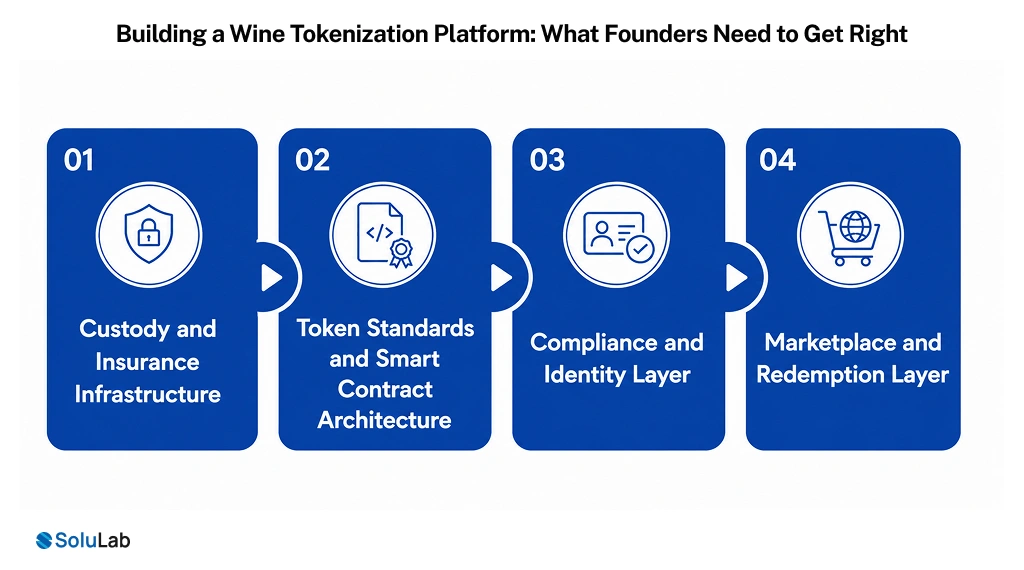
Anyone looking to build a wine tokenization platform is really building four systems that all have to work together, not just one blockchain app bolted onto a wine catalog.
1. Custody and Insurance Infrastructure
Nothing about the token matters if the physical wine isn’t stored and insured properly. Platforms typically partner with bonded warehouses that specialize in fine wine, since climate control and security directly determine what the asset is actually worth.
2. Token Standards and Smart Contract Architecture
Choosing the right RWA token standards shapes almost everything downstream, including how fractional ownership gets calculated and how transfer restrictions get enforced for regulatory reasons. It’s the same category of decision that shows up across other asset tokenization platforms, whether the underlying asset is a wine collection, a building, or a gold reserve.
3. Compliance and Identity Layer
If tokens represent a financial interest with an expectation of return, securities regulation likely applies, and it varies a lot by jurisdiction. This is exactly where wine asset tokenization solutions need real legal review built into the design from day one, not stapled on after launch.
Deloitte’s research on tokenized real-world assets projects that tokenized private market funds, real estate among them, could reach roughly 1 trillion U.S. dollars by 2035, a trajectory that’s already pushing regulators toward clearer frameworks for this exact category of asset-backed token.
4. Marketplace and Redemption Layer
Token holders need somewhere to trade, and in many models, a path to redeem the token for the physical bottle if they’d rather drink it than sell it. Building this layer well usually calls for RWA tokenization development services with experience beyond wine specifically, since the underlying trading logic borrows heavily from how real estate tokenization platforms already handle liquidity.
Risks and Challenges Tokenized Wine Investing Still Has to Solve
It would be misleading to present this as a fully solved problem, because it isn’t yet, not entirely.
Regulatory uncertainty tops the list. Securities treatment of wine tokens differs by country, and in some markets it hasn’t really been tested in court yet, which leaves platforms operating in a bit of a gray zone until case law or explicit guidance catches up.
Custody risk doesn’t disappear just because ownership moved on-chain. The token is only as trustworthy as the warehouse holding the physical wine behind it, and a platform’s insurance and audit practices matter just as much as its smart contract code, maybe more.
Market depth is thinner than people assume going in. Even with fractional ownership lowering the entry barrier, the number of active buyers and sellers on any given platform is still small next to public markets, which can make exiting a position slower than the pitch deck suggests.
Real-World Use Cases Emerging in the Market
A handful of patterns have started showing up as early platforms move past the pilot stage and into actual operation.
- Single-collection tokenization: a merchant or investment fund tokenizes one specific cellar or vintage lineup rather than trying to cover the entire wine market from the outset.
- Hybrid redemption models: token holders choose between selling on a secondary market or redeeming for physical delivery of the bottle, depending on what they’d rather do with it.
- Cross-asset RWA platforms: wine sits alongside tokenized real-world assets (RWA) like art, watches, or gold within the same investor dashboard, rather than living on its own island.
- Institutional custody partnerships: established fine wine merchants pair up with blockchain infrastructure providers, rather than trying to build storage and technology from scratch under one roof.
Conclusion
Fine wine has always been a legitimate alternative asset. What it’s lacked is liquidity, transparent provenance, and an entry point low enough for anyone outside a small circle of serious collectors.
Tokenized wine investments address all three at once, without asking anyone to change how the wine itself gets stored, aged, or eventually enjoyed.
Getting there takes more than issuing a token and calling it done. It takes real custody infrastructure, carefully chosen token standards, a compliance framework that holds up across jurisdictions, and a marketplace people actually trust enough to use.
SoluLab, as a tokenization platform development company, works with wine merchants, investment platforms, and RWA-focused businesses to build tokenization systems that get all four pieces right from the start, not just the parts that look good in a demo.
FAQs
Neha is a curious content writer with a knack for breaking down complex technologies into meaningful, reader-friendly insights. With experience in blockchain, digital assets, and enterprise tech, she focuses on creating content that informs, connects, and supports strategic decision-making.