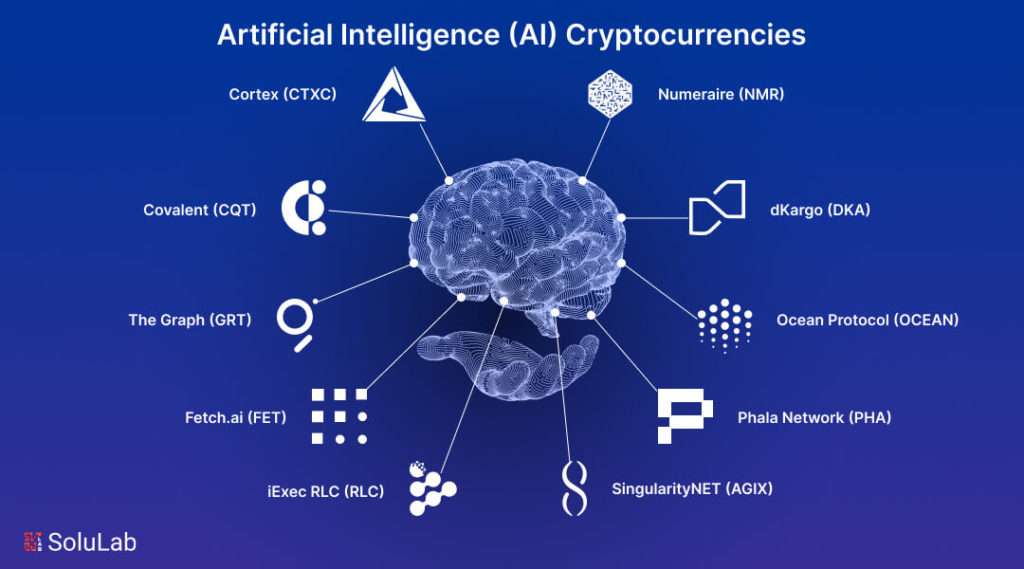

Artificial intelligence has changed how a lot of us work day to day. ChatGPT, built by OpenAI, is the obvious example: it writes in plain language, answers questions, and chews through information fast. What gets less attention is how much AI is starting to shape crypto too.
AI coins are digital assets that use artificial intelligence to make blockchain networks more secure, more scalable, and easier to use. They back real AI-driven projects, everything from portfolio management to decentralized marketplaces and market prediction tools.
These tokens also run the transactions inside their ecosystems and often carry governance rights. On the AI side, models can be trained to spot investment opportunities, read market trends, flag suspicious activity, and handle plenty of other jobs. There is real potential here. This post walks through the top 10 AI crypto coins, what they do well, and where they fit. Let’s get into it.

What are AI Cryptocurrencies?
AI cryptocurrencies sit at the meeting point of two technologies: artificial intelligence and blockchain. The idea is simple. Use AI to improve parts of blockchain technology that people actually care about, like security, scalability, and functionality. A regular cryptocurrency mostly works as a way to pay for things. AI crypto wallets go further by baking AI-driven features into their core infrastructure, and secure storage for them is handled by what are AI crypto wallets.
One of the biggest applications of AI in this space is the decentralized AI marketplace. On these platforms you can access, deploy, and even earn from AI algorithms and services without a central gatekeeper. Smart contracts and decentralized governance let developers, data scientists, and businesses pool resources, share work, and build AI tools together.
AI cryptocurrencies also make it easier to plug AI algorithms into blockchain apps and protocols. That opens the door to better data analysis, predictive modeling, and automation inside decentralized systems, which tends to mean more efficiency, clearer transparency, and better accuracy across a lot of different industries.
In short, AI cryptocurrencies change how we think about and use digital assets. They put AI to work to open up new use cases and reshape where decentralized technology goes next.
Why are Crypto Coins So Popular?
Why have AI crypto coins caught on, especially the ones leading on AI integration like SingularityNET (AGI), Fetch.ai (FET), and Numerai (NMR)? A few reasons stand out.
First, the decentralized side. People who want financial autonomy, and some distance from traditional banks, find that appealing. Blockchain records transactions on a distributed ledger, so you don’t need a middleman, and you get more transparency and security in return. That alone explains a big part of the appeal.
Second, the money. The chance at large returns has pulled in investors and traders. Projects like Cortex (CTXC) and DeepBrain Chain (DBC) showed how much attention an AI-focused coin can attract when people are hunting for high-growth bets in a young sector.
Third, they cross borders easily. Sending crypto across countries is cheap and quick compared to the alternatives, which makes these coins useful for global commerce and remittances alike. For individuals and businesses working across regions, that matters.
Put it together and the popularity of AI crypto coins comes down to a handful of things: they are decentralized, they can pay off, they have real-world uses, and they move without borders. As the projects and the tech keep improving, adoption is likely to pick up rather than slow down.
The Intersection of AI and Cryptocurrency
Bringing AI and cryptocurrency together is changing how digital assets get managed, traded, and secured. AI can read huge datasets in real time, which adds precision and speed to crypto trading and helps investors make better calls in markets that swing hard. Blockchain, for its part, brings transparency and decentralization, which gives AI-driven apps a stable base to build on in finance.
Trading is only part of it. AI is doing real work to make blockchain networks more efficient and more secure. It can trim energy use in mining and catch fraud before it spreads. That kind of pairing is also pushing new ideas in areas like decentralized finance (DeFi), tokenized AI models, and predictive analytics, stretching what blockchain and AI can pull off side by side.
Key Benefits of AI in Cryptocurrency
Here are some of the clearest benefits of AI in cryptocurrency:
1. Intelligent Trading Algorithms: AI reads market trends, forecasts price moves, and automates strategies so trades run with better odds of profit.
2. Fraud Detection: Machine learning models flag unusual transaction patterns, which protects assets and keeps things secure.
3. Energy Optimization: AI tightens up mining so it burns less energy and puts less strain on the network.
4. Smarter DeFi Applications: AI improves lending, borrowing, and yield strategies across decentralized finance platforms.
5. Innovative Tokenization: Crypto can tokenize AI models, which lets people earn from what they contribute to AI systems.
This overlap of AI and cryptocurrency is reshaping financial systems, and it’s opening new routes to decentralized, intelligent innovation along the way.
Top 10 AI Crypto Coins
Now that you know what AI crypto wallets are, here are the top 10 AI cryptocurrencies to keep an eye on in 2026.
1. The Graph (GRT)
Think of The Graph as Google’s web indexing, but for blockchain data. It breaks data into manageable pieces called “subgraphs” so retrieval is faster and cleaner. GRT is the network’s native cryptocurrency, and it powers transactions inside it. As a top AI crypto, GRT lets developers and users index and query across many different blockchains, which keeps things efficient and scalable as projects grow.
With GRT at the center of The Graph, developers can tap decentralized data access to build scalable decentralized applications (dApps). That approach opens blockchain data up to far more people, which is good for dApp development and for a more inclusive, efficient decentralized ecosystem. As blockchain keeps maturing, The Graph and GRT have a real hand in shaping how decentralized data gets indexed and retrieved.
2. SingularityNET (AGIX)
SingularityNET (AGI) is a major decentralized AI marketplace that pulls AI services together on the blockchain. The platform lets AI bots work with each other, share data, and split tasks. The AGI token handles transactions inside the ecosystem and keeps AI development and deployment transparent and efficient. As one of the top AI crypto coins, SingularityNET changes how AI resources get accessed and used.
By leaning on blockchain’s decentralization, SingularityNET builds a lively environment for AI agents, giving developers and users a rich ecosystem for creating and reaching advanced AI solutions. Its AGI token points toward more democratized AI services, so individuals and organizations can put artificial intelligence to work for themselves.
3. Fetch.ai (FET)
Fetch.ai (FET) is building a decentralized digital ecosystem where autonomous software agents handle complicated tasks on their own. The FET token is central to how it runs: it powers transactions and pays for access to resources on the network. Fetch.ai is reworking processes across sectors, supply chain management and decentralized finance (DeFi) development chief among them, by putting autonomous economic agents and machine learning up front.
Its approach to allocating resources and getting agents to cooperate is what sets it apart, and it tends to translate into more efficiency and more room for new ideas. As one of the best AI crypto tokens, Fetch.ai is pushing toward decentralized systems where intelligent agents interact cleanly, which opens fresh room for automation. With machine learning and autonomy at its core, Fetch.ai could reshape how decentralized economies and digital ecosystems develop.

4. Near Protocol (NEAR)
Near Protocol runs a computer network that lets programmers design and ship decentralized applications. It splits the network’s infrastructure into sections using sharding, so each node only handles a slice of the transactions rather than all of them. The point of sharding is to make the whole thing more efficient and less demanding on computing power.
You can build other apps on top of Near Protocol much like you would on a cloud provider such as Amazon Web Services. The difference is that NEAR is run and maintained by a spread-out network of computers, not a single company like the older setups.
5. iExec RLC (RLC)
iExec is a standout AI blockchain platform that lets users sell their computing power and grab on-demand cloud computing resources. At heart it runs a decentralized marketplace where people and organizations can put computing resources to use, handling jobs that range from AI model training to data analysis. Its native cryptocurrency, RLC (iExec Compute Token), is what you pay with when you use services on the platform.
RLC keeps the transactions moving inside the iExec ecosystem. With its take on decentralized cloud computing and AI resource sharing, iExec and RLC could change how computing resources get accessed and used, and point toward a more efficient, more decentralized way of doing it.
6. Numeraire (NMR)
Numeraire uses AI algorithms to read market data and sharpen investment strategies. Its native cryptocurrency, NMR (Numeraire), is the main medium of exchange on the network. NMR powers transactions and rewards data scientists for bringing their skills to the platform. By lining up incentives and running AI-driven analytics, Numeraire lets users help build predictive models for stock market investing, and it keeps the transaction side transparent and efficient.
As one of the best AI crypto coins, Numeraire stands out for how it blends decentralized finance (DeFi) with machine learning. Its focus on opening up investment opportunities and getting data scientists to work together gives it a real shot at reshaping AI-driven hedge fund management and financial markets.
Related: Top 8 ISO 20022 Cryptocurrencies
7. Bittensor
Bittensor runs an open-source protocol that powers a decentralized machine-learning network on the blockchain. It sets up a shared training environment where machine learning models work together and earn TAO token rewards based on how useful their contributions are to the collective intelligence. TAO also opens the door to outside access, so users can draw on the network’s knowledge while steering it toward what they need.
The goal, at bottom, is an AI marketplace and a profitable setting where producers and consumers deal with each other openly, transparently, and without needing to trust a middleman.
8. Render
Render is a distributed GPU network on the Ethereum blockchain, and it’s become an important platform for motion graphics, VFX rendering, and animation. Its native token, Render (RNDR), is a utility token made for use across the network. Two groups keep it running: creators and node operators.
Creators tap the network’s large pool of GPU power to produce striking visuals and high-quality images quickly and at lower cost. Node operators do the other side of the deal: they rent out their spare GPU capacity to those creators in exchange for render tokens.
9. Internet Computer (ICP)
The Internet Computer (ICP) protocol lets users host data, computation, the user experience, and content on-chain through smart contracts that can scale without a set limit. That makes it possible to build enterprise infrastructure, virtual reality, gaming, and tamper-proof Web 3 social media. ICP offers full-stack decentralization and multi-chain options.
It puts a premium on a low carbon footprint, scalability, and real utility, and it’s committed to building Web 3 Greentech solutions.
10. Cortex (CTXC)
Cortex brings something new to blockchain: a platform where users can upload and run AI models directly. By folding AI into smart contracts and decentralized applications (dApps), Cortex adds smarter, more advanced functionality to the blockchain ecosystem. Its native cryptocurrency, CTXC, is the main medium of exchange for AI model transactions and deployment.
As one of the top 10 AI cryptocurrencies, Cortex is a trailblazer in merging AI and blockchain technologies. By opening AI capabilities up to more people and encouraging new ideas, Cortex lets developers and users put AI-driven solutions to work across many industries. With its focus on making decentralized systems smarter and more capable, Cortex helps clear the path for wider adoption of AI-powered blockchain apps, and for new possibilities among AI crypto projects.
Read Also: AI in Crypto Banking
How Can I Buy AI Cryptocurrencies?
Plenty of AI cryptocurrency coins, like Bitcoin and Ethereum, can be bought on crypto exchanges such as Crypto.com and Coinbase. If you want to invest in AI crypto coins, the same platforms will get you there.
To trade, you first set up an account on an AI-integrated smart crypto wallet, which usually means verifying your identity, then deposit some fiat cash. From there you find the AI coin you want on the exchange, enter the amount, and finish the transaction. It’s a straightforward process, which makes the top AI coins of 2026 easy enough for most people to explore.
How Should I Store AI Cryptocurrencies?
Keep only the crypto you need for everyday transactions in a hot wallet. Move the rest into cold storage to cut your risk. And make sure someone you trust can reach your cryptocurrencies if there’s an emergency.
Cold wallets are generally safer than hot ones, since hackers can’t get at them as easily. The trade-off: if you lose your cold wallet login details, you won’t get the same help recovering access to your AI coin keys that a hot wallet would offer. Picking the right storage matters, so choose carefully to keep your AI coin investments safe.
Are AI Crypto Coins Safe?
How safe they are comes down to two things: how you store your AI coins, and how much risk you’re willing to take. Be cautious, because like any cryptocurrency, AI coins move with the market. Strong security on an AI-integrated smart crypto wallet is a must, since hackers do go after crypto wallets and exchanges. Cold wallets give you better protection, but you have to handle them with care to keep the online risks low.
Conclusion
Top AI crypto coins put blockchain and artificial intelligence to work together, and that combination is opening up genuinely interesting ground for decentralized AI applications. There’s a lot on offer here, but you still have to protect your investments and keep up with a crypto market that never stops moving. The more you understand how AI and cryptocurrencies work together, the better you can use them and catch the opportunities coming up in the digital world.
SoluLab Digital Quest worked with a travel business to lift customer engagement using an AI-powered chatbot. The chatbot pulls the relevant travel data and gives users real-time, personalized recommendations. Built with Generative AI, it keeps improving the accuracy of what it suggests. A feedback loop makes the experience better over time, and ongoing maintenance keeps it reliable. With cost-effective implementation and solid security, Digital Quest tightened up customer service and made travel planning quicker and easier to reach.
SoluLab, an AI development company has a team of experts who can help you launch AI-powered crypto coins. Contact us today to talk it through and get your business questions answered.
FAQs
Shipra Garg is a tech-focused content strategist and copywriter specializing in Web3, blockchain, and artificial intelligence. She has worked with startups and enterprise teams to craft high-conversion content that bridges deep tech with business impact. Her work translates complex innovations into clear, credible, and engaging narratives that drive growth and build trust in emerging tech markets.