Key Takeaways
- AI in logistics is a decision layer, not a single product. It sits on top of your TMS, WMS and telematics data.
- The highest-return starting points are route optimization, demand forecasting and predictive maintenance, because each has a clean feedback loop and a measurable cost line.
- Data quality decides the outcome. Patchy telematics or inconsistent order records will sink a model faster than any algorithm choice.
- Most failures are organizational, not technical. Planners who don’t trust the recommendation will override it, and the ROI disappears.
- Start with one lane, one depot or one fleet segment. Prove the number, then widen.
- Agentic AI is moving from pilot to production in logistics, but human oversight on exceptions is still non-negotiable.
Logistics margins are thin and getting thinner. Fuel prices move weekly, driver shortages persist, and customers expect next-day delivery on orders placed at midnight. AI in logistics is how more carriers, 3PLs, and shippers are responding.
Grand View Research projects the global digital logistics market to grow at a 20.5% compound annual rate through 2033, reaching roughly $169.5 billion, with North America holding about 36.6% of 2025 revenue. A rising share of that spend now carries an AI component.
This guide covers what AI development solutions in logistics actually do, where it earns money, which technologies sit underneath it, what usually goes wrong, and how to start.
You’ll get real project metrics, named tools, and an honest account of the failure modes, including the ones vendors leave out of the pitch deck. No promises about fully autonomous supply chains that don’t exist yet.

What Is AI in Logistics?
AI in logistics is the application of machine learning, optimization, and computer vision to planning and execution decisions across transportation, warehousing, and freight. The goal is narrow and practical: make a better decision than a static rule or a tired planner, and make it faster.
1. Predictive AI
Models that forecast a number. Demand by SKU and region, ETA for a shipment, probability that a truck breaks down in the next 500 miles. This is where most AI logistics software starts, because forecasts feed every downstream decision.
2. Prescriptive AI and Optimization
Solvers that pick an action. Which vehicle takes which stops in which order, how to slot inventory across three warehouses, which carrier gets a load at what rate. Tools like Google OR-Tools handle the combinatorial part; ML supplies the inputs.
3. Agentic AI
Systems that plan, act, and adapt across multiple steps without a human initiating each one. Rebooking a delayed container, negotiating a spot rate, escalating an exception. This is the newest layer, and the one that needs the tightest guardrails. We cover the pattern in depth in our guide to AI agents in supply chain and logistics.
Most real deployments combine all three. A forecast feeds an optimizer, and an agent handles the exceptions the optimizer can’t resolve on its own.
How Does AI Work in Logistics Operations?
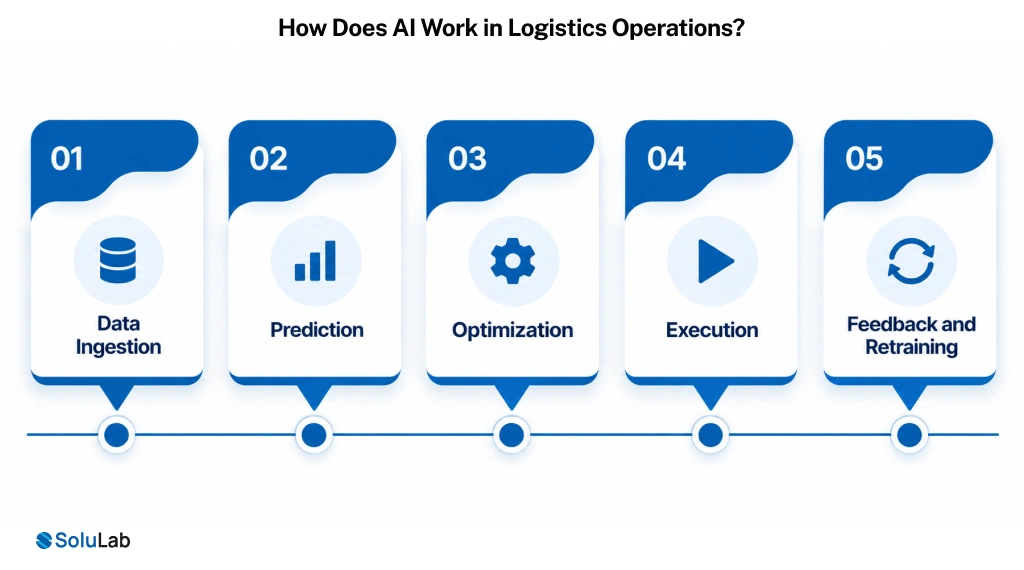
AI in logistics works as a loop: ingest operational data, predict what’s likely to happen, optimize the decision, execute it in your existing systems, then measure the outcome and retrain. Break any link in that chain, and the system stops improving.
1. Data Ingestion
Telematics feeds, TMS and WMS records, order history, carrier rate sheets, weather, traffic, port and customs data. In practice, this step takes longer than everyone budgets for. Expect two to four months on data plumbing before a single model goes live.
2. Prediction
Gradient-boosted models and neural networks generate demand forecasts, ETA estimates, dwell-time predictions, and failure probabilities. Set accuracy targets against your current baseline, not a vendor’s marketing claim. If your planners forecast within 18% error today, a model at 12% is a real win.
3. Optimization
The solver takes forecasts plus hard constraints (driver hours, vehicle capacity, delivery windows, hazmat rules) and returns a plan. AI route optimization lives here, and so does load consolidation and slotting.
4. Execution
The plan has to land inside the systems your people already use. A recommendation that arrives as a PDF report gets ignored. Push it into the TMS, the driver app and the dispatcher’s screen.
5. Feedback and Retraining
Actual outcomes flow back. Which routes ran late, which forecasts were missed, which overrides the planners made and why. Override data is the most valuable signal you’ll collect and the one most teams throw away.
What Are the Key Benefits of AI in Logistics?
Here are the benefits of AI in logistics:
1. Lower Transportation and Fuel Costs
Better routing means fewer miles and less idling. On a fleet-optimization build for a logistics client, we measured 24% lower fuel costs after the routing model went live across their network.
2. Higher On-Time Delivery Performance
Dynamic re-routing around traffic and weather protects delivery windows. The same engagement improved on-time deliveries by 38%.
3. Better Asset Utilization
Consolidated loads and smarter dispatch mean fewer half-empty trucks. Fleet utilization rose 32% on that project.
4. More Accurate Demand Planning
Forecasting at SKU and location level reduces both stockouts and dead inventory. If you want the mechanics, our piece on AI in demand forecasting goes deeper than this section can.
5. Fewer Unplanned Breakdowns
Telematics plus vibration and engine data predict component failures before they strand a vehicle. A roadside failure on a time-critical lane costs far more than the part.
6. Earlier Warning on Disruption
Supplier health monitoring, port congestion signals, and geopolitical risk feeds surface problems while there’s still time to act. This is where generative AI in supply chain has been genuinely useful, summarizing messy external signals into something a procurement lead can act on.
One caveat worth stating plainly. These numbers came from projects where the underlying data was already decent. AI amplifies the quality of your operational data. It does not repair it.
What Are the Top Applications of AI in Logistics?
Eight applications account for most logistics AI spend today. Each one has a measurable cost line attached, which is why they get funded ahead of broader transformation programmes.
- Route optimization and dynamic dispatch: Multi-stop routing that respects live traffic, driver hours, and delivery windows, then re-plans mid-shift. Usually the fastest project to show a number.
- Demand forecasting and inventory positioning: Predicting what sells where, then placing stock closer to the buyer so the last mile gets shorter and stockouts stop eating margin.
- Freight rate prediction and procurement: AI in freight management covers spot-rate forecasting, carrier scoring and automated tendering, so shippers know when to lock contract rates and when to ride spot.
- Warehouse automation and slotting: Computer vision catches pallet damage on the dock, while machine learning reorders pick paths and slot assignments as SKU velocity shifts week to week.
- Predictive maintenance: Engine, vibration and telematics data flag component failures before a truck strands a load. The part is cheap. The missed delivery window is not.
- Shipment visibility and ETA prediction: Live ETAs that factor in port dwell, customs clearance and weather, instead of a static transit table nobody has updated in three years.
- Document processing and customs: Extraction and validation of bills of lading, commercial invoices and customs paperwork. Unglamorous, high volume, and often the quickest payback in international freight.
- Exception handling with AI agents: Agents detect a delay, weigh the alternatives, then act or escalate to a human. See AI agents in transportation for how the guardrails work.
Which Technologies Power AI Logistics Software?
A production stack has four layers, and the interesting engineering happens in the joins between them.
1. Data and Integration Layer
Kafka or similar for streaming telematics and order events, PostgreSQL or a cloud warehouse for storage, connectors into SAP, Oracle TMS, Manhattan, Blue Yonder or whatever you already run.
2. Model Layer
Python with scikit-learn and XGBoost for tabular forecasting, TensorFlow or PyTorch for vision and sequence models, Google OR-Tools for vehicle routing and scheduling, and LLMs for document extraction and summarization.
3. Orchestration and Serving Layer
FastAPI services, LangChain or LangGraph for agent workflows, MLflow for experiment tracking and model registry, feature stores where the same features feed multiple models.
4. Interface and Traceability Layer
React dashboards for dispatchers, mobile for drivers, and an audit trail on every automated decision. For provenance and chain-of-custody requirements, some clients pair this with blockchain in supply chain infrastructure, which Gartner also flags as a 2026 trend under product provenance.
What Are the Challenges and Limitations of AI in Logistics?
Vendors rarely put this section in. It’s the one operations leaders actually need.
1. The ROI Gap Is Real
Deloitte’s 2026 State of AI in the Enterprise report, based on a survey of 3,235 business and IT leaders across 24 countries, found that two-thirds (66%) of organizations report productivity and efficiency gains from AI, while only 20% are already growing revenue through it against 74% who hope to. Deloitte’s separate 2025 survey of 1,854 executives across Europe and the Middle East found only about one in five organizations qualify as genuine AI ROI leaders. Efficiency gains are common. Transformation is not.
2. Data Quality and Fragmentation
Telematics from three vendors, order data in two ERPs, carrier rates in spreadsheets. Reconciling this is unglamorous work and it is the majority of the project.
3. Planner Trust and Override Behaviour
If the dispatcher overrides the model on Monday and nothing bad happens, they’ll override it every day after. Explainability and a visible accuracy scoreboard matter more than another point of model performance.
4. Integration With Legacy Systems
A twelve-year-old TMS with no usable API turns a three-month project into a nine-month one. Audit this before you scope.
5. Cost and Payback Period
Expect real money and a payback measured in quarters, not weeks. Budget for the data work, not just the model.
6. Regulatory and Safety Constraints
Driver hours-of-service rules, hazmat routing restrictions, and cross-border compliance are hard constraints. They belong in the solver, not in a post-hoc review.
How to Implement AI in Logistics? A Practical Roadmap
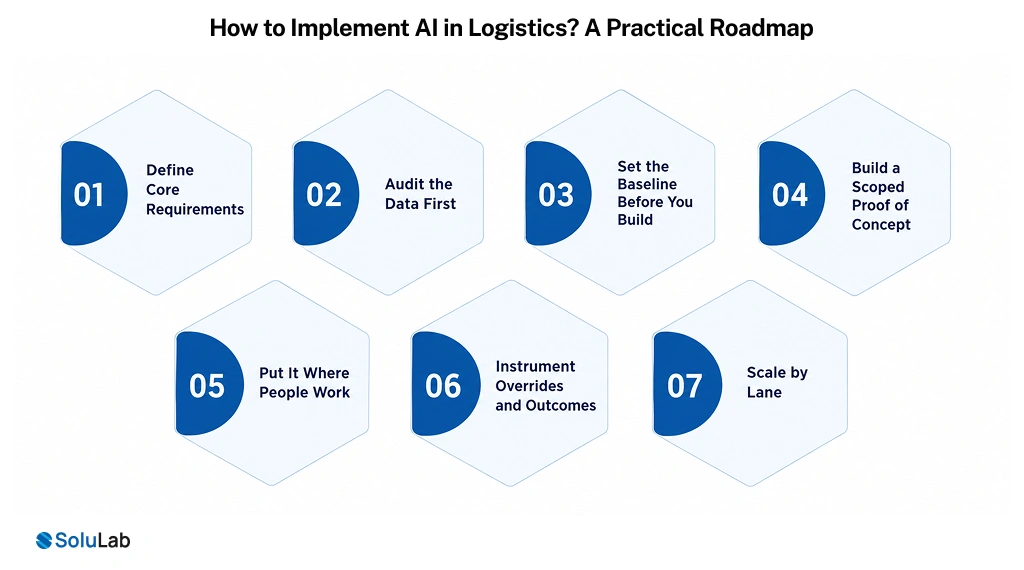
1. Define Core Requirements
“Reduce cost per delivery on the northeast lane” beats “transform logistics with AI.” Narrow scope is what makes the number provable.
2. Audit the Data First
Audit the data first. Two weeks of honest assessment: what exists, what’s clean, what’s missing, and what sits locked inside a system nobody can export from.
3. Set the Baseline Before You Build
Measure current fuel cost per mile, on-time percentage, and forecast error. Without a baseline you cannot claim a result, and the CFO will notice.
4. Build a Scoped Proof of Concept
Six to ten weeks, one lane or one depot, real data, real constraints. Working with an AI consulting company at this stage usually saves more time than it costs, mostly by avoiding the wrong architecture.
5. Put It Where People Work
Push recommendations into the TMS, the driver app, and the dispatcher’s screen. Adoption is an interface problem at least as much as a modeling one.
6. Instrument Overrides and Outcomes
Instrument overrides and outcomes. Log every planner override with a reason code. That dataset is how the model improves, and how you find where it is confidently wrong.
7. Scale by Lane
Add a region, add a fleet segment, add a use case. Each expansion reuses the data infrastructure you already paid for, which is why the second and third projects cost far less than the first.
Real World Examples of AI in Logistics
It’s the engine behind faster deliveries, smarter routing, and warehouses that practically run themselves. Here are real world examples of AI in logistics:;
- UPS ORION – UPS’s route optimization engine analyzes millions of delivery data points daily, helping drivers avoid unnecessary turns and idle time. It’s estimated to save close to 100,000 metric tons of CO₂ every year.
- Maersk’s AI-driven shipping – Maersk uses AI to plan vessel routes, manage fuel consumption, and predict port congestion across its maritime network. The result has been a meaningful cut in carbon emissions, reportedly around 1.5 million tons.
- Amazon’s warehouse AI – Amazon runs AI-powered systems like DeepFleet to coordinate thousands of robots across its fulfillment centers, reducing travel time and helping packages move from shelf to truck faster.
- Gatik’s driverless trucks – Gatik became the first company in North America to run fully driverless commercial trucks at scale, completing over 60,000 incident-free deliveries for retailers like Walmart.
- KNAPP’s warehouse robotics – KNAPP’s AI-driven control systems orchestrate fleets of autonomous mobile robots, letting warehouses dynamically rebalance workloads and avoid bottlenecks during peak periods.
How SoluLab Helps Logistics Companies Build AI Solutions
SoluLab is an AI consulting and engineering partner. We’ve delivered fleet optimization, supply chain risk intelligence, demand forecasting and document-processing systems for logistics and supply chain clients, and we build for your existing stack rather than asking you to replace it.
1. Logistics AI Consulting and Feasibility
Use-case assessment, data readiness audit, baseline measurement and a scoped roadmap with a cost estimate you can take to a board.
2. Custom Model and Platform Development
Forecasting, routing, ETA prediction, predictive maintenance and vision systems, built as an AI logistics development company rather than a reseller of someone else’s platform.
3. AI Agent Development for Exception Handling
Multi-step agents for disruption response, carrier communication and rebooking, with guardrails and human escalation. More on our approach as an AI agent development company.
4. Integration and MLOps
TMS, WMS, ERP and telematics integration, plus monitoring, retraining pipelines and model governance so performance doesn’t quietly decay.
5. Team Extension
If you have an internal team and need specific skills, you can hire AI developers with logistics domain experience rather than hiring generalists and training them on your time.

Conclusion
AI in logistics pays off when it’s pointed at a specific decision with a measurable cost attached, fed by data you’ve actually cleaned, and delivered into the tools your team already opens every morning. The technology is mature enough.
The constraint is scope discipline and change management, which is where most programmes quietly stall. Pick one lane. Measure the baseline. Ship something that saves money in a quarter. Then expand.
SoluLab, an AI development company, can help your business scope, build, and scale AI in logistics, from a data-readiness audit to a production platform running across your fleet.
FAQs
Neha is a curious content writer with a knack for breaking down complex technologies into meaningful, reader-friendly insights. With experience in blockchain, digital assets, and enterprise tech, she focuses on creating content that informs, connects, and supports strategic decision-making.