
Key Takeaways
- The best AI business ideas solve a specific expensive problem for a specific buyer. Broad platform plays are where first-time founders get crushed.
- Service businesses beat product businesses for a first venture. They generate revenue in weeks, and they teach you which product to build.
- Wrapping a general model with a thin interface is not defensible. Your moat comes from proprietary data, workflow depth, or distribution.
- Vertical beats horizontal. A narrow tool for one industry outsells a general tool for everyone, because you can name your buyer.
- The pilot-to-production gap is the commercial opportunity. Most companies have experimented, and few have shipped.
- Regulated categories carry real barriers. That makes them harder to enter and far harder for competitors to follow you into.
- Validate with a paid pilot before you build. An unpaid yes is not a signal.
AI business ideas worth starting in 2026 fall into three groups: service businesses selling AI-assisted work, vertical software solving one industry’s specific problem, and tooling that plugs into workflows companies already run. The common thread is not the model. It is owning a customer problem deep enough that a general-purpose assistant cannot casually replace you.
The market is enormous and still compounding. Grand View Research values the global artificial intelligence market at $539.5 billion in 2026, projecting $3.5 trillion by 2033 at a compound annual growth rate of 30.6%. Size is not the problem here. Differentiation is, and most published idea lists skip that part entirely.
This guide covers fifteen ideas, an honest read on which ones are defensible, the business models that actually work, what each takes to start, and where most AI startups fail.

What Makes an AI Business Idea Worth Pursuing in 2026?
A good AI business idea solves an expensive, repeated problem for a buyer you can name, using data or workflow knowledge a competitor cannot copy in a weekend. Everything else is a demo with a landing page.
1. Services Are Where the Money Currently Sits
Worth knowing before you pick a category. In Grand View Research’s breakdown, the services component held the largest share of the AI market in 2025 at 36.3%, ahead of software and hardware. Companies are buying help, not just tools.
For a first venture that matters enormously. A service business bills in week three. A product business bills in month nine, if it bills at all, and the service work tells you exactly which product is worth building.
2. Funding Is Abundant and Concentrated
AI absorbed roughly $202 billion of venture investment in 2025, about half of all global VC, and 207 AI-focused companies joined the unicorn board since 2024. That sounds encouraging. Read it the other way: capital is chasing this space hard, so a generic idea will meet a well-funded competitor quickly.
3. The Four Questions That Filter Most Ideas
Who specifically pays, and what are they paying for today? What do you have that a competitor cannot replicate in a month? How does the buyer find you? And can you verify whether your output was correct, cheaply and quickly?
Fail the fourth, and you cannot improve. That verification loop separates categories that work from categories that stall, and it applies just as much to a startup as to the enterprise programmes described in our guide to AI for startups.
4. Vertical Beats Horizontal, Almost Always
A general writing tool competes with every model provider on earth. A drafting tool for veterinary clinics competes with spreadsheets and a frustrated practice manager. The second market is smaller and vastly easier to win, and the buyer is someone you can actually find.
Top 15 AI Business Ideas to Start in 2026
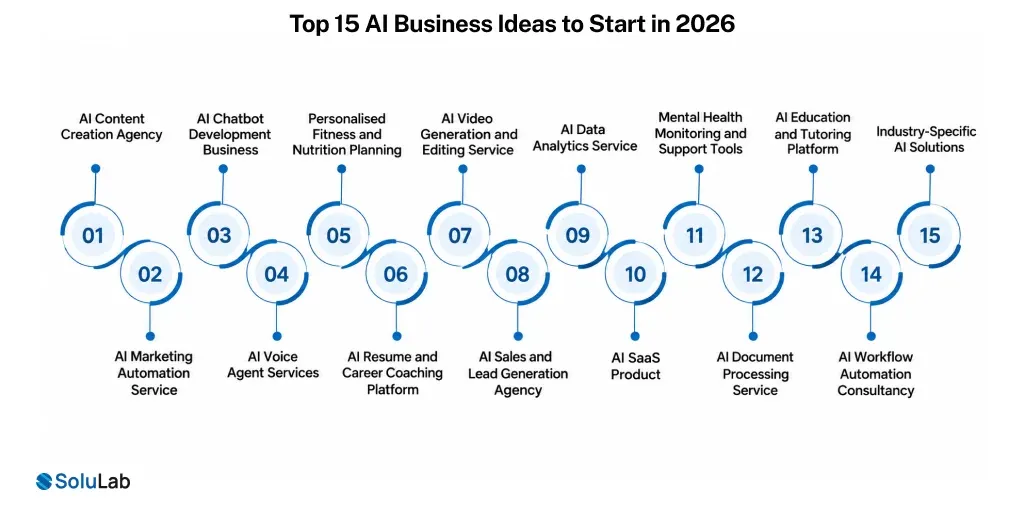
Fifteen ideas, each with what it is, what it takes, and an honest note on how defensible it is.
1. AI Content Creation Agency
Producing written, visual, and social content for businesses, with AI handling drafts and humans handling strategy, editin,g and brand voice. Low capital, fast to launch, immediate revenue.
Defensibility is the issue. Anyone can do this, so compete on a niche your clients care about: technical content for cybersecurity vendors, regulatory copy for medical devices, localisation for a specific market. Generalist content agencies are already commoditised.
2. AI Marketing Automation Service
Campaign personalisation, segmentation, subject line testing, ad creative variation, and lifecycle messaging, built on client data. Stronger than content because you sit inside their systems and your results are measurable in revenue.
The moat is integration depth plus accumulated performance data across accounts.
3. AI Chatbot Development Business
Building support and sales assistants grounded in each client’s own documentation. Demand is steady because every company wants one and few can build one that does not embarrass them.
Differentiate on the hard parts: retrieval quality, escalation design, and integration with the client’s ticketing system. Our chatbot development work sees far more projects fail on knowledge base quality than on model choice.
4. AI Voice Agent Services
Voice assistants handling appointment booking, reminders, qualification calls, and after-hours reception. Currently one of the strongest categories, because latency and quality crossed a usability threshold recently and the buyer pain is obvious.
Best verticals are the ones with high call volume and low complexity per call: clinics, dental practices, home services, restaurants, logistics dispatch.
5. Personalised Fitness and Nutrition Planning
Adaptive training and meal plans that respond to logged progress, preferences and constraints. Consumer subscription with recognisable demand.
Two cautions. Consumer acquisition costs are brutal without an existing audience, and anything that could be read as clinical advice needs qualified input and clear boundaries. Build it with a professional, not around one.
6. AI Resume and Career Coaching Platform
Resume tailoring against specific job descriptions, interview practice with feedback, and skills gap analysis. Proven willingness to pay, particularly in competitive markets.
Crowded at the consumer end. The better business is usually B2B: selling to universities, bootcamps, and outplacement firms who buy in volume.
7. AI Video Generation and Editing Service
Short-form video, product demos, training content and localised versions of existing footage. Demand is real and rising because video production costs have not fallen the way text production costs have.
Strongest as a service for companies with a constant content requirement rather than as a self-serve tool competing with well-funded platforms.
8. AI Sales and Lead Generation Agency
Prospect research, list building, personalised outreach and pipeline qualification. Easy to sell because the outcome is measured in meetings booked.
One warning. Deliverability rules and platform policies around automated outreach keep tightening, so build on quality and relevance rather than volume, or your clients’ domains pay for it.
9. AI Data Analytics Service
Turning messy business data into dashboards, forecasts, and written analysis for companies without an analytics team. Mid-market is the sweet spot: enough data to matter, no data scientist on staff.
Pairs naturally with AI agents for data analysis once you move from reports to something that runs continuously.
10. AI SaaS Product
A focused software product solving one workflow problem, sold by subscription. Highest ceiling and highest risk on this list.
Only attempt it with either domain expertise competitors lack or a distribution channel you already own. Building a general tool and hoping to find buyers is the most common way AI startups spend eighteen months and reach nothing.
11. Mental Health Monitoring and Support Tools
Mood tracking, early warning signals from behavioural patterns, and guided self-help content. Genuine need and growing employer and insurer demand.
Be clear-eyed about this one. It is regulated in most markets, requires clinical validation and professional oversight, and must never position itself as a substitute for care. Those barriers are real, which also means anyone who clears them is hard to follow. Build it with clinicians involved from day one, and look at how AI agents in healthcare handle escalation before designing yours.
12. AI Document Processing Service
Extracting structured data from invoices, contracts, claims, forms and scanned records. Unglamorous, high volume, and the buyer pain is quantifiable in hours.
Strong because output is checkable immediately, which makes the sales conversation easy. This is intelligent document processing territory and it is one of the safest first businesses on this list.
13. AI Education and Tutoring Platform
Adaptive learning, practice generation, homework feedback and progress tracking. The consumer market is competitive; the institutional market is underserved.
Selling to schools, training providers and corporate learning teams is slower and considerably more durable. Context on the sector sits in our overview of AI in education.
14. AI Workflow Automation Consultancy
Identifying where a client’s work queues and building automation to remove it. Arguably the highest-margin service business here, because you charge against measurable time saved.
Requires operational judgement more than technical depth, and the output is often simple. Much of it falls under AI workflow automation rather than anything requiring a model at all.
15. Industry-Specific AI Solutions
Purpose-built tools for one sector: construction bid analysis, legal document review, restaurant inventory forecasting, veterinary records, freight claim handling. Pick an industry you know and find its most hated recurring task.
This is the most defensible category on the list and the least glamorous. Domain knowledge is the moat, and it cannot be replicated by a better prompt.
Which AI Business Ideas Are Hardest to Defend?
The ones where your product is a thin layer over a general model that anyone can rebuild in a weekend. Three patterns are worth avoiding, and recognising them early saves months.
1. The Thin Wrapper
A prompt, an interface and a subscription page. It works until the model provider ships the same feature natively, which they routinely do, or until three competitors appear at half the price.
If you cannot answer what you have that a well-funded competitor cannot copy in a month, you have a wrapper.
2. Competing With the Model Providers Head On
General writing assistants, general coding assistants, general chat. These categories are occupied by companies with more compute and more distribution than you will ever have. Go where they will not bother to go.
3. Ignoring the Data Moat
The durable AI businesses accumulate something over time: proprietary training data, labelled outcomes, workflow telemetry, or a knowledge base competitors lack. Design that accumulation in from the start.
Even a simple retrieval product gets more defensible when it is grounded in content only you have, which is why building a RAG platform over proprietary content beats a generic assistant every time.
What AI Business Models Can You Consider?
Six models, and the right one is determined by how your customer experiences value rather than by what is fashionable.
1. Subscription
Fixed monthly or annual fee for access. Predictable revenue, straightforward to sell. The risk is inference cost: if a heavy user costs more to serve than they pay, growth hurts you.
2. Usage-Based
Charged per document, per call, per generation or per seat-hour. Aligns cost with revenue, which protects margin. Harder to forecast and customers dislike unpredictable bills, so cap it.
3. Service-Based
Project fees or retainers for AI-assisted work. Fastest route to revenue, lowest capital requirement, and it doubles as market research. Ceiling is your team’s capacity.
4. Freemium
Free tier converting to paid. Works when the free tier is cheap to serve. With AI it often is not, because every free user costs you inference. Constrain the free tier tightly or it becomes a charity.
5. Licensing
Selling your model, dataset or engine to other companies to embed. High margin, long sales cycles, and it needs something genuinely proprietary to license.
6. Commission or Outcome-Based
Charging a share of value created: a percentage of recovered revenue, cost saved or deals closed. Compelling to buyers and demanding to operate, because you have to measure the outcome credibly. Best suited to categories where results are unambiguous, such as several of the AI agent use cases in sales and collections.
How Do You Start an AI Business From Scratch?
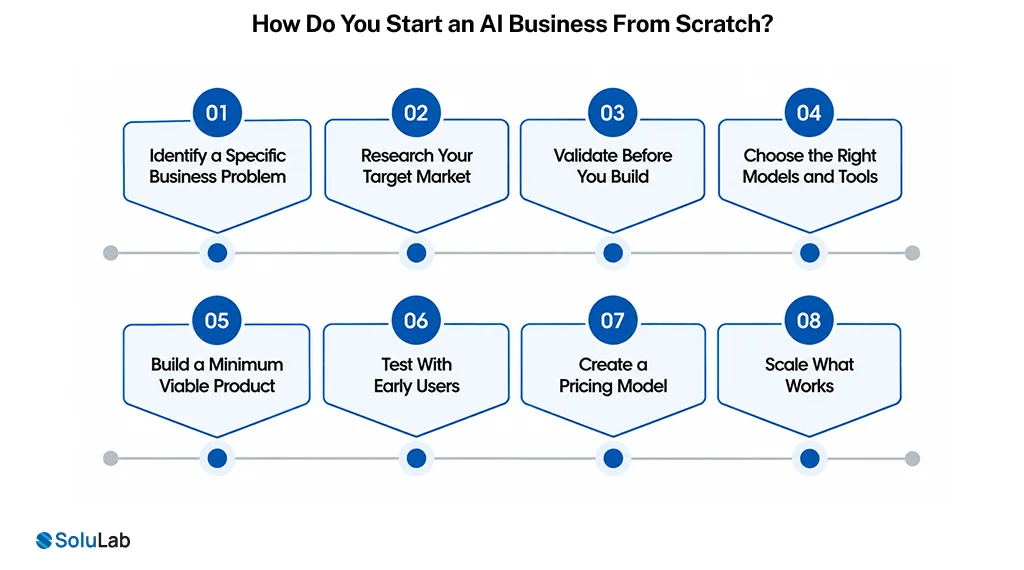
The first three decide whether the business works, and they involve no code at all. Here’s a complete step-by-step process to implement AI business idea:
1. Identify a Specific Business Problem
Not a technology you want to use. A problem someone is currently paying to solve badly. The best source is a job you have done yourself, because you already know where the hours go.
2. Research Your Target Market
Who has this problem, how many of them are there, what do they spend on it today, and how do they buy? If you cannot name twenty potential customers by company, the market is too abstract to sell into.
3. Validate Before You Build
Talk to fifteen or twenty of those buyers. Describe the outcome, not the technology. Then ask for a paid pilot. An unpaid yes means nothing, and the willingness to pay before the product exists is the only validation signal that has ever mattered.
4. Choose the Right Models and Tools
Start with off-the-shelf models and retrieval over your own data. Custom model work is almost never the right first move, and it consumes the budget you need for finding customers.
5. Build a Minimum Viable Product
One workflow, done properly, for a handful of users. Resist the feature list. Understanding the difference between a proof of concept, a prototype and an MVP saves real money here, and we break that down in our guide to PoC vs prototype vs MVP.
6. Test With Early Users
Watch them use it rather than asking whether they like it. Track whether they come back unprompted. Retention in the first month tells you more than any survey.
7. Create a Pricing Model
Price against the value delivered, not your costs. Know your inference cost per user and confirm your price covers it with margin at scale, because this is where AI businesses quietly go underwater.
8. Scale What Works
Add customers in the segment already succeeding before broadening. Most AI startups expand horizontally too early and end up serving several markets badly.
How Can SoluLab Help You Build an AI Business?
We work with founders and companies at the point where an idea has to become something customers can actually use.
1. Idea Validation and Technical Feasibility
Assessing whether the idea is buildable with current technology at a cost your business model supports, before you spend a development budget finding out.
2. MVP Development
One workflow built properly, with the evaluation and monitoring that tells you whether it works. Scoped to reach real users quickly rather than to impress a demo audience.
3. AI Agent and Automation Builds
Multi-step systems with scoped permissions and defined escalation, for products where the agent is the offering. Our AI agent development company practice runs these as fixed-scope engagements.
4. Data and Retrieval Architecture
Building the proprietary data layer that becomes your moat, rather than a wrapper that anyone can rebuild.
5. Scaling and Production Readiness
Moving from a working prototype to something that holds up under real usage, with the unit economics modelled before growth makes them a problem.

Conclusion
The AI business ideas that work in 2026 are narrower than the ones that get attention. A document processing service for insurance brokers will outlast a general AI assistant, because the buyer is findable, the problem is expensive, the output is checkable and the domain knowledge compounds.
If you are choosing where to start, run your idea through four questions. Who specifically pays. What do you have that a competitor cannot copy in a month. How does the buyer find you. And can you check whether your output was right. An idea that clears all four is worth building. One that clears two is worth a service business first.
SoluLab, an AI development company, can help your business pressure-test the idea, build an MVP that reaches real users, and get the data and unit economics right before scale makes them expensive to fix. We will also tell you plainly when an idea is a feature rather than a company.
FAQs
Neha is a curious content writer with a knack for breaking down complex technologies into meaningful, reader-friendly insights. With experience in blockchain, digital assets, and enterprise tech, she focuses on creating content that informs, connects, and supports strategic decision-making.