Key Takeaways
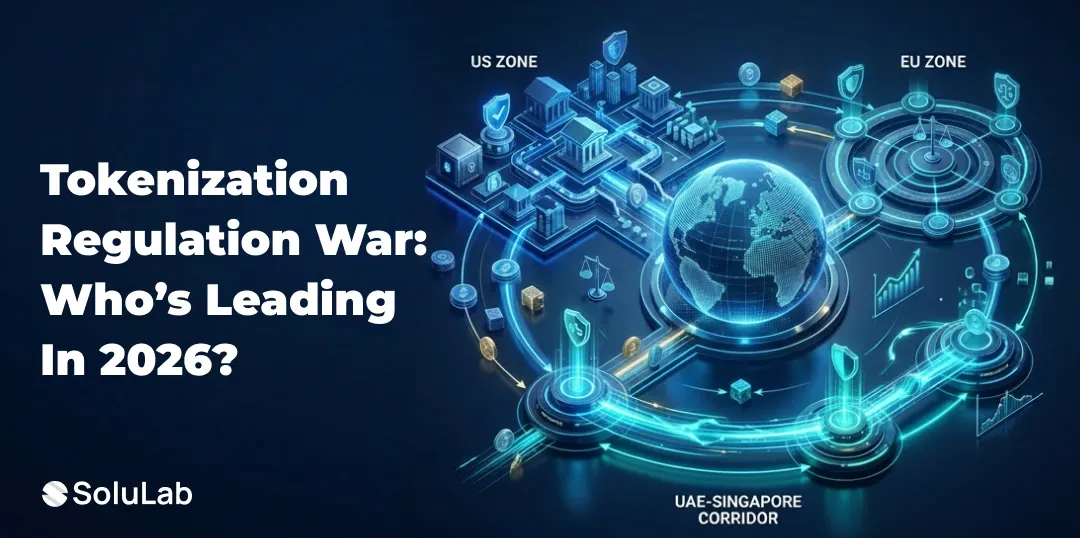
- No single leader dominates tokenization regulation in 2026—the US, EU, and UAE–Singapore corridor each controls different aspects of the global ecosystem.
- The EU (via MiCA) leads in structured, compliance-first frameworks, while the US drives innovation but faces regulatory fragmentation.
- The UAE–Singapore corridor, backed by the Virtual Assets Regulatory Authority and Monetary Authority of Singapore, is emerging as the fastest-growing hub for real-world asset (RWA) tokenization.
- Tokenization is shifting toward global, multi-jurisdictional strategies, where enterprises prioritize compliance agility, cross-border operability, and faster regulatory approvals.
- Tokenization platform development is becoming a strategic investment, enabling enterprises to build compliant, scalable infrastructure across finance, real estate, and trade ecosystems.
- AI-driven compliance, smart contract governance, and automation are redefining how tokenized ecosystems operate, reducing risk and accelerating deployment timelines.
- Enterprises are increasingly partnering with experienced firms like SoluLab to combine AI-powered tokenization development, regulatory alignment, and enterprise-grade scalability in a single execution model.
A year ago, most tokenization projects were still stuck in pilot mode. Teams were testing ideas, running small experiments, and waiting to see what regulators would say next.
Now, things feel very different.
The global tokenization market has started to move beyond experimentation, but not everywhere at the same pace. Some regions, such as the US, the Middle East, Asia, the EU, and Australia, are pulling ahead because they offer clarity, while others are still figuring things out.
Here’s what’s becoming obvious:
- Institutions only enter where rules are clear
- Assets without legal backing struggle to gain trust
- Real liquidity follows regulated environments
This is why the real-world asset tokenization ecosystem is starting to consolidate around a few key regions.
So what changed between the 2024 experiments and the 2026 production systems?
How “Compliance-By-Design” has Evolved From a Luxury to the Primary Engine of Digital Asset Tokenization?
In the pilot era, compliance was an “afterthought” layer. In March 2026, compliance is the very “code” that powers the asset.
Since the global tokenization market reached $27.65 billion in early April 2026 (a 4.07% surge in 30 days despite broader market volatility), institutions have stopped asking if the tech works. They are now focused on how predictably it behaves under global law.
1. Compliance Is Now Embedded, Not Layered
In 2026, the smart contract is the regulator. The institutional pivot is driven by the ability to automate “Programmable Guardrails” that previously required manual back-office teams.
- Solana’s RWA tokenization lending deposits hit $1.2 billion in March 2026, largely because its Token-2022 extensions allow for interest-bearing accounts and custom fee logic to be baked into the token itself.
- Using ZKP, an enterprise can verify that an investor is a U.S. Accredited Participant or a MiCA-Compliant European Entity without ever putting the investor’s personal ID on a public ledger.
- This has allowed Société Générale-FORGE and other Tier-1 banks to issue tokenized bonds that are 100% private but 100% compliant with the March 2026 MiCA enforcement.
- Frameworks in Australia (April 2026 Digital Assets Bill) and the UAE (VARA) now mandate “Burn-and-Reissue” capabilities.
Adopting these tokenization services means moving from a 2-day settlement (T+2) to a 10-minute settlement (T+0), while reducing transaction fees by over 70%.
To know more about the regulations and pick the region for your asset tokenization development, let’s enter a detailed discussion.
How the U.S. 2026 Joint Staff Statement Decoded Institutional Real-World Asset Tokenization?
On January 28, 2026, the SEC introduced a framework that positioned the US on top in asset tokenization in the global leader rankings.
1. Decoding the U.S. Two-Tier Tokenization Model
The US introduced a structure that separates technology from financial exposure. This is now influencing the global crypto regulation comparison.
Tier 1: Custodial Tokenized Securities
These are traditional securities (stocks, bonds, treasuries) issued as Security Token Offerings(STOs). They represent direct ownership.
- These are traditional assets represented on-chain
- Fully compliant under existing frameworks
- Used widely in the growth of the tokenized securities market
Tier 2: Synthetic Tokenized Exposure
Tokens that mirror the price of an asset (like a “Tokenized S&P 500”) without holding the physical share.
- As of March 2026, these are strictly limited to Eligible Contract Participants (ECPs).
- They serve as high-speed derivatives for the global tokenization market, allowing for instant, cross-border exposure.
2. The “Crypto-Security” Bridge: Where Digital Assets Meet RWAs
A critical update in the March 2026 SEC/CFTC coordinated guidance was the classification of “Hybrid Assets.”
- For the first time, major crypto assets like ETH and XRP are being used as secondary collateral for RWA STOs.
Enterprises can now build the best tokenization platforms where an institutional investor can borrow against their ETH to buy a fractionalized share of a U.S. Treasury fund, all on-chain and 100% compliant.
Case Study: BlackRock and the BUIDL Fund
In February 2026, BlackRock’s BUIDL fund recorded a 30% increase in market cap. By March, it reached $1.7 billion within the RWA tokenization market trends in 2026.
Key outcomes include:
- The fund acts as collateral in DeFi repo markets.
- It contributes to the $9.6 billion tokenized treasury segment.
- It demonstrates how tokenization consulting services align regulatory clarity with liquidity.
This example answers who dominates real-world asset tokenization in institutional finance.
How the EU Solved Tokenization at Scale with MiCA 2026?
While the U.S. builds a fortress for institutional capital, the European Union has built a “Passport to 450 Million Consumers.”
As of March 2026, the Markets in Crypto-Assets (MiCA) regulation has reached full enforcement, transforming 27 fragmented nations into a single, synchronized digital asset tokenization ecosystem.
1. The “Passport” Advantage: One License, 27 Nations
In 2026, the most vital competitive advantage in the EU is the Regulatory Passport (Article 16). For an enterprise, this means the end of “Multi-Jurisdictional Friction.”
- A tokenization platform licensed in Estonia or Luxembourg can legally offer services in France, Germany, and Italy without seeking local approval.
- Under MiCA Article 3, every asset must have a compliant White Paper. Unlike 2024, issuers in 2026 are legally liable for the accuracy of their claims, providing the “Consumer-Grade Trust” required for mass-market adoption.
- In April 2026, MiCA-compliant stablecoins (EMTs) reached a combined market cap of €14.2 Billion, serving as the primary liquidity bridge for the European RWA market.
2. The Privacy Revolution: GDPR Meets the Blockchain
The EU has solved the “Privacy Paradox” that once haunted the real-world asset tokenization ecosystem. By allying MiCA with GDPR, the bloc has mandated the use of Zero-Knowledge Proofs (ZKP) for institutional and retail transfers.
- Enterprises now use ZKP to verify an investor’s “Qualified” status and location without storing sensitive personal data on a public ledger.
- Every transaction over €1,000 is tracked via the Transfer of Funds Regulation (TFR), but the data remains encrypted, satisfying both regulators and privacy advocates.
Case Study: Société Générale-FORGE (EU)
On March 10, 2026, SG-FORGE made history by deploying its MiCA-compliant stablecoin, EUR CoinVertible (EURCV), across the XRP Ledger and Stellar networks to settle industrial trade invoices.
- They created a seamless “Cash-to-Asset” bridge. A German manufacturer could pay a Spanish supplier in EURCV, with the settlement occurring in under 5 seconds and the compliance “checks” (KYC/AML) happening automatically within the smart contract.
- By leveraging the MiCA Passport, SG-FORGE didn’t have to navigate 27 different banking laws. The “Trust” was built into the license itself.
This reduced the manufacturer’s settlement costs by 82% compared to traditional SEPA transfers and eliminated the “Counterparty Risk” of multi-day clearing.
Choose the EU if your roadmap involves cross-border transactions within a predictable, single-license framework that prioritizes user protection and data privacy.
Which Digital Asset Tokenization Framework Scales You in the UAE’s Commodity Vault?
If the US is where capital sits, the UAE is where execution happens.
The UAE tokenization market growth is not just fast. It’s structured for production. Since regulations are clear and asset-focused, they play a major role in the real-world asset tokenization ecosystem.
1. The Rise of Commodity and Real Estate Tokenization
Unlike other regions, the UAE focuses heavily on:
- Gold
- Real estate
- Energy assets
This positions it strongly within the RWA tokenization market trends 2026.
Key Regulatory Requirements
- A VARA Category 1 license is mandatory
- Proof of Reserve (PoR) is required
- Assets must exist physically within the UAE
These rules define how tokenization regulations in the US, EU, and UAE differ in real execution.
2. Secondary Market Advantage
Here’s where the UAE gets interesting. Since 2020, blockchain-based tokenized real estate is no longer locked.
- Investors can buy and sell fractions
- Liquidity is real, not theoretical
- This drives tokenization adoption by region
Case Study: Bank-to-Vault Model
In January 2026, the Bank-to-Vault model had evolved from a pilot to the global standard for institutional trust. By tethering digital tokens to serialized, physical assets via Tier-1 custodians, enterprises are unlocking trillion-dollar liquidity pools.
- Gold & Bullion: HSBC, in partnership with Paxos, now manages “allocated” tokens where each unit represents a specific, serialized 400oz bar in LBMA-certified vaults. This eliminates “paper gold” risks.
- Real Estate: In February 2026, the Dubai Land Department activated a secondary market for 7.8 million property tokens, linking fractional ownership directly to sovereign title deeds for instant resale.
- Strategic Value: Enterprises adopt this to achieve “Asset Finality.” It replaces “trust me” with “audit me,” allowing tokens to serve as high-quality collateral for institutional repo markets.
By adopting the Bank-to-Vault model, enterprises transition from “Crypto-curious” to “Sovereign-Scale,” capturing a share of the $24B+ RWA market that is currently migrating onto the ledger.
Singapore & Australia’s Interoperability Hub: Solving the “Locked Liquidity” Problem in Sovereign Asset Tokenization?
The primary failure of early RWA projects was “Liquidity Isolation.” You could tokenize a building in Sydney or a bond in Singapore, but the asset remained trapped on a private ledger. In 2026, the Singapore-Australia Bridge solved this by treating the two nations as a unified “Global Layer One” (GL1).
1. Singapore’s Project Guardian
Since its inception, Singapore’s Project Guardian has matured into the world’s most successful inter-bank tokenization framework. As of March 2026, it is no longer a series of pilots but a live ecosystem connecting global giants like DBS, JP Morgan, and SBI Group.
- Using standardized protocols, tokens can now move between different institutional blockchains without “wrapping” or manual bridging.
- Project Guardian assets under management (AUM) reached $12 billion in Q1 2026, driven by high-yield tokenized funds and cross-border repo markets.
- In late 2025, the Guardian Fixed Income Framework (GFIF) was updated to include on-chain settlement mechanisms, allowing a Singaporean investor to buy a tokenized bond and receive settlement in minutes.
2. Australia’s Project Acacia and the DFMI Sandbox
On April 1, 2026, Australia passed the Corporations Amendment (Digital Assets Framework) Bill 2025, a landmark bill that formally integrated tokenized assets into the AFSL (Australian Financial Services Licence) regime.
- The Reserve Bank of Australia (RBA) concluded Project Acacia in March 2026, proving that tokenization could deliver A$24 billion ($17bn) in annual gains for the Australian economy.
- Following Acacia, the RBA launched the Digital Financial Market Infrastructure (DFMI) Sandbox. This allows banks like ANZ and NAB to move tokenized wholesale money (CBDCs and stablecoins) into commercial use cases.
- Under the new April 1 law, all Tokenised Custody Platforms (TCP) must support administrative recovery.
- If a corporate key is lost, the bank can legally “burn” the lost token and “reissue” it, solving the “finality risk” that previously blocked institutional entry.
Use Case: ANZ’s A$DC and the Singapore Cross-Border Settlement
In March 2026, ANZ Bank successfully utilized its A$DC stablecoin to settle a cross-border trade for tokenized commercial paper between an Australian exporter and a Singaporean buyer.
- The transaction used the Project Guardian rails to settle the trade in under 60 seconds, replacing a process that traditionally took 3-5 business days.
- This trial moved from “Proof of Concept” to “Production Line,” with ANZ now offering A$DC-based settlement as a standard service for institutional clients in the APAC corridor.
By building on the GL1 standards, your token becomes “bank-ready” from day one, ensuring it doesn’t end up as a “Locked Liquidity” asset.
How to Choose Your Jurisdiction and Build for 2026 Asset Tokenization Success?

By now, it’s clear that no single region dominates everything. Each one leads a specific part of the stack.
So the real question is not who leads, but where your product fits.
This is where most enterprises make mistakes. They pick a jurisdiction based on popularity, not on product alignment.
1. Match Your Asset Type with the Right Market
Different regions serve different purposes in the RWA tokenization market in 2026.
- US → Best for institutional funds and securities
- EU → Strong for retail distribution and compliance scale
- UAE → Ideal for real estate and commodities
- Singapore/Australia → Best for liquidity and custody infrastructure
This directly impacts the RWA tokenization global market share, since assets flow toward regions where they function best.
2. Build with Compliance at the Core
Choosing a region is only half the job. The build itself must reflect regulatory expectations.
- Smart contracts should enforce investor eligibility
- Identity layers must align with jurisdictional rules
- Custody systems must support recovery and auditability
This is where experienced tokenization solution providers play a critical role. Without compliance-ready architecture, even strong ideas fail to launch.
3. Practical Build Strategy for Enterprises
To move forward with confidence:
- Start with asset classification before choosing tech
- Align legal, tech, and custody layers from day one
- Design for cross-border compatibility, not just local launch
4. Final ROI To Build RWA Tokenization Platform Across these Regions
It’s about launching in the right place, with the right structure, and being able to scale without rebuilding everything again and again.
| Metric (Avg. 2026 Data) | United States | European Union | UAE (VARA/ADGM) | Singapore/Australia |
| Total RWA AUM (Q1 2026) | $13.8 Billion | $6.2 Billion | $4.1 Billion | $3.5 Billion |
| Avg. Settlement Time | <10 Minutes | <5 Minutes | Instant (Atomic) | <2 Minutes |
| Legal Setup Cost (Est.) | $20k – $40k | €20k – €45k | $15k – $30k | $25k – $50k |
| Operational Savings | 45% (vs Legacy) | 62% (Passporting) | 78% (Automation) | 55% (Interop) |
| Secondary Market Volume | High (OTC/Repo) | Medium (Retail) | Extreme (Real Estate) | High (Inter-bank) |
| Compliance Logic | Transfer Hooks | ZK-Proofs (GDPR) | IoT-Oracle Linking | Burn-and-Reissue |
Choose your tokenization service requirement, place, and grow in that area, and spread your vision globally.

Conclusion
The world is running after the latest updates in digital asset tokenization. It’s high time to start your development. You can visit top tokenization platform development companies like SoluLab to get free consultation on where you should distribute your funds.
We help you in
- Building compliance-ready tokenization platforms aligned with global regulations.
- Integrating smart contract logic with identity, custody, and recovery mechanisms.
- Designing a scalable tokenization infrastructure for liquidity and settlement.
Connect with SoluLab to get started with a clear, execution-ready roadmap today!
FAQs
Deepika is a content writer who blends storytelling with strategic thinking. She explores topics across digital innovation, emerging tech, and the evolving blockchain industry. She enjoys breaking down complex ideas into simple, engaging narratives in the growing global markets.