Key Takeaways
- Token standards (ERC-1400/1410, ERC-3643, etc.) and why standard choice affects both audit scope and compliance flexibility
- Custody requirements for security tokens specifically (qualified custodian rules, private key management)
- Cross-border marketing restrictions (reverse solicitation risk, national gold-plating of the Prospectus Regulation)
- Ongoing audit/monitoring—a one-time audit isn’t enough if the contract is upgradeable or governance changes post-launch
- Cost/timeline benchmarks for an STO-grade audit vs. a standard DeFi audit
A security token offering (STO) in Europe issues tokenized securities that fall under securities and financial-instrument rules, not the pure crypto regime. Because a token that represents equity, debt, or fund interests is treated as a MiFID II financial instrument, it sits largely outside MiCA, and the smart contracts enforcing transfers, whitelists, and investor caps must be audited to prove the offering behaves as its documents claim.
SoluLab builds and audits the contracts behind regulated token offerings through its blockchain development company practice. This guide maps EU regulation to the smart-contract controls that enforce it and the audit checks that verify it, so an issuer can see the full picture in one place. It is not legal advice; confirm every regulatory point with qualified EU counsel.

What is a security token offering and how is it regulated in the EU?
A security token offering is the issuance of a blockchain-based token that represents a real financial instrument: a share, a bond, a fund unit, or a claim on an asset. Unlike a utility token or a payment token, a security token carries investor rights, so European regulators treat it as a regulated security rather than a generic crypto asset.
That distinction drives everything. The EU’s Markets in Crypto-Assets Regulation (MiCA) covers “crypto-assets that are not currently regulated by existing financial services legislation,” per ESMA. A token that qualifies as a financial instrument is excluded from MiCA and captured instead by the older securities framework, chiefly MiFID II and the Prospectus Regulation. So an STO issuer in Europe is running a securities offering that happens to settle on-chain, and the compliance burden reflects that.
Definition box. Security token: a token whose economic substance is a financial instrument (equity, debt, fund interest, or asset claim). If a token grants ownership, profit share, or a repayment right, assume it is a security until counsel confirms otherwise.
Which EU regulations apply to a security token offering?
Three regimes matter, and knowing which one bites is the first compliance step.
MiCA and its boundary. MiCA regulates crypto-assets not already covered by financial-services law. ESMA states the regulation “covers crypto-assets that are not currently regulated by existing financial services legislation.” Analysts reading the text note that MiCA “excludes financial instruments from its scope,” which is why a genuine security token is a MiFID II matter, not a MiCA one.
MiFID II. MiFID II defines a financial instrument, and its definition now explicitly reaches tokens. ESMA’s rulebook records that “financial instrument” means the instruments in Section C of Annex I, “including such instruments issued by means of distributed ledger technology.” A tokenized share or bond is therefore a transferable security under MiFID II.
Prospectus Regulation. When securities are offered to the public in the EU, a prospectus is generally required unless an exemption applies. The EUR-Lex summary references a small-offer threshold under the amending Regulation (EU) 2020/1503; the exact figure and its national implementation change over time, so treat any specific number as. National regulators also set their own thresholds and formats for smaller offers.
The practical takeaway: classify the token first. If it is a financial instrument, plan for MiFID II and prospectus obligations, and use MiCA only for any non-security components. SoluLab’s engineers work alongside your counsel on this split through the asset tokenization development company team.
Why must the smart contracts behind an STO be audited?
Audited contracts give verifiable proof that the on-chain logic does what the offering documents promise. In an STO, the contract is not a wrapper around a security; it is the security’s transfer agent, register, and rulebook. If the code lets an ineligible wallet receive tokens, the “restriction” in your prospectus is fiction.
The financial stakes are concrete. Hacken reports that in Q1 2024 smart-contract exploits caused almost $45 million in losses across 16 incidents, averaging $2.8 million per exploit. Historic failures were larger still: an academic survey records that more than $182 million was lost in the 2017 Parity multi-signature wallet incident triggered through smart contracts. For a regulated offering, a bug is not just a loss event; it is a breach of the investor protections you represented to a regulator.
An audit is a detailed analysis of contract code to find vulnerabilities before deployment, as Chainlink describes it. For an STO that means checking the exact functions that carry legal weight: who can hold, who can transfer, who can mint, and who can override.
What does a smart contract audit for an STO actually check?
A generic DeFi audit hunts for reentrancy and overflow. An STO audit does that too, then adds the compliance layer that a securities offering lives or dies on.
- Transfer controls. Does the contract block transfers to non-whitelisted addresses, and can it enforce lock-ups and holding periods? Security-token standards such as ERC-1400 exist to provide “a suite of standard interfaces for issuing/redeeming security tokens, managing their ownership and transfer restrictions.”
- KYC and whitelist gating. Auditors trace how identity checks map to on-chain permissions and confirm an unverified wallet cannot bypass the gate. ERC-1400 is built around how token balances “behave with respect to transfer restrictions, rights and obligations.”
- Cap-table logic. The register of holders and balances must match the legal cap table, with no path to silent minting or double-counting.
- Dividend and redemption functions. Payout and buyback logic is checked for correct pro-rata math and for who can trigger it.
- Upgradeability and admin-key risk. Proxy patterns and privileged keys are the highest-risk area. Auditors document every admin power, because an unrestricted upgrade key can rewrite the security’s rules after investors buy in.
SoluLab covers this scope on Ethereum and other chains through its Ethereum blockchain development company practice, and applies the same standards to real-world asset work described in its real estate tokenization guidance.
How do EU rules and the audit fit together in practice?
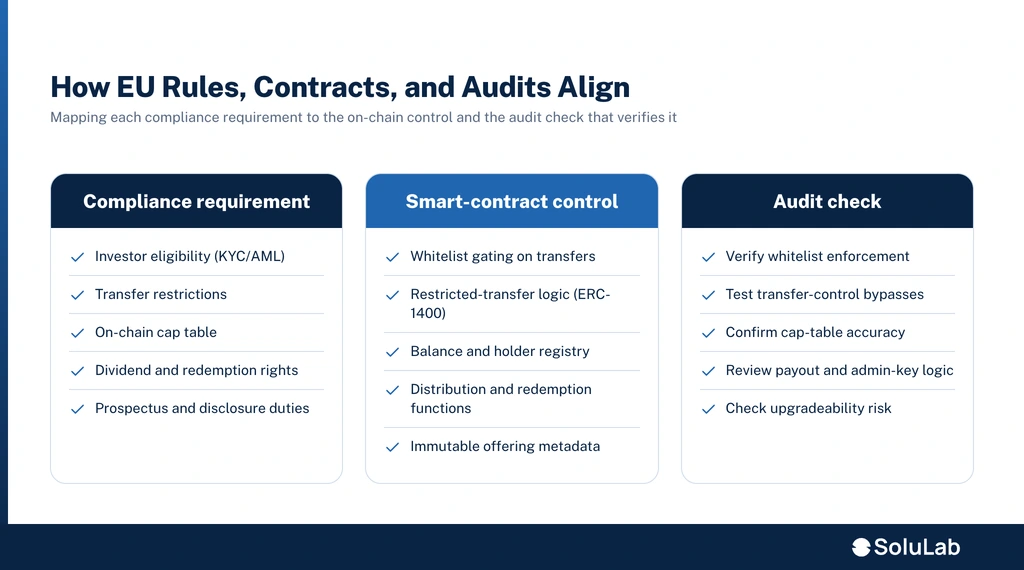
This mapping is the core of a compliant STO: each regulatory requirement should trace to a smart-contract control and an audit check that verifies the control works. Confirm every regulatory row with counsel before relying on it.
| Compliance requirement | Smart-contract control | Audit check |
| Restrict to eligible investors | Whitelist / KYC-gated transfer function | Confirm non-whitelisted transfers revert. |
| Honor lock-ups and holding periods | Time-locked transfer rules | Verify locked tokens cannot move early. |
| Maintain an accurate holder register | On-chain cap table / balance ledger | Reconcile on-chain balances to legal register. |
| Enforce transfer caps and jurisdiction limits | Per-address and per-region rules | Test boundary and over-limit transfers. |
| Support forced transfers for legal orders | Controller/recovery function (e.g., ERC-1644) | Confirm only authorized role can invoke |
| Pay dividends or redemptions correctly | Distribution / redemption logic | Check pro-rata math and access control. |
| Prevent unauthorized rule changes | Guarded upgrade/admin keys | Document every privileged key and timelock. |
Read a row across and you get the honest answer to “how does audited code support a lawful EU offering?” The regulation states the duty, the contract encodes it, and the audit proves the code enforces it.
What is a step-by-step compliance checklist for an EU STO?
Follow the order. Each step depends on the one before it, and skipping the classification step is where most issuers go wrong. Every legal step below is.
- Classify the token. Confirm with counsel whether the token is a financial instrument (MiFID II/prospectus route) or a MiCA crypto-asset.
- Structure the offering. Choose the legal entity, jurisdiction, and offering type, and decide whether a prospectus or an exemption applies.
- Prepare offering documents. Draft the prospectus or exemption memorandum, term sheet, and investor disclosures so their promises match what the code will enforce.
- Set investor eligibility. Define KYC/AML, accreditation, and jurisdiction rules, then translate them into a whitelist policy.
- Implement transfer controls. Build the token on a security-token standard so restrictions, lock-ups, and forced transfers are native, not bolted on.
- Audit the contracts. Run an independent audit against the STO-specific scope above before any public sale.
- Arrange custody. Decide on qualified custody or self-custody with key controls, and confirm it against local rules.
- Plan reporting. Set up ongoing investor and regulatory reporting, cap-table updates, and event handling.
What are the common compliance mistakes in EU security token offerings?
Most failures are avoidable and show up in the audit if you run one early.
- Unaudited upgradeable contracts. A proxy with an open admin key lets someone rewrite the security’s rules after investors commit. Auditors flag this first.
- Missing transfer restrictions. Shipping a plain fungible token with no whitelist means anyone can hold the “restricted” security, which contradicts the offering documents.
- Weak KYC gating. Off-chain identity checks that never bind to on-chain permissions leave a gap an ineligible buyer walks through.
- Unclear custody. No defined key management or custody model creates loss and control risk that regulators and investors both dislike.
- Treating classification as an afterthought. Deciding the MiFID II versus MiCA question late forces expensive rebuilds. Classify first.
How long does an STO smart contract audit take and what does it cover?
An STO audit typically runs in phases: scoping and threat modeling, automated static analysis, manual line-by-line review of the compliance logic, exploitation testing, a findings report with severity ratings, and a re-audit after fixes. The exact duration depends on code size, upgradeability, and how many compliance functions exist; treat any specific timeline or price as. What stays constant is the coverage: the audit must exercise every function that carries a legal obligation, not just the token’s ERC-20 surface. A clean report with no high or critical findings, plus fixes verified in a second pass, is the bar before a public sale.
How does SoluLab support compliant EU security token offerings?
SoluLab builds and audits the smart contracts behind regulated token offerings and asset-tokenization platforms. Its engineers implement security-token standards, transfer restrictions, whitelisting, and cap-table logic, then test that logic against the compliance controls an issuer needs. The team works across tokenized real estate, funds, and other assets, and applies the same audit discipline to gold and commodity work covered in its gold tokenization guidance.
SoluLab builds the technology; it does not provide legal advice or guarantee regulatory approval. Route every question about securities classification, prospectus obligations, and investor eligibility to qualified EU counsel, and let the engineering team encode the rules counsel confirms. To scope an STO build or audit, talk to our blockchain development company team, and connect it to your broader stack through our Web3 development company practice.
FAQs
Shipra Garg is a tech-focused content strategist and copywriter specializing in Web3, blockchain, and artificial intelligence. She has worked with startups and enterprise teams to craft high-conversion content that bridges deep tech with business impact. Her work translates complex innovations into clear, credible, and engaging narratives that drive growth and build trust in emerging tech markets.