Key Takeaways
- Tokenized money market funds turn fund shares into blockchain-based tokens. The fund itself still runs on the same securities law that governs any traditional MMF, tokenization doesn’t change that part.
- Deloitte’s 2026 investment management outlook points to the GENIUS Act’s stablecoin clarity as the trigger behind a fresh wave of US-issued tokenized money market funds.
- A tokenized MMF platform needs nine distinct layers, from investor-facing apps down to custody infrastructure. Not a smart contract bolted onto an existing fund and called done.
- Building one from scratch typically runs from the low six figures for an MVP to well over a million dollars for a fully compliant, institution-grade build.
Money market funds hold roughly $8.3 trillion in assets, by Bloomberg’s count, sitting on operational infrastructure that hasn’t really changed since the 1970s.
That gap, trillions of dollars running on decades-old plumbing, is exactly what’s pulling asset managers toward asset tokenization. BlackRock’s BUIDL, Franklin Templeton’s BENJI, and a growing list of institutional issuers have already shown the model works at scale.
So the interesting question isn’t whether tokenized MMFs are real. They clearly are. It’s what actually has to get built to launch one without it falling apart under regulatory review.
This guide walks through the architecture, the features, the build process, and what it realistically costs.
Tokenized Money Market Fund Platform Development: What It Is and Why It Matters
A tokenized money market fund platform issues digital tokens representing shares in a fund that, like any traditional MMF, holds short-term, low-risk instruments such as Treasury bills, repos, or commercial paper.
The token wraps around a real fund structure. It doesn’t replace the regulatory framework sitting underneath it, whatever the pitch decks imply. What actually changes is how ownership, transfers, and day-to-day operations get handled. Most teams that get this right work with an asset tokenization development company early, before the fund structure gets finalized, rather than trying to retrofit tokenization onto a fund that was never designed for it.
1. Faster Settlement
Blockchain infrastructure can support near-real-time transaction and settlement workflows, where the legal and operational structure actually permits it. Traditional MMF settlement often runs T+1 or T+2. Tokenized structures can compress that. Though “instant” claims deserve a second look until you’ve checked what’s actually settling on-chain versus what’s still happening off it behind the scenes.
2. Programmable Fund Operations
Smart contracts automate selected rules and workflows: subscription and redemption logic, yield accrual, and eligibility checks. It cuts down on the manual processes that still dominate legacy fund administration at most shops.
3. Transparent Ownership Records
Blockchain gives you a shared, tamper-resistant record of token ownership and transactions. Auditors and regulators get one source of truth instead of reconciling data across a fund administrator, a custodian, and a transfer agent who don’t always agree with each other.
4. Improved Operational Efficiency
Fewer manual reconciliation steps, less administrative overhead. Real cost savings over time, especially for funds processing high subscription and redemption volume where the manual work adds up fast.
5. Digital Distribution
Tokenized fund interests can potentially be distributed through digital financial infrastructure, subject to whatever regulatory restrictions apply in the fund’s jurisdiction. That opens distribution channels that just weren’t practical with paper-based fund shares.
6. Integration With Digital Asset Ecosystems
A tokenized MMF share can plug into broader digital asset infrastructure: used as collateral, held in a multi-asset digital wallet, settled against stablecoins. A traditional fund share can’t do any of that.

Core Platform Architecture: From Fund Shares to On-Chain Tokens
Building this right means treating it as a full stack, not a blockchain feature bolted onto an existing fund admin system. A typical architecture runs through nine layers, and skipping one usually shows up later as an expensive rebuild:
- User Layer: investors and fund operators interacting with the platform
- Web/Mobile Application: the interface layer for onboarding, transactions, and reporting
- API & Business Logic Layer: orchestrates requests between the app, compliance checks, and the blockchain
- Compliance & Identity Layer: KYC, AML, accredited investor verification, eligibility rules
- Fund Management Layer: NAV calculation, subscription and redemption processing, fund accounting
- Blockchain Layer: the distributed ledger recording token issuance and transfers
- Smart Contracts: programmable logic governing token behavior, transfer restrictions, distributions
- Custody / Wallet Infrastructure: secure storage of tokens for institutional and retail holders alike
- Banking, Payment & Market Data Integrations: fiat rails, stablecoin settlement, pricing feeds
Nine layers is a lot to stand up from zero, which is why most issuers don’t. They lean on a tokenization platform development partner that already has several of these layers built and audited, and focus their own team’s time on the fund structure and investor relationships instead. Skip the compliance layer specifically, though, and you don’t have a functional platform. You have a demo that won’t survive its first regulatory review.
Regulatory and Compliance Foundations
This is the layer that decides whether anything else here actually matters. In the US, the GENIUS Act’s 2025 passage gave stablecoin issuers real regulatory clarity, and Deloitte’s 2026 investment management outlook notes that several US investment managers have since launched tokenized money market funds on the back of that clarity.
Not a coincidence. Fund tokenization projects tend to stall in exactly the spot where compliance gets treated as an afterthought instead of a design constraint from day one.
A compliant platform needs, at minimum, investor eligibility checks baked into the smart contract layer itself (not just sitting on the onboarding form), jurisdiction-aware transfer restrictions, ongoing AML monitoring, and audit-ready reporting that satisfies fund regulators and, where relevant, whichever banking regulators oversee the custody side.
Gartner’s blockchain research has repeatedly flagged regulatory uncertainty as one of the persistent blockers keeping enterprise tokenization projects stuck in pilot mode. MMFs, already among the more tightly regulated fund types out there, have less room for error on this than almost any other tokenized asset class.
Essential Platform Features for Tokenized MMFs
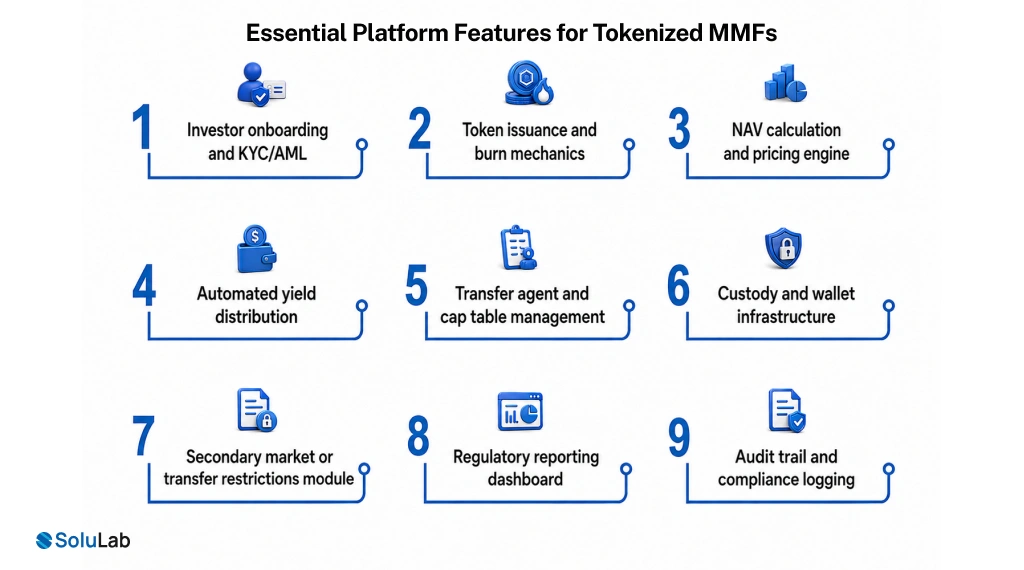
A production-ready platform needs to cover the full lifecycle of a fund investment, not just the token issuance moment everyone gets excited about.
- Investor onboarding and KYC/AML: Automated identity verification tied to jurisdiction-specific rules
- Token issuance and burn mechanics: Controlling supply as investors subscribe and redeem
- NAV calculation and pricing engine: Accurate, frequent net asset value updates feeding token pricing
- Automated yield distribution: Smart contracts calculating and distributing proportional returns to token holders
- Transfer agent and cap table management: An accurate, real-time record of who owns what, at all times
- Custody and wallet infrastructure: Institutional-grade key management, not a browser extension wallet, someone’s holding the seed phrase for
- Secondary market or transfer restrictions module: Enforcing who can trade, and when, based on the fund’s legal structure
- Regulatory reporting dashboard: Exportable records satisfying SEC, FINRA, or equivalent regional requirements
- Audit trail and compliance logging: An immutable record that auditors can actually rely on, not one that requires a reconciliation project every quarter
If building all nine in-house sounds like a lot of specialized hiring for a first launch, that’s usually because it is. This is where tokenization as a service models have started gaining traction, letting fund managers plug into existing infrastructure rather than staffing a blockchain engineering team from scratch.
Development Process for a Tokenized Money Market Fund Platform
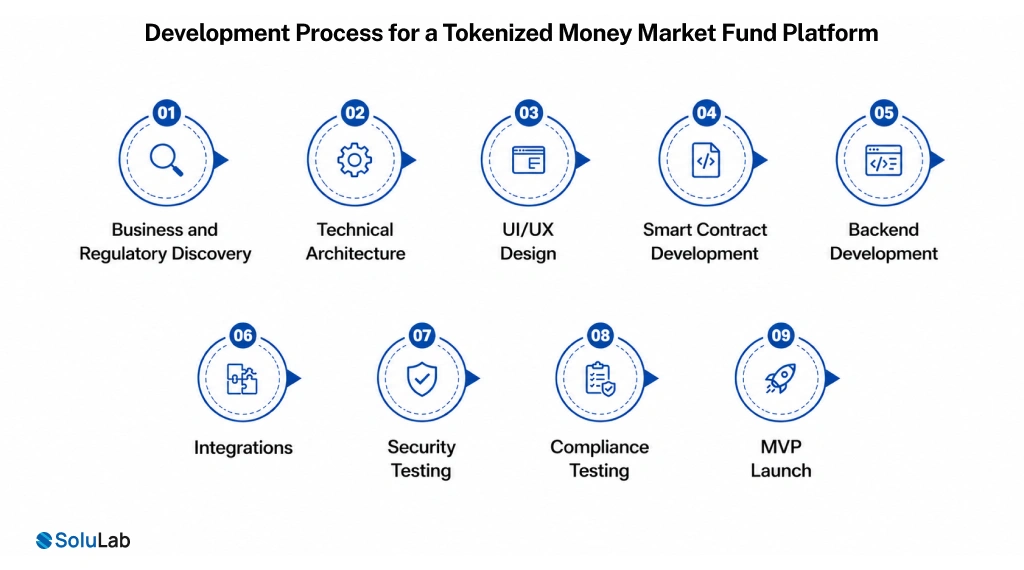
Here’s a complete step-by-step process for a tokenized money market fund platform:
1. Business and Regulatory Discovery
Defining the fund structure, target jurisdictions, investor base, and applicable securities framework before a single line of code gets written.
2. Technical Architecture
Mapping the nine-layer stack above to specific technology choices: blockchain network, custody provider, integration partners.
3. UI/UX Design
Designing onboarding and transaction flows that don’t feel like a crypto exchange bolted onto a fund portal. Institutional investors expect fund-grade polish, and it shows immediately when they don’t get it.
4. Smart Contract Development
Writing and testing the contracts governing issuance, transfers, distributions, and compliance rules.
5. Backend Development
Building the fund management, NAV calculation, and business logic layers that sit between the app and the blockchain.
6. Integrations
Connecting banking rails, payment processors, custody providers, and market data feeds, usually the part that eats the most calendar time.
7. Security Testing
Independent smart contract audits and penetration testing. Non-negotiable, given how much capital these platforms are meant to hold.
8. Compliance Testing
Validating KYC/AML workflows, transfer restrictions, and reporting outputs against actual regulatory requirements, not just internal specs someone wrote six months ago.
9. MVP Launch
Rolling out to a limited investor base first, watching how compliance and settlement workflows hold up under real transaction volume before a full launch.
How Much Does It Cost to Build a Tokenized Money Market Fund Platform?
Cost depends heavily on scope, regulatory complexity, and whether you’re building fully custom or working with a partner who already has reusable infrastructure. Here’s a rough breakdown by tier.
| Platform Tier | Scope | Estimated Cost |
| MVP / Pilot | Core token issuance, basic KYC, single-jurisdiction compliance | $80,000 – $180,000 |
| Mid-Market Platform | Full nine-layer architecture, multi-role dashboards, one custody integration | $200,000 – $450,000 |
| Institutional-Grade Platform | Multi-jurisdiction compliance, multiple custody and banking integrations, advanced reporting | $500,000+ |
| Ongoing Maintenance | Security monitoring, compliance updates, infrastructure support | 15–20% of build cost annually |
These are directional figures, not quotes, and they vary widely depending on which jurisdictions you’re launching in and how many third-party integrations the compliance layer ultimately requires.
Future of Tokenized Money Market Funds
The next few years look less like one big breakthrough and more like several trends landing at the same time.
1. Institutional RWA Adoption
Institutional capital is moving from pilot programs into production. RWA.xyz data shows tokenized Treasury and money market products collectively topped $15 billion in on-chain assets in 2026, up sharply from where the category sat just two years earlier.
2. Stablecoin-Based Settlement
Stablecoins are becoming the default settlement layer for tokenized fund transactions, cutting out the delay and cost of converting between fiat and digital assets on every single trade.
3. On-Chain Fund Administration
More of the fund accounting and NAV process is moving on-chain, narrowing the reconciliation gap between a fund’s official books and its blockchain record.
4. Digital Custody
Institutional-grade custody solutions are maturing fast enough that major custodians are now willing to hold tokenized fund shares right alongside traditional assets, not in a separate silo.
5. Programmable Compliance
Compliance rules are getting written directly into smart contracts, so eligibility and transfer restrictions enforce themselves instead of relying on a back-office team to catch violations after the fact.
6. Cross-Chain Interoperability
As more funds launch on different blockchain networks, moving tokenized shares across chains without losing compliance guarantees stops being a nice-to-have and becomes an actual technical requirement.
7. Tokenized Treasury Products
Tokenized Treasury products remain the largest, fastest-growing category within fund tokenization, and they’re increasingly used as collateral in ways that start blurring the line between a money market investment and programmable digital cash.

Conclusion
Tokenized money market fund platforms aren’t a speculative crypto experiment anymore. They’re becoming standard infrastructure for asset managers who want faster settlement, lower administrative overhead, and distribution channels traditional fund shares simply can’t reach.
Whether you’re evaluating this for the first time or already scoping a build, treating architecture and compliance as one decision instead of two sequential ones will save you months of rework down the line.
SoluLab, a tokenization development company, works with asset managers and fintech teams on smart contract architecture, custody integration, and compliance workflows for teams building tokenized MMFs, treasury products, or broader fund tokenization initiatives.
Talk to a SoluLab blockchain architect about compliance-ready fund tokenization.
FAQs
Neha is a curious content writer with a knack for breaking down complex technologies into meaningful, reader-friendly insights. With experience in blockchain, digital assets, and enterprise tech, she focuses on creating content that informs, connects, and supports strategic decision-making.