
Money market funds have always been the quiet backbone of institutional finance. Corporations use them to park excess cash. Banks use them for short-term liquidity management. Asset managers use them to provide low-risk yield.
Now, that infrastructure is moving on-chain.
In 2025, tokenized money market funds (MMFs) grew 80% to $7.4B. Additionally, funds have shifted from pilot experiments to real capital allocation vehicles.
For blockchain experts, this shift offers a clear message. Institutional tokenized money market funds are not about hype. They are about 2x liquidity efficiency, settlement speed, and balance sheet optimization.
Let us break down what is driving this change and what enterprises should learn from it.
Key Takeaways
- On-chain money market funds can improve liquidity access and reduce settlement timelines compared to traditional T+1 fund structures.
- Regulated fund structures combined with blockchain infrastructure are creating compliant, asset-backed tokenized funds suitable for enterprise balance sheets.
- Successful institutional adoption depends on secure custody, integrated compliance layers, and enterprise-grade tokenization development platforms.
Why Are Institutional Investors Moving Toward Tokenized Money Market Funds in 2026?
Institutional demand for money market fund digital tokenization solutions is not speculative. It is operational.
1. Demand for Real-Time Settlement
Traditional money market funds settle on T+1. In volatile markets, even one day matters. On-chain money market funds enable near real-time settlement and programmable transfers.
Large financial institutions have publicly stated that atomic settlement reduces counterparty exposure and intraday liquidity risk. For treasury teams managing billions, shaving even 0.1% off funding costs is meaningful.
2. Yield in a High-Rate Environment
In 2024 and 2025, U.S. money market funds crossed $6 trillion in assets under management, according to widely reported data covered by Yahoo Finance. High short-term interest rates made MMFs attractive.
Digital tokenized MMF products allow institutions to access the same underlying treasury yield but with enhanced mobility. Instead of idle capital, tokens can be used as collateral, traded, or integrated into digital asset workflows.
3. Stablecoin Reserve Diversification
Stablecoin issuers increasingly hold short-term U.S. Treasuries and money market funds as reserves. Tokenized MMF investment platforms make this process transparent and programmable.
For fintech firms and exchanges, blockchain-based money market funds provide compliant yield exposure without leaving the digital asset ecosystem.
4. Regulatory Maturity
Regulators in the U.S., Europe, and Asia have clarified frameworks around digital securities money market funds. This has reduced uncertainty for asset managers.
Institutions are not waiting for perfect clarity. They are building within defined guardrails.

How Do Tokenized Money Market Funds Improve Liquidity, Transparency, and Settlement Efficiency?
The real advantage of digital tokenization of money market funds is structural.
1. Real-Time Liquidity Access
With traditional funds, liquidity windows are fixed. With on-chain money market funds, ownership transfers can occur instantly between verified participants.
This matters for:
- Corporate treasury desks
- Prime brokers
- Collateral managers
- Crypto-native institutions
Liquidity becomes portable rather than static.
2. Transparent Ownership Records
Blockchain-based money market funds maintain a transparent ledger of token ownership. This reduces reconciliation errors.
In large institutions, reconciliation costs can represent millions annually. Deloitte has estimated that distributed ledger technology can reduce reconciliation and reporting overhead significantly in capital markets operations.
3. Programmable Yield Distribution
A digital asset money market fund can distribute yield automatically through smart contracts.
Instead of manual accounting cycles, yield can be calculated and distributed based on token balance snapshots. This reduces operational friction.
4. Collateral Mobility
Asset-backed tokenized funds can be pledged as collateral in repo or lending markets.
Instead of waiting for redemption and re-subscription cycles, institutions can move tokenized units directly between wallets or custodians.
That efficiency improves capital velocity.
Where Are Banks, Asset Managers, and Corporations Deploying Tokenized MMFs in Real-World Use Cases?
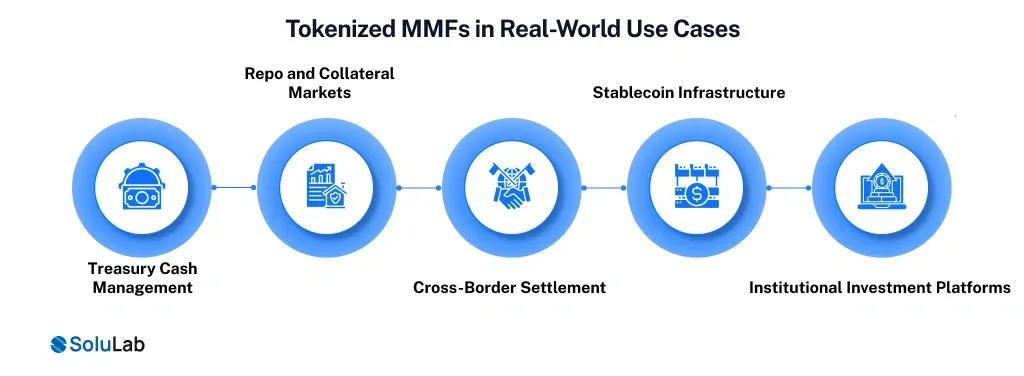
Tokenized MMFs are not theory. They are being used in defined areas.
1. Treasury Cash Management
Large corporates often hold surplus liquidity in money market funds. With real-world asset tokenization money market funds, treasury teams can integrate MMF tokens into digital payment flows.
For multinational companies operating across time zones, 24/7 settlement is attractive.
2. Repo and Collateral Markets
In repo transactions, speed and transparency matter. On-chain tokenized money market funds can serve as high-quality collateral.
Banks experimenting with digital asset settlement rails are exploring tokenized MMFs to streamline margin calls and collateral transfers.
3. Cross-Border Settlement
Cross-border transfers are still slow in traditional systems. Blockchain-based money market funds allow institutions to move value across jurisdictions in token form, then redeem locally.
This reduces friction in global liquidity management.
4. Stablecoin Infrastructure
Some stablecoin frameworks integrate tokenized treasury and MMF exposure for yield generation. A digital tokenized MMF can sit alongside fiat reserves in structured portfolios.
This creates hybrid digital asset money market fund models tailored for Web3-native enterprises.
5. Institutional Investment Platforms
Asset managers are building tokenized MMF investment platforms to serve hedge funds, family offices, and digital asset firms.
These platforms combine custody, compliance, and subscription management under a digital securities structure.
What Infrastructure and Compliance Stack Is Required to Launch Institutional-Grade Tokenized MMFs?
Building institutional tokenized money market funds requires more than issuing tokens.
1. Regulated Fund Structure
The underlying fund must comply with securities regulations in the relevant jurisdiction.
This includes:
- Registered fund vehicle
- Independent custodian
- Licensed transfer agent
- Regular reporting and audit
Tokenization wraps around the regulated structure. It does not replace it.
2. Smart Contract Framework
A tokenization development platform must support:
- Role-based access controls
- KYC-gated transfers
- Whitelisting mechanisms
- Redemption logic
- Yield distribution automation
Smart contracts must be audited and upgrade-controlled.
3. Custody and Wallet Infrastructure
Institutions require qualified custodians or enterprise-grade wallet providers.
Private key management, disaster recovery, and multi-signature controls are mandatory.
4. Compliance and Reporting Layer
Enterprise clients expect:
- AML monitoring
- Transaction reporting
- Investor onboarding workflows
- Tax documentation
Digital tokenization of money market funds must integrate compliance into the core design.
5. Interoperability
Tokenized MMFs should integrate with:
- Core banking systems
- Treasury management systems
- ERP platforms
- Risk analytics tools
Without integration, adoption stalls.
How to Build Enterprise-Ready Tokenized Fund Platforms for Institutional Clients?
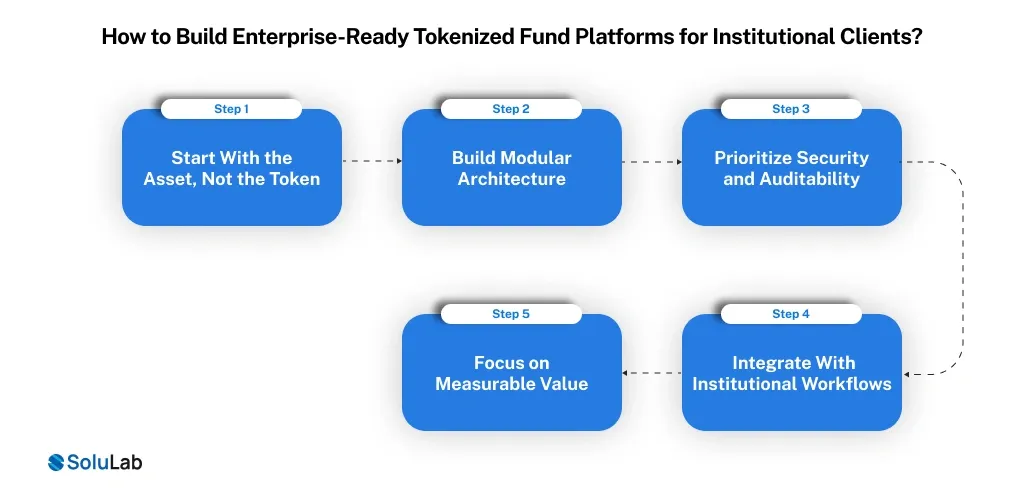
If you are building in this space, focus on enterprise reality.
1. Start With the Asset, Not the Token
Institutional buyers care about:
- Credit quality
- Liquidity profile
- Regulatory status
- Counterparty risk
The token layer should enhance trust, not complicate it.
2. Build Modular Architecture
A scalable tokenized MMF investment platform should separate:
- Fund management logic
- Token issuance layer
- Compliance module
- API integration layer
This allows customization for banks, asset managers, and fintech firms.
3. Prioritize Security and Auditability
Enterprise clients will demand:
- Smart contract audits
- Penetration testing
- SOC reporting
- Detailed governance documentation
Security is a sales requirement, not an afterthought.
4. Integrate With Institutional Workflows
Tokenized money market funds should plug into existing capital markets systems.
APIs and middleware matter more than flashy dashboards.
5. Focus on Measurable Value
Enterprise decision-makers respond to numbers.
Highlight:
- Reduction in settlement time
- Lower reconciliation costs
- Improved collateral turnover
- 24/7 liquidity access
When tokenization reduces friction by even 10–20%, treasury teams notice.

Conclusion
As discussed, institutional tokenized money market funds are gaining traction because they solve real problems.
- They improve liquidity access.
- They reduce operational friction.
- They enable programmable finance.
For blockchain innovators, it’s clear what they have to focus on:.
- Build compliant.
- Build integrated.
- Build for institutions.
To get these in your system, you need the support of an asset tokenization development company. We at SoluLab, with 250+ skilled developers, help enterprises design compliant, scalable tokenization strategies tailored to institutional standards.
If you are evaluating your next capital raise, contact us today to explore how we can support your tokenization roadmap- This is where real ROI begins.
FAQs
Deepika is a content writer who blends storytelling with strategic thinking. She explores topics across digital innovation, emerging tech, and the evolving blockchain industry. She enjoys breaking down complex ideas into simple, engaging narratives in the growing global markets.