Key Takeaways
- A technology stack is the set of languages, frameworks, databases and infrastructure used to build and run one application.
- In 2026 the most used building blocks are JavaScript and TypeScript on the front end and Node.js or Python on the backend. PostgreSQL leads databases and AWS leads cloud.
- MERN, Next.js with TypeScript, Python with Django or FastAPI, and .NET cover most new business software. LAMP and Ruby on Rails remain solid for specific cases.
- The right stack depends on your product, your team’s skills and your hiring market more than on popularity.
- Most products now need a fifth layer for AI features, so check that your technology stack can call models and store embeddings before you commit.
- Switching your technology stack later is possible, but it’s a phased migration, not a quick swap. Choosing well up front is far cheaper.
Introduction
The best technology stack for software development in 2027 is the one that fits your product, your team and your budget. For most new web products, that means a JavaScript or TypeScript front end (React or Next.js), a Node.js or Python backend, and PostgreSQL, deployed on a major cloud. Enterprise and regulated systems often run on .NET or Java instead.
That’s the short answer. The longer one matters. The technology stack you pick now decides how fast you ship, what your cloud bill looks like in two years, and how easily you can hire. This guide compares the ten stacks that cover most business software today. It also shows what developers actually use, based on the latest Stack Overflow surveys, and gives you a practical way to choose.
What Is a Technology Stack?
A technology stack is the set of languages, frameworks, libraries, databases, servers and cloud services that work together to build and run a software application. It’s also called a tech stack, software stack or development stack. Each layer handles one job, from what the user sees to where the data lives.
The term comes from the way the layers sit on top of each other. Your users touch the top layer. Everything underneath exists to make that layer fast, reliable and secure.
A technology stack is often named after its parts. LAMP is Linux, Apache, MySQL and PHP. MERN is MongoDB, Express, React and Node.js. Those acronyms are useful shorthand, but real products rarely stop at four components. A 2026 production app usually adds a cache, a message queue, a CI/CD pipeline, monitoring, and increasingly an AI model or two.
What Are the Layers of a Technology Stack?
A modern stack has five layers. The first two have been around forever.
1. Front End (Client Side)
The front end is everything users see and interact with in the browser or app: layout, forms, navigation and animations. It’s built with HTML, CSS and JavaScript or TypeScript, usually through a framework such as React, Angular, Vue or Svelte. For mobile, teams use native Swift and Kotlin, or cross-platform tools like React Native and Flutter.
2. Backend (Server Side)
The backend holds the business logic. It handles authentication, processes requests and manages data through CRUD operations: create, read, update, and delete. Common choices are Node.js with Express or NestJS, Python with Django or FastAPI, Java with Spring Boot, C# with ASP.NET Core, PHP with Laravel, and Ruby on Rails.
3. Database and Storage
The database stores your application’s data. Relational databases such as PostgreSQL, MySQL and Microsoft SQL Server store structured data in tables and are queried with SQL, the query language. Document databases such as MongoDB store flexible JSON-like records. Most production systems add Redis for caching and object storage such as Amazon S3 for files.
4. Infrastructure and DevOps
This layer decides where and how the software runs: cloud platform (AWS, Microsoft Azure or Google Cloud), containers (Docker), orchestration (Kubernetes), or serverless functions. It also covers CI/CD pipelines, infrastructure as code, logging and monitoring. Get this layer wrong and a well-written app still goes down under load.
5. AI and Data Layer
In 2026, many products ship with AI features: search that understands questions, assistants, document processing or recommendations. That adds model APIs or self-hosted models, an orchestration framework, and a vector store for embeddings, often PostgreSQL with the pgvector extension. Our AI tech stack guide covers this layer in depth.
What Are the Best Tech Stacks in 2027?
The ten stacks below cover most business software built today. They’re grouped by language family, not ranked, because the “best” one depends on what you’re building. Each entry lists its components, the projects it suits, and the trade-offs teams run into in practice.
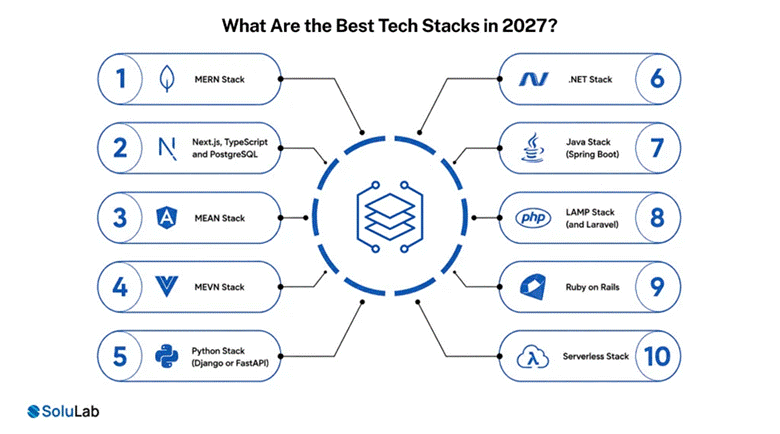
1. MERN Stack
MERN keeps the whole application in JavaScript, which means one language and one team from browser to database.
Components: MongoDB (database), Express (backend framework), React (front-end library), Node.js (runtime).
Best for: single-page applications, dashboards, real-time apps such as chat and collaboration tools, and MVPs that need to ship quickly.
Trade-offs: MongoDB’s flexible documents are fast to start with but don’t enforce relationships the way a relational database does. Many teams now swap it for PostgreSQL (sometimes called PERN) once data relationships get complex. React is the most widely used front-end library in the 2025 Stack Overflow survey, so hiring is easy. If React is your front end of choice, our React.js development services team builds on it daily.
2. Next.js, TypeScript and PostgreSQL
This is the technology stack most new SaaS products start on in 2026. Next.js is a React framework that adds server-side rendering, routing and API endpoints, so one codebase covers the front end and much of the backend.
Components: Next.js (React framework), TypeScript (a typed superset of JavaScript), Node.js runtime, PostgreSQL with an ORM such as Prisma or Drizzle, hosted on Vercel, AWS or another cloud.
Best for: SaaS platforms, ecommerce, marketing sites that depend on search traffic, and products where page speed matters.
Trade-offs: Next.js moves fast, and major releases have changed core patterns such as routing and caching. Managed hosting is convenient but can get expensive at scale, so plan the hosting model early. Teams that build on it usually need people comfortable across the front and back end, which is why many companies hire full-stack developers for it.
3. MEAN Stack
MEAN is MERN’s older sibling, with Angular in place of React.
Components: MongoDB, Express, Angular, Node.js.
A note on versions: AngularJS (version 1.x) reached end of support on 31 December 2021. Modern Angular (version 2 and later) is a separate framework that Google actively maintains, and it’s what MEAN uses today.
Best for: large enterprise front ends, internal tools with many forms and workflows, and big teams that want a framework with strong conventions built in.
Trade-offs: Angular has a steeper learning curve than React or Vue. In return, its opinionated structure keeps large codebases consistent across many developers.
4. MEVN Stack
MEVN swaps in Vue, a lighter front-end framework known for a gentle learning curve.
Components: MongoDB, Express, Vue.js, Node.js.
Best for: small and mid-sized web apps, and teams adding interactivity to an existing site one page at a time, since Vue can be adopted gradually.
Trade-offs: Vue’s hiring pool is smaller than React’s in most markets, especially in the US. Vue focuses on the view layer and uses a component-based design, so you’ll pick separate libraries for routing and state as the app grows.
5. Python Stack (Django or FastAPI)
Python is the default language for data and AI work, which makes it a strong backend choice when a product leans on either.
Components: Python, Django (full-featured framework with admin and ORM) or FastAPI (lightweight, async API framework), a React or Vue front end, PostgreSQL, Redis and Celery for background jobs.
Best for: data-heavy platforms, products with machine learning or LLM features, fintech and healthtech backends, and internal analytics tools. It’s also the usual backbone of AI development projects.
Trade-offs: Python is slower than Go, Java or C# for CPU-heavy work, so performance-critical services sometimes move to another language later. Async code in FastAPI needs discipline to avoid blocking calls.
6. .NET Stack
Microsoft’s stack has been cross-platform since .NET Core, so it runs on Linux and in containers, not only on Windows servers.
Components: C#, ASP.NET Core (backend framework), Angular, React or Blazor (front end), Microsoft SQL Server or PostgreSQL, often hosted on Microsoft Azure.
Best for: enterprise systems, companies already invested in Microsoft 365 and Azure, and regulated industries that value long-term support releases.
Trade-offs: SQL Server and Windows licences add cost compared with open-source alternatives. The ecosystem is strongest when you stay inside Microsoft’s tools.
7. Java Stack (Spring Boot)
Java remains the backbone of banking, insurance and large-scale transaction systems.
Components: Java or Kotlin, Spring Boot, a React or Angular front end, PostgreSQL or Oracle, and Apache Kafka for event streaming.
Best for: high-volume transactional systems, microservices architectures and enterprises with existing Java teams.
Trade-offs: more setup and boilerplate than Node.js or Rails, which slows early MVP work. It pays back in stability and tooling once the system is large.
8. LAMP Stack (and Laravel)
LAMP is the original open-source web stack and still runs a large share of the web, including WordPress.
Components: Linux, Apache (or Nginx, which makes it LEMP), MySQL or MariaDB, PHP, usually with the Laravel framework for custom applications.
Best for: content-driven websites, WordPress builds, budget-conscious web applications and hosting on low-cost shared or virtual servers.
Trade-offs: LAMP is built on Linux by definition, though PHP code moves to Windows-based variants (WAMP) with little change. It’s less suited to real-time features than Node.js, and PHP code quality varies widely between teams.
9. Ruby on Rails
Rails is built around convention over configuration, which lets a small team ship a full product quickly. GitHub and Shopify both built on it.
Components: Ruby, Rails, PostgreSQL, Hotwire for interactive front ends without heavy JavaScript.
Best for: MVPs, marketplaces and SaaS products where speed to market matters more than raw performance. Our Ruby on Rails development company page covers what we build with it.
Trade-offs: Rails was used by 5.9% of developers in the 2025 Stack Overflow survey, so the talent pool is smaller and often more senior and more expensive.
10. Serverless Stack
A serverless stack runs your code on cloud services where the provider manages servers, scaling and patching. Your team deploys functions and pays per request instead of keeping machines running.
Components: AWS Lambda, Azure Functions or Google Cloud Functions; an API gateway; a managed database such as Amazon DynamoDB or Aurora Serverless; a front end served from a CDN.
Best for: event-driven workloads, APIs with spiky traffic, scheduled jobs and back-office automation. Choosing the provider is usually the bigger decision, and our cloud computing consulting services team helps with that.
Trade-offs: cold starts add latency to the first request, local debugging is harder, and each provider’s services differ, which increases lock-in. At steady high traffic, containers are often cheaper.
How Does Each Technology Stack Compare?
| Stack | Main language | Best for | Learning curve | Hiring pool |
| MERN | JavaScript | SPAs, real-time apps, MVPs | Moderate | Very large |
| Next.js + TypeScript | TypeScript | SaaS, ecommerce, SEO-led sites | Moderate | Large |
| MEAN | TypeScript | Enterprise front ends | Steep | Large |
| MEVN | JavaScript | Small to mid web apps | Gentle | Medium |
| Python (Django/FastAPI) | Python | Data, AI and fintech backends | Gentle | Very large |
| .NET | C# | Enterprise, Microsoft shops | Moderate | Large |
| Java (Spring Boot) | Java/Kotlin | Banking, high-volume systems | Steep | Large |
| LAMP / Laravel | PHP | Content sites, budget web apps | Gentle | Medium |
| Ruby on Rails | Ruby | MVPs, marketplaces | Gentle | Small |
| Serverless | Any | Event-driven, spiky workloads | Moderate | Depends on provider |
Hiring pool is relative, based on how many developers report using each core technology in the Stack Overflow surveys below.
Which Technologies Do Developers Actually Use in 2026?
Popularity isn’t a reason to pick a technology stack on its own. Still, it tells you how easy hiring will be and how much community support you’ll find.
According to the Stack Overflow 2026 Developer Survey (more than 30,000 respondents), JavaScript is the most used language at 62.0%, followed by SQL (58.4%), Python (58.0%) and TypeScript (43.8%). PostgreSQL leads databases at 57.9%, ahead of SQLite (42.1%), MySQL (35.1%), Redis (28.3%), Microsoft SQL Server (27.1%) and MongoDB (19.0%).
The 2025 survey’s framework data shows the same pattern:
| Web framework or technology | Share of developers (2025) |
| Node.js | 48.7% |
| React | 44.7% |
| Next.js | 20.8% |
| Express | 19.9% |
| ASP.NET Core | 19.7% |
| Angular | 18.2% |
| Vue.js | 17.6% |
| FastAPI | 14.8% |
| Spring Boot | 14.7% |
| Django | 12.6% |
| Laravel | 8.9% |
| Ruby on Rails | 5.9% |
On cloud, AWS (43.3%) leads Microsoft Azure (26.3%) and Google Cloud (24.6%) in the 2025 data.
Two things stand out. PostgreSQL has become the default database for new projects, which is why several stacks above now pair with it instead of MongoDB or MySQL. And TypeScript is used by more than four in ten developers, so most new JavaScript stacks are really TypeScript stacks.
How Do You Choose the Right Technology Stack?
Start from the product, not the trend. Work through these seven questions in order. By the end, two or three stacks will usually stand out.
1. What Does the Product Need to Do?
List the features that shape the architecture: real-time updates, heavy data processing, offline mobile use, payments, or AI features. A chat app pushes you toward Node.js. A reporting platform leans toward Python and PostgreSQL. For a content site, LAMP or Next.js may be all you need.
2. Does the Technology Stack Match Your Team’s Skills?
A technology stack your team knows well beats a better-on-paper one they have to learn mid-project. If you’ll hire, check the local talent market and rates for that stack. If you’ll outsource, make sure the partner has shipped production work in it, not just a demo. Our guide to choosing a software development partner lists what to check before you sign.
3. How Far Will the Technology Stack Need to Scale?
Estimate users, requests and data volume for the next two to three years, not the next ten. Every technology stack in this guide can scale with the right architecture. The difference is how much engineering effort it takes and what it costs to run.
4. What Are the Security and Compliance Requirements?
Healthcare, finance and government projects carry rules on data residency, encryption and audit trails. Mature stacks such as .NET and Java come with long-term support releases and established security tooling, which simplifies audits. Whatever you choose, check that the cloud region and managed services meet your regulator’s rules.
5. What Will the Technology Stack Cost to Build and Run?
Look beyond build cost. Licences, cloud hosting, monitoring and developer salaries over three years usually outweigh the initial build. Our breakdown of the cost to build a SaaS product shows how those line items add up.
6. How Fast Do You Need to Launch?
To test the market in weeks, choose a technology stack built for speed: Rails, Django, Laravel or Next.js. It also helps to be clear about what you’re building first. Our guide to POC vs prototype vs MVP explains which one fits which stage.
7. Is the Technology Stack Ready for AI Features?
Even if AI isn’t on the first roadmap, it probably will be soon. Check that your backend can call model APIs comfortably and that your database can store embeddings, for example, PostgreSQL with pgvector. Python and TypeScript have the most mature AI libraries today.

Which Technology Stack Fits Which Type of Project?
| Project type | Strong choices | Why |
| SaaS platform | Next.js + TypeScript + PostgreSQL; Python + React | Fast iteration, strong ecosystems, easy hiring |
| Enterprise internal system | .NET; Java Spring Boot; MEAN | Long-term support, structure for large teams |
| Fintech or banking | Java Spring Boot; .NET; Python for analytics | Transaction safety, audit tooling, mature security |
| Ecommerce | Next.js; LAMP with Laravel or WooCommerce | Page speed, SEO, payment integrations |
| Real-time app (chat, live tracking) | MERN; Node.js with WebSockets | Event-driven, non-blocking I/O |
| AI-powered product | Python (FastAPI) + React + PostgreSQL with pgvector | Best AI library support |
| MVP on a tight timeline | Ruby on Rails; Django; Next.js | Convention-driven, fast to ship |
| Event-driven or spiky workloads | Serverless on AWS, Azure or Google Cloud | Pay per use, automatic scaling |
| Mobile app | React Native or Flutter (cross-platform); Swift and Kotlin (native) with any backend above | Web stacks like MERN or Rails power the backend, not the app itself |
A note on mobile: MERN, Rails and other web stacks don’t build mobile apps on their own. They supply the backend and APIs. The app itself is built with a cross-platform framework such as React Native or Flutter, or natively with Swift or Kotlin.
If you’re building a SaaS product, our SaaS product development team works across most of the stacks above.
What Are the Most Common Technology Stack Mistakes?
We see the same handful of mistakes across projects.
Choosing for the resume. Teams pick a new framework because engineers want to learn it, then spend months fighting immature tooling.
Over-engineering on day one. Microservices, Kubernetes and event streaming make sense at scale. For an MVP with a few hundred users, they mostly add cost and slow you down.
Ignoring the hiring market. A niche stack can work brilliantly until a key developer leaves and the replacement takes four months to find.
Skipping DevOps. Without CI/CD, automated tests and monitoring, any stack becomes fragile. Our DevOps consulting services team often gets called in at exactly this point.
Not matching the delivery process. Your technology stack and your team’s way of working should fit together. Our guide to software development methodologies covers how to pick the right process.
Can You Switch Your Technology Stack Later?
Yes, but treat it as a migration, not a switch. The safest approach is phased. Put APIs in front of the old system and rebuild modules one at a time on the new stack. Run old and new in parallel, and cut over only after each piece passes testing. This is often called the strangler fig pattern.
A full rewrite is riskier and usually the last resort, kept for code that’s too fragile or undocumented to change safely. If you’re already running on an outdated stack, our guide to legacy application modernization walks through the options, from rehosting to full refactoring.
The best way to avoid a painful migration is to choose your technology stack with the next three years in mind, not just the next three months.
Conclusion: Which Technology Stack Is Best?
No single stack wins everywhere. In 2027, the safest default technology stack for a new web product is TypeScript on the front end with Node.js or Python on the backend. Pair it with PostgreSQL on a major cloud. Enterprises with Microsoft or Java teams are usually better served staying in those ecosystems. Rails, Django and Laravel still get MVPs to market fastest.
Whatever you choose, decide based on your product, your team, and your total cost over three years. Fashion and benchmarks matter far less. If you want an outside view, our custom software development team can review your shortlist with you.
Shipra Garg is a tech-focused content strategist and copywriter specializing in Web3, blockchain, and artificial intelligence. She has worked with startups and enterprise teams to craft high-conversion content that bridges deep tech with business impact. Her work translates complex innovations into clear, credible, and engaging narratives that drive growth and build trust in emerging tech markets.