Key Takeaways
- Legacy application modernization improves application performance, security, scalability, and maintainability.
- Businesses can choose from approaches such as rehosting, replatforming, refactoring, rearchitecting, rebuilding, or replacing applications.
- Modernization costs depend on application complexity, integrations, data migration, technology stack, and project scope.
- Cloud computing, APIs, automation, and AI-assisted development are shaping modernization strategies in 2026.
- A phased modernization approach helps reduce business disruption, manage costs, and minimize migration risks.
Legacy application modernization is the process of updating outdated software, code, or architecture so it runs on current platforms. It cuts maintenance cost and security risk, and opens the door to cloud, API, and AI capabilities. Teams choose from seven strategies, ranging from a simple rehost to a full rebuild, based on business goals and app risk.
SoluLab builds and modernizes enterprise systems for companies stuck on aging stacks. If your roadmap needs an engineering partner, our enterprise software development company team assesses your application portfolio, picks the right strategy per app, and ships the migration in phases so you avoid a risky big-bang cutover.
What is legacy application modernization?
Legacy application modernization is the work of updating aging software so it fits current technology and business needs. That can mean moving an app to the cloud, rewriting its code, replacing its database, exposing REST APIs, or refreshing its user interface. IBM defines it as upgrading or transforming outdated, often monolithic systems into modern, more efficient ones (IBM).
A “legacy” application is any system that still runs but blocks current work. Common examples:
- A monolith where every change forces a full redeploy.
- A mainframe app written in COBOL that few engineers still know.
- An on-premise system that cannot scale during traffic spikes.
- Software tied to an operating system or database version the vendor no longer supports.
Modernization touches four layers: code (refactoring, language migration), data (schema and database moves), infrastructure (on-prem to cloud, containers), and experience (the UI and the APIs other systems call). You rarely touch all four at once. The point is to fix what holds the business back, not to rewrite for its own sake.
Definition box: legacy modernization vs. rewrite vs. migration
| Term | What it means |
| Modernization | Updating an app’s code, data, infrastructure, or UX so it meets current needs. The umbrella term. |
| Cloud migration | Moving an app from on-prem to a cloud platform. One tactic inside modernization. |
| Rewrite (rebuild) | Building the app fresh from the ground up. The most expensive modernization path. |
| Refactor | Restructuring existing code without changing what the app does from the outside. |
Why do companies modernize legacy applications?
Companies modernize because old software gets more expensive and riskier every year it stays untouched. The direct drivers are cost, security, talent, and integration limits.
- Maintenance eats the budget. Analyst estimates for the share of IT spend that goes to keeping existing systems running are high. Gartner projected that by 2025 organizations would spend a large portion of their IT budgets servicing technical debt rather than building new capability [VERIFY: confirm exact Gartner figure and year]. McKinsey has reported that CIOs estimate 10 to 20 percent of the technology budget meant for new products gets diverted to resolving tech-debt issues (IT Convergence citing McKinsey).
- Security exposure grows. Unsupported operating systems and libraries stop getting patches, so known vulnerabilities stay open.
- Talent gets scarce. Fewer engineers learn COBOL, old PL/SQL, or dated frameworks, so hiring and knowledge transfer get harder and slower.
- Integration hits a wall. Old apps often lack APIs, so connecting them to modern SaaS, analytics, or AI tools means brittle workarounds.
Left alone, these costs compound. Modernization is how a business stops paying a growing tax on software it can no longer change quickly.
What are the 7 strategies for legacy application modernization?
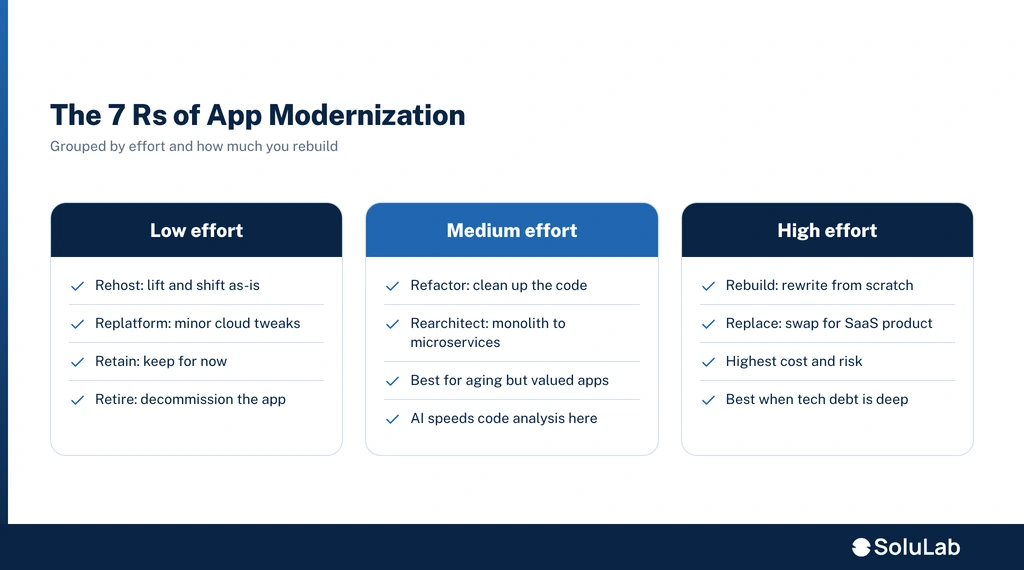
There are seven common strategies, often called the 7 Rs: rehost, replatform, refactor, rearchitect, rebuild, replace, and retire or retain. Gartner introduced the original set of migration options, and AWS popularized a 6 Rs version for cloud migration; Microsoft documents a 6 Rs framework for application modernization directly (Microsoft Learn). IBM lists a 7 Rs version for cloud migration including relocate, repurchase, retire, and retain (IBM). The table below is the single comparison none of the top-ranking pages ship.
| Strategy | What it means | Effort [VERIFY] | Cost signal [VERIFY] | Risk | Best-fit situation |
| Rehost (lift and shift) | Move the app to new infrastructure, usually cloud, with no code change. | Low | Low | Low | You need to exit a data center fast and the app runs fine as-is. |
| Replatform (lift and reshape) | Move to the cloud with minor changes, such as a managed database or container. | Low to medium | Low to medium | Low to medium | You want some cloud benefits (managed services, autoscaling) without a rewrite. |
| Refactor | Restructure the existing code for clarity, performance, or maintainability, same behavior. | Medium | Medium | Medium | The app is worth keeping but the code is hard to change or slow. |
| Rearchitect | Change the app’s structure, for example splitting a monolith into microservices. | High | High | Medium to high | Scaling, deployment speed, or team autonomy is blocked by the current architecture. |
| Rebuild | Rewrite the app from scratch on a modern stack, keeping the requirements. | Very high | High | High | The code is beyond saving but the business capability must stay. |
| Replace (repurchase) | Retire the custom app and adopt a commercial or SaaS product instead. | Medium | Varies (licensing) | Medium | A market product already covers the need better than custom software. |
| Retire / Retain | Decommission apps no longer used, or intentionally leave one alone for now. | Low | Low | Low | The app is redundant (retire) or not worth touching yet (retain). |
Effort, cost, and risk labels above are directional planning signals, not quotes. Confirm figures against your own portfolio during assessment.
How do you choose the right modernization strategy?
You choose by weighing three things per app: business value, technical health, and risk tolerance. High-value apps in poor technical shape justify heavier strategies (rearchitect or rebuild). Low-value or healthy apps get the light touch (rehost, retain, or retire).
A simple decision path our engineering team uses:
- Is the app still needed? If not, retire it. If yes, continue.
- Does a commercial product cover the need better? If yes, consider replace. If no, continue.
- Is the code healthy and just hosted in the wrong place? If yes, rehost or replatform.
- Is the code the problem but the architecture is fine? If yes, refactor.
- Is the architecture blocking scale, speed, or team autonomy? If yes, rearchitect, and rebuild only when refactoring cannot get there.
Most real portfolios mix strategies. A single migration program might rehost twenty low-risk apps, replatform the databases behind them, refactor two revenue systems, and retire a handful nobody uses. The skill is mapping each app to the cheapest strategy that removes its actual constraint.
How does AI help with legacy application modernization?
AI speeds up the slowest, most manual parts of modernization: reading old code, documenting what it does, and rewriting it. AI coding agents can analyze a legacy codebase, recover lost documentation, generate tests, and propose refactors, which shortens the discovery phase that usually stalls these projects.
Where AI helps most today:
- Code analysis. Parse a large, undocumented codebase and map dependencies, dead code, and data flows.
- Documentation recovery. Generate readable explanations of what modules do when the original authors are gone.
- Refactoring assistance. Propose safer restructurings and translate between languages, with human review.
- Test generation. Write characterization tests so you can change code with a safety net.
This is where SoluLab’s combined AI and software engineering position matters. We wrote about the mechanics in our guide to AI coding agents for legacy code refactoring, which covers how agents modernize codebases faster while keeping code quality and stability intact. AI does not remove the need for engineers. It removes the grind so engineers spend time on judgment calls instead of archaeology.
What are the common challenges in legacy modernization, and how do you avoid them?
The biggest challenges are hidden dependencies, data migration risk, downtime fear, and change management. Each has a known mitigation.
- Hidden dependencies. Old systems connect to things nobody documented. From our engineering team: before touching code, we run a discovery pass that maps every inbound and outbound connection, including the batch jobs and shared databases that never show up in an architecture diagram. Skipping this is the most common reason a “simple” migration breaks something downstream.
- Data migration risk. Moving or reshaping data can corrupt or lose records. Mitigate with staged migration, reconciliation checks, and a rollback plan before any cutover.
- Downtime and the big-bang fear. Many buyers say the same thing: we cannot afford downtime or a large risky rewrite [SALES INPUT NEEDED: phrase the phased, zero-downtime migration offer]. The answer is a phased migration where you move slices behind a routing layer, run old and new side by side, and cut over gradually. No single high-stakes switch.
- Change management. Users resist new interfaces and workflows. Involve them early, keep familiar patterns where you can, and train before launch, not after.
How much does legacy application modernization cost?
Cost depends on scope, not a single price tag. The honest answer is that it scales with how many apps you modernize, how complex they are, how much data moves, and which compliance rules apply. Any firm quoting a flat number before assessing your portfolio is guessing.
The main cost drivers:
- App count and complexity. More apps, and more interdependencies between them, raise both effort and coordination cost.
- Chosen strategy. A rehost is far cheaper than a rebuild. Your blended cost depends on the mix across the portfolio.
- Data volume and quality. Large or messy datasets need more migration and cleanup work.
- Compliance and security. Regulated data (health, finance) adds audit, encryption, and validation work.
- Integration surface. Every external system the app talks to is added scope.
Rough project ranges vary too widely to state responsibly without your specifics [VERIFY: SoluLab typical engagement cost bands by strategy]. One useful comparison we have published looks at AI-assisted versus manual migration costs [VERIFY live URL], which shows where automation shifts the cost curve. To scope your own number, start with a portfolio assessment.
How long does a legacy modernization project take?
Timeline scales with strategy and app count, not calendar preference. A single rehost can take weeks. A rearchitect from monolith to microservices, or a full rebuild, can run many months to over a year for a large system [VERIFY: SoluLab typical timeline bands].
Timeline drivers by strategy:
- Rehost / replatform: shortest, because code stays largely intact.
- Refactor: medium, gated by test coverage and code size.
- Rearchitect / rebuild: longest, because you are redesigning and re-implementing.
Phasing changes the felt timeline. A phased program delivers value in the first months (early apps migrated, early cost savings) even while the full portfolio takes a year, which is easier to fund and de-risk than a single long push with no interim wins.
What does a legacy modernization roadmap look like?
A modernization roadmap moves through five stages: assess, prioritize, pilot, migrate, and optimize. Each stage feeds the next, and you revisit the plan as you learn.
- Assess. Inventory every application. Score each on business value and technical health. Map dependencies. This is the application portfolio assessment.
- Prioritize. Rank apps by value and risk. Pick the strategy (one of the 7 Rs) for each.
- Pilot. Modernize one representative app end to end. Prove the approach, the tooling, and the cutover process on something real but low risk.
- Migrate. Roll out in waves, running old and new in parallel where downtime is unacceptable, with reconciliation and rollback at each step.
- Optimize. Once migrated, tune cost, performance, and security, and retire the old infrastructure.
This is where a partner earns its fee. If you want a team to run this loop with you, from portfolio assessment through cutover, talk to SoluLab’s enterprise software development company practice.
Where does modernization connect to cloud and DevOps?
Modernization rarely stops at the app. Most programs also touch how the app is hosted and how it ships. Moving to the cloud is often the vehicle for modernization, which is why a cloud application development company is usually involved in replatform and rearchitect work. Getting the platform right (managed services, autoscaling, networking) is what a cloud computing consulting company handles during assessment and design.
The second half is delivery. A modernized app is only as good as your ability to ship changes to it safely. That is where DevOps consulting services fit: CI/CD pipelines, infrastructure as code, and observability so the newly modernized system stays fast to change instead of drifting into the next generation of legacy.
Ready to modernize your legacy applications?
The fastest way to a credible plan is a portfolio assessment: inventory your apps, score value and risk, and map each to the right strategy. SoluLab runs that loop end to end and ships the migration in phases so you avoid downtime and big-bang risk. Talk to our enterprise software development company team to scope your modernization roadmap and get a costed, phased plan for your stack.
FAQ
Chintan leads SoluLab's highest-level AI consulting conversations, assessing whether a client's business problem actually justifies an AI investment before any solutioning begins.