More companies shift to the cloud every quarter, and that shift has pushed demand for SaaS development sky high. SaaS stands for Software as a Service. In plain terms, it’s a way of distributing software where a third party runs the application and users everywhere reach it through the internet. Cloud computing has a couple of cousins worth knowing: IaaS (infrastructure as a service) and PaaS (platform as a service). Of the three, SaaS is the one most businesses actually touch day to day.
According to Statista, worldwide SaaS revenue will hit $197 billion in sales in 2023. That’s two-thirds of the entire public cloud services market. So no, this isn’t a fluke. Companies are moving to SaaS development because it simplifies operations, makes collaboration easier, and just works better for teams spread across time zones. A good SaaS development firm can be worth the investment here, helping you build software with the right features baked in from the start, and often paying for itself through ROI down the line. Work with a proven SaaS development company and you get something scalable and effective, built for what businesses actually need today, not a demo that only looks nice in a pitch deck.
That climb toward cloud-based tools isn’t slowing down. But what does it actually cost to build a SaaS product in a market this crowded? For startups and companies eyeing this space, that question matters more than almost any other.
SaaS development costs swing wildly, and the reasons are fairly predictable once you look closely: project size, feature set, and where your developers sit geographically all move the number. This piece walks through those cost factors so your budget and your strategy line up with where the market actually is.
Overview of SaaS-Based Products
SaaS, or Software as a Service, delivers programs over the internet. No downloads, no installs. People also call it web-based software, hosted software, or on-demand software. Whatever the label, it’s built to be simple to use and easy to scale.
Subscribe to a SaaS product and you’re paying for access, not ownership. Once you’re in, the software keeps adjusting to give you a more personalized experience. These SaaS solutions carry a handful of features built to make company operations run smoother.
Three things matter most here: value-based pricing, real competitive research, and a clear read on user demand, especially for organizations working out how to price B2C SaaS products. Get it right, and the strategy satisfies customers now while protecting revenue for years down the line.
How to Start Building a Saas Product From Scratch?
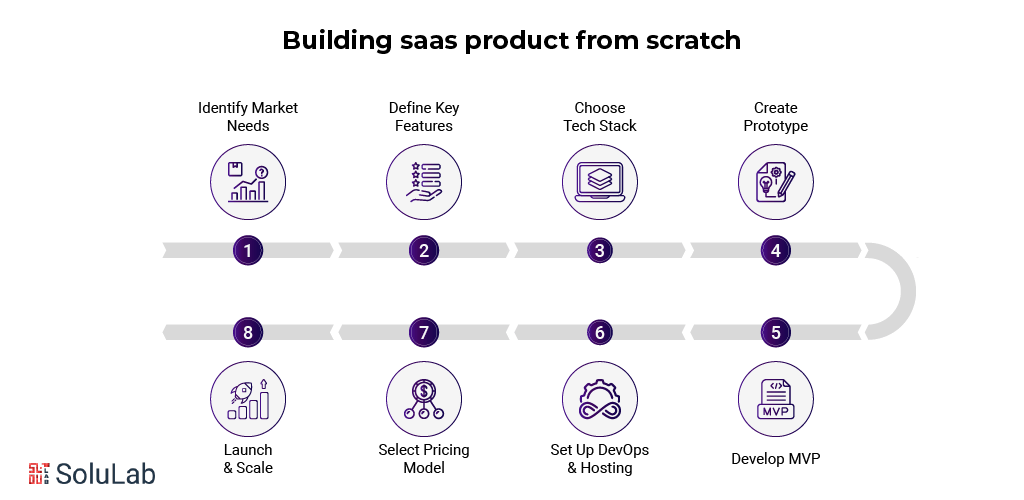
Building a SaaS product from zero takes three things: technical know-how, real market research, and a working grasp of how the SaaS business model actually functions. Whether you’re launching a brand-new Software-as-a-Service company or moving an old-school product onto the cloud, a methodical approach gets you to something scalable a lot faster than winging it. Start here:
1. Find a Need in the Market
A good SaaS product solves something real, not something theoretical. So study your rivals. Study your target buyers even harder. What’s actually broken for them, and how would you fix it? A market gap you’ve genuinely researched, not guessed at, is what keeps your SaaS business model tied to customer needs instead of drifting into features nobody asked for.
2. List the Main Features and the Unique Value Proposition
Figure out the handful of features that actually set your SaaS product apart, then build those first. Resist the urge to ship everything at once. It’s tempting, sure, but it slows you down and blurs your positioning. This focused approach is what gets you to a Minimum Viable Product (MVP) you can put in front of real users right away.
3. Pick the Right SaaS Technologies
The tech stack you choose now shapes how well your Software as a Service business scales later, how secure it stays, and how much sleep your team loses during outages. A few common choices:
- Frontend: React.js, Vue.js, or Angular are the usual picks for a responsive, dynamic interface.
- Backend: Node.js, Python (Django or Flask), and Ruby on Rails all handle server-side logic well; pick based on what your team already knows.
- Database: PostgreSQL, MongoDB, and Firebase each handle data differently, so match the choice to your data structure.
- Cloud Infrastructure: AWS, Google Cloud, and Azure all give you room to host and scale as demand grows.
- Security and Authentication: OAuth, JWT, two-factor authentication, and SSL encryption cover most of what you need for identity and data protection.
4. Make a Prototype and Gather Feedback
Sketch it out first. A rough prototype tells you how the experience actually feels before you sink months into full development. Then put a beta version in front of real prospective customers and let their feedback shape what comes next.
5. Make the MVP (Minimum Viable Product)
An MVP is how you test the business plan without burning through your whole budget. Before you scale your Software as a Service or Blockchain as a Service business, nail the core features first and confirm users are genuinely getting value from it, not just signing up and disappearing.
6. Set up DevOps and Cloud Hosting
SaaS runs in the cloud, full stop, so the infrastructure underneath needs real money behind it, not an afterthought. Set up CI/CD pipelines so development never stalls, and lean on services like AWS Lambda, Kubernetes, and Docker to keep server management from eating your team’s week.
7. Choose a Pricing Model for SaaS
Revenue depends on getting the pricing model right for a B2C SaaS product. A few options worth weighing:
- Subscription pricing, monthly or annual plans
- A freemium model with premium tiers unlocked
- Usage-based pricing: pay-per-use, API calls, or storage caps
Tiered pricing lets different users get different levels of access, matched to what they actually need.
8. Launch and Grow Your SaaS Product
Once your MVP is stable, launch it with a real go-to-market plan behind it, not just an announcement and a hope. SEO, content marketing, PPC ads, and link building all pull traffic toward your site. Track your key metrics closely, ask customers what’s working and what isn’t, and adjust the business plan as you go.
Follow this path and you end up with a SaaS product built to adapt as user needs shift and new technology becomes available.
Benefits of SaaS Implementation
Adopt SaaS and the benefits show up fast, starting with the flexibility to work and collaborate whenever you need to. Here’s why so many businesses end up building it into how they operate:
- It reaches more people, in more places, without much extra effort. Small company or large one, a solid SaaS solution helps teams work together across distance.
- Building SaaS applications remains the top software choice for enterprises worldwide, mostly because it’s simple to set up and simple to use.
- Start-up costs stay low with SaaS, and a company can trim them further if the budget gets tight.
- Setup and ongoing effort stay minimal. Even a two-person shop can run SaaS without a dedicated IT team.
- Changes show up in real time. Multiple people can work the same file at once, no manual merging, no version chaos.
- Security gets built in from the start with SaaS application development, keeping company and customer data locked down.
Related: Enterprise SaaS
Why is it important to know how much it costs to build a SaaS Platform?
Before you start building a SaaS platform or app, figure out what it’s going to cost. There’s no fixed number here, no universal price tag you can plan around blindly. Too many variables shift the total. And if you don’t know roughly what it costs to hire SaaS developers, you’re making decisions without the one number that matters most.
- Budget Allocation Based on Knowledge: Know the real cost upfront and budgeting gets a lot easier. You can tell right away whether the project has the resources it actually needs.
- Better Risk Management: Cost clarity makes risk easier to manage. You can spot what’s likely to push the number up, and where extra funding might be needed before it turns into an emergency.
- Profit-Driven Pricing Strategy: Knowing your build cost lets you price the product to cover expenses, turn a profit, and still stay competitive against everyone else in the space.
- Retain Investors: A clear cost picture makes it far easier to convince investors to back your SaaS app, and to fund the bigger version you eventually want to build.
- Feature Prioritization: Once you know what things cost, prioritizing features stops being a guessing game.
Factors to Look For While Deciding the SaaS Product Development Cost
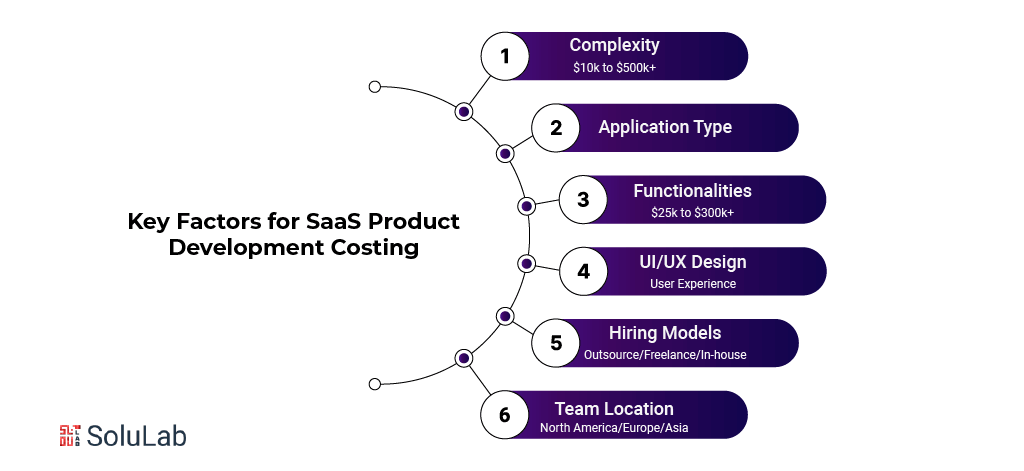
We touched on this earlier: a handful of factors drive the total SaaS product development cost, and shifting any one of them can swing the final number by a lot. Skip the guesswork. Taking the time to understand these pieces properly lets you shape the app around your actual needs without blowing past your budget.
1. Complexity of the Product
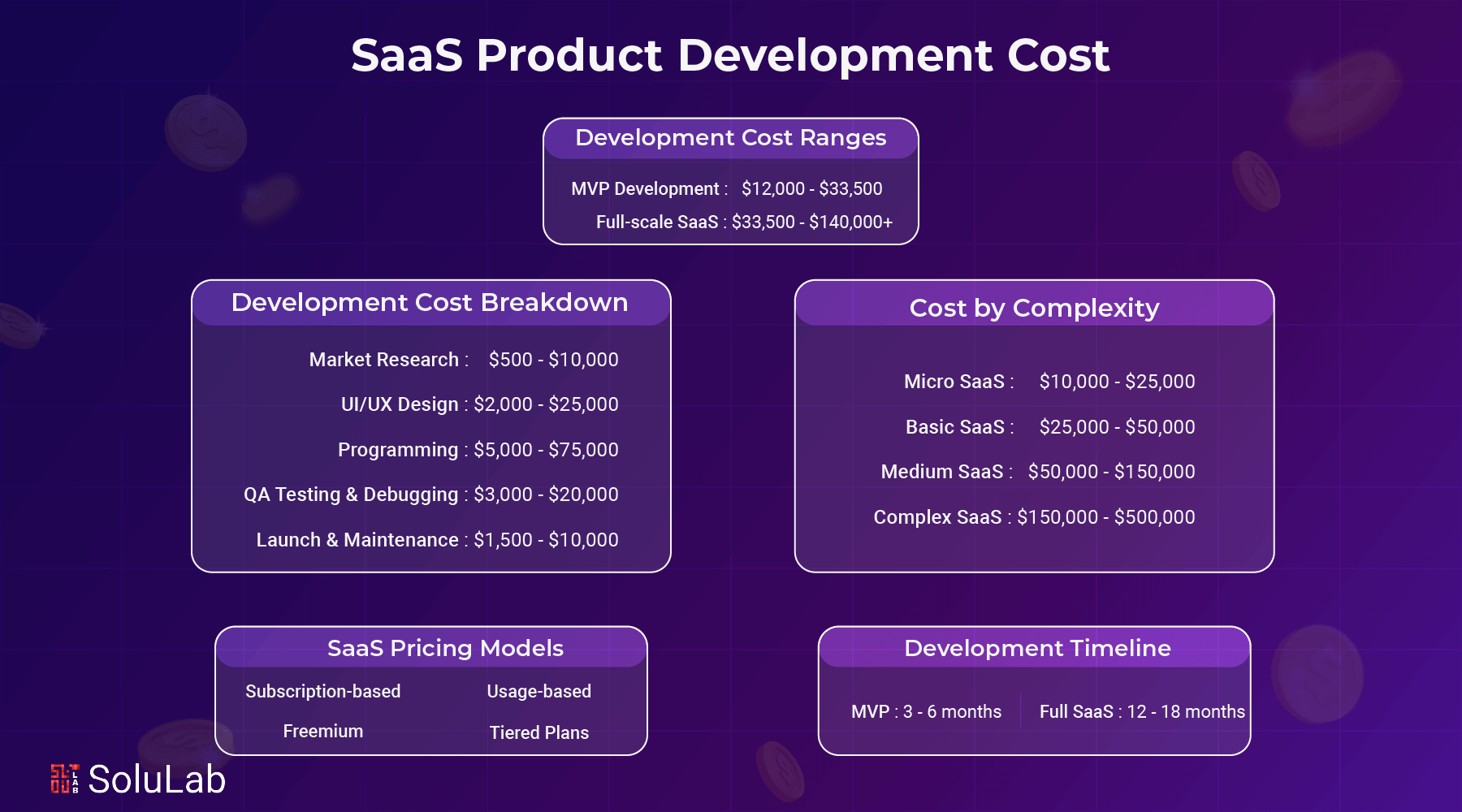
Complexity drives the cost more than anything else on this list. Pack in complex features and aim for wide usage, and both the timeline and the price tag stretch out. Here’s a rough breakdown by project complexity:
| Project Complexity | Estimated Cost |
| Micro SaaS Development | $10,000 – $25,000 |
| Basic SaaS Application | $25,000 – $50,000 |
| Medium SaaS Application | $50,000 – $150,000 |
| Complex SaaS Application | $150,000 – $500,000 |
2. Type of Application
What kind of SaaS application are you actually building? That answer moves the price more than most people expect. Different industries need different SaaS development services, and each app type calls for its own tech stack and its own team. Here’s what that looks like by application type:
| Application Type | Estimated Cost |
| Custom CRM Development | $30,000 – $150,000 |
| E-commerce Website Development | $40,000 – $200,000 |
| ERP Software Development | $50,000 – $250,000 |
| HRM Software Development | $25,000 – $120,000 |
3. Set of Functionalities
More features and more complexity means higher cost. It’s a fairly direct relationship. Add complex functionality, third-party integrations, or heavy customization, and the number climbs right along with it.
| Type of SaaS MVP | Estimated Cost |
| Simple SaaS MVP | $25,000 – $50,000 |
| Medium-Complexity SaaS App MVP | $50,000 – $150,000 |
| Complex SaaS MVP | $150,000 – $300,000+ |
4. UI/UX Design
Every SaaS system needs a user interface, that part’s non-negotiable. What varies is how much customization you layer on top, and that’s where the cost really moves. A well-designed, user-friendly interface does boost engagement, but good design isn’t free. It needs skilled UI/UX people behind it.
5. Hiring Models
You’ve got a few ways to staff this. Outsource the whole build to a SaaS development firm for a set cost. Hire freelance individuals instead, generally a more cost-effective choice than outsourcing. Or go in-house, recruiting dedicated SaaS engineers you manage directly. In-house works best for long-term projects, but it’s also the most expensive route, by a wide margin.
6. Location of the SaaS Development Team
Where your development team physically sits changes the total project cost more than most founders expect. Hire a SaaS development business in North America, Western Europe, or Australia, and you’re often paying double what you’d pay a comparable team in an Asian nation like India. Location alone can swing the entire cost of building your SaaS product.
Get a handle on these elements, and budgeting your SaaS application stops being guesswork. You can make choices that actually fit your numbers.
Read Also: How to Develop an AI SaaS Product?
A Detailed Breakdown of SaaS Development Costs
We’ve covered what drives the cost of SaaS application development. Now it helps to see where that money actually lands once you spend it. Here’s a recent tweet on SaaS development costs:
So this section breaks the price down phase by phase, showing where the budget needs to go for each core function.
1. R&D Expenses for SaaS Development
Building a SaaS product starts with real research and planning, and that phase needs its own dedicated budget. Market research, competitive analysis, and figuring out what users actually expect all happen here. Below is a rough estimate of the main cost components in the R&D stage of SaaS development:
| R&D Task | Description | Estimated Cost |
| Market Analysis | Identifying market demand, analyzing competitors, and defining the target audience. | $5,000 – $15,000 |
| Requirement Analysis | Documenting product specifications and gathering requirements from stakeholders. | $3,000 – $10,000 |
| Prototype & Wireframing | Designing early-stage product wireframes and visual representations. | $5,000 – $20,000 |
| Technical Feasibility Study | Assessing technological requirements, frameworks, and system architecture. | $7,000 – $25,000 |
| Proof of Concept (PoC) | Creating a basic version of the software to validate core functionality. | $10,000 – $30,000 |
| UI/UX Design | Designing an intuitive, visually appealing, and user-friendly interface. | $8,000 – $25,000 |
| Quality Assurance & Testing | Conducting various tests to ensure software performance and compliance with standards. | $10,000 – $30,000 |
| Deployment Strategy | Planning cloud deployment, infrastructure setup, and server configurations. | $5,000 – $15,000 |
| Ongoing Maintenance & Support | Post-launch updates, bug fixes, and continuous technical support. | $20,000 – $50,000+ |
2. SaaS Product Development Costs
This is where front-end and back-end work happens, where every capability and feature actually gets built into the program. It covers picking the right tech stack, the programming language, the SaaS architecture, API integration, and third-party services. Here’s how the development spend breaks down:
| SaaS Development Task | Description | Estimated Cost |
| Frontend Development | Implementing a user-friendly and responsive interface. | $10,000 – $40,000 |
| Backend Development | Creating server-side functionalities such as authentication, data handling, and processing. | $15,000 – $60,000 |
| Database Management | Structuring and optimizing the database to store and process data efficiently. | $8,000 – $30,000 |
| API Development | Building and managing APIs for seamless communication between front-end and backend systems. | $5,000 – $25,000 |
| Third-Party Integrations | Connecting external services such as payment gateways and analytics tools. | $5,000 – $20,000 |
3. Design-Related Costs
Usability comes down to an interface that’s genuinely interactive and engaging, especially for users who aren’t particularly tech-savvy. Custom UI/UX work costs extra, and SaaS development businesses bill for it separately. Here’s what to budget for on the design side:
| Design Task | Description | Estimated Cost |
| UI/UX Design | Crafting intuitive user interfaces, wireframes, and interactive prototypes. | $5,000 – $20,000 |
| Graphic Design | Creating visuals, icons, and graphical assets for branding. | $3,000 – $10,000 |
| Branding & Marketing Assets | Designing logos, brand colors, and promotional materials. | $2,000 – $8,000 |
4. Hosting Costs and Infrastructure
Infrastructure cost covers a handful of backend pieces: cloud hosting, server maintenance, database administration, networking. Here’s roughly what those expenses look like:
| Infrastructure Element | Description | Estimated Cost |
| Cloud Hosting Services | Subscription fees for platforms like AWS, Azure, or Google Cloud. | $500 – $5,000/month |
| Database Management | Costs for data storage solutions. | $200 – $3,000/month |
| Network Infrastructure | Includes expenses for data transfer, CDN, and load balancing. | $100 – $2,000/month |
| Cybersecurity Measures | Investments in firewalls, encryption, and data protection. | $1,000 – $10,000/year |
The Bottom Line
Building a SaaS product for 2026 takes careful planning, a clear read on development expenses, and the right tech stack from day one. Cost gets shaped by feature complexity, scalability needs, integrations, and compliance requirements, among other things. Get the SaaS solution organized well, and it pays back in productivity, creativity, and long-term growth, whether you’re a scrappy start-up or an established company.
We recently launched Morpheus.Network here at SoluLab, a SaaS platform built on blockchain technology and aimed squarely at the logistics sector. Morpheus. Network strengthens supply chain security and efficiency by pulling together blockchain, IoT, and real-time alerts into one system. It’s a solid example of how modern SaaS solutions can bridge legacy systems with newer technology, letting companies step into a more distributed future without ripping everything out and starting over.
The team at SoluLab, a SaaS development company, can walk you through the whole development process, from the first concept to final deployment, if you’re looking to build a high-performance SaaS application. Contact us now to learn how we can bring your SaaS vision to life quickly and without wasting budget.
FAQs
Shipra Garg is a tech-focused content strategist and copywriter specializing in Web3, blockchain, and artificial intelligence. She has worked with startups and enterprise teams to craft high-conversion content that bridges deep tech with business impact. Her work translates complex innovations into clear, credible, and engaging narratives that drive growth and build trust in emerging tech markets.