
Key Takeaways
- A software development partner is an external company that takes ongoing responsibility for building and maintaining your software, rather than delivering a one off project. Choosing one comes down to four things you can actually verify: technical expertise on your stack, a track record you can inspect, working practices that fit yours, and contract terms that let you leave.
What is a software development partner?
A software development partner builds and maintains software for you over time, with continuity of people and accountability that extends past the delivery date.
The difference from a vendor is duration and responsibility. A vendor completes a scope and moves on. A partner carries the consequences of its own architecture decisions, because it is still there when those decisions become expensive. For the broader relationship question, including strategy and hiring, see /technology-partner/
Why companies look for a software development partner
- Hiring a full team takes longer than the roadmap allows.
- The skills needed, particularly production AI and blockchain, are scarce and slow to hire locally.
- Headcount is constrained but the budget is operational.
- The work is outside the company’s core competence.
- An existing supplier has failed and the codebase needs someone to take it over.
How to find the right software development partner: a 10 step process
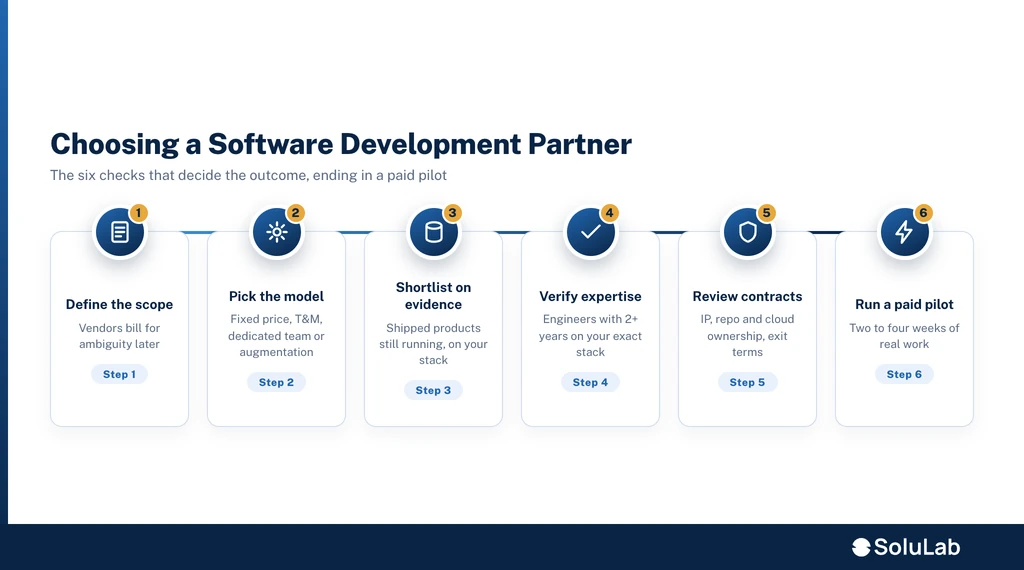
- Define the project scope, even roughly. A partner cannot be evaluated against an undefined need, and vendors who accept an undefined scope will bill for the ambiguity later.
- Decide the engagement model first. Fixed price, time and materials, dedicated team and staff augmentation attract different companies. See /it-staff-augmentation-services/
- Research and shortlist potential partners from inspectable evidence: shipped products still running, in your domain, on your stack.
- Check technical expertise properly. Ask how many engineers have two or more years on your exact stack, and ask to see code or architecture they are proud of.
- Evaluate industry experience. Regulated domains change the work more than the technology does.
- Assess communication and cultural fit. Time zone overlap in hours, response windows, language, and whether they will disagree with you.
- Check project management practice. How scope changes are recorded, how progress is demonstrated, and who you escalate to.
- Review contract terms: intellectual property assignment, repository and cloud ownership, replacement, notice, exit and transition.
- Interview the potential software development partner’s actual engineers, not the account team.
- Run a paid pilot, two to four weeks of real work. This tells you more than every proposal combined.
Key questions to ask before choosing a software development partner
- Who exactly will work on this, and can I interview them?
- How many of your engineers have shipped this stack to production?
- What would you cut from our scope, and why?
- What went wrong on a recent project, and what did you change?
- How do you handle a production incident out of hours?
- Who owns the code, the cloud accounts and the IP, from which day?
- What does handover look like if we leave?
- How do you record and price scope changes?
- What is your engineer turnover on a long engagement?
- Can we speak to a client of our size who has been with you over a year?
How to evaluate technical expertise
Claims are cheap on this. Four checks that are not:
| Check | What good looks like |
| Inspect real work | A running product they can name, with the engineers who built it available to discuss it |
| Depth on your stack | Named engineers with multi year experience, not a logo grid of technologies |
| Architecture reasoning | They can explain a decision they made and what they rejected |
| Paid pilot | Real code, in your repository, reviewed by you or an advisor |
If you have no technical person to judge the output, budget for an independent technical advisor for the pilot review. It is the cheapest insurance available in this process.
Common red flags when choosing a partner
- No scope cutting. A partner who agrees to everything is selling hours, not outcomes.
- You cannot meet the engineers. The people in the pitch are not the people who build.
- Code kept in the vendor’s repositories. Ownership should never be a migration project.
- Estimates with no ranges or assumptions. Certainty this early is a sales technique.
- No questions about your users. A partner that asks only technical questions will build exactly what you said.
- Rate far below the market. Someone is absorbing the difference, usually through seniority or turnover.
- Vendor only tooling that makes leaving expensive.
- No named escalation contact.
- Reluctance to discuss a failed project. Everyone has one.

Clear communication and cultural fit
The practical version of cultural fit is four agreements, written down:
- Overlap hours, in hours, not “flexible”.
- Response window for blocking questions.
- A weekly demo of working software.
- One named decision maker on each side.
Teams that agree these four rarely have a communication problem. Teams that talk about culture without them usually do.
Measuring software development partner success
Agree the measures before the engagement starts:
| Measure | Why it matters |
| Working software demonstrated every cycle | The only real evidence of progress |
| Cycle time from start to production | Reveals process problems early |
| Defect escape rate | Catches speed that is really corner cutting |
| Scope decisions recorded | Prevents the end of project dispute |
| Burn against estimate, monthly | Gives you time to act |
| Team stability | Turnover destroys context and is rarely disclosed |
| Documentation kept current | Decides what leaving costs |
What to look for in a custom software development partner specifically
Custom work adds three requirements beyond the general list: they must be willing to tell you when to buy off the shelf instead, they must design for the change you have not thought of yet, and they must hand over a test suite. Custom software without tests is a hostage situation rather than an asset.
How to partner with a software developer and launch a product
The sequence that works for a first product: scope small, agree the engagement model, run a paid pilot, contract properly, build one workflow to production, launch to a narrow audience, then decide what to build next from usage. The most common failure is agreeing a large scope with a partner you have not tested.
Why SoluLab
- You interview the engineers who will do the work.
- We say what we would cut from your scope, in writing, before you sign.
- Your repositories, cloud accounts and IP from the first commit.
- Written overlap hours and a named escalation contact.
- Documentation, test suite and runbook handed over, so leaving is always possible.
Proof
- Instant loans app for small business lending. Regulated delivery end to end.
- Algorithmic stock trading system. Data intensive engineering.
- Blockchain powered framework for EMR. Healthcare with access control requirements.
FAQs
Chintan leads SoluLab's highest-level AI consulting conversations, assessing whether a client's business problem actually justifies an AI investment before any solutioning begins.