Key Takeaways
- The healthcare industry faces major challenges, including fragmented data systems, rising breach costs, slow insurance processes, funding gaps, and inefficient asset utilization.
- Growing adoption of RWA tokenization in healthcare is changing how hospitals, biotech firms, and insurers manage medical infrastructure, research assets, and patient data.
- Technologies like blockchain in healthcare, smart contracts, and AI tokenization in healthcare are helping organizations improve security, transparency, automation, and operational efficiency.
- Medical industries are implementing healthcare data tokenization models to monetize digital healthcare assets, improve compliance, and unlock faster funding opportunities.
Healthcare is generating some of the world’s most valuable assets: genomic datasets, clinical IP, advanced diagnostic infrastructure.
Most of it is stuck. Locked inside systems built for filing cabinets, not programmable finance.
In 2026, the average healthcare data breach cost has crossed $10.22 million, while claim denials and fragmented data workflows keep draining billions from providers and insurers every year.
That is why RWA tokenization in healthcare is getting serious institutional attention. Converting physical and intangible healthcare assets into secure digital tokens gives organizations a real path to better liquidity, compliance visibility, and less operational drag.
More to the point, asset tokenization development services move healthcare away from slow-moving administrative systems toward transparent, automated, investor-accessible infrastructure built for modern medical scale.
What is Real World Asset Tokenization Development in Healthcare?
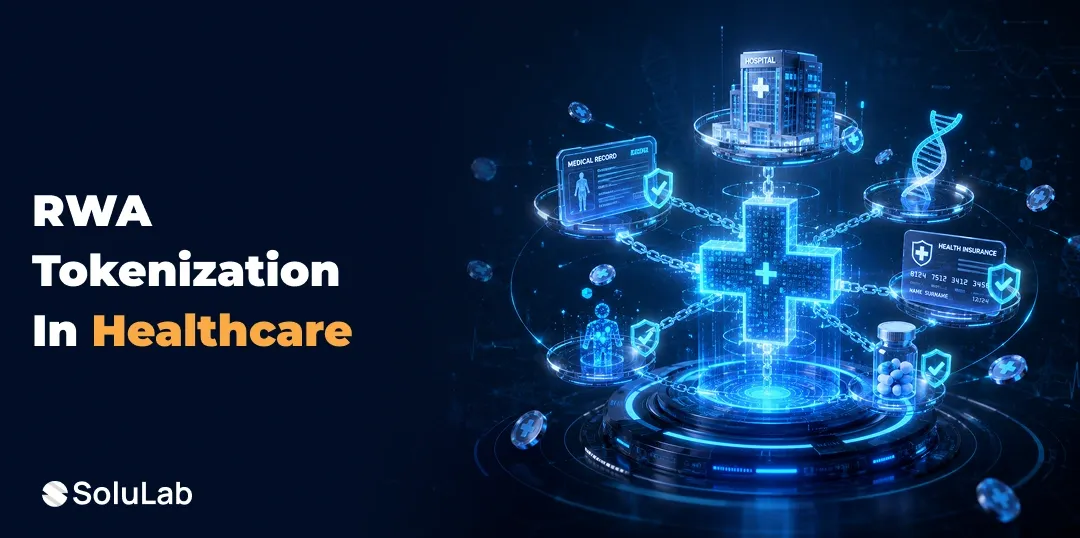
Real-world asset tokenization in healthcare means converting healthcare-based physical or financial assets into blockchain-backed digital tokens that carry ownership, usage rights, or revenue participation. The assets covered include hospital infrastructure, medical equipment, biotech patents, insurance claims, pharmaceutical research data, and tokenized patient-consent frameworks.
This is not about speculative crypto. The focus is operational: faster funding access, tighter compliance automation, and verifiable records across healthcare networks. A modern healthcare tokenization platform creates transparent transactions and programmable permissions that siloed legacy systems simply cannot.
1. Why Healthcare Needs Tokenization Services Now?
Healthcare systems bleed billions every year through administrative delays, denied claims, siloed records, and broken funding cycles. Tokenization addresses those structural gaps directly.
1.1. Faster Capital Access for Medical Innovation
Biotech firms and healthcare startups can use asset tokenization services to raise capital from global investors without waiting on traditional VC funding timelines.
1.2. Fractional Ownership of High-Value Assets
Expensive infrastructure like MRI machines, diagnostic labs, and specialty hospitals can become investable through a tokenized healthcare investment platform, which directly improves liquidity access for asset owners.
1.3. Secure and Auditable Data Sharing
With HIPAA-compliant healthcare tokenization, patient data access can be permissioned, traceable, and encrypted while meeting regulatory standards.
1.4. Automated Healthcare Operations
Smart contracts cut manual verification steps in insurance claims, provider settlements, and licensing workflows. In practice, this is where teams see the fastest return: fewer back-and-forth approvals, fewer errors, and lower per-transaction cost across the network.
How Asset Tokenization Development Solutions Apply to the Modern Medical Industry
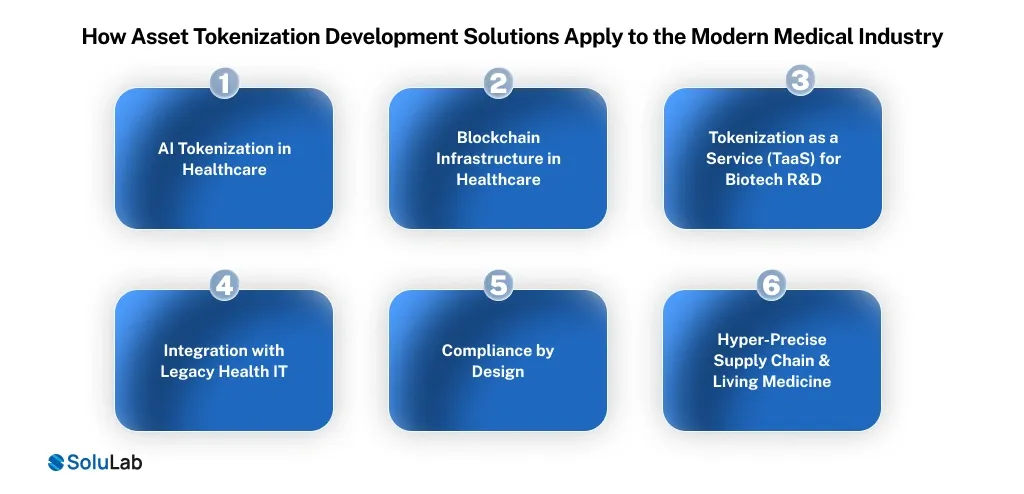
Simple record-keeping is behind us. The tokenization solutions disrupting the sector now are turning every clinical touchpoint into a value-generating event.
1. AI Tokenization in Healthcare
The biggest bottleneck for medical AI in 2026 is getting access to high-quality, diverse datasets. AI tokenization in healthcare lets labs securely “tokenize” their proprietary data.
- AI models can rent access to these tokens to train their algorithms without the data ever leaving the hospital’s secure environment.
- This creates a decentralized AI training network where hospitals earn revenue every time an AI model learns from their healthcare data tokenization nodes.
2. Blockchain Infrastructure in Healthcare
Healthcare demands high data security, interoperability, and transparency. Blockchain infrastructure gives you a decentralized, tamper-proof foundation to build on.
2.1 Role of Smart Contracts
Smart contracts are self-executing agreements coded on a blockchain. In healthcare, they handle a range of tasks that would otherwise require human sign-off at every step:
- Patient consent management: Automatically recording and verifying patient permissions to use their data, keeping privacy and legal compliance intact.
- Billing and payments: Cutting through insurance claims and billing by automatically triggering payments the moment conditions are met.
- Medical supply tracking: Automatically updating the status of pharmaceutical shipments or equipment, reducing errors and fraud.
Less manual work means fewer errors and faster workflows. Remove the hand-off bottlenecks and the whole system becomes more reliable.
3. Tokenization as a Service (TaaS) for Biotech R&D
Small biotech firms often die in the “Valley of Death,” the gap between discovery and Phase III trials, simply because funding runs out.
- Through tokenization as a service, a startup can tokenize the future royalties of a drug candidate.
- Instead of chasing a single VC, they can raise $50M from a global pool of 5,000 institutional and accredited investors in 48 hours. This is the “Uberization” of biotech funding.
4. Integration with Legacy Health IT
Healthcare organizations already run on a patchwork of IT systems, like electronic health records (EHRs) and hospital management software. Wiring blockchain into that existing stack is not trivial. It requires:
- Careful planning: Blockchain solutions must be compatible with current software and hardware so daily operations do not stall during the transition.
- Data interoperability: Blockchain platforms need to communicate and exchange data cleanly with legacy systems, not just sit alongside them.
- Scalable design: The infrastructure has to grow with the provider’s needs without performance degrading over time.
Blockchain consulting companies do the heavy lifting here: phased adoption, risk management, and making sure the transition does not break what already works.
5. Compliance by Design
Healthcare data is sensitive and heavily regulated under HIPAA and GDPR. Any blockchain solution in this space has to be built around those constraints from day one, not retrofitted later. That means:
- Secure: Protect patient data with encryption and decentralized storage to prevent breaches.
- Privacy-focused: Give patients control over who accesses their data through smart contracts and permissioned blockchains.
- Regulation-compliant: Designed from the start to meet all legal requirements, not as an afterthought that triggers costly fines and legal challenges.
When compliance is baked into the architecture, healthcare providers can actually adopt new technology confidently rather than treating every innovation as a legal liability.
6. Hyper-Precise Supply Chain & Living Medicine
With the rise of personalized mRNA treatments and Cell & Gene Therapy (CGT), the supply chain is the product. A temperature-sensitive treatment that fluctuates by 2 degrees Celsius becomes worthless.
- Tokenizing the shipment as a smart asset means payment only releases via smart contract when IoT sensors confirm the medicine stayed stable throughout the journey.
The Difference Between Utility Tokens vs Asset-Backed Tokens?
In healthcare, utility tokens give you access to specific services like telemedicine or health tracking apps. asset-backed tokens, by contrast, represent real ownership: shares in a biotech firm, rights to a medical patent. That distinction matters a lot when you are working with blockchain consulting companies to decide what kind of token structure fits your use case.
Non-fungible tokens in healthcare sit in their own category, used for unique medical items like individual test results or genetic profiles.
| Feature | Utility Tokens | Asset-Backed Tokens |
| Definition | Tokens that provide access to services or apps | Tokens that represent ownership of real assets |
| Purpose in Healthcare | Access to telemedicine, health monitoring tools, or platforms | Ownership of shares in biotech companies, patents, or physical healthcare assets |
| Value Basis | Value depends on usefulness within a platform | Value tied to the underlying real-world asset |
| Transferability | Usually transferable within a specific network | Can represent tradable ownership, often regulated |
| Regulatory Impact | Typically, fewer regulations, considered a utility | Often subject to securities laws and stricter compliance |
| Role in blockchain consulting companies | Used to build apps or platforms enhancing healthcare services | Used to enable investment and ownership opportunities in healthcare assets |
| Examples | Access tokens for a patient engagement app | Tokenized shares in a biotech research project |
Why the Healthcare Sector Needs RWA Tokenization?
Healthcare is one of the most asset-intensive sectors in existence: medical equipment, infrastructure, intellectual property, research data. Most of those assets are illiquid, underutilized, and nearly impossible to transfer or finance through traditional channels. RWA tokenization converts them into blockchain-based tokens that are tradable, divisible, and accessible in real time.
- Data Privacy and Ownership
Centralized data systems are sitting targets for breaches and leaks. Healthcare tokenization creates a decentralized system that gives patients actual control over who sees their data, while staying within HIPAA and GDPR boundaries.
- Transparent and Decentralized Clinical Trials
Clinical trials are slow and often opaque. With tokenization in healthcare, trial records become immutable: researchers cannot quietly alter data after the fact, and sponsors get live visibility into how a study is progressing. This matters for blockchain development companies that are trying to reform how clinical research actually works.
If you want to see exactly how blockchain can improve the quality and transparency of clinical trials, check out this case study
- Empowering Patients with Control Over Their Data
With tokenization, patients own their health information and decide who can use it. Smart contracts allow patients to share or block access without going through a hospital’s IT department every time, making healthcare genuinely patient-centered.
- New Research and Biotech Funding
With RWA asset tokenization, biotech companies can break large assets into smaller, affordable pieces. New funding channels open up, and leading blockchain development companies in healthcare are already helping clients take advantage of that shift.
Real-World Use Cases of RWA Tokenization in Healthcare
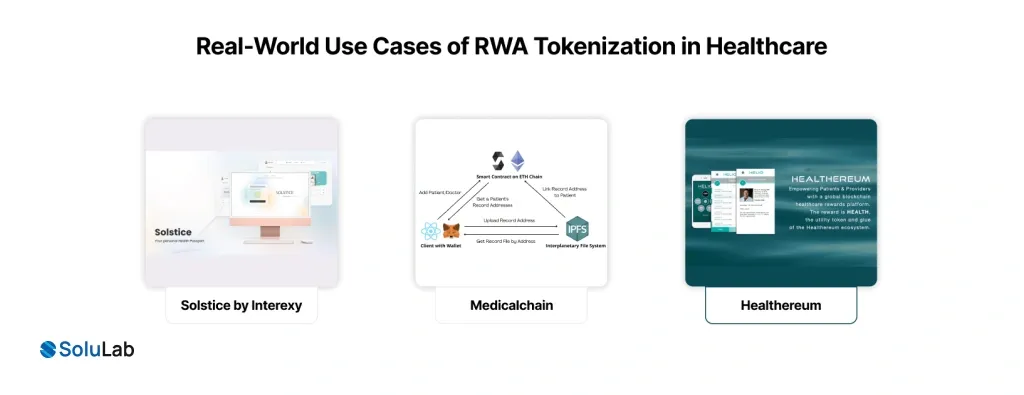
RWA tokenization is already producing measurable results across multiple segments of healthcare. Here are three cases worth knowing:
- Solstice by Interexy
Solstice is a blockchain-based platform built to protect clinical trial data. By anchoring records on-chain, it makes that data secure, transparent, and unchangeable. Researchers and healthcare professionals get a source of truth they can actually trust, which accelerates drug development and tightens patient safety.
- Medicalchain
Medicalchain manages electronic health records on blockchain platforms. Patients get real control: they decide who sees their data and when. Fewer breaches. Better communication between patients and the people treating them.
- Healthereum
Healthereum uses token rewards to keep patients engaged in their own care. Complete a health-related task, attend an appointment, follow a treatment plan, and you earn tokens. It turns passive patients into active participants, and the outcomes data backs that up.
How Healthcare RWA Tokenization Works?
Healthcare tokenization converts real-world assets, such as medical equipment, patient invoices, clinical trial data, or hospital infrastructure, into digital tokens on a blockchain. Here is a plain breakdown of how that process runs:
- Asset Digitization Process
Medical records, lab results, and medical devices get converted into digital tokens and stored on a blockchain. That makes them trackable, shareable, and manageable in ways paper-based or siloed digital records simply are not.
- Identity and Access Layers
Strong identity checks and access controls are non-negotiable. Only authorized users can view or interact with sensitive data. That is how privacy stays intact and healthcare rules stay met.
- On-chain vs Off-chain Data Handling
Not all medical data lives directly on the blockchain:
- On-chain: Stores important proofs (e.g., verification, timestamps, permissions)
- Off-chain: Stores large files like MRI scans or full medical histories
This hybrid approach keeps the system fast, secure, and cost-effective. Large files do not clog the chain, and sensitive data stays more private.
3-Step Process for Healthcare Tokenization Development
1. Asset Identification & Compliance Mapping
- The first step in healthcare tokenization is identifying which assets can be digitized securely and legally.
- That includes medical infrastructure, pharmaceutical IP, insurance claims, patient consent records, clinical trial datasets, and other digital healthcare assets.
- Teams define compliance layers for HIPAA, GDPR, and regional healthcare regulations before token creation begins, not after.
- A secure tokenization platform for healthcare assets is then structured to manage permissions, ownership rights, and access controls.
2. Software Integrations
- In this stage, developers implement blockchain in healthcare infrastructure to create tamper-proof asset records and automated smart contract workflows.
- Healthcare data tokenization models are integrated to manage sensitive patient and research data without exposing private information.
- Organizations also use AI tokenization in healthcare to connect anonymized datasets with AI engines for diagnostics, predictive analytics, and research automation.
- Smart contracts handle approvals, transactions, claim settlements, and asset verification in real time.
3. Deployment, Liquidity & Ecosystem Scaling
- Once the infrastructure is tested, the tokenized ecosystem goes live across hospitals, labs, insurers, and research networks.
- Through tokenization as a service, healthcare enterprises can launch scalable funding and operational models without rebuilding legacy systems from scratch.
- Tokenized assets become tradable, licensable, shareable, or monetizable across approved healthcare participants.
The output is faster movement, clearer audit trails, and a tokenized healthcare infrastructure that can actually scale with the demands of modern medicine.
Navigating Regulatory Standards
As healthcare adopts blockchain and tokenization, regulatory compliance is both a real constraint and a competitive advantage for teams that get it right.
- HIPAA and GDPR with Blockchain
Healthcare tokenization solutions have to meet strict privacy laws: HIPAA in the US, GDPR in Europe. Blockchain solutions are designed to follow these laws by controlling who accesses data and maintaining a clear record of every action taken.
- Regulatory Sandboxes and Healthcare Pilots
Many blockchain development companies use regulatory sandboxes, controlled environments where they can test new healthcare blockchain tools without full legal exposure. It is a practical way to move faster while keeping safety and compliance in check.
Future Trends in Healthcare Tokenization
The direction is clear. Asset tokenization is becoming core infrastructure for healthcare’s next phase. Three trends are worth watching:
- AI-Driven Token Utility
Pairing artificial intelligence (AI) with tokenized healthcare data changes what is possible in health analytics. AI can predict diseases, personalize treatments, and run medical research faster and with more accuracy than any single institution’s dataset would allow.
- Tokenized Healthcare Equity
RWA tokenization in healthcare lets investors buy fractional shares of healthcare assets, biotech companies, medical patents. This fractional ownership opens funding channels that simply did not exist before and helps push healthcare innovation forward.
- Decentralized Health Marketplaces
Platforms are emerging where patients can securely share, and in some cases sell, their health data in decentralized marketplaces. Patients control the information. If they choose to share it, they benefit financially. That is a fundamentally different model from what exists today.

Conclusion
Blockchain, data tokenization, and AI tokenization in healthcare are not theoretical anymore. Providers, biotech firms, and insurers are already using them to build infrastructure that is connected, patient-friendly, and transparent in ways legacy systems never were.
SoluLab has delivered 1500+ digital solutions across AI, blockchain, and enterprise systems. If you are building a healthcare tokenization platform and need a team that has already navigated the compliance, integration, and scaling questions, that track record matters. With a tokenization development company like SoluLab, you can automate workflows and open funding models that your current setup cannot support.
The team’s depth comes from years of custom tokenization development solutions and real-world integrations across healthcare and adjacent sectors. That experience is what separates a platform that works at scale from one that breaks under production load.
Contact us to explore how we can support your specific project and move it forward.
FAQs
Deepika is a content writer who blends storytelling with strategic thinking. She explores topics across digital innovation, emerging tech, and the evolving blockchain industry. She enjoys breaking down complex ideas into simple, engaging narratives in the growing global markets.