Asset tokenization is changing how we invest in and trade high-value assets: real estate, art, company equity. The market is projected to reach between $5 trillion and $16 trillion by 2030, pulled by demand across financial assets, real estate, and niche categories like intellectual property and carbon credits. Estimates from Citigroup and Boston Consulting Group place tokenized assets at up to 10% of global GDP by 2030.
By representing physical assets digitally through blockchain, tokenization simplifies and speeds up trading. Two main approaches exist: on-chain and off-chain. Both convert physical and digital assets into blockchain-based tokens, opening up fractional ownership and new liquidity. But on-chain vs off-chain tokenization works quite differently in practice.
This blog walks through the asset tokenization comparison, covering the differences between on-chain and off-chain tokenization, where each method shines, and how they map to real-world use cases.
What is Asset Tokenization?
Asset tokenization is the process of converting real-world or digital assets into digital tokens using Distributed Ledger Technology (DLT), most often a blockchain. Each token represents ownership or rights to the underlying asset. It can be traded, transferred, or held on a decentralized platform. The result: better liquidity, clearer transparency, and stronger security for assets that traditionally offered none of those things.
DLT Tokenization lets assets like real estate, fine art, commodities, or intellectual property be digitized and traded in fractional amounts. This process opens up high-value assets to a wider pool of investors. Instead of buying the whole thing, you can own a fraction. That concept is called asset fractionalization. A property worth $1 million could be split into 1,000 tokens, each representing a fractional stake, making it possible for smaller investors to participate.
The engine behind this is smart contracts in tokenization: self-executing code with the agreement terms written directly in. Smart contracts handle ownership transfers, dividend payouts, and compliance checks without any intermediary needing to approve each step.
Then there are token standards, which define how tokens behave on a given blockchain. ERC-20 and ERC-721 on Ethereum are two of the most established. These standards make tokens interoperable across platforms, which is what makes consistent creation, management, and trading actually work at scale.
Put it together and asset tokenization via DLT creates a more accessible, efficient, and transparent system for ownership and exchange. By combining blockchain with smart contracts and token standards, tokenization opens up new markets for investors and businesses, with more liquid assets and fewer of the friction points that make traditional asset management slow and expensive.
The Role of Blockchain in Asset Tokenization
Blockchain is the foundation. It provides the infrastructure for digitizing, securing, and transferring assets. Through decentralized ledger technology (DLT), it creates a transparent, tamper-proof record of ownership. That immutability is what makes the whole system trustworthy at a level traditional systems struggle to match.
One of the core blockchain tokenization methods involves representing physical or digital assets as tokens on-chain. Each token is a digital certificate of ownership. Every transaction gets recorded on a distributed ledger that every participant can audit and verify. That level of visibility cuts the risk of fraud and ownership disputes considerably.
Asset tokenization security is one of blockchain’s biggest real contributions here. Because the ledger is decentralized, no single entity controls the data. Cryptographic methods lock down who can access or transfer ownership. For high-value assets, that kind of protection matters.
Blockchain also makes digital asset custody solutions more practical. Smart contracts automate asset management tasks: dividend payments, ownership transfers, regulatory checks. Third-party intermediaries get cut out. Costs drop. Security holds, through cryptographic safeguards that protect against theft or unauthorized access.
In short, blockchain technology is what makes asset tokenization actually work. Through blockchain tokenization methods, stronger security, and better custody solutions, it changes how assets get digitized, transferred, and stored, creating real opportunities in global markets.
What is On-Chain Tokenization?
On-chain tokenization converts physical or digital assets into tokens that live and are managed directly on a blockchain. The tokens represent ownership or rights to the underlying asset: real estate, artwork, intellectual property, or crypto. Because everything runs on a decentralized ledger, every transaction, ownership transfer, and ownership record is transparent, secure, and permanent. Once it’s on-chain, you can’t quietly change it.
A core feature is asset fractionalization: high-value items get divided so multiple people can hold shares. Smart contracts handle the ownership rules, including transfers, regulatory checks, and dividend payouts, automatically. No middlemen required. The result is better liquidity for assets that historically had none, and global access to markets that were once closed to most investors.
Key Features of On-Chain Tokenization
On-chain tokenization means issuing and managing asset tokens directly on a blockchain. That comes with some concrete advantages that are worth understanding before choosing an approach:
Full Transparency and Immutability
Every transaction, ownership transfer, and token issuance gets written to a publicly accessible, permanent ledger. Auditing is straightforward. And because the data can’t be altered once recorded, fraud risk drops sharply. Participants trust what they see because there’s no back-room editing.
Enhanced Security and Fraud Prevention
Blockchain’s cryptographic security makes unauthorized access and cyber threats much harder to pull off. Every transaction gets verified and encrypted. For high-value or sensitive assets, this security model is genuinely strong, not just theoretical.
Real-Time Settlement and Efficiency
On-chain tokenization settles transactions in real time, without needing a third party to sign off. That cuts both time and cost. Smart contracts do the heavy lifting: ownership transfers, dividend payments, compliance checks all happen automatically when conditions are met.
Regulatory Compliance Tokenization
Regulatory requirements can be baked directly into the token through smart contracts. Restrictions on who can trade certain assets, geographic limits, minimum holding periods: all of it can be coded in. Compliance runs at the blockchain level, not as an afterthought checked by a compliance team later.
Fractional Ownership and Liquidity
On-chain tokenization makes fractional ownership practical: assets get divided into smaller units, owned by multiple parties. That opens investment to people who couldn’t afford the whole asset. Real estate, fine art, commodities: assets that were previously illiquid get fractional shares that can trade on secondary markets.
Global Accessibility
Blockchain platforms operate around the clock. Assets can be traded globally, without restrictions tied to traditional market hours or geographic borders. That changes the liquidity picture for assets that previously had a local-only audience.
Together, these features: transparency, security, real-time settlement, compliance, fractional ownership, and global reach, make on-chain tokenization a compelling option for asset management in the digital economy. The method works especially well when you want full control and don’t need traditional legal systems handling the underlying asset.
How Does On-Chain Tokenization Work?
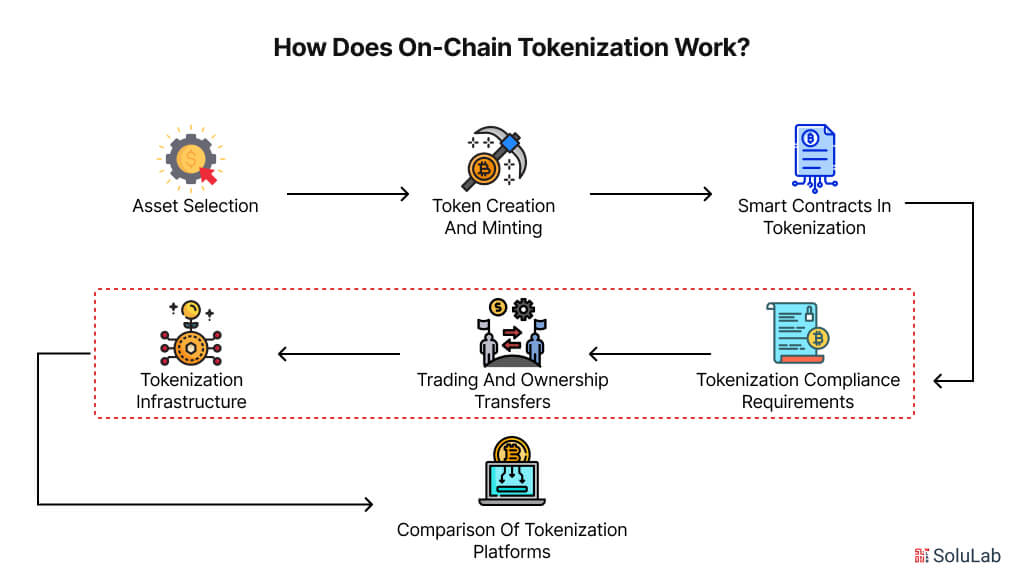
On-chain tokenization converts physical or digital assets into tokens that are managed directly on a blockchain. It improves how assets get tracked, traded, and transferred. Here is how the process actually works, step by step.
Asset Selection
First, you decide what to tokenize. Real estate, art, digital intellectual property: any of these can work. Converting an asset to on-chain tokens makes it easier to track and trade. Tokenization platforms offer different options based on asset type, with varying blockchain support, cost structures, and ease of use. That comparison matters before you commit to a platform.
Token Creation and Minting
The asset gets divided into digital tokens, each representing a share of ownership. This is minting. Depending on what the asset is, different digital asset tokenization types apply: fungible tokens (interchangeable, like standard cryptocurrencies) or non-fungible tokens (unique, like Non-fungible tokens (NFTs)). After minting, tokens can be traded, tracked, and transferred freely on the blockchain.
Smart Contracts in Tokenization
Smart contracts are automated agreements coded directly into the blockchain. They manage the rules for token transfers, ownership, and compliance. No intermediary has to approve each transaction. When payment conditions are met, the smart contract transfers ownership. That automation cuts costs and keeps the process reliable.
Tokenization Compliance Requirements
For on-chain tokenization to be legally sound, tokens must meet tokenization compliance requirements. Smart contracts get programmed to enforce restrictions: who can hold the tokens, how many one person can hold, where buyers can be located. This lets the tokenization process follow regulatory standards across different jurisdictions, reducing risk for both issuers and investors.
Trading and Ownership Transfers
Once tokens are minted and compliance is in place, they can be traded or transferred. The blockchain records every transaction: a transparent, permanent ownership trail. Assets that were hard to trade before, like real estate, can now be broken into smaller tradeable units. That is what makes fractional ownership real, not just theoretical.
Tokenization Infrastructure and Digital Asset Custody Solutions
The whole process needs solid tokenization infrastructure: the blockchain network itself, smart contract development, and platforms that support token creation and trading. On top of that, digital asset custody solutions secure the tokens using advanced encryption and access controls. Tokenized assets need to be protected from theft and fraud, and custody solutions are what make that protection operational.
Comparison of Tokenization Platforms
Different tokenization platforms vary in blockchain compatibility, interface quality, and fees. Some target specific industries like real estate or fine art. Others are general-purpose. Comparing platforms helps asset owners pick the right one based on compliance capabilities, token issuance ease, and how well it integrates with custody solutions.
Use Cases for On-Chain Tokenization
On-chain tokenization has practical applications across a wide range of industries. It makes assets more accessible, more liquid, and easier to secure. Using tokenization infrastructure on a blockchain, businesses and individuals gain new investment and ownership options. Here are the areas where on-chain tokenization is making a real difference:
1. Real Estate Tokenization: One of the biggest use cases is real estate tokenization. Property gets tokenized and divided into smaller tradable units. This is asset fractionalization in action: multiple investors owning a slice of one building. Instead of needing millions to buy the whole property, investors can get in for a few thousand dollars. Those fractions can trade on secondary markets too, which is a genuine shift for a market that has traditionally been hard to exit.
2. Art and Collectibles: Fine art, rare collectibles, and luxury items can be tokenized so people can invest without buying the whole piece. On-chain tokenization records fractional ownership of a painting or collectible directly on the blockchain. Art lovers and collectors get a way to diversify and trade ownership shares far more easily than before.
3. Commodities and Precious Metals: Tokenization applies to commodities like gold, silver, or oil. Instead of physically storing these assets, ownership gets represented by digital tokens. That removes the logistics of storage and transportation while still giving investors a real stake in the commodity. Smaller investors can enter markets that were previously accessible only to large players.
4. Equity and Bonds: Traditional financial instruments like stocks and bonds benefit from on-chain tokenization too. Companies can tokenize equity shares or debt instruments and offer them to investors on the blockchain, with global reach built in. Tokenized equity and bonds can trade on secondary markets, giving investors more liquidity and flexibility than conventional systems allow.
5. Intellectual Property: On-chain tokenization works for intellectual property (IP) rights: patents, trademarks, copyrights. Creators can license or sell fractions of their IP to multiple investors. Ownership is tracked cleanly on-chain, while tokenization infrastructure.
6. Crowdfunding and Fundraising: Tokenization has become a popular tool in crowdfunding, particularly for new ventures. Startups and businesses issue tokens to raise capital from a large group of investors, who get fractional ownership or other rights tied to the project. Blockchain keeps the process transparent, and smart contracts handle fund distribution based on each token holder’s contribution.
The use cases span real estate, fine art, commodities, equity, intellectual property, and beyond. By combining blockchain with tokenization infrastructure, asset fractionalization becomes a practical tool: wider investment access, better liquidity, and more efficient asset management. That is how this technology is reshaping how people buy, sell, and own things of real value.
Related: Real-World Asset Tokenization
Benefits of On-Chain Tokenization
On-chain tokenization delivers real advantages through blockchain, changing how assets get owned, traded, and managed. Key benefits:
Increased Liquidity
Asset fractionalization converts traditionally illiquid assets like real estate or fine art into smaller, tradeable tokens. Buying, selling, and investing become much simpler. That creates actual market liquidity where little existed before.
Accessibility
Tokenization lowers the investment barrier. More people can own a fraction of a high-value asset. That promotes financial inclusion and opens up investment classes that were previously out of reach for most people.
Transparency and Security
Blockchain gives you a transparent, permanent ownership and transaction record. Pair that with digital asset custody solutions and cryptographic protection, and the risk of fraud drops substantially.
Efficiency and Automation
Smart contracts automate ownership transfers and regulatory compliance. Intermediaries get removed from the process. Costs and delays shrink as a result.
Global Reach
On-chain tokenization lets assets trade globally, around the clock. Asset owners reach a much wider pool of international investors, and liquidity improves accordingly.
What is Off-Chain Tokenization?
Off-chain tokenization means representing assets as digital tokens on a blockchain, but handling the actual ownership and management of the asset outside the blockchain. The blockchain tracks token transactions and ownership. Legal ownership, documentation, and asset management stay in traditional systems: banks, legal entities, or custodians. Tokens on the chain are a representation of ownership, not ownership tied directly to the ledger. Off-chain tokenization is common for assets like real estate or physical goods, where full on-chain management is impractical.
The question of which tokenization method is better depends heavily on the asset and its regulatory context. On-chain tokenization gives you full transparency and security: all transactions and ownership data live on the blockchain, immutably, without relying on third parties. But for highly regulated or complex assets, off-chain tokenization often makes more sense. Traditional legal frameworks handle ownership rights and regulatory compliance better than purely blockchain-based systems can, at least right now. Both methods have real strengths. The choice comes down to what the asset actually requires.
Key Features of Off-Chain Tokenization
Off-chain tokenization takes a hybrid approach: blockchain for token tracking, traditional systems for actual asset management. Here are the defining features:
Asset Representation
In off-chain tokenization, the token on the blockchain represents ownership or rights to an asset. The asset itself, whether real estate, commodities, or securities, is managed and stored outside the blockchain. Legal ownership and documentation stay with custodians, banks, or legal entities. This is what makes off-chain tokenization practical for assets that require physical or legal oversight that a blockchain simply cannot provide.
Regulatory Flexibility
Because the assets themselves stay off-chain, organizations can meet local laws, industry standards, and regulatory requirements more easily than a purely blockchain-based system allows. In real estate, finance, or commodities, where compliance with existing legal systems is non-negotiable, this flexibility is often what tips the decision toward off-chain.
Lower Transaction Costs
Because actual asset transfers are not recorded on-chain, off-chain tokenization can cut transaction costs significantly compared to fully on-chain models. Fewer blockchain interactions means lower gas fees. The asset is governed by traditional contracts while only the token itself moves on-chain.
Security and Trust
The question of which tokenization method is more secure is more nuanced than it looks. Off-chain tokenization combines blockchain’s cryptographic security for token transactions with traditional legal governance for the asset itself. Real-world processes, such as enforcing legal rights or transferring physical assets, get handled within existing frameworks. That said, off-chain models rely more heavily on third-party custodians for protection, which introduces some risk that fully on-chain models avoid.
Scalability
Off-chain tokenization handles scale better because not every asset-related action hits the blockchain. Offloading processes to traditional systems allows for higher transaction volumes without the high costs and slower speeds of recording everything on-chain. For businesses managing large volumes of assets, this is a real practical advantage.
Use Cases for Off-Chain Tokenization
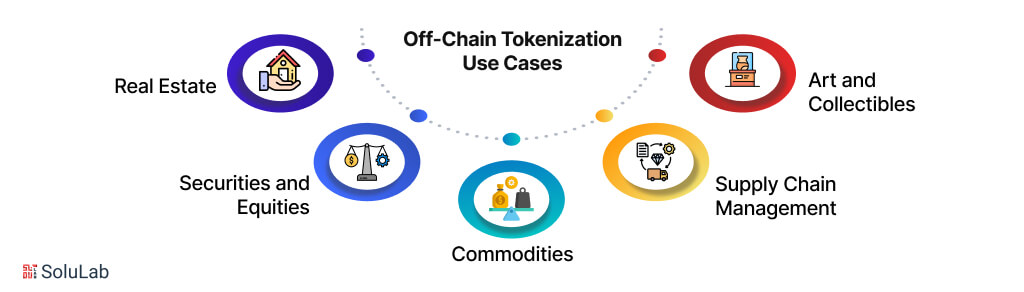
Off-chain tokenization, one of the widely used blockchain tokenization methods, works best in industries where physical or legal oversight is non-negotiable, but where blockchain can still add efficiency and transparency to ownership tracking. Here are the areas where it proves most valuable:
1. Real Estate: Real estate is one of the most common applications. High-value properties get tokenized, letting investors hold a fraction of a building or plot of land. The tokens trade on-chain, but the property itself stays governed by traditional legal frameworks and custodians. That balance allows for fractional ownership and global investor participation while still meeting local property laws. The tokenization infrastructure handles on-chain tracking and trading, while actual asset management happens off-chain.
2. Securities and Equities: Off-chain tokenization is also well-suited to securities and equities, where financial regulation compliance is the top priority. Stocks, bonds, and other instruments can be tokenized for faster, more secure ownership trading. Because regulatory requirements around securities require asset rights and legal ownership to remain outside the blockchain, off-chain models fit naturally. Token standards like ERC-20 handle the digital tokens, while traditional financial systems manage dividends and actual ownership rights.
3. Commodities: Physical commodities like gold, silver, oil, or agricultural products can be represented by tokens on a blockchain while being stored and managed off-chain. Off-chain tokenization enables fractional ownership of these commodities, letting investors buy, sell, and trade shares easily. The tokenization infrastructure provides on-chain transparency while physical commodities stay secured by traditional custodians. Smaller investors get access to commodity markets without the logistics of physical holding.
4. Supply Chain Management: In supply chain management, off-chain tokenization represents ownership and tracking of physical goods. Companies can tokenize shipments or products, creating a transparent on-chain record of movement through the supply chain. But because the goods themselves require real-world logistics and management, actual transfers happen off-chain. This creates tokenization infrastructure that improves visibility and traceability without disrupting existing supply chain operations.
5. Art and Collectibles: Off-chain tokenization also works for high-value art and collectibles. By tokenizing a piece of artwork, fractional ownership can be distributed among multiple investors. Tokens trade on the blockchain. The artwork itself stays with a custodian, physically secured and properly managed. The blockchain provides transparency for token transactions; the custodian handles the asset. On-chain vs off-chain tokenization in this case comes down to whether the asset is fully digital (on-chain is viable) or a physical item requiring traditional oversight (off-chain makes more sense).
Benefits of Off-Chain Asset Tokenization
Off-chain asset tokenization combines blockchain’s transparency and security with practical, traditional asset management. That hybrid approach is particularly valuable for industries that need legal or physical oversight: real estate, commodities, and art. Here are the key benefits of off-chain asset tokenization:
- Lower Blockchain Tokenization Costs: One of the main advantages is the reduction in blockchain tokenization costs. Because the actual asset is managed off-chain, the number of on-chain transactions stays low, which keeps gas fees and transaction costs down. For large or complex assets like real estate or commodities, this makes off-chain tokenization more cost-effective than fully on-chain models.
- Regulatory Compliance and Legal Oversight: Off-chain tokenization suits industries with strict regulatory requirements. In real estate tokenization, tokens representing ownership trade on the blockchain, but legal property management and compliance remain off-chain, which means local laws are met. Asset owners get blockchain’s efficiency and transparency without sacrificing compliance. When comparing on-chain vs off-chain real estate tokenization, off-chain models give you much more flexibility when the physical asset has legal or regulatory overhead that cannot move on-chain.
- Improved Scalability and Flexibility: Because the asset itself is not directly recorded on the blockchain, off-chain tokenization scales better. Fewer on-chain transactions means the system handles larger volumes of assets and trades without high blockchain fees or slow processing times. For large-scale real estate projects, commodity portfolios, or high-volume securities trading, that scalability is a real operational advantage.
- Enhanced Security with Custodianship: In off-chain tokenization, assets are typically held by trusted custodians who make sure physical items like real estate, art, or commodities are securely stored and managed. The blockchain secures the tokens. Established legal and custodial systems protect the physical asset. That dual-layer approach gives you both digital and physical security, which matters a great deal for high-value tangible assets.
- Tokenization Platforms Comparison: Off-chain tokenization offers more choices when selecting a platform. Different platforms specialize in on-chain or off-chain models, with off-chain options providing more flexibility for industries like real estate and art. Tokenization platforms comparison helps businesses find platforms that match their needs: regulatory support, low transaction costs, secure custodial services, all while keeping the transparency and efficiency of blockchain technology.
Difference Between On-Chain and Off-Chain Tokenization
The table below summarizes the key differences between on-chain and off-chain tokenization, covering aspects like real estate tokenization, blockchain tokenization costs, and DLT tokenization.
| Aspect | On-Chain Tokenization | Off-Chain Tokenization |
| Definition | Assets and their ownership details are fully recorded and managed directly on the blockchain. | Assets are represented as tokens on the blockchain, but the actual assets and legal rights are managed off-chain. |
| Real Estate Tokenization | Full ownership and transaction details of real estate are recorded on the blockchain. This method is best for tokenizing fully digital real estate or land that doesn’t require traditional legal systems. | Tokenized real estate is represented on-chain, but actual property ownership and legal processes remain managed by traditional entities, such as real estate firms or custodians. |
| Blockchain Tokenization Costs | Higher transaction costs due to more frequent blockchain interactions, such as gas fees and transaction processing. | Lower blockchain tokenization costs, as fewer on-chain transactions are required, with much of the asset management taking place off-chain. |
| Regulatory Compliance | Regulatory rules and compliance can be automated with smart contracts directly on the blockchain, but integrating local legal frameworks may be challenging. | Easier to integrate with existing legal and regulatory frameworks, as the asset itself is governed off-chain, allowing for compliance with real-world laws. |
| DLT Tokenization | The asset is fully integrated into Distributed Ledger Technology, with full transparency and decentralization. | Only the token representation of the asset is recorded on DLT, while the actual asset remains within traditional legal and custodial systems. |
| Security | Provides high transparency and security through blockchain immutability and decentralized verification. | Offers security through blockchain transparency for token trading, but relies on off-chain custodians for asset protection, introducing some third-party risk. |
| Liquidity and Trading | High liquidity potential, as assets, are fully tradeable on decentralized exchanges without needing third-party intermediaries. | Moderate liquidity, as the tokens can be traded on blockchain platforms, but actual asset transfers depend on off-chain legal and custodial systems. |
| Scalability | Less scalable due to high costs and slower processing speeds associated with recording all transactions on-chain. | More scalable as fewer blockchain interactions are needed, making it suitable for large-scale projects and high-volume trades. |
| Use Case Example | Ideal for fully digital assets like cryptocurrencies, digital art (NFTs), or certain tokenized financial instruments. | Best suited for physical assets like real estate, fine art, or commodities that require off-chain legal management and oversight. |
How to Choose Between On-Chain and Off-Chain Tokenization?
The right choice depends on your asset type, security requirements, regulatory obligations, and how much on-chain cost you can absorb. Here is a quick framework:
Asset Type and Fractionalization
For digital assets like cryptocurrencies or NFTs, on-chain tokenization is the cleaner option for asset fractionalization and global trading. For physical assets like real estate, off-chain tokenization works better: you keep traditional management in place while still allowing token-based fractional ownership.
Security
On-chain tokenization gives you higher transparency and security, with every transaction recorded immutably on the blockchain. For physical assets that need custodianship, off-chain tokenization balances blockchain transparency with secure, trusted asset handling.
Regulatory Compliance
If your asset sits inside a strict regulatory framework, off-chain tokenization is the more practical path. Traditional legal systems handle compliance in ways that on-chain smart contracts still struggle to match. On-chain can automate compliance, but integrating local legal systems is harder than it looks.
Costs and Scalability
On-chain tokenization carries higher blockchain tokenization costs from frequent transaction fees. For large-scale projects with lower on-chain interaction, off-chain tokenization is the more cost-effective and scalable choice.
Choose on-chain for digital assets and global liquidity. Choose off-chain for physical assets that need legal oversight and regulatory compliance. In practice, many projects land somewhere in between.
How SoluLab Can Help in On-Chain and Off-Chain Asset Tokenization?
SoluLab delivers end-to-end solutions for both on-chain and off-chain asset tokenization, drawing on deep experience in blockchain development. Whether you are tokenizing digital assets like cryptocurrencies and NFTs or physical assets like real estate and commodities, our asset tokenization development company builds customized tokenization platforms fitted to your specific needs. For on-chain tokenization, we wire in smart contracts for secure, transparent, and automated asset management. For off-chain tokenization, we build hybrid solutions that balance blockchain transparency with the legal and custodial requirements your asset actually demands.
Our tokenization services cover blockchain infrastructure development, asset fractionalization, tokenization compliance requirements, and secure digital asset custody solutions. Whether you are working through real estate tokenization on-chain vs off-chain or any other asset class, we provide scalable, efficient solutions. One example: we built Borrowland, a crypto borrowing and lending platform that extended traditional financial services through blockchain. Users could borrow, lend, swap, and manage crypto assets with secure global access and the ability to earn interest on their holdings.
Ready to move your assets onto blockchain? Contact us today to learn more about how SoluLab can support your on-chain and off-chain tokenization needs.
FAQs
Shipra Garg is a tech-focused content strategist and copywriter specializing in Web3, blockchain, and artificial intelligence. She has worked with startups and enterprise teams to craft high-conversion content that bridges deep tech with business impact. Her work translates complex innovations into clear, credible, and engaging narratives that drive growth and build trust in emerging tech markets.