
Key Takeaways
- Price stability after a launch is mostly a supply-and-liquidity engineering problem, not a marketing problem.
- Low float paired with a high fully diluted valuation flatters day one and punishes month six.
- Unlock schedules move price before the unlock date, so the calendar itself is a market signal.
- Wide airdrops reliably manufacture sellers; narrow, usage-linked distribution produces better retention.
- Liquidity depth on the first exchange pair matters more than the number of exchange listings.
- Tokens that held value generally had revenue or fees flowing back to the token, not just a roadmap promising it.
Token launches keep failing for reasons that were visible in the tokenomics spreadsheet months earlier. Supply comes online faster than demand, insiders reach a cliff before the product reaches users, and the first exchange pair has half the depth it needs on the day volume spikes.
The wider market keeps growing around those failures. Deloitte’s Center for Financial Services projects tokenized real estate alone will reach $4 trillion by 2035, up from under $0.3 trillion in 2024, a compound growth rate of roughly 27%. Serious capital is arriving. So is a far higher bar for how a token is built before it trades.
We looked at what actually separated the launches that held their price from the ones that gave everything back. Five factors did most of the work.
Token launches keep failing for reasons that were visible in the tokenomics spreadsheet months earlier. Supply comes online faster than demand, insiders reach a cliff before the product reaches users, and the first exchange pair has half the depth it needs on the day volume spikes.
The wider market keeps growing around those failures. Deloitte’s Center for Financial Services projects tokenized real estate alone will reach $4 trillion by 2035, up from under $0.3 trillion in 2024, a compound growth rate of roughly 27%. Serious capital is arriving. So is a far higher bar for how a token is built before it trades.
We looked at what actually separated the launches that held their price from the ones that gave everything back. Five factors did most of the work.

2. How Many Token Launches Actually Fail?
More than half of all tokens launched since 2021 are no longer traded. That is the baseline every founder should plan against, and it has worsened sharply as launch tooling got cheaper.
1. The failure rate is now the default outcome
CoinGecko’s analysis of GeckoTerminal listings found that 53.2% of the roughly 20.2 million tokens listed between mid-2021 and the end of 2025 are no longer actively traded. Around 11.6 million of those failures happened in 2025 alone, with 7.7 million in the fourth quarter.
2. Below-TGE is the normal condition
Failure is the extreme case. Underperformance is the common one. Memento Research, reviewing 118 token generation events during 2025, found 84.7% of them trading below their TGE valuation. The median token launched in 2025 was down more than 70% from its initial price by year-end.
3. The market is growing anyway
None of this suggests the category is shrinking. Statista puts cryptocurrency market revenue at around US$85.3 billion in 2026, with user penetration near 9.9% and the user base forecast to pass 795 million by 2027. Demand exists. It just is not distributed evenly across 20 million tokens, which is why the structural decisions below carry so much weight.
Why Do Low Float and High FDV Break Token Price Stability?
Low float with a high fully diluted valuation produces a strong first week and a weak first year. The mechanism is simple: scarcity at listing inflates price, then scheduled supply arrives faster than new buyers do.
1. What the float actually does on day one
With only a small share of supply circulating, thin liquidity amplifies every buy. Binance Research documented this pattern directly, noting that price growth driven by constrained float is unsustainable once unlocking supply reaches the market.
2. The overhang nobody prices in
The same research estimated roughly US$155 billion worth of tokens would unlock between 2024 and 2030. Tokens launched in 2024 carried an average market cap to FDV ratio of about 12.3%, implying around US$80 billion of new demand would be needed just to hold prices flat as supply expanded.
3. What a defensible float looks like
There is no universal number, and anyone quoting one is guessing. The workable test is arithmetic rather than convention: model the dollar value of every scheduled release over 24 months, compare it against a conservative estimate of monthly net inflows, and adjust the float until the two are in the same range. If your model needs a bull market to balance, the tokenomics are not finished.
This modelling work belongs with your crypto token development team well before the contracts are deployed, because changing a vesting curve after mainnet deployment usually means a migration.
What Do Unlock Schedules Do to Token Price?
Unlocks are almost always negative for price, and the decline typically begins before the unlock date. Market participants read vesting tables, so the calendar becomes tradable information well ahead of the event.
1. The pre-unlock drift
Market maker Keyrock analysed more than 16,000 unlock events and found roughly 90% produced negative price pressure, with declines often starting around 30 days before the unlock itself. Larger unlocks amplified the effect and increased volatility.
2. Team unlocks do the most damage
Keyrock identified team allocations as the most damaging recipient class. Teams are uncoordinated sellers with years of deferred compensation, which produces persistent rather than one-time pressure.
Their ApeCoin example is instructive: a team unlock releasing about 0.7% of supply monthly coincided with a 77% price decline over seven months, against a 9% decline in ETH over the same window.
3. Cliff versus linear, and why mixed wins
Cliffs create a sharp, predictable shock. Linear schedules create continuous mild dilution. Most well-structured launches now use a long cliff followed by extended linear vesting, which keeps insiders committed without concentrating the sell pressure into a single date.
Whatever curve you choose, enforce it in code. Hand-managed treasury wallets are one of the most common findings in pre-launch smart contract development reviews, and they undermine every promise in the whitepaper.
Why Do Most Airdrops Create Sellers Instead of Holders?
Broad airdrops reliably produce selling because they reward extraction rather than usage. The wallets that optimise for a distribution are the same wallets that exit it.
1. The dump rates are consistent across studies
Keyrock’s review of 62 airdrops across six chains found 88% of airdropped tokens declined in price, with the steepest drops inside the first 15 days. Delphi Digital tracked 3.7 million wallets over five years and found between 78% and 94% of recipient wallets sold most of their allocation within 90 days. On-chain analysis of over two million airdrop addresses put immediate selling at TGE at roughly 64%.
2. Targeting beats volume
The pattern that separates workable distributions from wasteful ones is narrowness. Smaller allocations aimed at genuine product users have been associated with materially more buyers and fewer sellers than wide-spray campaigns. Nansen’s data on the ZK launch showed 41.1% of the top 10,000 recipient wallets sold their entire allocation almost immediately, which tells you what farmed eligibility criteria actually buy.
3. What to do instead
Tie eligibility to behaviour that costs something: capital committed, fees paid, positions held through a defined period. Stage the distribution across several months and make later tranches conditional on continued usage. It is slower, and it produces a smaller headline number, but it changes who holds your token in month three.
How Does Liquidity Design Decide the First 90 Days?
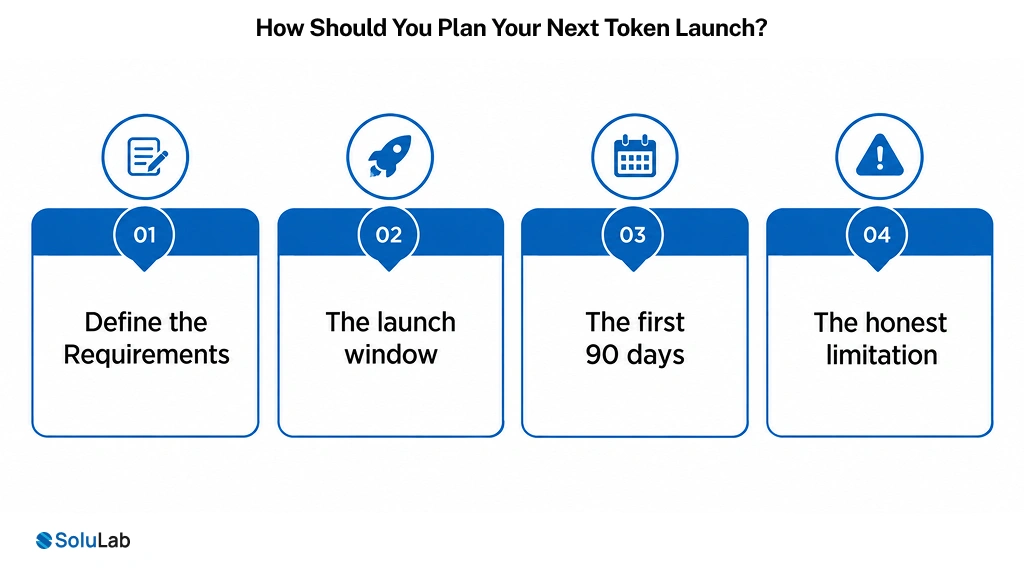
Liquidity depth, not listing count, determines whether a token absorbs its first large sell order or gaps through it. A token listed on six venues with thin books is more fragile than one with a single deep pair.
1. Depth is the number that matters
Headline 24-hour volume can be manufactured. Order book depth within 2% of mid-price cannot be faked as easily, and it is what decides slippage when an unlock lands or sentiment turns. Model the worst realistic sell day and size the book for it.
2. Market maker terms deserve real scrutiny
Loan-and-option structures are standard, and they can quietly hand a market maker an incentive to see your token trade lower. Read the strike prices. Understand what happens at contract expiry. Ask what depth they are contractually committed to maintain and at what spread, then verify it after listing.
3. Where venue strategy actually fits
Centralised listings bring reach, decentralised pools bring permanence, and each requires different preparation. Teams building their own venue or token launch platform need to plan for custody, compliance, and pool seeding long before the listing date. Our ICO, IDO and IEO comparison covers how launch mechanisms differ in practice.
What Did the Launches That Held Price Actually Build?
The tokens that survived were backed by engineering work that made the tokenomics enforceable and the supply verifiable. The whitepaper claims matched what the contracts did.
1. Vesting enforced on-chain
Vesting contracts with immutable schedules, multi-sig treasury control, and public dashboards that let anyone verify circulating supply. When holders can check the numbers themselves, the pre-unlock panic is smaller because the surprise is smaller.
2. Audits that cover supply, not just reentrancy
Most audits check for exploits. Fewer check whether the mint authority was actually revoked, whether the vesting contract can be upgraded by a single key, or whether the stated supply matches on-chain reality. A smart contract audit scoped to cover supply integrity catches the issues that cost projects their credibility.
3. Standards and compliance built in early
Gartner’s strategic predictions for 2026 note that stablecoins, deposit tokens, and tokenized real-world assets are becoming mainstream enterprise instruments, while fragmented standards and weak interoperability across blockchain infrastructure continue to inhibit market growth. For a launching project, that translates into practical choices about chain selection, token standards, and transfer restrictions. Getting them wrong makes later institutional distribution far harder, which is why these belong in the blockchain development architecture phase rather than the compliance review.
How Should You Plan Your Next Token Launch?
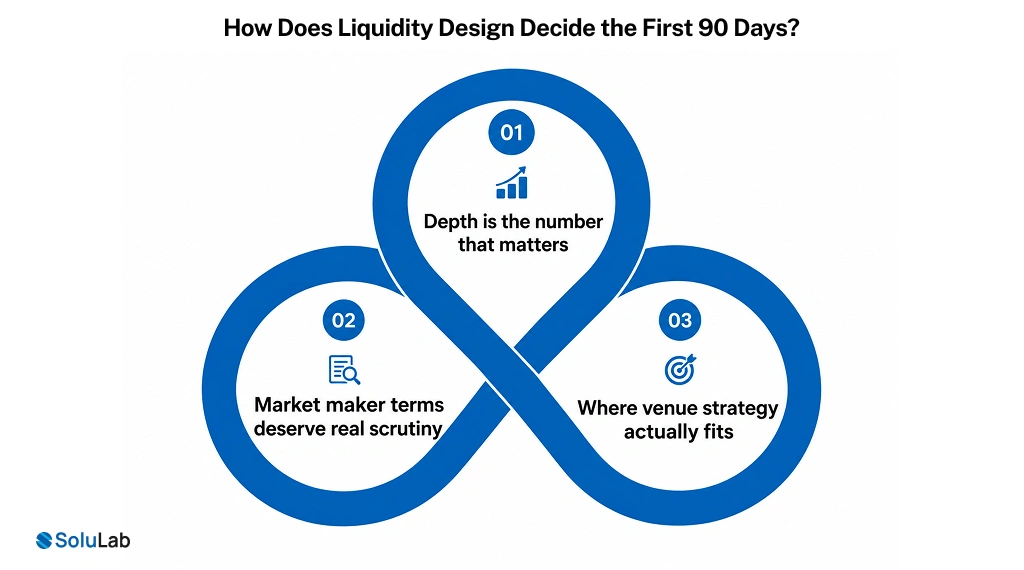
Work backwards from the first 180 days of trading rather than forwards from the launch date. Most fixable damage is caused by decisions made 90 days before the token exists.
1. Define the Requirements
Model supply against realistic demand. Finalise the vesting curve and deploy it in code. Commission an audit that covers supply integrity. Define airdrop eligibility around paid usage. Negotiate market maker terms with the option structures fully understood.
2. The launch window
Seed the initial pool with depth sized to your modelled worst-case sell day. Publish the full unlock calendar before listing rather than after. Keep the float honest and price to it.
3. The first 90 days
Publish circulating supply verifiably. Report treasury movements. Ship the product features that justify the token. Route fees or revenue back to the token as early as the model allows.
4. The honest limitation
None of this saves a token with no underlying demand. Market beta dominates most single-token outcomes, and a well-structured launch in a falling market still falls. The realistic claim is narrower and more useful: good supply design removes the self-inflicted failures, which in this dataset were the majority of them. Products people actually use, funded by DeFi protocols with real fee revenue or tokenized real-world assets with genuine cash flows, start from a far better position than a token whose only utility is governance.

Conclusion
The launches that held their price were not luckier. Teams structured them by treating float, unlocks, distribution, and liquidity as engineering constraints with numbers attached, then enforced those constraints in contracts anyone could verify. That work happens before the token exists, and it is largely irreversible afterwards.
If you are planning a launch, the highest-value next step is a supply model stress-tested against realistic demand, not another marketing push.
SoluLab, a crypto launchpad development company, can help your business design tokenomics that survive contact with the market, build and audit the contracts that enforce them, and plan the liquidity and listing strategy around them.
FAQs
Shipra Garg is a tech-focused content strategist and copywriter specializing in Web3, blockchain, and artificial intelligence. She has worked with startups and enterprise teams to craft high-conversion content that bridges deep tech with business impact. Her work translates complex innovations into clear, credible, and engaging narratives that drive growth and build trust in emerging tech markets.