Key Takeaways
- RWA vault tokenization wraps a real-world asset, or a pool of them, inside a smart contract structure that issues tradable, blockchain-based tokens representing ownership or a claim on that asset.
- Vaults differ from simple point-to-point tokenization because they pool assets, manage yield distribution, and often handle redemption logic automatically.
- Institutional appetite is growing fast, driven by faster settlement, fractional ownership, and 24/7 liquidity that legacy custody rails can’t match.
- Smart contract risk, custody of the underlying asset, and inconsistent global regulation remain the three biggest hurdles to adoption.
- Most serious platforms are choosing custom-built vault infrastructure over generic templates once they need specific compliance logic or yield mechanics.
A commercial building, a private credit pool, a basket of treasury bills: once you bought in, you were stuck until a buyer showed up or a maturity date arrived. That’s the problem RWA vault tokenization is chipping away at.
By representing ownership of a real-world asset as a digital token within a smart contract vault, investors gain access to liquidity closer to that of public markets, without waiting on paperwork or a broker’s calendar.
The global asset tokenization market size was estimated at USD 1,756.58 billion in 2025, and is projected to reach USD 24,479.17 billion by 2033, growing at a CAGR of 42.1% from 2026 to 2033.
This guide walks through what a tokenized vault actually is, how the mechanics work under the hood, and what it takes to build one properly.
What Is RWA Vault Tokenization?
At its simplest, RWA vault tokenization means locking a real-world asset, or a pool of similar assets, into a smart contract “vault” that then mints tokens representing a claim on whatever sits inside. Think of the vault as a digital strongbox with rules coded directly into it: who can deposit, how yield gets distributed, and what happens when someone wants their share back.
This is a step beyond basic RWA tokenization, where a single asset gets a single token and that’s the end of the story. A vault pools capital, often from many investors, and automates the operational layer that used to require a fund administrator, a transfer agent, and a stack of spreadsheets.

Vault Tokenization vs. Simple Asset Tokenization
- Simple tokenization issues one token type per asset, with minimal built-in logic beyond ownership transfer.
- Vault tokenization pools multiple assets or investor deposits, calculates share value dynamically, and often automates yield or interest distribution.
- Vaults typically follow standardized token frameworks (ERC-4626 being the most common on Ethereum) so they can plug into other DeFi protocols without custom integration work every time.
How RWA Vault Tokenization Works
Underneath the interface, a working vault runs on a fairly consistent sequence of steps, whether it’s holding real estate debt, invoice receivables, or a treasury bill ladder.
- Asset selection and legal structuring. The underlying asset gets identified and wrapped in a legal entity (often an SPV) that formally holds it and issues rights to token holders.
- Smart contract deployment. A vault contract gets deployed to manage deposits, mint tokens representing shares, and track the vault’s net asset value.
- Oracle integration. Off-chain data, like asset valuations, interest accruals, or repayment schedules, feeds into the contract through an oracle so on-chain token value stays accurate.
- Token issuance. Investors deposit capital (often stablecoins) and receive vault tokens proportional to their share, similar in concept to receiving shares in a mutual fund.
- Yield distribution and compliance checks. As the underlying asset generates income, the vault distributes it to token holders, often automatically, while KYC/AML checks gate who can hold or transfer the tokens in the first place.
- Redemption. Token holders can redeem shares back into the underlying value, subject to the liquidity terms baked into the vault, which vary quite a bit depending on how liquid the underlying asset actually is.
Why Institutions Are Turning to RWA Vaults Now
A few years ago, this was mostly a crypto-native experiment. That’s changed. Statista’s data, sourced from BCG and Ripple research, projects the real-world asset tokenization market climbing into the multi-trillion-dollar range by 2033 under a midpoint growth scenario, driven by clearer regulation and more mature blockchain infrastructure.
On-chain data backs up that trajectory in the near term too: the RWA tokenization market grew almost fivefold in three years, reaching roughly USD 24 billion by mid-2025.
What’s actually pulling institutions in isn’t ideology. It’s practical friction they’ve dealt with for decades.
- Settlement speed. Traditional securities settlement can take days. A tokenized vault settles in the time it takes a blockchain transaction to confirm.
- Fractional access. A commercial real estate deal that once required a minimum six- or seven-figure check can be split into much smaller, tradable units.
- 24/7 markets. Unlike traditional exchanges, tokenized assets can trade around the clock, which matters more than people expect once cross-border investors get involved.
- Programmable compliance. Vaults can encode transfer restrictions and investor eligibility rules directly into the token, cutting down on manual compliance review.
None of this happens by simply slapping a blockchain label on an existing fund structure. It requires asset tokenization services that understand both the legal wrapper and the smart contract mechanics well enough to make the two work together without creating a gap regulators (or investors) will eventually find.
Key Benefits of RWA Vault Tokenization
Beyond the liquidity pitch, there’s a case here that goes deeper than “it’s on a blockchain now.”
For Asset Owners and Fund Managers
- Access to a broader investor base, since fractional tokens lower the minimum check size needed to participate.
- Lower administrative overhead, since much of the recordkeeping and distribution logic runs automatically through the smart contract.
- Faster capital-raising cycles than traditional private placements, which often take months to close.
For Investors
Deloitte’s research puts real numbers behind the appetite: 86% of institutional investors surveyed said they already have, or plan to have, exposure to digital assets this year, and the firm’s analysts expect the RWA market specifically to exceed USD 50 billion in 2025 before scaling toward USD 18.9 trillion by 2033.
That’s not a fringe allocation anymore; it’s becoming a standard line item in institutional portfolios. Investors get exposure to asset classes that were previously hard to access at all, along with the ability to exit a position without waiting for a buyer to show up through traditional channels.
For the Broader Market
Tokenized real-world assets create a bridge between DeFi liquidity pools and traditional finance, which is part of why banks that spent years dismissing crypto are now running their own tokenization pilots.
Core Components of RWA Vault Infrastructure
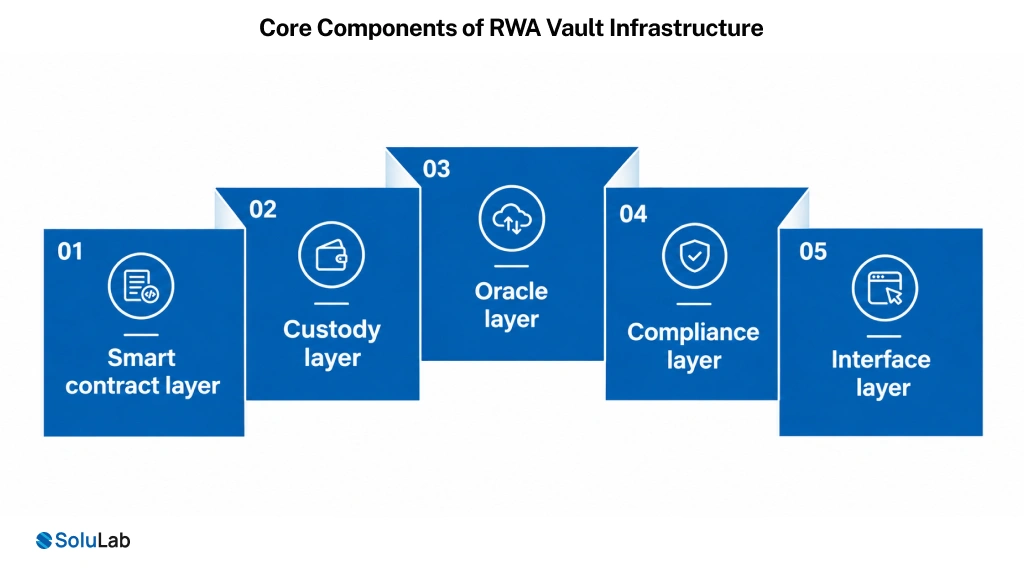
A functioning vault isn’t just a smart contract sitting alone on a blockchain. It’s a stack of interconnected pieces, and missing any one of them tends to show up as a problem later, usually at the worst possible time.
The Technical Stack
- Smart contract layer: Handles minting, burning, share accounting, and access control for the vault itself.
- Custody layer: Manages the actual real-world asset or its legal wrapper, often through a licensed custodian or SPV structure.
- Oracle layer: Pipes real-world valuation and performance data on-chain so the vault’s token value reflects reality, not a stale snapshot.
- Compliance layer: Enforces KYC/AML rules and jurisdiction-specific transfer restrictions at the token level.
- Interface layer: The dashboard or app investors actually use to deposit, track performance, and redeem.
A weak point in any one of these layers can undermine the whole system, which is exactly why serious RWA vault infrastructure gets built with redundancy and independent audits at each layer, not just at the smart contract level everyone tends to focus on.
Common Use Cases for Tokenized Vaults
Not every asset class is an equally good fit, and it helps to know where the technology is already proving itself versus where it’s still catching up.
- Private credit and lending pools. Loans get pooled into a vault, with yield distributed to token holders as borrowers make repayments. This remains the largest segment of the tokenized RWA market by value.
- Real estate income funds. Commercial or residential property income streams get tokenized, letting investors buy fractional exposure to rental yield without the headaches of direct ownership.
- Treasury and money market products. Short-duration government debt gets wrapped into a vault, giving crypto-native investors a way to earn yield on idle stablecoin holdings.
- Commodities. Gold and other physical commodities get represented by vault tokens backed by verified, audited reserves.
- Trade finance. Short-term receivables and invoice financing get pooled, offering investors relatively short-duration, yield-bearing exposure.
Common Use Cases for Tokenized Vaults
Not every asset class is an equally good fit, and it helps to know where the technology is already proving itself versus where it’s still catching up.
- Private credit and lending pools. Loans get pooled into a vault, with yield distributed to token holders as borrowers make repayments. This remains the largest segment of the tokenized RWA market by value.
- Real estate income funds. Commercial or residential property income streams get tokenized, letting investors buy fractional exposure to rental yield without the headaches of direct ownership.
- Treasury and money market products. Short-duration government debt gets wrapped into a vault, giving crypto-native investors a way to earn yield on idle stablecoin holdings.
- Commodities. Gold and other physical commodities get represented by vault tokens backed by verified, audited reserves.
- Trade finance. Short-term receivables and invoice financing get pooled, offering investors relatively short-duration, yield-bearing exposure.
How to Build an RWA Vault?
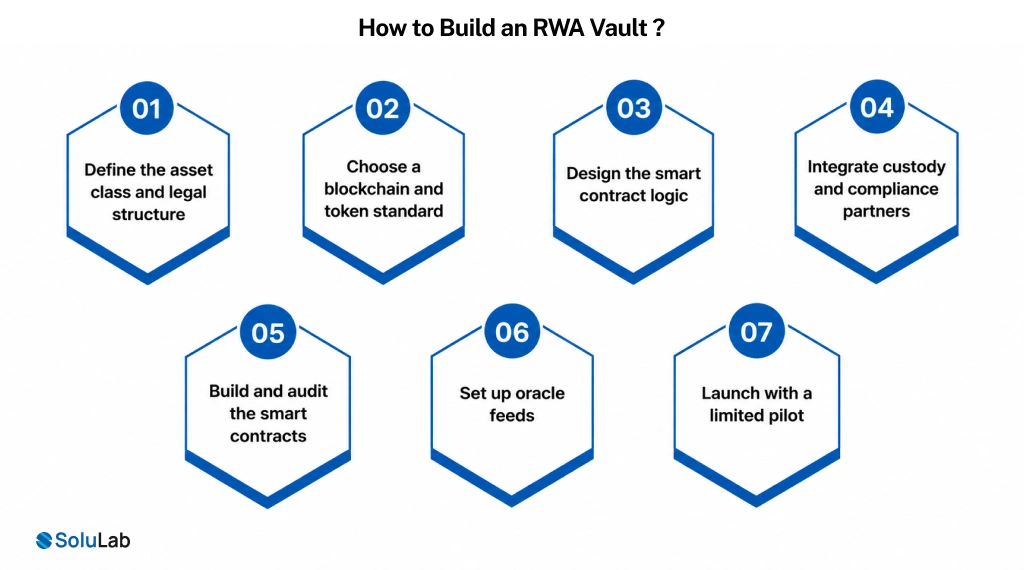
Getting from concept to a live, audited vault involves more coordination between legal, financial, and engineering teams than most first-time builders expect.
- Define the asset class and legal structure. Decide what’s going into the vault and set up the SPV or trust structure that will formally hold it.
- Choose a blockchain and token standard. Ethereum’s ERC-4626 standard is the common default for yield-bearing vaults, though other chains offer lower fees for high-frequency use cases.
- Design the smart contract logic. Map out deposit, yield distribution, and redemption mechanics before writing any code, since retrofitting this later is expensive.
- Integrate custody and compliance partners. Line up licensed custodians and KYC/AML providers early; this step often takes longer than the engineering itself.
- Build and audit the smart contracts. Development should run alongside, not after, an independent security audit from a firm with real DeFi experience.
- Set up oracle feeds. Connect reliable, ideally decentralized, data sources for asset valuation and performance reporting.
- Launch with a limited pilot. Start with a smaller investor pool and asset size before scaling, so any operational gaps surface while the stakes are still manageable.
Teams that try to shortcut this sequence, usually by skipping the audit step or bolting compliance on at the end, tend to be the ones that end up in the headlines for the wrong reasons.
Working with an experienced RWA tokenization platform development partner from day one avoids most of that risk, since the legal, financial, and technical pieces get designed to fit together rather than getting stitched together after the fact.

Conclusion
RWA vault tokenization isn’t a speculative side project anymore. It’s becoming real financial infrastructure, backed by institutional capital, growing market data, and a genuine improvement over how illiquid assets used to trade.
The platforms getting this right treat the legal structure, the smart contract logic, and the compliance layer as one connected system, not three separate problems handled by three separate teams that never quite talk to each other.
If you’re exploring how to bring a real-world asset on-chain, SoluLab, an RWA development company with hands-on experience across DeFi and asset tokenization, can help you scope the right architecture before you commit engineering time and legal fees to the wrong one.
FAQs
Neha is a curious content writer with a knack for breaking down complex technologies into meaningful, reader-friendly insights. With experience in blockchain, digital assets, and enterprise tech, she focuses on creating content that informs, connects, and supports strategic decision-making.